What is a concrete and masonry contract?
Concrete and masonry work is hard to undo. Once a slab is poured or a wall is built, disagreements about thickness, finish, colour or a crack across the patio are expensive to settle. A concrete and masonry contract records the specification and the expectations in writing first.
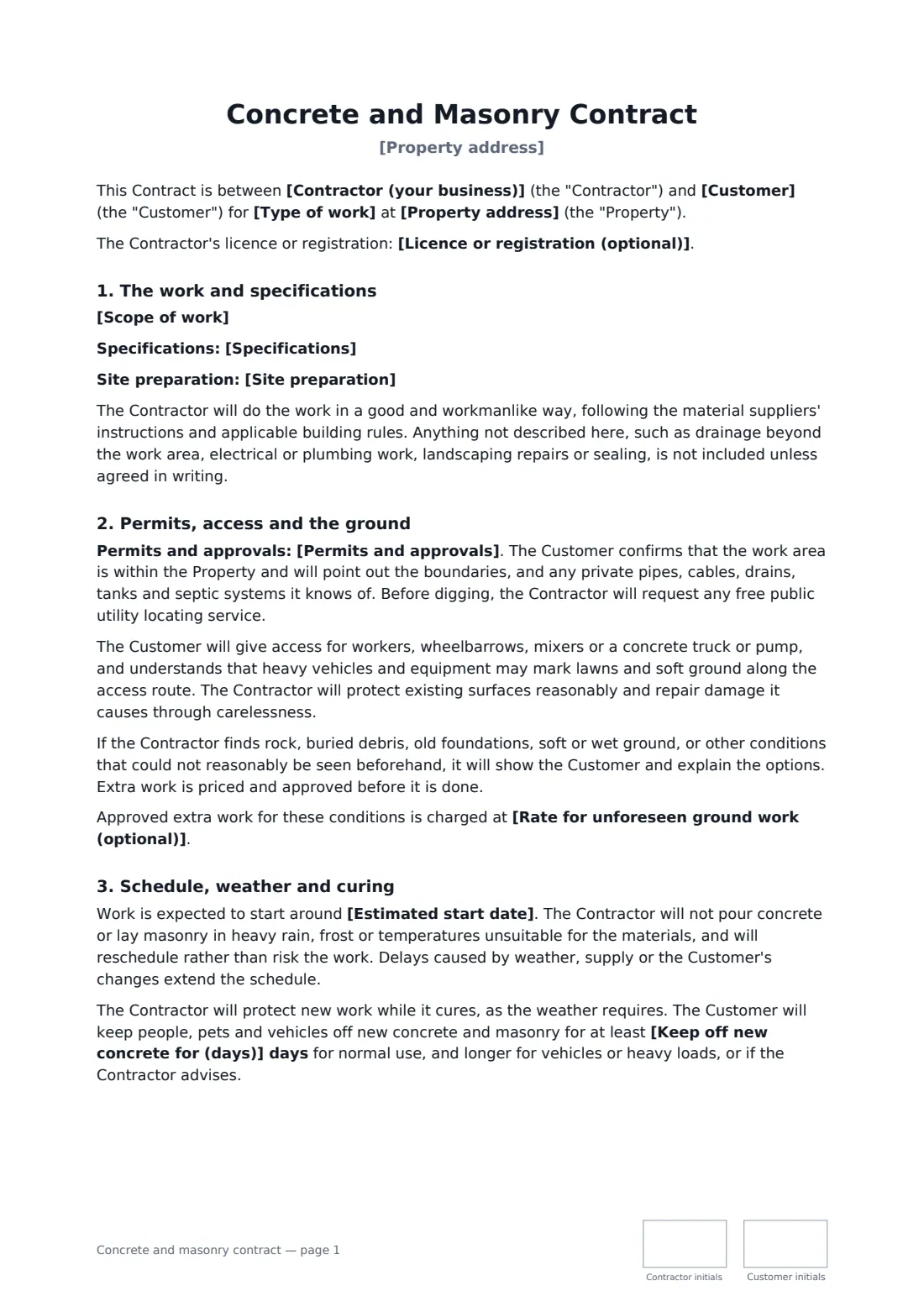
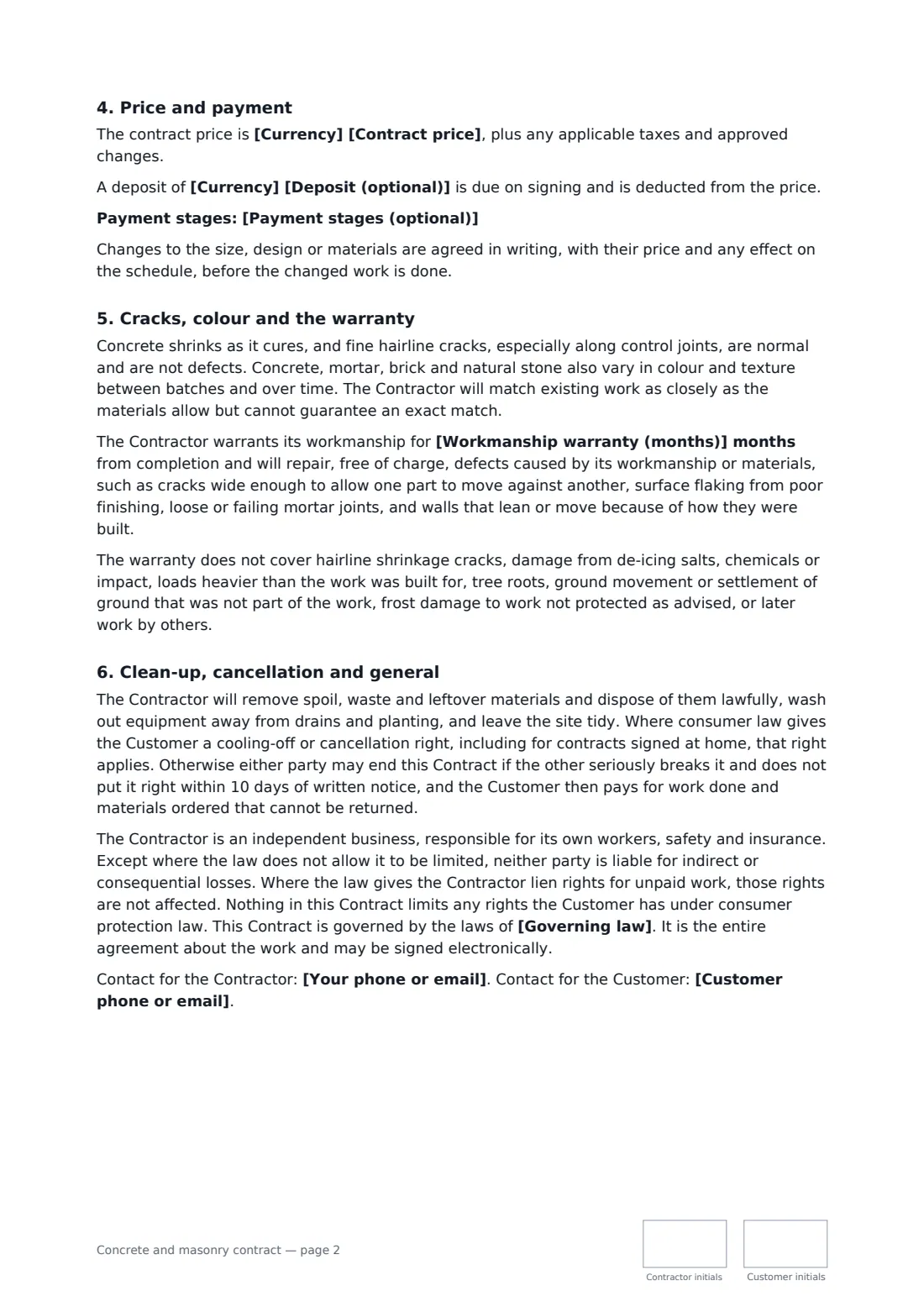
This template covers slabs, patios, steps and paths, brick, block and stone walls, retaining walls and repointing. It records the scope, the specifications (thickness, strength or mix, reinforcement, finish, brick or stone and mortar) and editable site preparation. It sets who obtains permits, utility locating, access for trucks and pumps, and a show-and-approve process for rock, buried debris or soft ground, with an optional rate. It covers weather limits on pouring and laying, protection while curing, an optional keep-off period, the price, deposit and optional payment stages, and changes. The warranty section explains that hairline shrinkage cracks and colour variation are normal, lists what the workmanship warranty does cover, and what it does not.
- Best for
- Concrete contractors, bricklayers, stonemasons and landscapers
- Signed by
- The contractor and the customer
- Covers
- Specs, site prep, permits, curing, payments, cracks, warranty
- Length
- About 2 to 3 pages, initialled on every page
When to use a concrete and masonry contract
- Pouring a broom-finished concrete patio at the back of a house
- A garage or shed base slab
- Building a brick garden wall with matching coping
- A stone-faced retaining wall on a sloping garden
- Repointing and repairing an old brick boundary wall
What you fill in
20 blanks, then the name and email of each person who signs: contractor, customer.
1 The parties
- Contractor (your business)*
- Your phone or email*
- Licence or registration (optional)
- Customer*
- Customer phone or email*
2 The work
- Property address*
- Type of work* a concrete slab · a concrete patio · concrete steps or paths · a brick or block wall · a stone wall or stone veneer · a retaining wall · brick, block or stone repairs and repointing · other concrete and masonry work
- Scope of work*
- Specifications*
- Site preparation*
- Permits and approvals* none are needed for this work · obtained by the Contractor, included in the price · obtained by the Contractor and charged at cost · obtained by the Customer
3 Price and payment
- Currency*
- Contract price*
- Deposit (optional)
- Payment stages (optional)
- Rate for unforeseen ground work (optional)
4 Schedule and warranty
- Estimated start date*
- Keep off new concrete for (days)
- Workmanship warranty (months)*
- Governing law*
5 Who signs
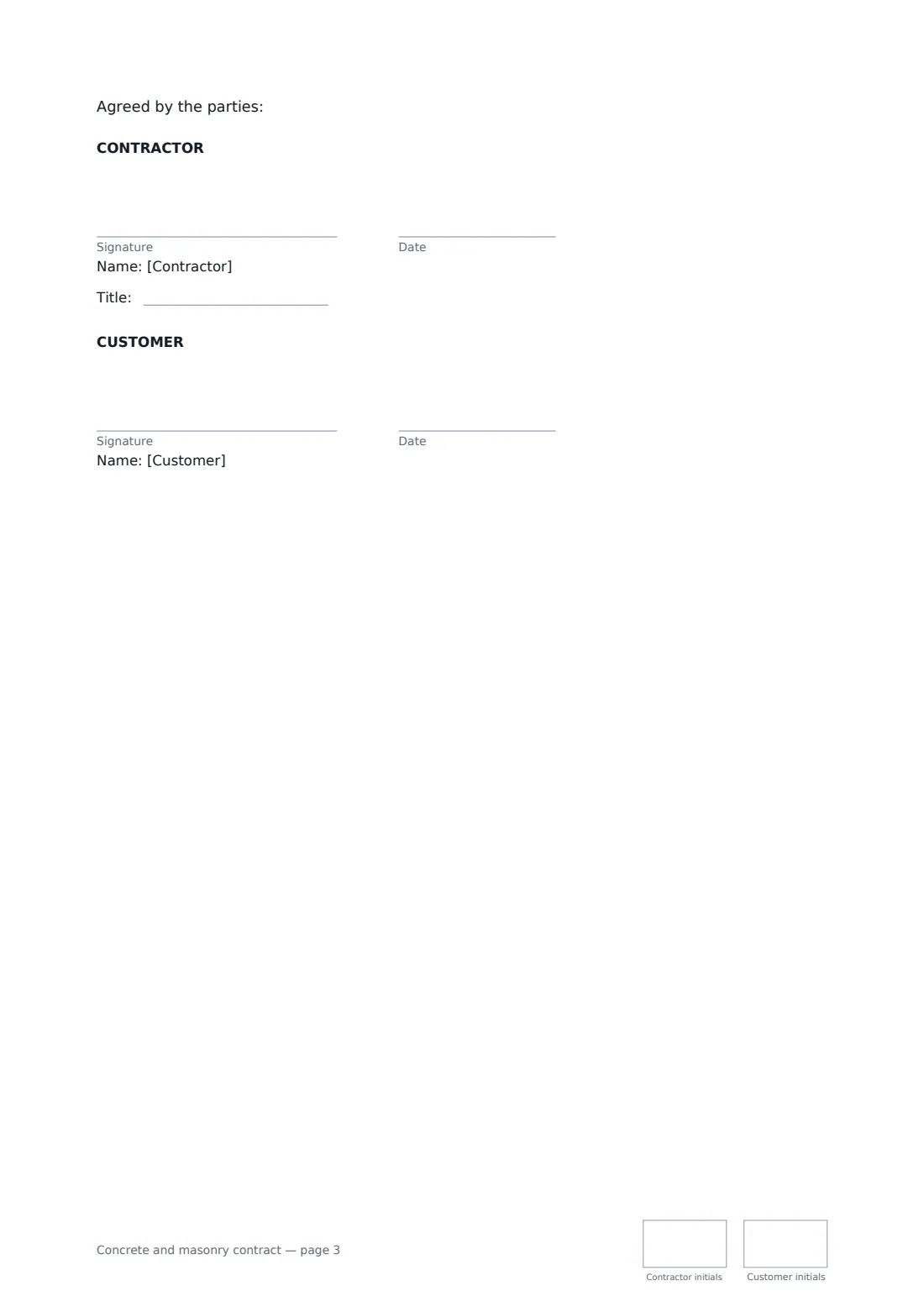
- Contractor signature and date, job title, initials on every page · The concrete or masonry business doing the work.
- Customer signature and date, initials on every page · The property owner, or someone authorised by the owner.
What the concrete and masonry contract covers
- The work and specifications
- Permits, access and the ground
- Schedule, weather and curing
- Price and payment
- Cracks, colour and the warranty
- Clean-up, cancellation and general
Using the concrete and masonry contract, step by step
1 Describe the work
Choose the type of work, describe the scope and enter the specifications: thickness, mix or strength, reinforcement, finish, brick or stone and mortar.
2 Set out the preparation
Edit the pre-filled site preparation and choose who obtains any permit or approval.
3 Price it
Enter the price, an optional deposit and payment stages, and an optional rate for unforeseen ground work.
4 Schedule and warranty
Set the start date, the keep-off period, the workmanship warranty in months and the governing law, then send it for signature.
Tips before you send it
- Explain shrinkage cracks before you pour. The contract says hairline cracks are normal, and customers accept that more easily when told up front.
- Retaining walls, tall walls and work near a boundary often need approval or an engineer's design. Check local rules before agreeing who handles permits.
- Write the keep-off period on your completion note too. Most early damage comes from cars or furniture on concrete that hasn't cured.
- Keep a sample brick or stone and mortar mix from the job. It makes later repairs and matching far easier.
Sign it online in minutes
- Fill in the blanks. Names, dates and amounts go straight into the agreement — the preview shows exactly where.
- Name who signs. Tick “This is me” for your own part. FileIt builds the PDF with every signature, date and initials box on the right line, and you can check or move anything before sending.
- Send it. Each signer gets a secure link and signs from any device — no account needed. The signed PDF, with an audit trail and a Certificate of Completion, is filed in your vault and emailed to everyone.
Concrete and masonry contract: frequently asked questions
Are cracks in new concrete a defect?
Fine hairline cracks from shrinkage, especially along control joints, are normal and are not covered. The warranty covers cracks wide enough for one part to move against another, flaking from poor finishing, failing mortar joints and walls that move because of how they were built.
What happens if the contractor hits rock or old foundations?
The contractor shows the customer and explains the options. Extra work is priced and approved before it's done, at the optional rate if you set one.
Will new brickwork match my existing wall?
The contractor matches as closely as the materials allow, but the contract states that brick, stone, mortar and concrete vary between batches and over time, so an exact match isn't guaranteed.
How is payment handled?
You set the price, an optional deposit and optional stages, such as a part payment once formwork and reinforcement are in place. Without stages, the balance is due on completion after a joint walk-through.
Can I sign it electronically?
Yes. E-signatures are generally valid for home improvement contracts in the US, UK, EU and Canada, though some places add notice rules for contracts signed at home. FileIt keeps an audit trail with the signed PDF.