What is a demolition contract?
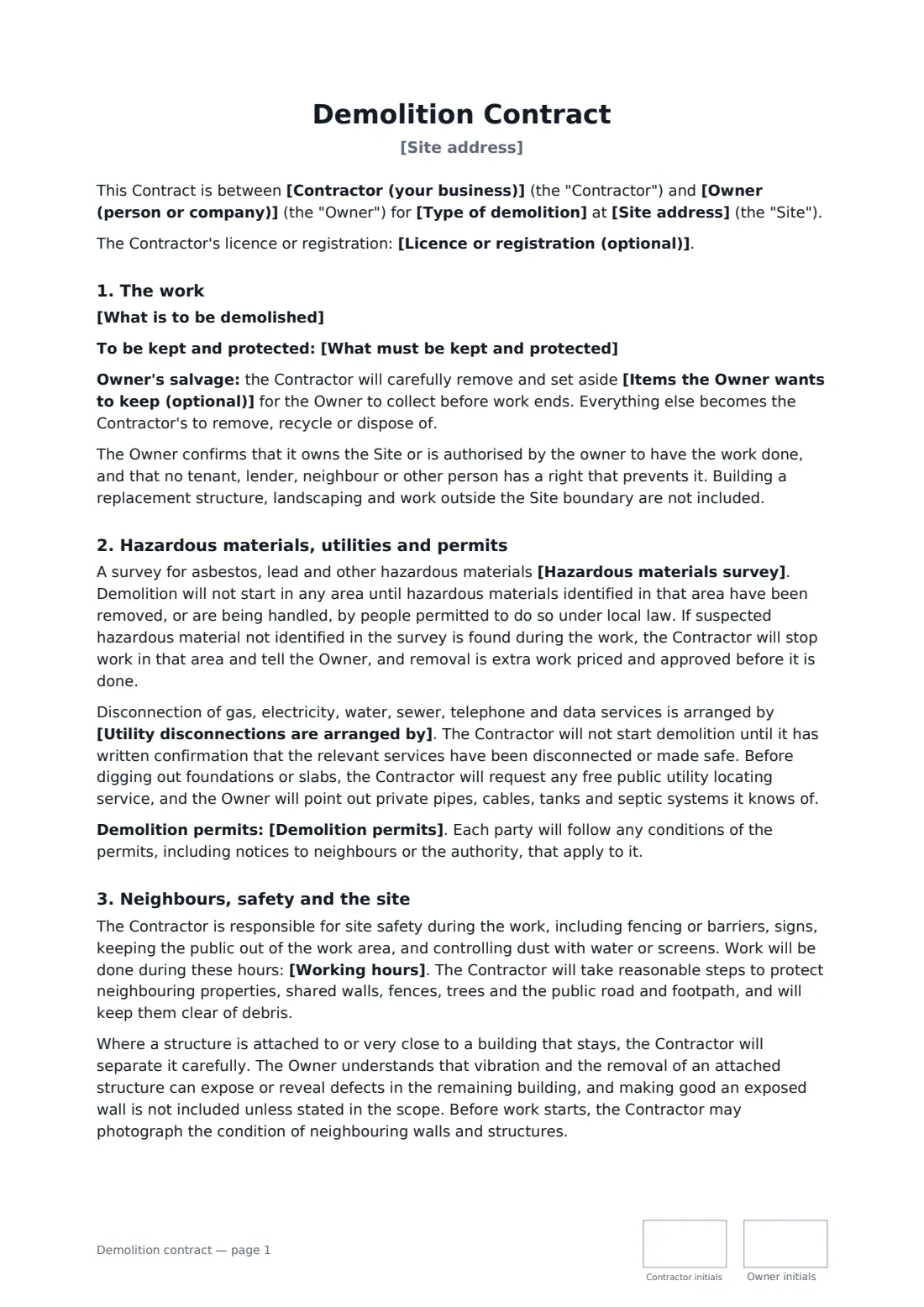
Demolition is quick; the preparation is not. Before a garage, house or interior comes down, someone has to check for asbestos and lead, disconnect the services, get the permit and warn the neighbours. A demolition contract makes clear who does each of those things, and what the site should look like at the end.
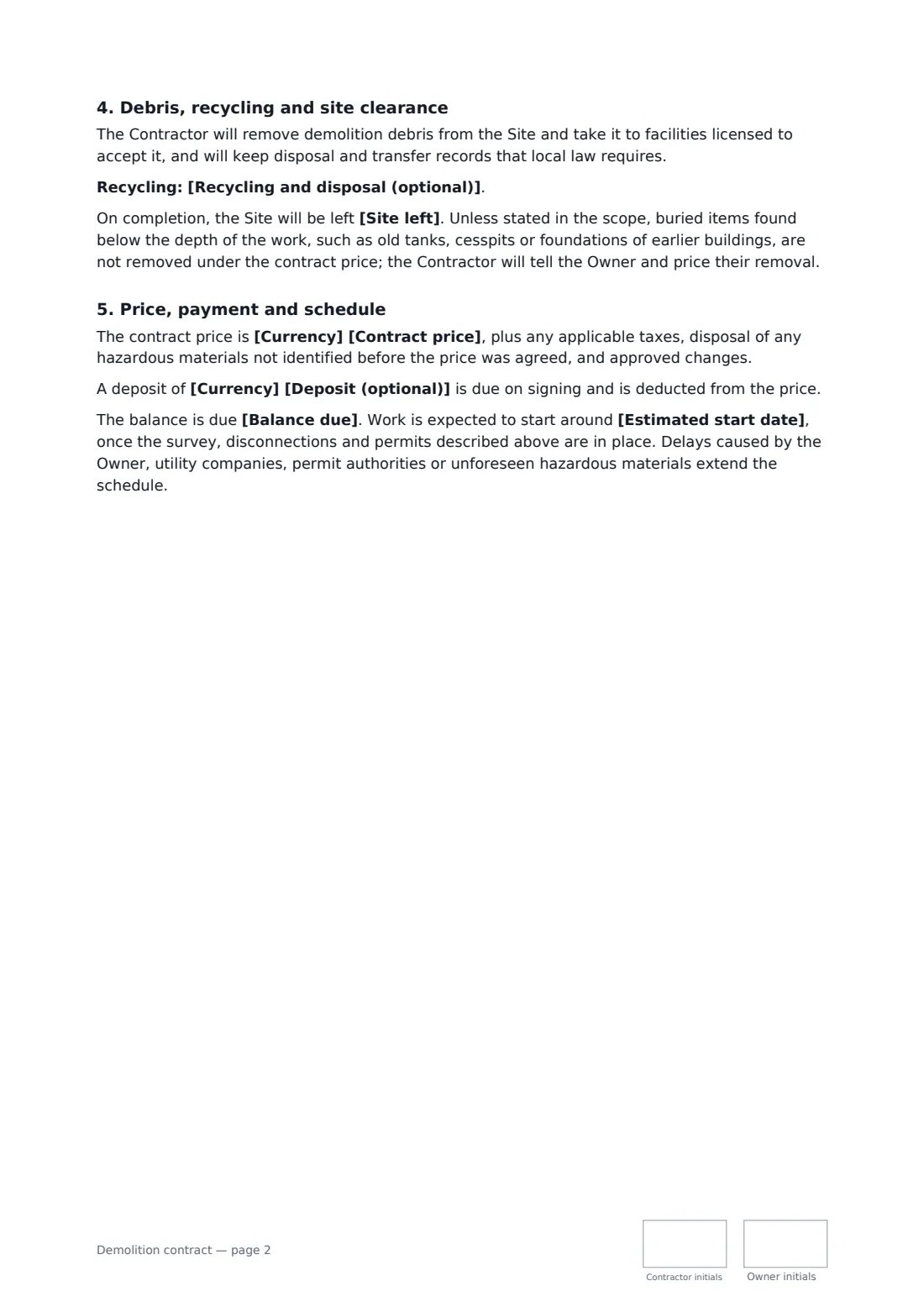
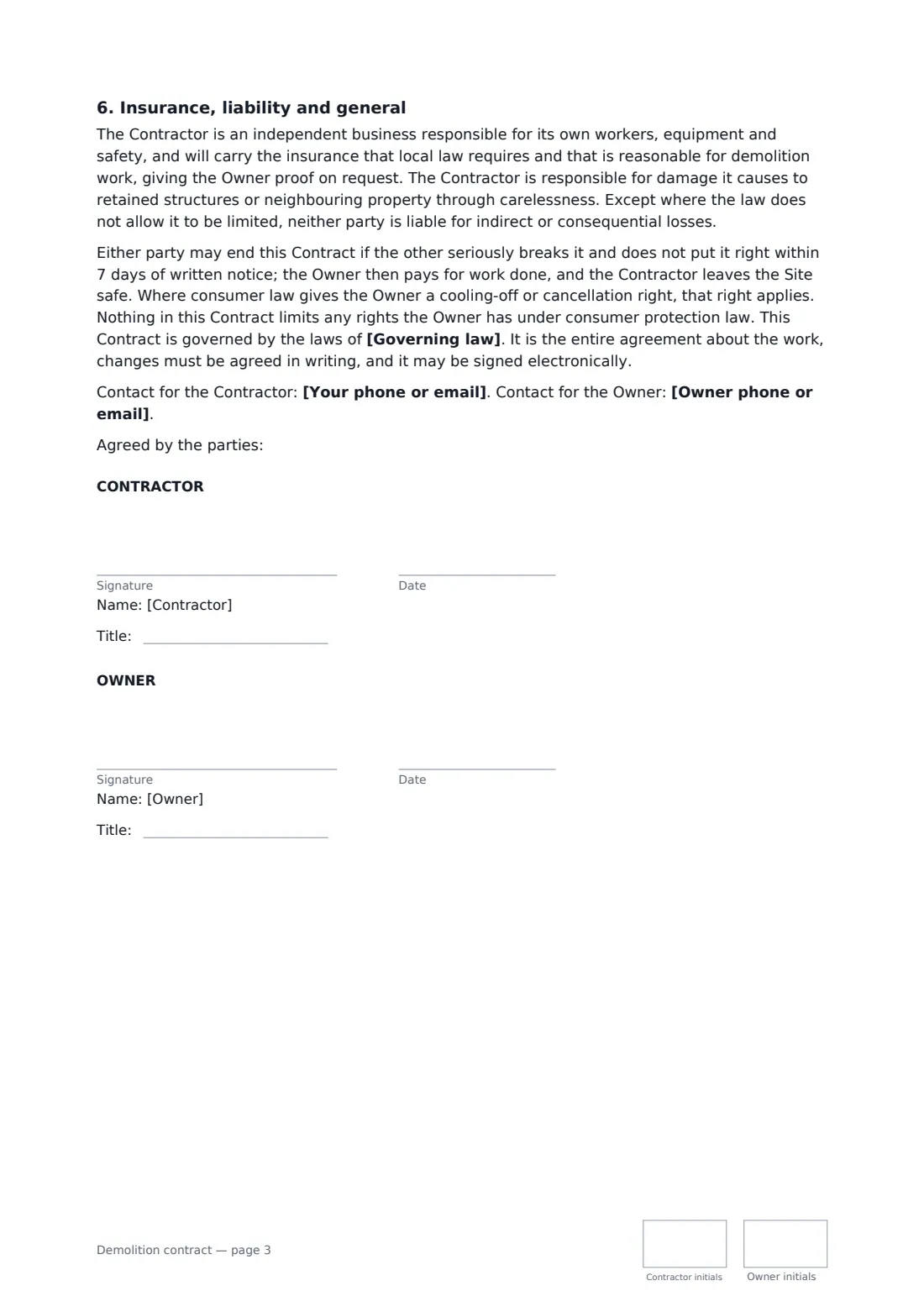
This template covers whole and partial demolition, interior strip-outs, outbuildings, and pools, slabs or hard landscaping. It records what is demolished, what must be kept and protected, and anything the owner wants salvaged, and confirms the owner's authority. It sets who arranges the hazardous materials survey, the utility disconnections and the permits, with a stop-work rule for hazards found later. It covers site safety, working hours, dust, neighbouring property and walls exposed by the work, lawful disposal with optional recycling, the finished state of the site, buried items, the price, deposit and balance, insurance and ending the contract.
- Best for
- Demolition contractors, strip-out crews and general contractors
- Signed by
- The contractor and the owner
- Covers
- Survey, disconnections, permits, neighbours, debris, site clearance
- Length
- About 3 pages, initialled on every page
When to use a demolition contract
- Knocking down a detached garage and removing the slab
- Stripping out a kitchen and bathrooms before a renovation
- Demolishing an old house to clear a plot for a new build
- Removing an in-ground pool and backfilling it
- Taking down a lean-to attached to the main house
What you fill in
22 blanks, then the name and email of each person who signs: contractor, owner.
1 The parties
- Contractor (your business)*
- Your phone or email*
- Licence or registration (optional)
- Owner (person or company)*
- Owner phone or email*
2 The work
- Site address*
- Type of demolition* demolition of a whole structure · partial demolition of a structure · an interior strip-out · removal of an outbuilding, garage or shed · removal of a pool, slab or hard landscaping
- What is to be demolished*
- What must be kept and protected
- Items the Owner wants to keep (optional)
3 Safety and permits
- Hazardous materials survey* has been done, and its report has been given to the Contractor · will be arranged by the Owner before work starts · will be arranged by the Contractor, included in the price · will be arranged by the Contractor, charged at cost
- Demolition permits* obtained by the Contractor, included in the price · obtained by the Contractor and charged at cost · obtained by the Owner · none are needed for this work
- Utility disconnections are arranged by* the Owner, with written confirmation given to the Contractor · the Contractor, with the utility companies' charges paid by the Owner · the Contractor, included in the price
- Recycling and disposal (optional)
4 Price and schedule
- Currency*
- Contract price*
- Deposit (optional)
- Balance due* on completion of site clearance · within 14 days of completion · within 30 days of completion
- Estimated start date*
- Working hours*
- Site left* cleared to ground level, with holes backfilled and rough-graded · cleared, with foundations removed and the excavation backfilled and compacted · broom clean, for interior strip-outs
- Governing law*
5 Who signs
- Contractor signature and date, job title, initials on every page · The demolition business doing the work.
- Owner signature and date, job title, initials on every page · The owner of the property, or someone authorised to sign for the owner.
What the demolition contract covers
- The work
- Hazardous materials, utilities and permits
- Neighbours, safety and the site
- Debris, recycling and site clearance
- Price, payment and schedule
- Insurance, liability and general
Using the demolition contract, step by step
1 Describe the demolition
Choose the type, describe what comes down, list what must be protected and anything the owner wants salvaged.
2 Assign the preparation
Choose who arranges the hazardous materials survey, the utility disconnections and the permits, and add any recycling commitments.
3 Price and schedule
Enter the price, an optional deposit and the balance terms, the start date and working hours, and how the site will be left.
4 Send for signature
Enter the governing law and send it to the owner. Both parties initial every page.
Tips before you send it
- Many places require an asbestos survey before any demolition of older buildings, and licensed removal of what it finds. Check local rules before you price.
- Get written confirmation that gas and electricity are disconnected before you start. The contract makes it a condition.
- Photograph neighbouring walls and fences before you begin. It protects both parties if a neighbour later claims damage.
- Agree what 'cleared' means. The contract offers three finishes, from rough-graded to foundations removed and compacted.
Sign it online in minutes
- Fill in the blanks. Names, dates and amounts go straight into the agreement — the preview shows exactly where.
- Name who signs. Tick “This is me” for your own part. FileIt builds the PDF with every signature, date and initials box on the right line, and you can check or move anything before sending.
- Send it. Each signer gets a secure link and signs from any device — no account needed. The signed PDF, with an audit trail and a Certificate of Completion, is filed in your vault and emailed to everyone.
Demolition contract: frequently asked questions
Who is responsible for asbestos?
You choose who arranges the survey. Demolition doesn't start in an area until identified hazardous materials there have been dealt with by people permitted to do so. Hazards found later stop work in that area and are priced as extra work.
What about a wall left exposed after removing an attached structure?
The contractor separates the structure carefully, but making good the exposed wall isn't included unless it's in the scope. The contract also notes that removal can reveal existing defects.
What if old tanks or foundations are buried on the site?
Items below the depth of the work aren't removed in the contract price unless the scope says so. The contractor tells the owner and prices their removal.
Can a company sign as the owner?
Yes. The owner role asks for a job title, and the owner confirms they own the site or are authorised to have the work done.
Can I sign it electronically?
Yes. E-signatures are generally valid for construction and demolition contracts in the US, UK, EU and Canada. FileIt keeps an audit trail with the signed PDF.