What is a eV charger site host agreement?
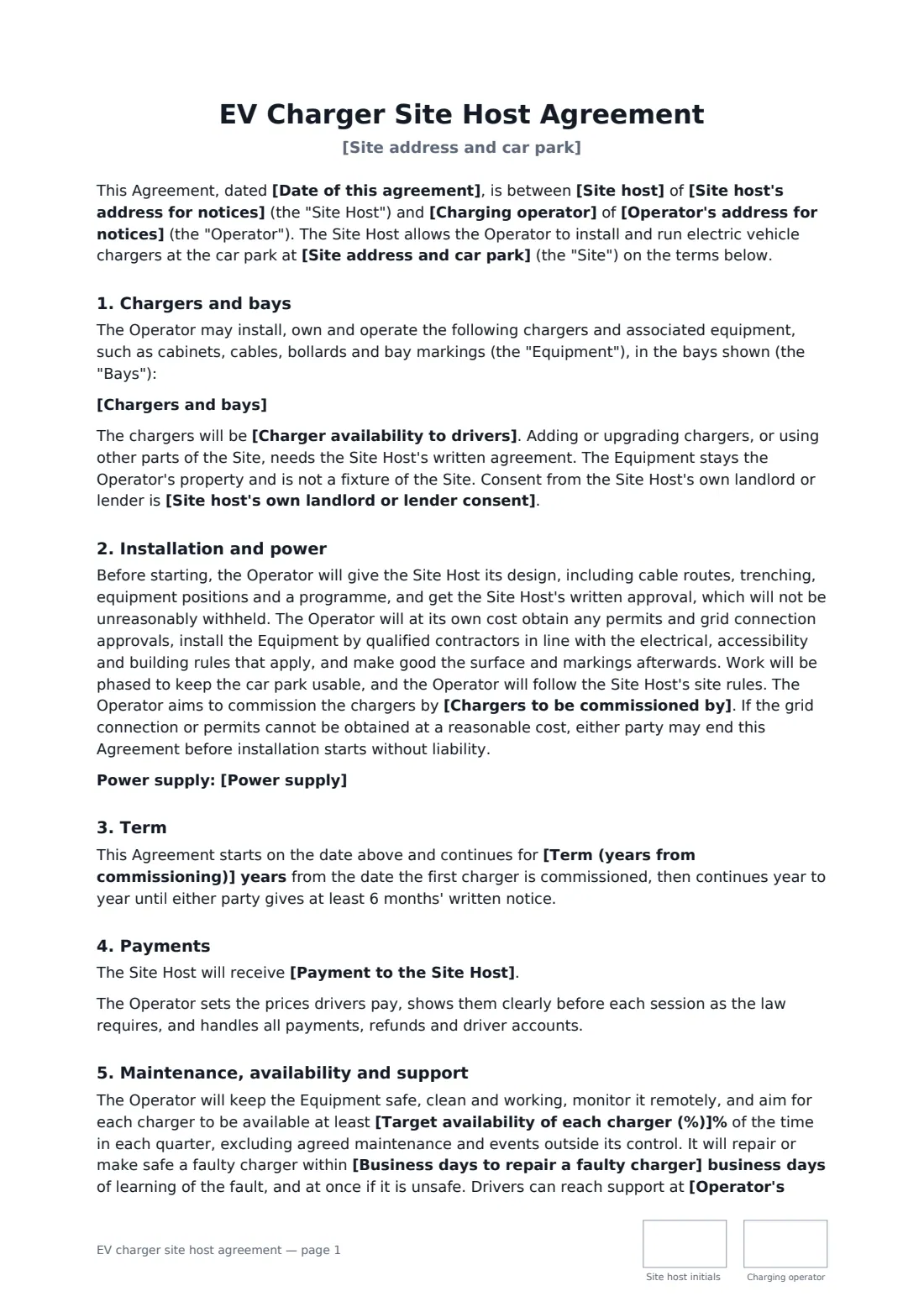
Retailers, offices, hotels and apartment blocks are often approached by charging companies offering to put chargers in the car park at no cost, in return for a long agreement. A site host agreement sets out what the operator installs and where, who pays for the grid connection and electricity, what the host earns, and what happens to the equipment when the agreement ends.
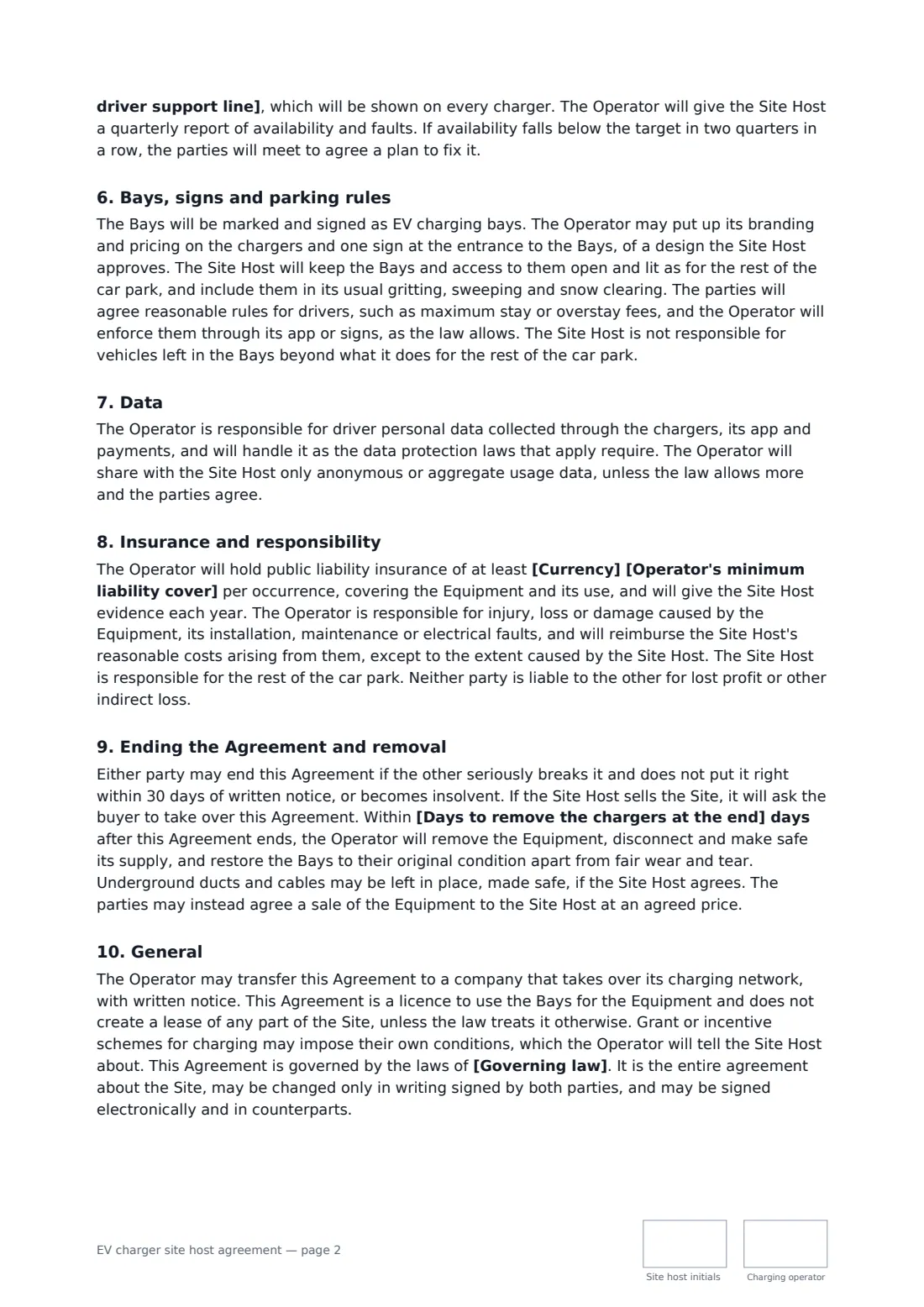
You list the chargers and bays, choose who pays for power and who may use the chargers, and say whether your own landlord or lender must consent. The term runs from commissioning. Choose fixed rent, a revenue share, both, or no payment, with revenue defined net of taxes, fees and electricity and reported quarterly. The operator commits to a target availability and a repair time, a support line on every charger, and care of driver data. At the end it removes the equipment and restores the bays within the days you set.
- Best for
- Retail, office, hotel and residential car parks hosting public or private chargers
- Signed by
- The site host and the charging operator, with job titles
- Money options
- Fixed rent, revenue share, both, or none
- Length
- About 3 pages, initialled on every page
When to use a eV charger site host agreement
- A supermarket hosting rapid chargers run by a charging network
- An office park adding chargers for staff and visitors
- An apartment building offering chargers to residents only
- A hotel adding destination chargers for guests
- Replacing an informal arrangement with a written agreement
What you fill in
22 blanks, then the name and email of each person who signs: site host, charging operator.
1 The parties
- Date of this agreement*
- Site host*
- Site host's address for notices*
- Charging operator*
- Operator's address for notices*
- Operator's driver support line*
2 The site
- Site address and car park*
- Chargers and bays*
- Site host's own landlord or lender consent* not needed, as the Site Host owns the site outright · needed, and the Site Host will obtain it before installation starts
- Power supply* The Operator arranges and pays for a new, separately metered grid connection and pays the electricity bills for it directly. · The chargers run from the Site Host's supply through a sub-meter, and the Operator reimburses the electricity used each month at the Site Host's actual cost per unit.
- Charger availability to drivers* open to the public 24 hours a day · open to the public during the car park's opening hours · for the Site Host's staff, tenants or customers only
3 Term and money
- Term (years from commissioning)*
- Chargers to be commissioned by*
- Payment to the Site Host* a fixed yearly rent · a share of net charging revenue · a fixed yearly rent plus a share of net charging revenue · no payment, as the chargers serve the Site Host's own customers
- Currency*
- Fixed yearly rent (if rent is part of the payment)
- Revenue share to the Site Host (%, if a share is part of the payment)
4 Maintenance
- Target availability of each charger (%)*
- Business days to repair a faulty charger*
5 Insurance and law
- Operator's minimum liability cover*
- Days to remove the chargers at the end*
- Governing law*
6 Who signs
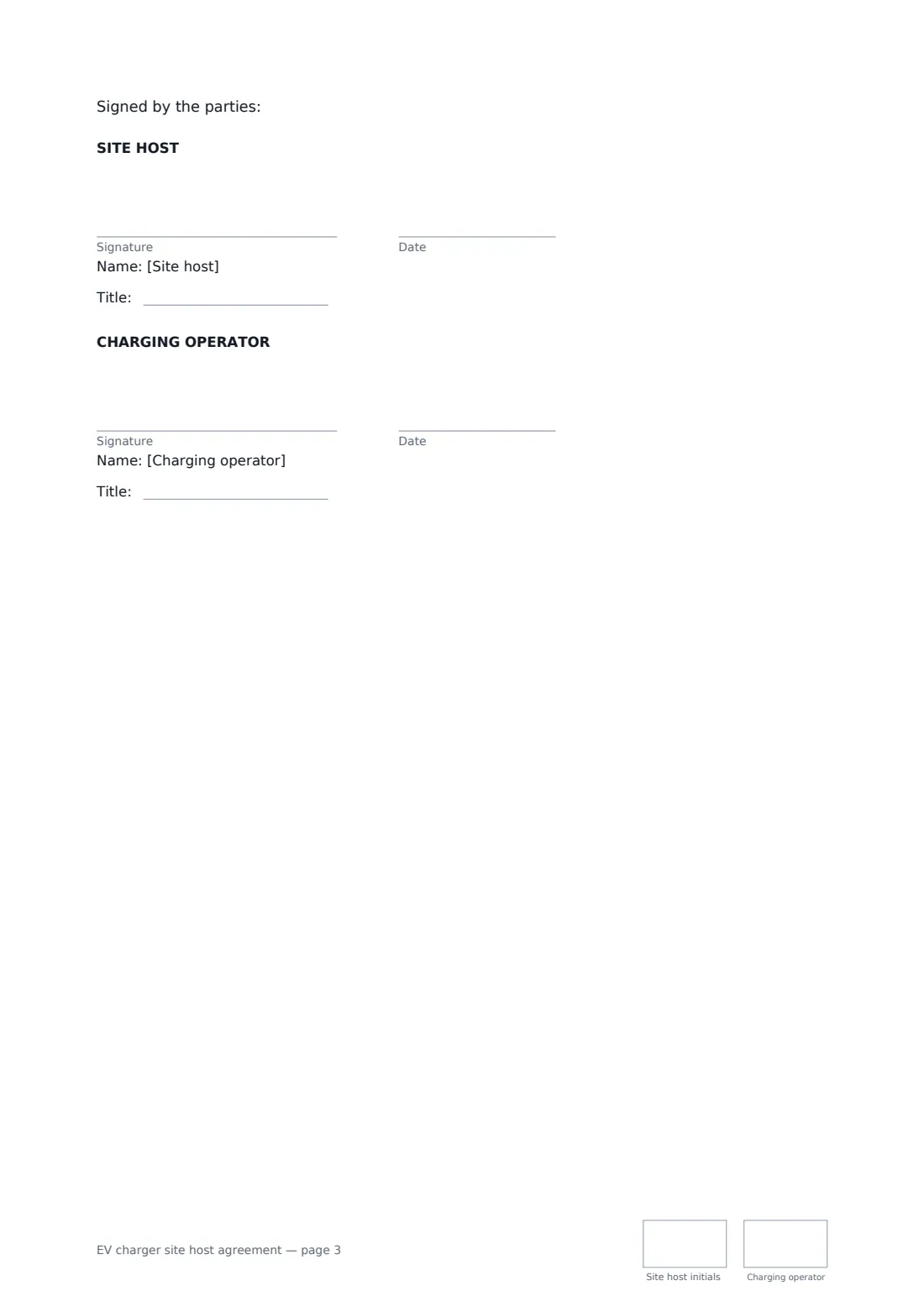
- Site host signature and date, job title, initials on every page · The owner or leaseholder of the car park.
- Charging operator signature and date, job title, initials on every page · The company that installs, owns and runs the chargers.
What the eV charger site host agreement covers
- Chargers and bays
- Installation and power
- Term
- Payments
- Maintenance, availability and support
- Bays, signs and parking rules
- Data
- Insurance and responsibility
- Ending the Agreement and removal
- General
Using the eV charger site host agreement, step by step
1 Describe the site
Enter the car park, the chargers and the bays they serve, the power arrangement and who may use them.
2 Set term and money
Enter the commissioning date and term, then choose the payment model and fill in the rent or revenue share.
3 Set service levels
Enter the target availability and how many business days the operator has to repair a faulty charger.
4 Insurance, removal and signing
Set the operator's minimum liability cover and removal period, add the governing law and send.
Tips before you send it
- If you lease the site or it is mortgaged, check whether your landlord or lender must consent before you sign.
- Ask how net revenue is calculated and ask for a sample quarterly statement. The agreement lets you check records once a year.
- Grant schemes often set minimum terms, uptime or public access rules. Ask the operator which apply.
- Diary the commissioning date. The term runs from it, not from signing.
Sign it online in minutes
- Fill in the blanks. Names, dates and amounts go straight into the agreement — the preview shows exactly where.
- Name who signs. Tick “This is me” for your own part. FileIt builds the PDF with every signature, date and initials box on the right line, and you can check or move anything before sending.
- Send it. Each signer gets a secure link and signs from any device — no account needed. The signed PDF, with an audit trail and a Certificate of Completion, is filed in your vault and emailed to everyone.
EV charger site host agreement: frequently asked questions
Who pays for the electricity?
You choose. Either the operator pays for its own metered connection, or the chargers run from your supply through a sub-meter and the operator pays you back each month at your actual cost.
What does net charging revenue mean?
What drivers pay for charging at the site, less taxes, payment processing fees and the cost of the electricity. Your share is paid quarterly with a statement.
What if the chargers are often broken?
The operator aims for the availability you set, repairs faults within the business days you set, and reports each quarter. Two quarters below target in a row trigger a meeting to agree a fix, and serious unremedied breaches allow termination.
Is this a lease of the car park?
It is drafted as a licence to use the bays for the equipment, not a lease, unless the law treats it otherwise. Local property rules decide how such arrangements are treated.