
What is a demotion letter?
A demotion changes someone's role, responsibilities and often their pay, so it needs to be written down clearly and agreed. It may be the employee's own choice — stepping back from management, or reducing pressure — or the outcome of a restructuring, a performance process or a disciplinary process.
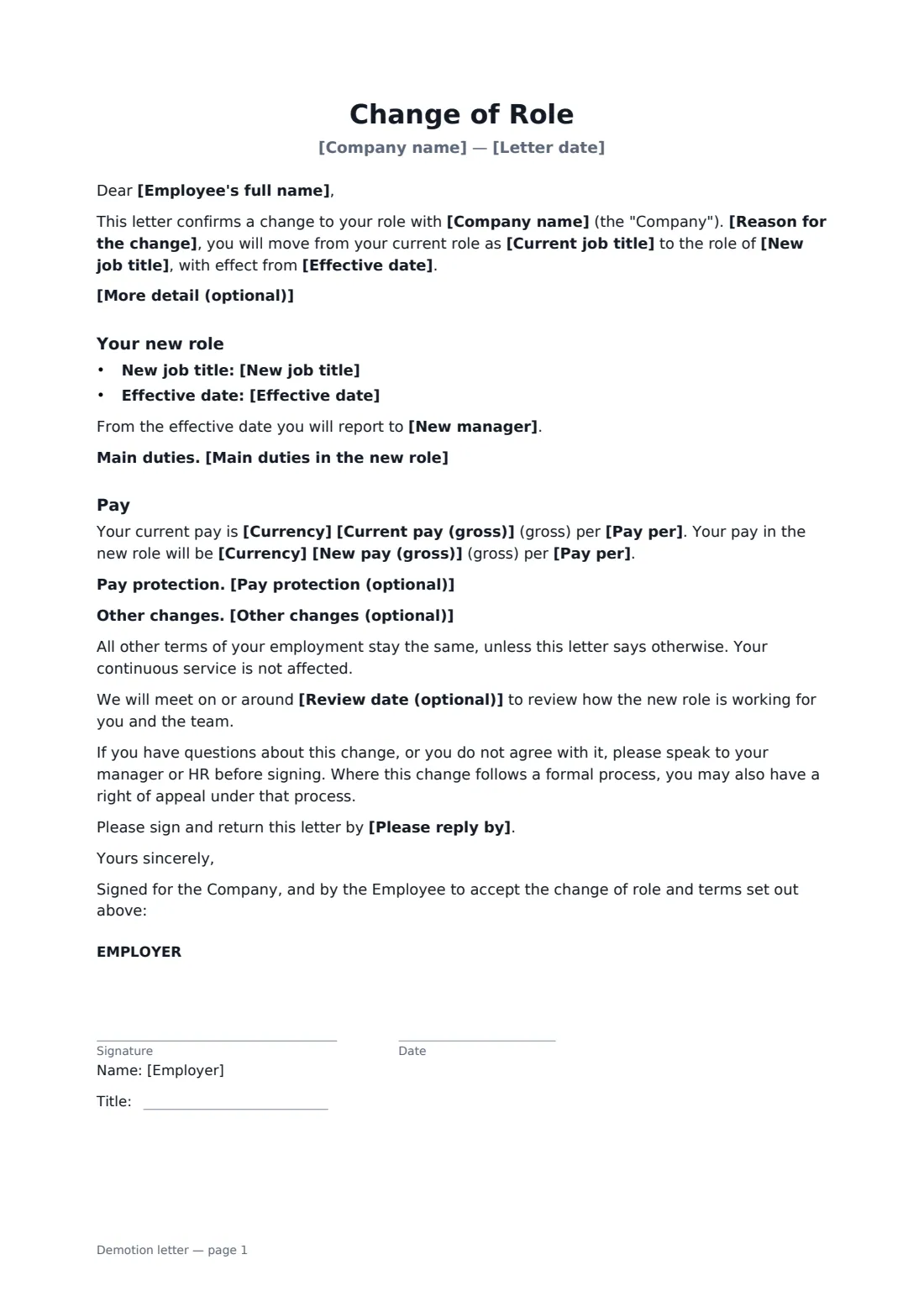
This letter states the reason in neutral wording you pick from a list, the current and new job title, the effective date, the new manager and duties, and the old and new pay side by side. You can add a period of pay protection, list other changes such as bonus eligibility, set a review date, and say that everything else in the employment stays the same. The employee signs to accept, and the letter invites them to raise questions — or use any right of appeal — before signing.
- Best for
- Voluntary step-downs, restructuring alternatives and outcomes of formal processes
- Signed by
- The employer and the employee
- Pay
- Old and new pay shown side by side, with optional pay protection
- Length
- 1 to 2 pages
When to use a demotion letter
- A team leader asks to return to a specialist role without line management
- Offering a lower-graded role as an alternative to redundancy
- Recording a change of role agreed after a performance improvement plan
- A change of role after a disciplinary outcome, where your procedure allows it
- A role change for health or personal reasons the employee has asked for
What you fill in
18 blanks, then the name and email of each person who signs: employer, employee.
1 The letter
- Company name*
- Letter date*
- Employee's full name*
- Reason for the change* At your request · Following a restructuring of the team, as an alternative to redundancy · Following the outcome of the performance process · Following the outcome of the disciplinary process · Following a change in your health or circumstances, as we discussed
- More detail (optional)
2 The change
- Current job title*
- New job title*
- Effective date*
- New manager
- Main duties in the new role
3 Pay
- Currency*
- Current pay (gross)*
- New pay (gross)*
- Pay per* year · month · week · hour
- Pay protection (optional)
- Other changes (optional)
4 Review
- Review date (optional)
- Please reply by
5 Who signs
- Employer signature and date, job title · The manager or HR person confirming the change.
- Employee signature and date · Signs to accept the new role and terms.
What the demotion letter covers
- Your new role
- Pay
Using the demotion letter, step by step
1 Pick the reason
Choose the reason that fits — at the employee's request, a restructuring, or the outcome of a performance or disciplinary process — and add a sentence of detail if helpful.
2 Describe the new role
Enter the current and new titles, the effective date, the new manager and the main duties.
3 Set out pay
Enter current and new pay. If you are protecting pay for a while, or other benefits change, say so in the optional fields.
4 Send for signature
Add yourself as the employer and the employee as the second signer. Once both have signed, the letter is filed in your vault with its audit trail.
Tips before you send it
- Talk to the employee before sending. A letter should confirm a conversation, not replace it.
- A demotion the employee has not agreed to can be a breach of contract in many places. Get advice if they don't agree.
- Pay protection for a few months can make a restructuring-related move fairer and easier to accept.
- Update payroll and any benefits enrolment on the effective date.
Sign it online in minutes
- Fill in the blanks. Names, dates and amounts go straight into the agreement — the preview shows exactly where.
- Name who signs. Tick “This is me” for your own part. FileIt builds the PDF with every signature, date box on the right line, and you can check or move anything before sending.
- Send it. Each signer gets a secure link and signs from any device — no account needed. The signed PDF, with an audit trail and a Certificate of Completion, is filed in your vault and emailed to everyone.
Demotion letter: frequently asked questions
Can I demote an employee without their agreement?
It depends on their contract, your procedures and local law. Often a change to role or pay needs the employee's agreement. This letter is designed to record an agreed change; take advice if the employee doesn't agree.
Does the letter have to mention pay?
Yes — current and new pay are both required, so the change is clear. If pay is staying the same, enter the same figure twice.
What if the employee wants to appeal?
The letter says that where the change follows a formal process, the employee may have a right of appeal under that process, and invites them to raise questions before signing.
Is an e-signed demotion letter valid?
Electronic signatures are generally accepted for employment documents like this in the US, UK, EU and Canada. FileIt keeps an audit trail and a Certificate of Completion with the signed PDF.