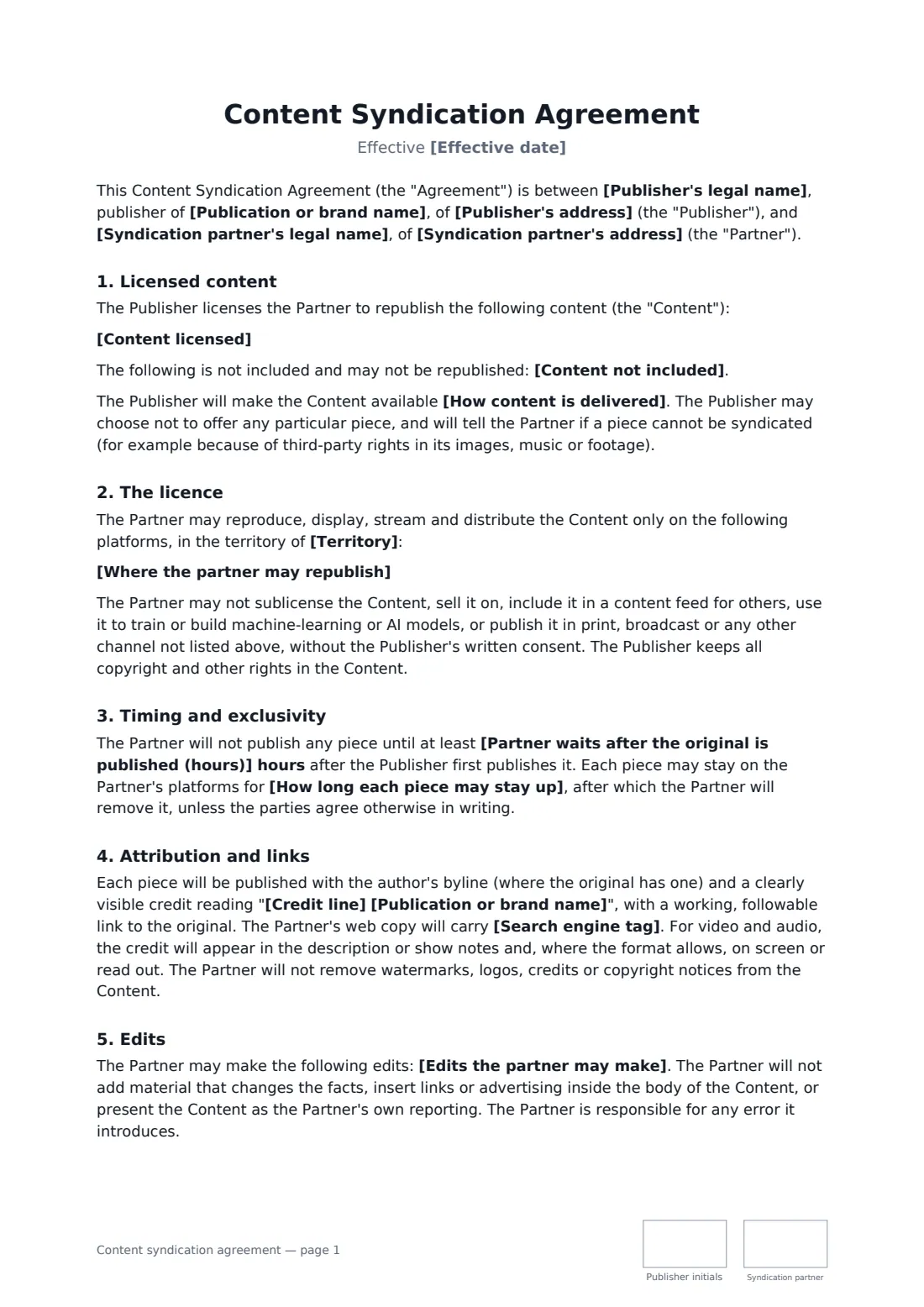
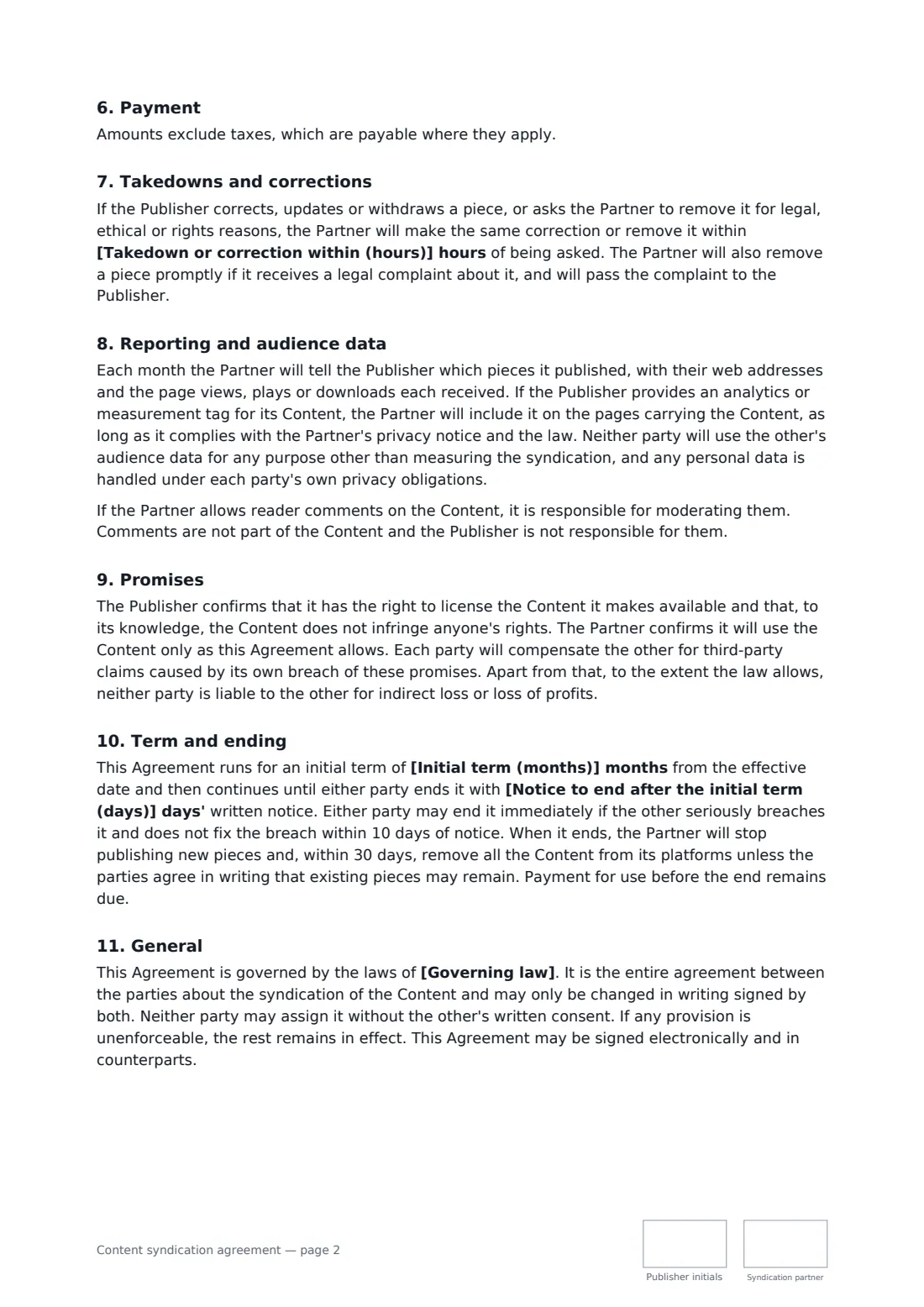
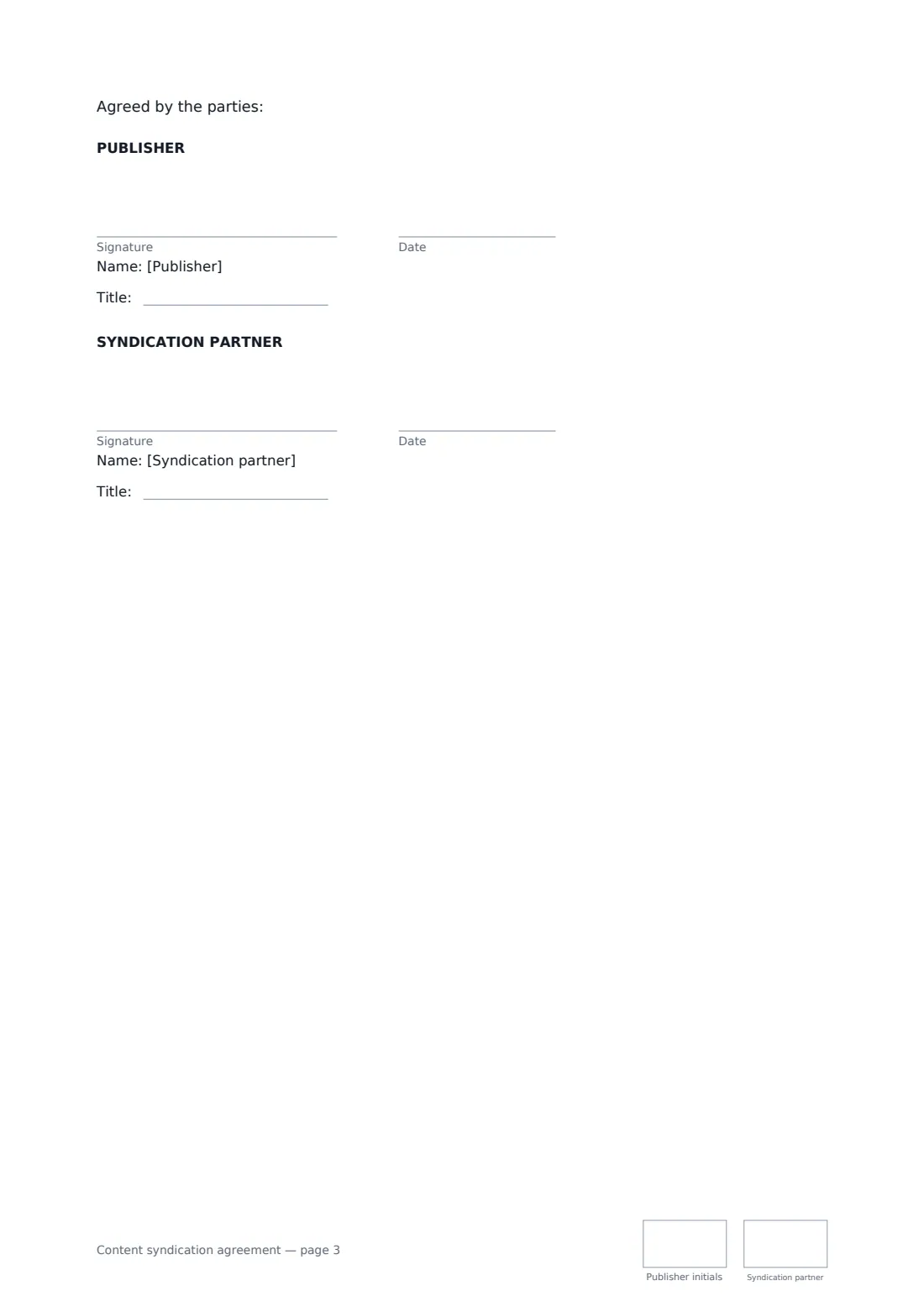
What is a content syndication agreement?
A content syndication agreement lets a publisher's work appear on another outlet's website, app, newsletter or channel, while the publisher keeps the copyright and gets credit, links and often a fee. It is how news sites, blogs, video channels and podcasts reach a partner's audience without losing control of their work.
This template covers which content is licensed (and what is excluded, such as wire stories or third-party photos), where the partner may publish and in which territory, how content is delivered, a waiting period after the original goes live, how long each piece may stay up, a non-exclusive licence or an exclusive window in the partner's market, a credit line with a followable link and a canonical or noindex tag, the edits allowed, advertising alongside the content, four payment models (monthly fee, per piece, advertising revenue share or no fee), monthly reporting and analytics tags, takedowns and corrections within the hours you set, and ending the agreement.
- Best for
- News sites, blogs, magazines, video channels and podcasts licensing content to partner outlets
- Signed by
- The publisher and the syndication partner, each with a job title
- Payment
- Monthly fee, fee per piece, ad revenue share, or no fee in exchange for credit and links
- Length
- 3 pages, initialled on every page
When to use a content syndication agreement
- A local news site licensing its stories to a regional aggregator
- A food blog letting a magazine's website republish selected recipes
- A video creator licensing episodes to a partner's streaming channel
- A podcast network syndicating episodes to another network's feed
- A trade publication sharing articles with an industry association's newsletter
What you fill in
29 blanks, then the name and email of each person who signs: publisher, syndication partner.
1 The parties
- Effective date*
- Publisher's legal name*
- Publication or brand name*
- Publisher's address
- Syndication partner's legal name*
- Syndication partner's address
2 The content
- Content licensed*
- Content not included
- Where the partner may republish*
- Territory*
- How content is delivered* by RSS or API feed · by email or shared folder · by the partner copying it from the Publisher's site once published · by video or audio file transfer
3 Timing and exclusivity
- Exclusivity* Non-exclusive · Exclusive in the partner's market for a window
- Partner's exclusive market
- Exclusive window per piece (days)
- Partner waits after the original is published (hours)*
- How long each piece may stay up*
4 Attribution and edits
- Credit line*
- Search engine tag* a canonical tag pointing to the original · a noindex tag · no special tag
- Edits the partner may make* none, except formatting to fit the partner's layout · headline, length and formatting only, without changing the meaning · headline, length and formatting, plus light copy edits for house style, without changing the meaning
- Advertising alongside the content* The partner may sell advertising around the content · No advertising around the content without written approval
5 Money
- Payment model* A flat monthly fee · A fee per piece · A share of advertising revenue · No fee (exchange for credit and links)
- Currency*
- Fee amount
- Publisher's share of net advertising revenue (%)
- Paid within (days after month end)*
6 Term and other terms
- Takedown or correction within (hours)*
- Initial term (months)*
- Notice to end after the initial term (days)*
- Governing law*
7 Who signs
- Publisher signature and date, job title, initials on every page · An authorised person at the publisher that owns the content.
- Syndication partner signature and date, job title, initials on every page · An authorised person at the outlet that will republish the content.
What the content syndication agreement covers
- Licensed content
- The licence
- Timing and exclusivity
- Attribution and links
- Edits
- Payment
- Takedowns and corrections
- Reporting and audience data
- Promises
- Term and ending
- General
Using the content syndication agreement, step by step
1 Describe the content and the channels
Say which content is licensed — whole sections, a series, or listed pieces — and what is not, then list the partner's websites, apps, newsletters or channels. Anything not listed is not licensed.
2 Set timing and exclusivity
Choose how many hours the partner waits after you publish, how long each piece may stay up, and whether the licence is non-exclusive or gives the partner an exclusive window in a market you name.
3 Decide credit and edits
Write the credit line, choose a canonical tag, noindex tag or no tag, and pick the edits allowed — from formatting only up to light copy edits for house style, never changing the meaning.
4 Choose payment
Pick a monthly fee, a fee per piece, a percentage of net advertising revenue (with statements and a records check), or no fee. Payment is due within the days you set after each month.
5 Takedowns, term and send
Set the takedown window, the initial term and the notice to end. FileIt places both signature boxes; the signed copy is filed in your vault.
Tips before you send it
- A canonical tag on the partner's copy helps search engines treat your page as the original. Ask for it if search traffic matters to you.
- Exclude anything you don't own outright — wire copy, agency photos, licensed music or footage — unless your own licence lets you sublicense it.
- The template bars the partner from sublicensing your content or using it to train AI models. Keep that if it matters to you.
- Whatever the payment model, the partner reports each month which pieces it published and their page views or plays. Keep those reports: they show what the syndication is worth when you renew.
Sign it online in minutes
- Fill in the blanks. Names, dates and amounts go straight into the agreement — the preview shows exactly where.
- Name who signs. Tick “This is me” for your own part. FileIt builds the PDF with every signature, date and initials box on the right line, and you can check or move anything before sending.
- Send it. Each signer gets a secure link and signs from any device — no account needed. The signed PDF, with an audit trail and a Certificate of Completion, is filed in your vault and emailed to everyone.
Content syndication agreement: frequently asked questions
Who owns the content after it is syndicated?
The publisher. The partner gets a licence to republish on the listed platforms and in the listed territory, and the publisher keeps all copyright and other rights.
What happens when a story is corrected or pulled?
The partner must make the same correction or remove the piece within the number of hours you set. It must also remove a piece promptly if it receives a legal complaint about it, and pass the complaint to the publisher.
What happens to republished pieces when the agreement ends?
The partner stops publishing new pieces and removes the content within 30 days, unless you agree in writing that existing pieces may stay up. Payment for use before the end is still due.
Can a content syndication agreement be signed electronically?
In most countries, including the US (ESIGN Act and UETA), the UK, the EU (eIDAS) and Canada, an electronic signature is generally valid for an ordinary commercial contract like this one. FileIt keeps an audit trail and a Certificate of Completion with the signed PDF as evidence of who signed and when.
Is this template free?
Yes. The template is free to use with the eSignature app in FileIt, and the people you send it to don't need a FileIt account to sign.