What is a collection agency agreement?
When invoices are months overdue and reminders have stopped working, many businesses pass the accounts to a collection agency that works on commission. The agency's conduct reflects on you — it is talking to your customers — so it pays to agree in writing how it may collect, what it can settle for without asking, and how quickly it hands over what it recovers.
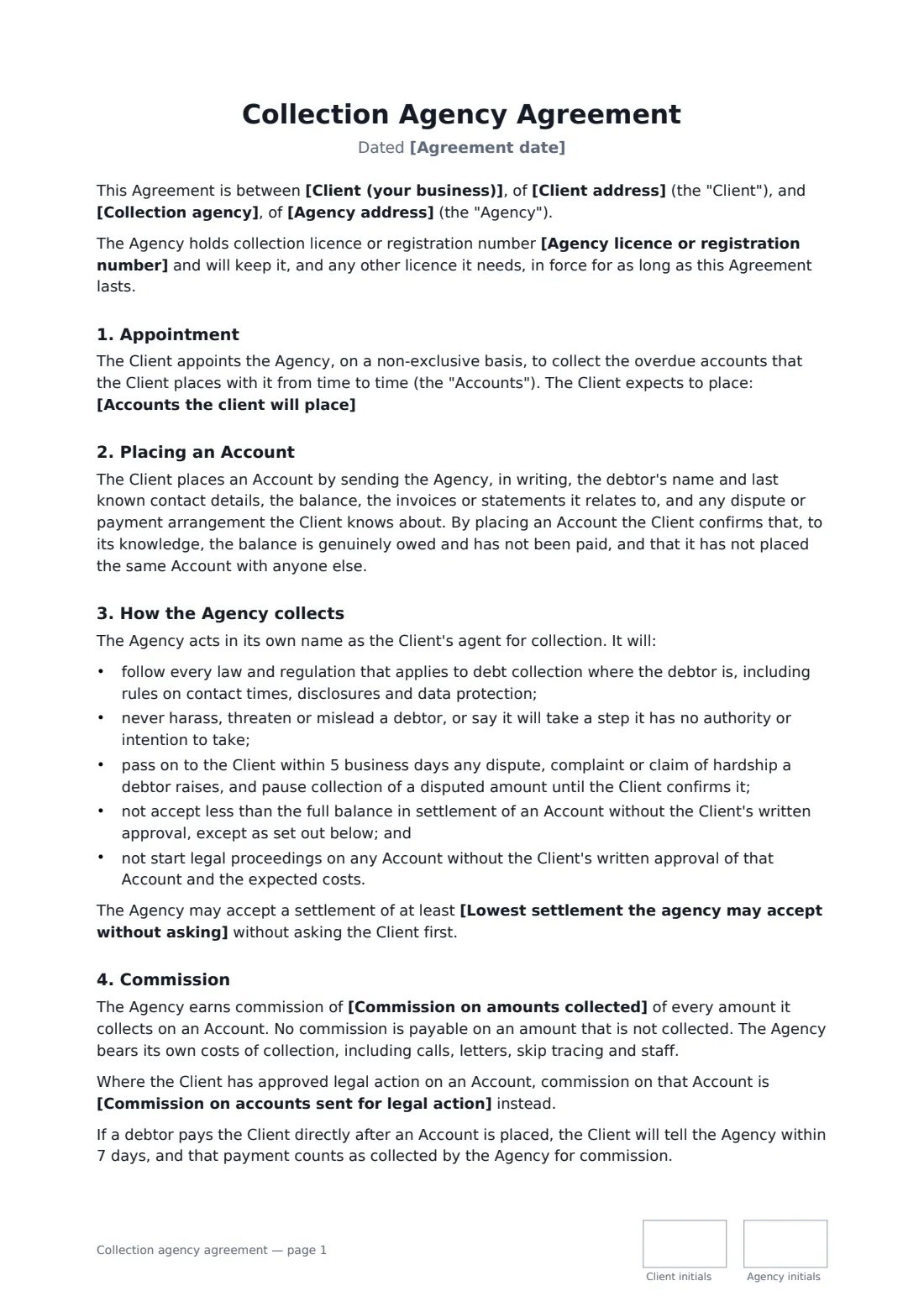
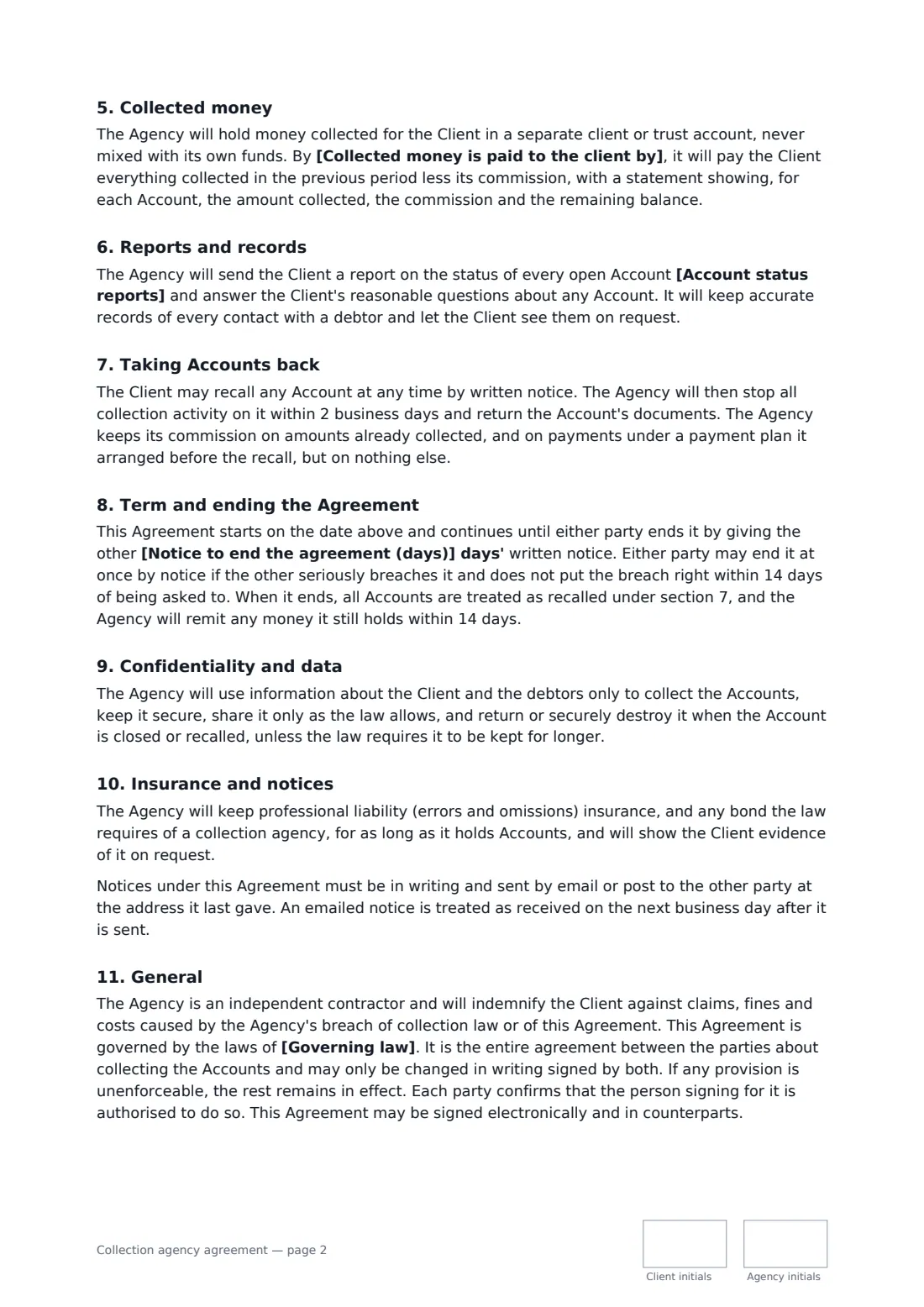
This template sets up a non-exclusive arrangement: you place accounts by sending the details, and the agency earns a percentage only of what it actually collects. It covers lawful and respectful collection, passing on disputes and hardship claims, a settlement floor, approval before any legal action, a separate trust account for collected money, a monthly remittance with a statement, regular status reports, your right to recall an account at any time, notice to end the agreement, and data handling. An extra clause switches on when some debtors are individuals.
- Best for
- Small and mid-sized businesses outsourcing overdue trade or customer accounts
- Signed by
- Your business and the collection agency
- Fees
- Contingency commission on amounts collected, with an optional higher rate for legal action
- Length
- 2–3 pages, initialled by both on every page
When to use a collection agency agreement
- A dental practice placing patient balances that are more than 120 days old
- A wholesaler handing unpaid trade invoices to a commercial collections firm
- A gym or club recovering missed membership fees from former members
- A landlord or property manager chasing arrears left by past tenants
- A software company passing unpaid annual subscriptions to an agency after its own reminders
What you fill in
15 blanks, then the name and email of each person who signs: client, agency.
1 The parties
- Agreement date*
- Client (your business)*
- Client address
- Collection agency*
- Agency address
- Agency licence or registration number
2 The accounts
- Accounts the client will place*
- Do the accounts include individuals (consumers)?* No — business customers only · Yes — some debtors are individuals
3 Commission
- Commission on amounts collected*
- Commission on accounts sent for legal action
- Lowest settlement the agency may accept without asking
4 Payment and reports
- Collected money is paid to the client by* the 15th of the following month · the last day of the following month · the Friday after the week it was collected
- Account status reports* every week · every two weeks · every month · every quarter
5 Term
- Notice to end the agreement (days)*
- Governing law*
6 Who signs
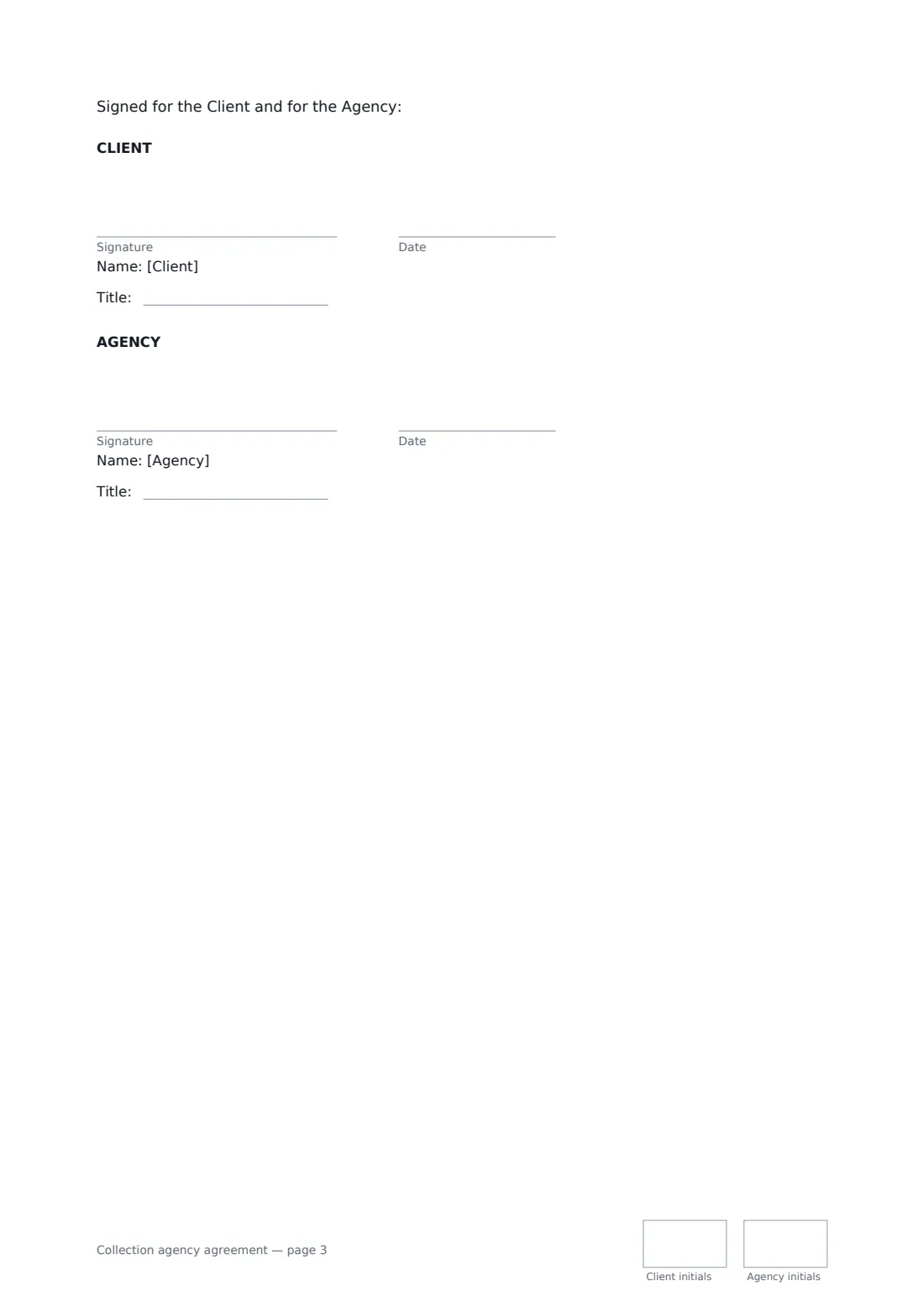
- Client signature and date, job title, initials on every page · The business whose customers owe it money.
- Agency signature and date, job title, initials on every page · The collection agency recovering the accounts.
What the collection agency agreement covers
- Appointment
- Placing an Account
- How the Agency collects
- Commission
- Collected money
- Reports and records
- Taking Accounts back
- Term and ending the Agreement
- Confidentiality and data
- Insurance and notices
- General
Using the collection agency agreement, step by step
1 Name the agency and its licence
Enter the agency's legal name and, where it has one, its collection licence or registration number. Describe the kind of accounts you expect to place.
2 Set the commission and the limits
Add the commission rate and, if the agency may sue, the rate for accounts sent to legal action. Optionally set the lowest settlement it can accept without asking you first.
3 Choose payment and reporting
Pick when collected money reaches you and how often you get a status report on every open account. Say whether any debtors are individuals, which brings in the consumer-collection clause.
4 Sign with the agency
Sign for your business and send it to the agency's signer. The signed copy is filed in your FileIt vault, so the terms are easy to find when you place the next batch.
Tips before you send it
- Ask the agency how it contacts debtors and request a copy of its standard letters before you place accounts.
- Keep a log of every account you place and the date, so recall and commission questions are easy to settle.
- Tell the agency promptly if a customer pays you directly — the agreement counts it as collected for commission.
- Rules on collecting consumer debts differ a lot between places. If your customers are individuals, check the agency is licensed where they live.
Sign it online in minutes
- Fill in the blanks. Names, dates and amounts go straight into the agreement — the preview shows exactly where.
- Name who signs. Tick “This is me” for your own part. FileIt builds the PDF with every signature, date and initials box on the right line, and you can check or move anything before sending.
- Send it. Each signer gets a secure link and signs from any device — no account needed. The signed PDF, with an audit trail and a Certificate of Completion, is filed in your vault and emailed to everyone.
Collection agency agreement: frequently asked questions
Does the agency get paid if it collects nothing?
Not under this template. Commission is a percentage of what is collected, and the agency covers its own costs. If you agree legal action, court fees are approved by you account by account.
Can I take an account back?
Yes. You can recall any account by written notice. The agency stops within two business days and keeps commission only on amounts already collected and on a payment plan it set up before the recall.
Can I use more than one agency?
Yes. The appointment is non-exclusive, but you confirm that you haven't placed the same account with anyone else.
Can it be signed electronically?
In most countries, including the US (ESIGN Act and UETA), the UK, the EU (eIDAS) and Canada, an electronic signature is generally valid for an ordinary commercial contract like this one. FileIt keeps an audit trail and a Certificate of Completion with the signed PDF as evidence of who signed and when.
Is this template free?
Yes. The template is free to use with the eSignature app in FileIt, and the people you send it to don't need a FileIt account to sign.