What is a debt assignment agreement?
A debt assignment agreement transfers the right to collect money someone owes you to another business or person. Small firms use it to turn slow-paying invoices into cash, to tidy up loose receivables when a business is sold, or to hand a stubborn debt to a buyer who specialises in recovering it. The debtor doesn't sign: they're told about the transfer afterwards, and from then on they pay the new owner.
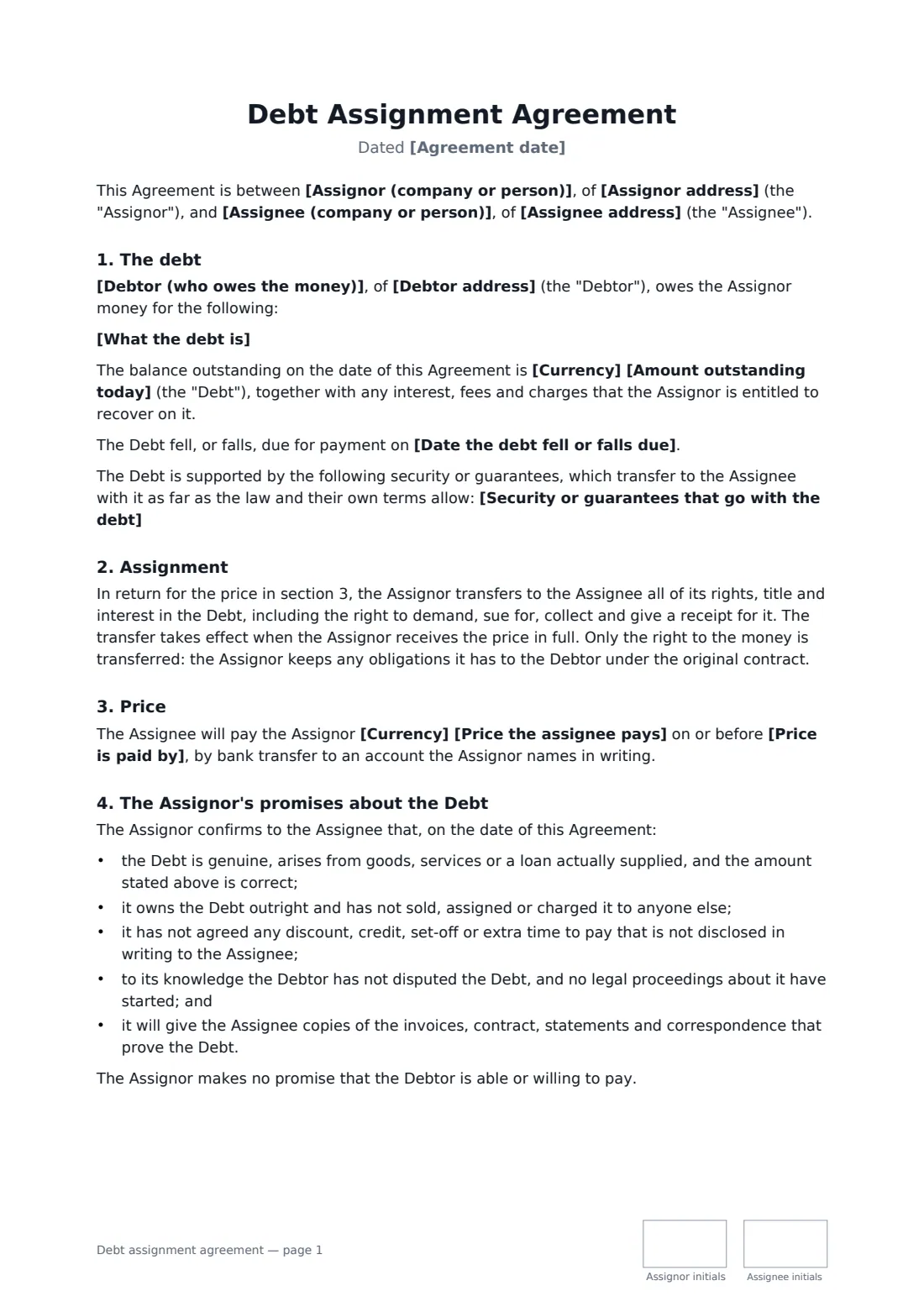
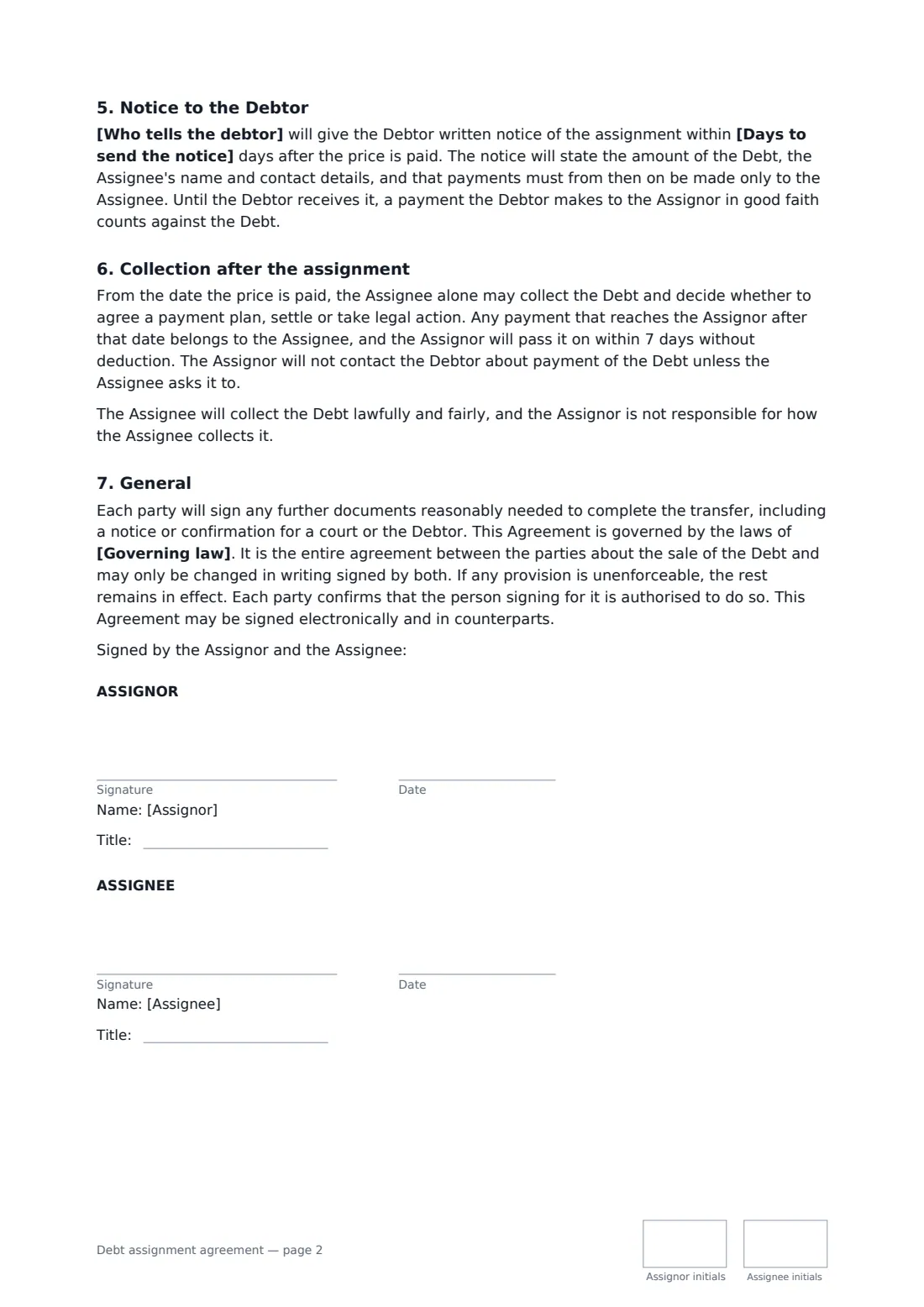
This template is signed by the current creditor (the assignor) and the buyer (the assignee). It describes the debt and the balance, any guarantee or security that goes with it, the price and when it's paid, whether the sale is with or without recourse, the assignor's promises that the debt is genuine and unencumbered, who sends the notice of assignment and how quickly, and who collects from then on — including what happens to a payment that still lands with the old creditor.
- Best for
- Selling unpaid invoices, a personal or business loan, or another receivable
- Signed by
- The current creditor and the buyer of the debt
- Risk of non-payment
- You choose: the buyer takes it, or the seller buys the debt back
- Length
- 2 pages, initialled by both on every page
When to use a debt assignment agreement
- A wholesaler selling a bundle of overdue trade invoices to a buyer at a discount
- Moving receivables to the buyer as part of selling a small business
- A family member taking over a loan that a relative made to a friend
- A contractor passing an unpaid final invoice to a partner company that will chase it
- Transferring a debt between two companies in the same group
What you fill in
19 blanks, then the name and email of each person who signs: assignor, assignee.
1 The parties
- Agreement date*
- Assignor (company or person)*
- Assignor address
- Assignee (company or person)*
- Assignee address
2 The debt
- Debtor (who owes the money)*
- Debtor address
- What the debt is*
- Currency*
- Amount outstanding today*
- Date the debt fell or falls due
- Security or guarantees that go with the debt
3 Price and payment
- Price the assignee pays*
- Price is paid by*
- If the debtor does not pay* Without recourse — the assignee takes the risk · With recourse — the assignor buys the debt back
- Days before the assignee can ask for a buy-back
4 Notice and collection
- Who tells the debtor* The Assignor · The Assignee · The Assignor and the Assignee jointly
- Days to send the notice*
- Governing law*
5 Who signs
- Assignor signature and date, job title, initials on every page · The business or person who is owed the money today and is transferring the right to collect it.
- Assignee signature and date, job title, initials on every page · The business or person taking over the debt and paying the price for it.
What the debt assignment agreement covers
- The debt
- Assignment
- Price
- The Assignor's promises about the Debt
- Notice to the Debtor
- Collection after the assignment
- General
Using the debt assignment agreement, step by step
1 Describe the debt precisely
Name the debtor and list the invoices, loan or contract the money is owed under, with the balance today. If a guarantee backs the debt, mention it so it moves across too.
2 Agree the price and the risk
Enter the price and the date it's paid. Choose without recourse if the buyer accepts the risk that the debtor never pays, or with recourse if the seller will buy back what's still unpaid after a number of days.
3 Decide who tells the debtor
Pick the seller, the buyer or both jointly, and how many days they have. Until the debtor gets the notice, a payment made in good faith to the old creditor still counts.
4 Sign and send
Tick "This is me" for your role, add the other party's name and email, and send. FileIt places both signature blocks with title boxes, and initials on every page.
Tips before you send it
- Check the original contract or invoice terms first — some forbid assignment or need the debtor's consent.
- Gather the paperwork before signing: the seller promises to hand over invoices, statements and correspondence that prove the debt.
- If the debtor is a consumer, rules on debt buying and collection may apply where they live; look them up before agreeing the price.
- Send the notice of assignment in writing and keep a copy, so the debtor can't later say they didn't know whom to pay.
Sign it online in minutes
- Fill in the blanks. Names, dates and amounts go straight into the agreement — the preview shows exactly where.
- Name who signs. Tick “This is me” for your own part. FileIt builds the PDF with every signature, date and initials box on the right line, and you can check or move anything before sending.
- Send it. Each signer gets a secure link and signs from any device — no account needed. The signed PDF, with an audit trail and a Certificate of Completion, is filed in your vault and emailed to everyone.
Debt assignment agreement: frequently asked questions
Does the debtor need to agree?
Usually the debtor only needs to be told, not to agree, but the original contract may say otherwise. That's why the template has a notice clause rather than a debtor signature. If your contract needs consent, get it before you sign.
What's the difference between with and without recourse?
Without recourse, the buyer takes the loss if the debtor doesn't pay. With recourse, the buyer can ask the seller to buy back any unpaid part after the number of days you set, for the same share of the price, less what has already been collected.
Is this the same as debt settlement?
No. Debt settlement is between a creditor and a debtor agreeing to accept less. A debt assignment is between the creditor and a third party who takes over the right to collect. FileIt has a separate debt settlement agreement template.
Can it be signed electronically?
In most countries, including the US (ESIGN Act and UETA), the UK, the EU (eIDAS) and Canada, an electronic signature is generally valid for an ordinary commercial contract like this one. FileIt keeps an audit trail and a Certificate of Completion with the signed PDF as evidence of who signed and when.
Is this template free?
Yes. The template is free to use with the eSignature app in FileIt, and the people you send it to don't need a FileIt account to sign.