What is a acknowledgement of debt?
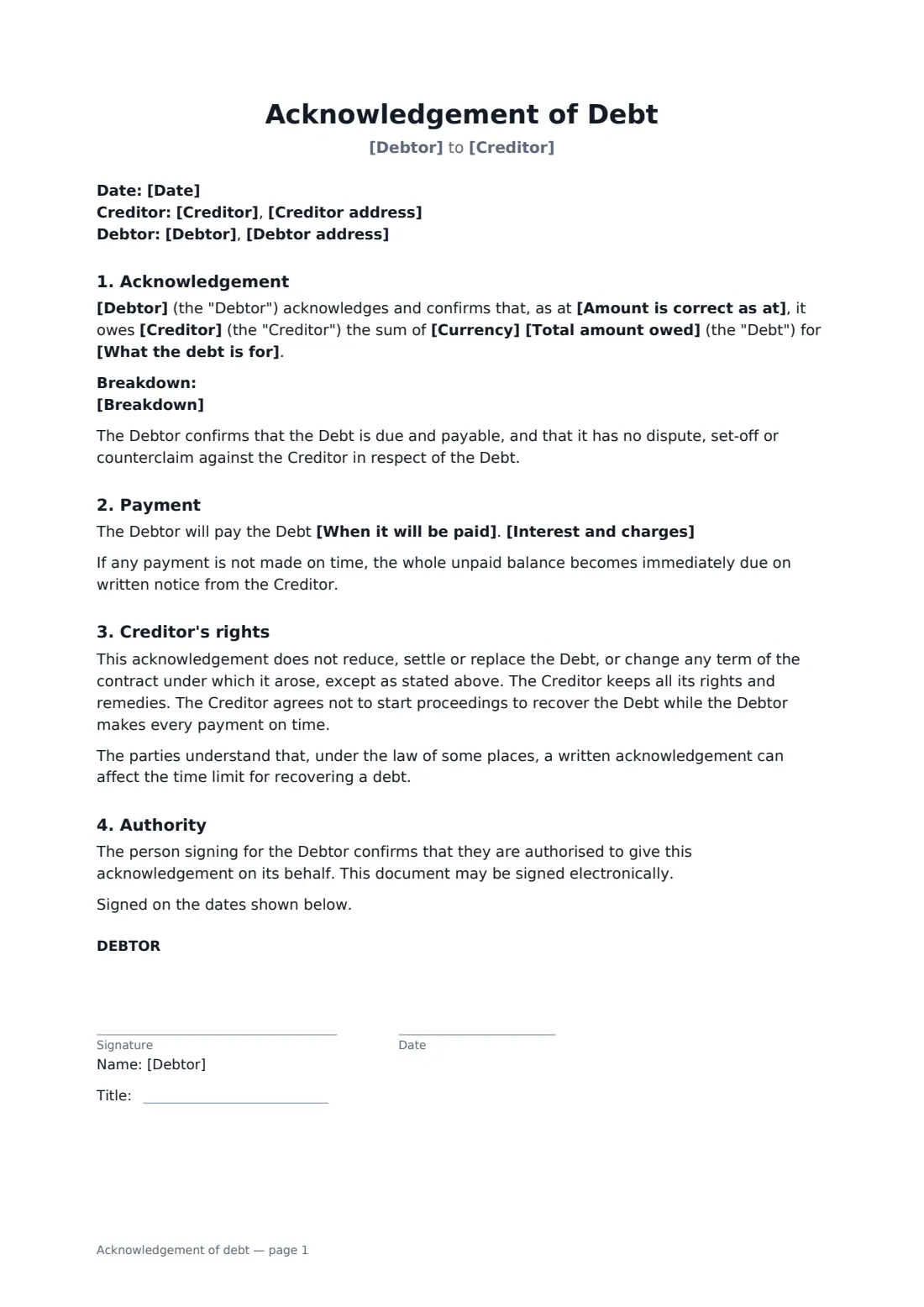
When invoices run overdue, the first useful step is often to agree the number. A signed acknowledgement of debt records that the debtor accepts the amount is owed, has no dispute or counterclaim, and commits to a payment date or plan. It is not a settlement: the full amount stays owed, and the creditor keeps all its rights.
This template records the amount as at a date, what the debt is for with an optional invoice breakdown, when it will be paid, what happens to interest and charges, and acceleration if a payment is missed. In return the creditor agrees not to sue while payments are made on time. It also notes that, in some places, a written acknowledgement can affect the time limit for recovering a debt.
- Best for
- Suppliers and lenders with an overdue business customer
- Signed by
- The debtor and the creditor
- Does not
- Reduce, settle or replace the debt
- Length
- 1–2 pages
When to use a acknowledgement of debt
- Confirming an overdue balance before agreeing a payment plan
- Getting a customer's sign-off on a statement of account
- Recording money owed when a business relationship ends
- Documenting an informal loan between two businesses
- Preparing for possible recovery action with clear evidence
What you fill in
12 blanks, then the name and email of each person who signs: debtor, creditor.
1 The parties
- Date*
- Creditor*
- Creditor address
- Debtor*
- Debtor address
2 The debt
- Currency*
- Total amount owed*
- Amount is correct as at*
- What the debt is for*
- Breakdown
3 Payment
- When it will be paid*
- Interest and charges* Interest and charges continue to apply as set out in the original contract or invoices. · The creditor will not charge further interest if every payment is made on time. · No interest or charges are claimed.
4 Who signs
- Debtor signature and date, job title · The party that owes the money.
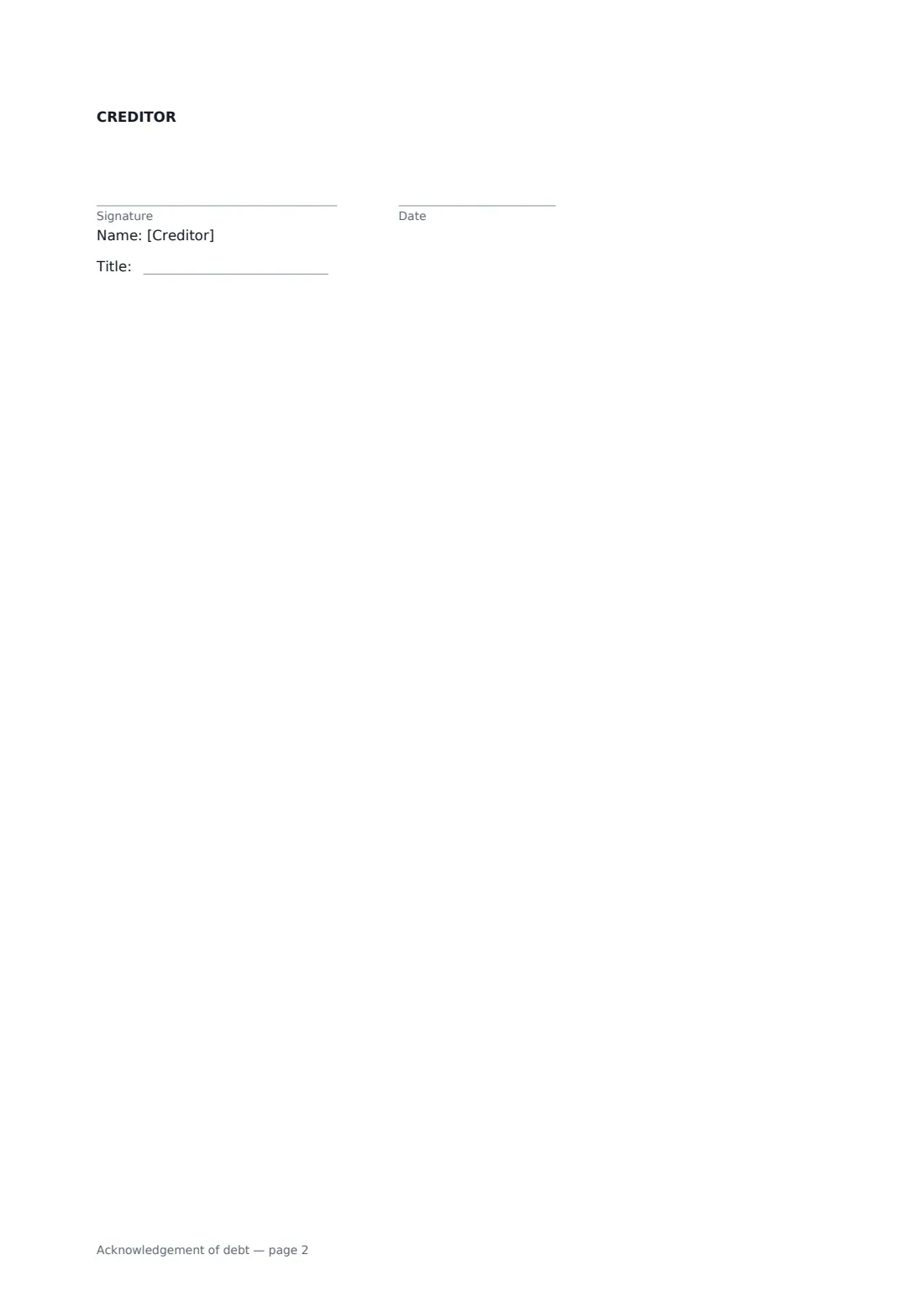
- Creditor signature and date, job title
What the acknowledgement of debt covers
- Acknowledgement
- Payment
- Creditor's rights
- Authority
Using the acknowledgement of debt, step by step
1 Name the parties
Enter the creditor and the debtor with their addresses.
2 State the debt
Enter the total, the date it is calculated to, and what it is for. Add an invoice-by-invoice breakdown if you can.
3 Agree payment
Write when and how it will be paid, and choose whether interest and charges continue, are suspended for on-time payment, or are not claimed.
4 Send for signature
The debtor signs to acknowledge, then you countersign. The signed copy and audit trail are kept in your vault.
Tips before you send it
- Reconcile the amount with the customer before sending, so they can sign without argument.
- Make sure the person signing for the debtor is authorised to commit the business.
- If you are accepting less than the full amount, use a debt settlement agreement instead.
- Time limits for recovering debts vary by place; take advice if the debt is old.
Sign it online in minutes
- Fill in the blanks. Names, dates and amounts go straight into the agreement — the preview shows exactly where.
- Name who signs. Tick “This is me” for your own part. FileIt builds the PDF with every signature, date box on the right line, and you can check or move anything before sending.
- Send it. Each signer gets a secure link and signs from any device — no account needed. The signed PDF, with an audit trail and a Certificate of Completion, is filed in your vault and emailed to everyone.
Acknowledgement of debt: frequently asked questions
Is an acknowledgement of debt the same as a settlement?
No. An acknowledgement confirms the full amount owed. A settlement usually reduces it or changes the terms in exchange for a release.
Does it restart the limitation period?
In some places a signed written acknowledgement can extend or restart the time to sue for a debt. The rules vary; check local law.
Can I charge interest?
The template lets you keep contractual interest, waive further interest for on-time payment, or claim none. Any interest must have a contractual or legal basis.
Can individuals use it?
It is written for business debts. For personal loans, see the promissory note.