What is a invoice factoring agreement?
Invoice factoring turns unpaid customer invoices into cash now. A business sells its invoices to a factor, which pays most of their value up front and the rest, less its fee, once the customer pays. The agreement behind it has to answer a handful of questions clearly: which invoices the factor will buy, how much it advances, what it charges, whether customers pay the factor directly, and who loses out if a customer never pays.
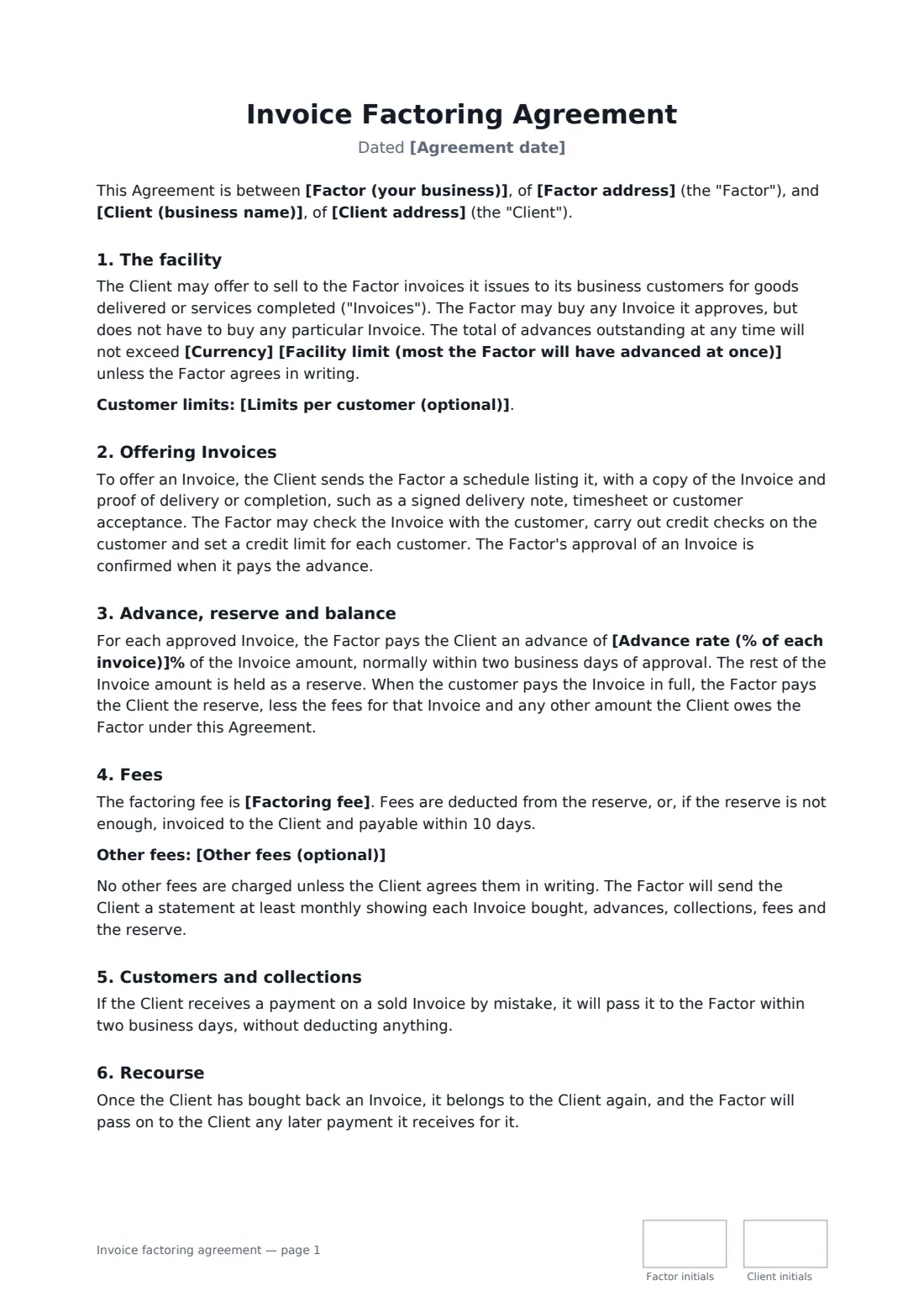
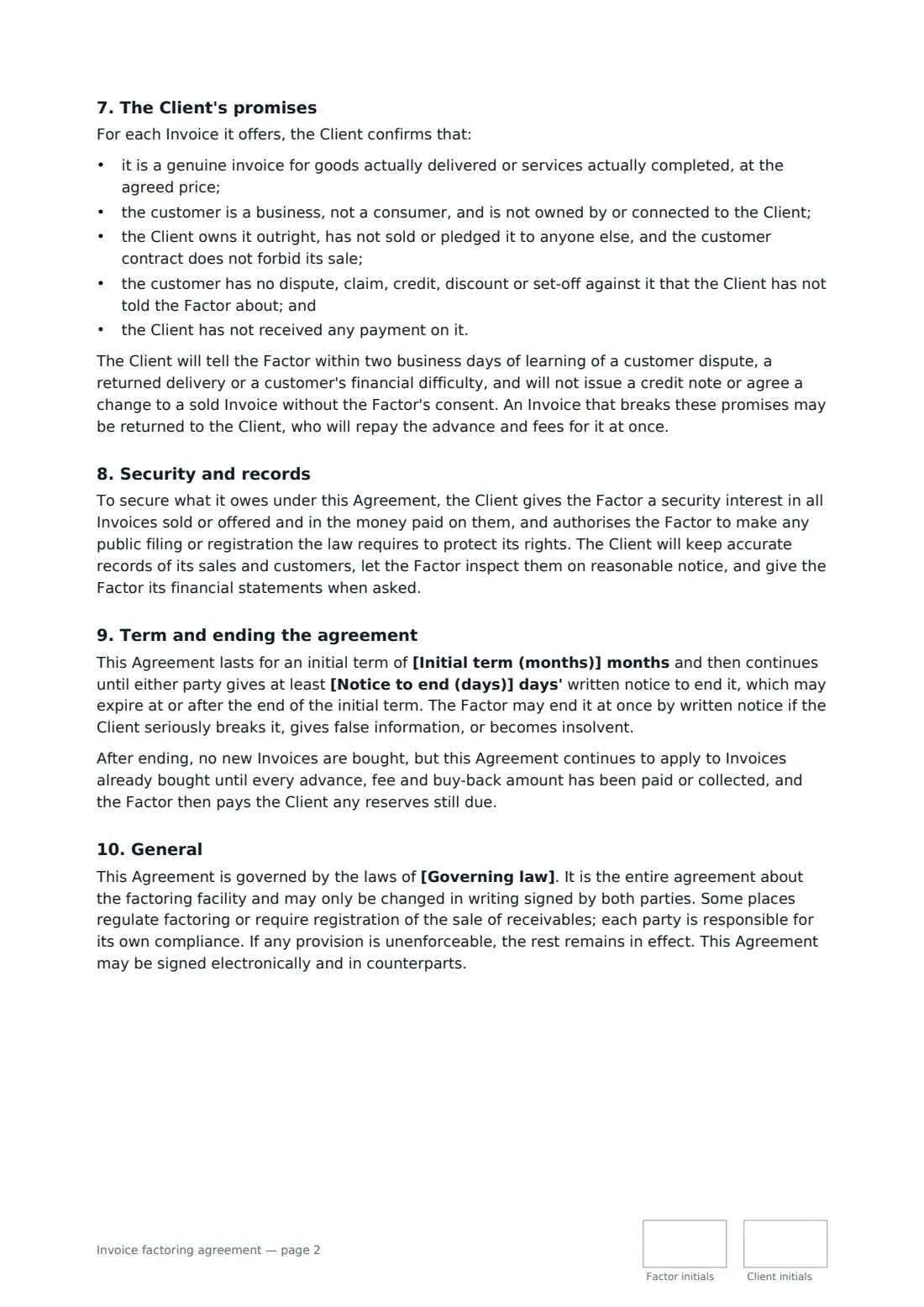
This template is written for the factor to send. It sets a facility limit, optional per-customer limits, the advance percentage and the reserve, a factoring fee and any other fees you list, and a monthly statement. Choose notified factoring, with customers paying the factor, or confidential factoring, with the client collecting on trust. Choose full recourse or protection against an approved customer's insolvency, with a buy-back period. The client's promises about each invoice, dispute reporting, a security interest and filings, record access, the term, notice and what happens to bought invoices after the end are all covered.
- Best for
- Factoring companies and invoice finance providers
- Signed by
- The factor and the client business
- Options
- Recourse or non-recourse, notified or confidential
- Length
- About 3 pages, initialled on every page
When to use a invoice factoring agreement
- A trucking company factoring freight invoices to cover fuel and payroll
- A staffing agency funding weekly wages while clients pay on 60-day terms
- A wholesaler selling invoices to a big retailer to fund the next production run
- A contractor using confidential factoring so customers keep paying it directly
- A factor moving a client onto non-recourse terms for approved customers
What you fill in
17 blanks, then the name and email of each person who signs: factor, client.
1 The parties
- Agreement date*
- Factor (your business)*
- Factor address*
- Client (business name)*
- Client address*
2 The facility
- Currency*
- Facility limit (most the Factor will have advanced at once)*
- Advance rate (% of each invoice)*
- Factoring fee*
- Other fees (optional)
- Limits per customer (optional)
3 Risk and collections
- Recourse* with recourse · without recourse for an approved customer's insolvency
- Unpaid invoices are bought back after (days from invoice date)*
- Will customers be told?* Yes, customers pay the Factor directly · No, confidential: customers keep paying the Client
4 Term
- Initial term (months)*
- Notice to end (days)*
- Governing law*
5 Who signs
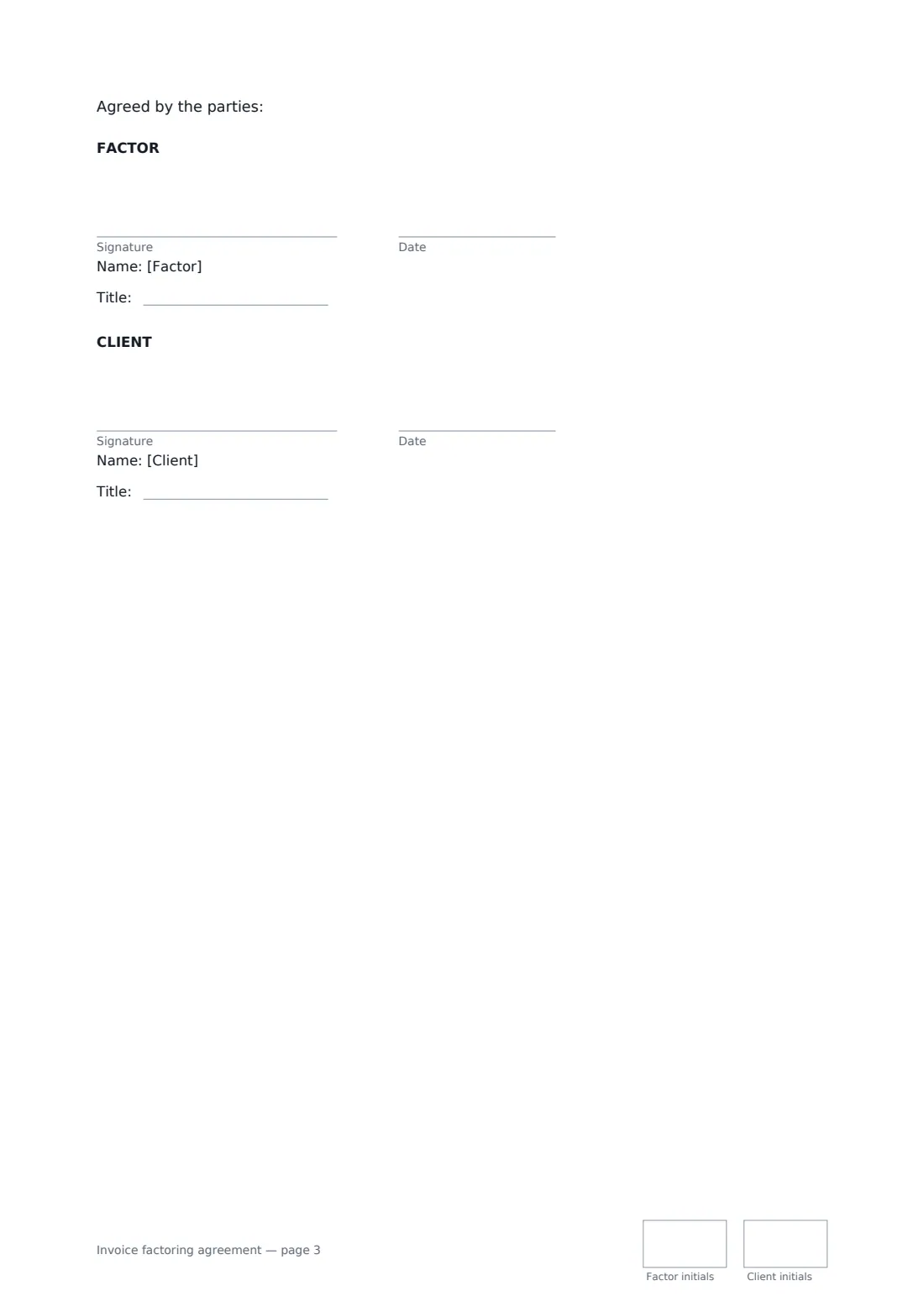
- Factor signature and date, job title, initials on every page · The finance company buying the invoices.
- Client signature and date, job title, initials on every page · The business selling its invoices.
What the invoice factoring agreement covers
- The facility
- Offering Invoices
- Advance, reserve and balance
- Fees
- Customers and collections
- Recourse
- The Client's promises
- Security and records
- Term and ending the agreement
- General
Using the invoice factoring agreement, step by step
1 Enter the parties
Your company is pre-filled as the factor. Add the client's legal name and address.
2 Set the facility
Enter the facility limit, any customer concentration limit, the advance rate, the factoring fee in plain words, and any set-up or transfer fees.
3 Choose the risk and notice terms
Pick recourse or non-recourse for insolvency, the buy-back period in days, and whether customers are told to pay you or keep paying the client.
4 Term and send
Set the initial term, the notice period to end, and the governing law, then send it to the client's authorised signatory.
Tips before you send it
- Write the fee so a business owner can work out the cost of a 45-day invoice without a calculator. Clear fees mean fewer disputes over statements.
- Factoring of business receivables is regulated or needs a public filing in some places. Check what applies where you and the client are based.
- Ask for proof of delivery with every schedule. The template makes it part of offering an invoice, and it is your best evidence if a customer disputes the debt.
- If a bank or lender already holds security over the client's receivables, get a release or an agreement with that lender before funding.
Sign it online in minutes
- Fill in the blanks. Names, dates and amounts go straight into the agreement — the preview shows exactly where.
- Name who signs. Tick “This is me” for your own part. FileIt builds the PDF with every signature, date and initials box on the right line, and you can check or move anything before sending.
- Send it. Each signer gets a secure link and signs from any device — no account needed. The signed PDF, with an audit trail and a Certificate of Completion, is filed in your vault and emailed to everyone.
Invoice factoring agreement: frequently asked questions
What's the difference between recourse and non-recourse here?
With recourse, the client buys back any invoice that stays unpaid past the buy-back period, for any reason. With the non-recourse option, the factor takes the loss if an approved customer becomes insolvent, up to that customer's credit limit, and the client still buys back invoices unpaid for any other reason, such as a dispute.
Do customers have to be told?
Only if you choose notified factoring. With confidential factoring, customers keep paying the client, which holds the money on trust and passes it on within two business days.
What is the reserve?
The part of each invoice not advanced up front. When the customer pays, the factor releases the reserve to the client after deducting its fees and anything else the client owes under the agreement.
Can a factoring agreement be signed online?
Electronic signatures are generally valid for commercial finance contracts like this in the US, UK, EU and Canada. Any public filing of a security interest is a separate step. FileIt keeps an audit trail and Certificate of Completion with the signed PDF.
Is this template free?
Yes. It's free with FileIt eSignature, and your client doesn't need an account to sign.