What is a closing date extension addendum?
Closings slip all the time: an appraisal comes back late, a title issue needs clearing, the agreed repairs aren't finished, or the seller's own purchase is delayed. When the date in the purchase agreement passes without a signed extension, one side may be in default, and the other may suddenly have a way out of a deal it has cooled on. A short written extension, signed before the date, keeps everyone on the same contract.
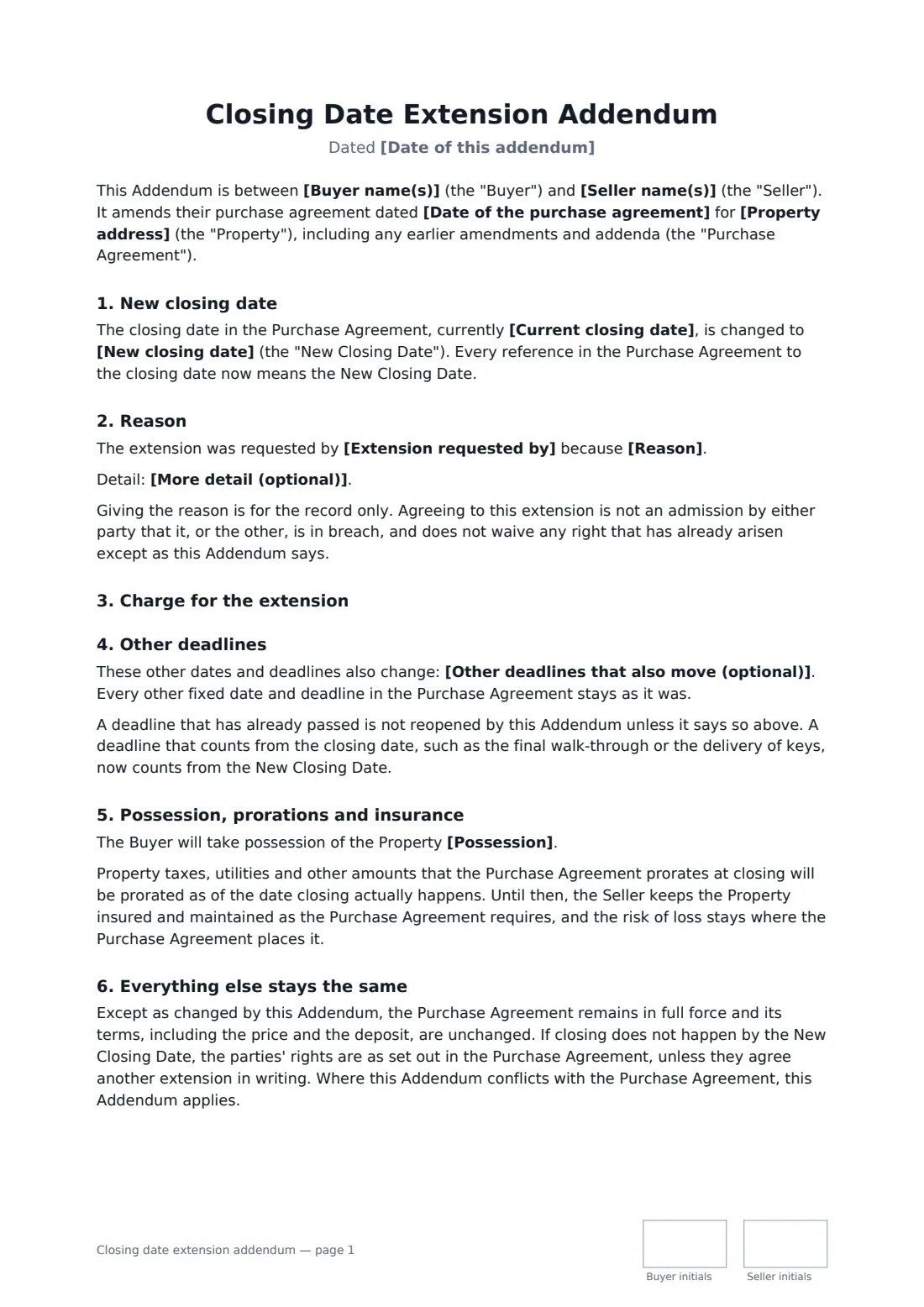
This addendum replaces the closing date, records who asked for the extension and why (without either side admitting a breach), and sets any charge: none, a one-off fee or a per-diem for each day of delay, paid either way, credited against the price or not. You can list other deadlines that move too. Otherwise only the closing date changes and deadlines already passed stay passed. It confirms when possession passes, that prorations follow the actual closing day, and that every other term stays the same.
- Best for
- Moving the closing or settlement date on a home or land purchase
- Signed by
- Buyer and seller, initialled on every page
- Charge options
- No charge, a one-off fee, or a per-diem for each day of delay
- Length
- 2 pages
When to use a closing date extension addendum
- A buyer's lender needing more time to fund the loan
- Extending closing while a title defect or boundary survey is resolved
- Giving the seller time to finish repairs agreed after the inspection
- A seller whose own onward purchase has been delayed
- Both sides agreeing a later date to line up their moves
What you fill in
19 blanks, then the name and email of each person who signs: buyer, seller.
1 The purchase
- Date of this addendum*
- Buyer name(s)*
- Seller name(s)*
- Property address*
- Date of the purchase agreement*
2 The new date
- Current closing date*
- New closing date*
- Extension requested by* the Buyer · the Seller · both parties
- Reason* the Buyer's lender needs more time to fund the loan · a title, survey or document issue needs to be resolved · agreed repairs are not yet finished · the Seller needs more time to move out · the parties' other arrangements have changed
- More detail (optional)
3 Money
- Charge for the extension* No charge · A one-off extension fee · A per-diem charge for each day of delay
- Currency*
- Fee or daily amount (if charged)
- Paid by* the Buyer to the Seller · the Seller to the Buyer
- How it is treated* paid at closing as an adjustment on the closing statement, and not credited against the purchase price · paid at closing and credited against the purchase price · paid within 3 business days to the deposit holder, non-refundable unless the sale fails because of the payee's default, and credited against the purchase price at closing
4 Deadlines and possession
- Other deadlines that also move (optional)
- Possession* at closing on the new closing date, as the purchase agreement already provides · on the date and time set out below
- Possession date and time (if set out below)
- Governing law*
5 Who signs
- Buyer signature and date, initials on every page · The buyer under the purchase agreement. All buyers should sign.
- Seller signature and date, initials on every page · The seller under the purchase agreement. All owners should sign.
What the closing date extension addendum covers
- New closing date
- Reason
- Charge for the extension
- Other deadlines
- Possession, prorations and insurance
- Everything else stays the same
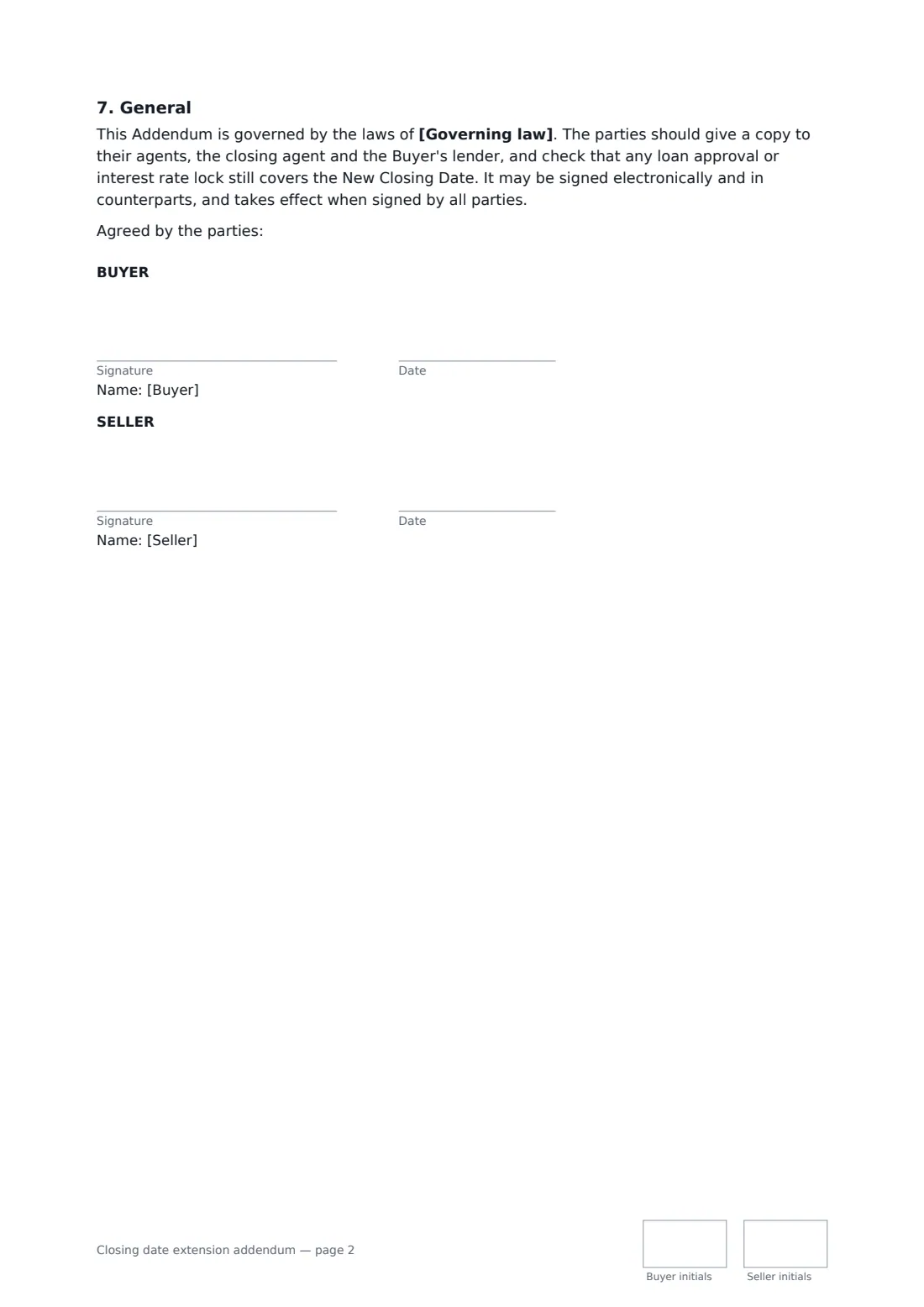
- General
Using the closing date extension addendum, step by step
1 Identify the purchase
Enter the buyer, seller, property and date of the purchase agreement.
2 Set the new date
Enter the current and new closing dates, who asked for the extension and the reason, with any detail.
3 Agree any charge
Choose no charge, a one-off fee or a per-diem, the amount, who pays whom, and whether it is credited against the price.
4 Deadlines, possession and sending
List any other deadlines that move, confirm when possession passes, add the governing law and send it to the other side to sign.
Tips before you send it
- Sign the extension before the current closing date passes, not after.
- Check the buyer's interest rate lock and loan approval. Many expire on a fixed date and may cost money to extend.
- Send the signed addendum to the closing agent and the lender at once. They work from the latest signed dates.
- Update the closing date reminder on the purchase agreement in FileIt so the new date is the one you're reminded about.
Sign it online in minutes
- Fill in the blanks. Names, dates and amounts go straight into the agreement — the preview shows exactly where.
- Name who signs. Tick “This is me” for your own part. FileIt builds the PDF with every signature, date and initials box on the right line, and you can check or move anything before sending.
- Send it. Each signer gets a secure link and signs from any device — no account needed. The signed PDF, with an audit trail and a Certificate of Completion, is filed in your vault and emailed to everyone.
Closing date extension addendum: frequently asked questions
Does extending closing change the other deadlines?
Not unless you list them. By default only the closing date moves, and deadlines that count from closing, such as the final walk-through, follow it. Deadlines that have already passed are not reopened.
Who pays the per-diem charge?
You choose. It is usually paid by the party who asked for the extension, to the other, for each day of delay up to the new closing date.
Does agreeing to an extension mean someone is in breach?
No. The reason is recorded for the record only, and the addendum says the extension is not an admission of breach by either party.
What if we miss the new date too?
The purchase agreement's normal rules on a missed closing apply, unless you sign a further extension.