What is Form 8857?
When you file a joint return, both of you are normally responsible for the whole tax bill, including any interest and penalties added later. Form 8857 asks the Internal Revenue Service to relieve you of some or all of that liability because it belongs to the person you filed with — for example, because they left income off the return or claimed deductions you knew nothing about, or because the tax shown was never paid. The same form covers the three kinds of relief: innocent spouse relief, separation of liability relief and equitable relief.
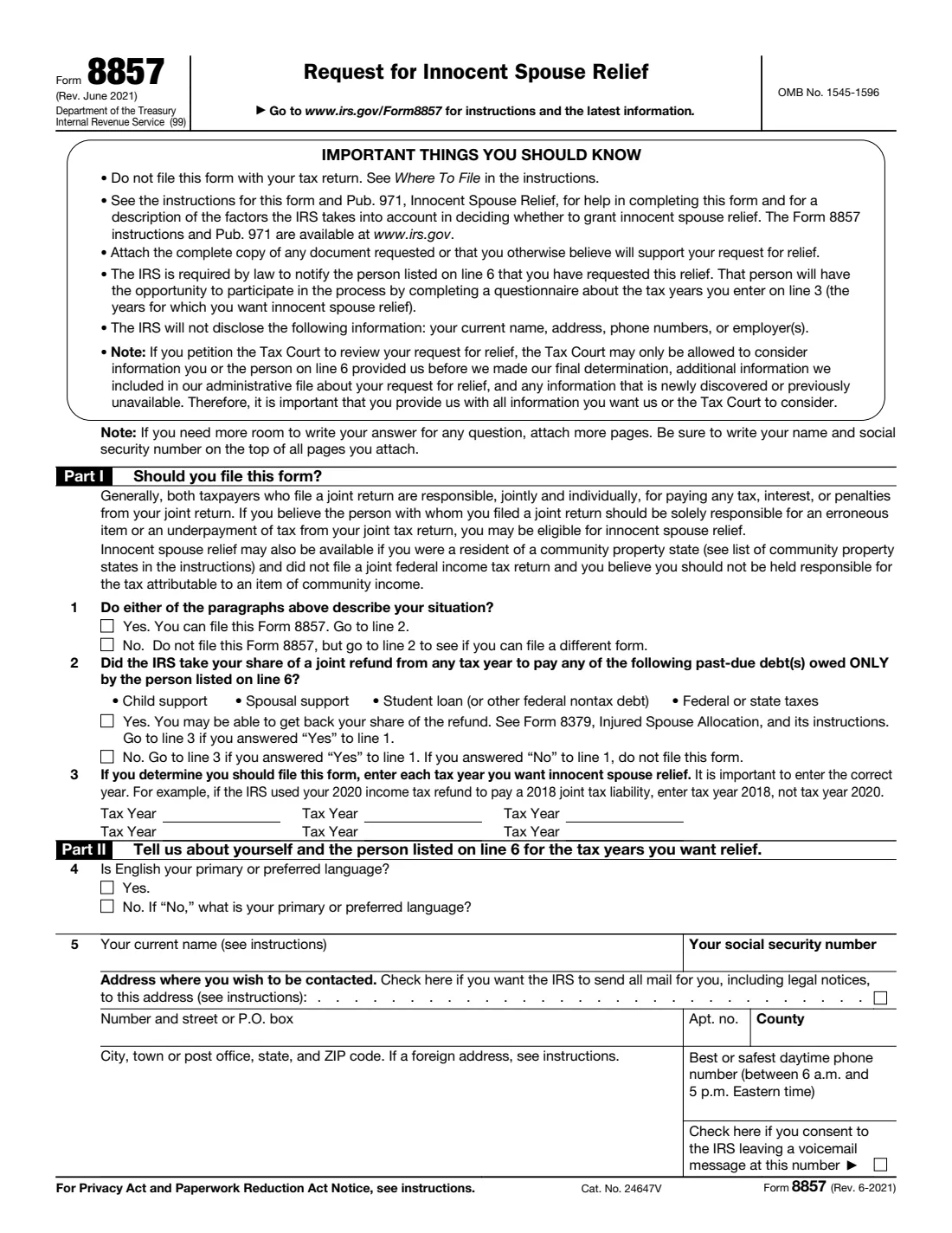
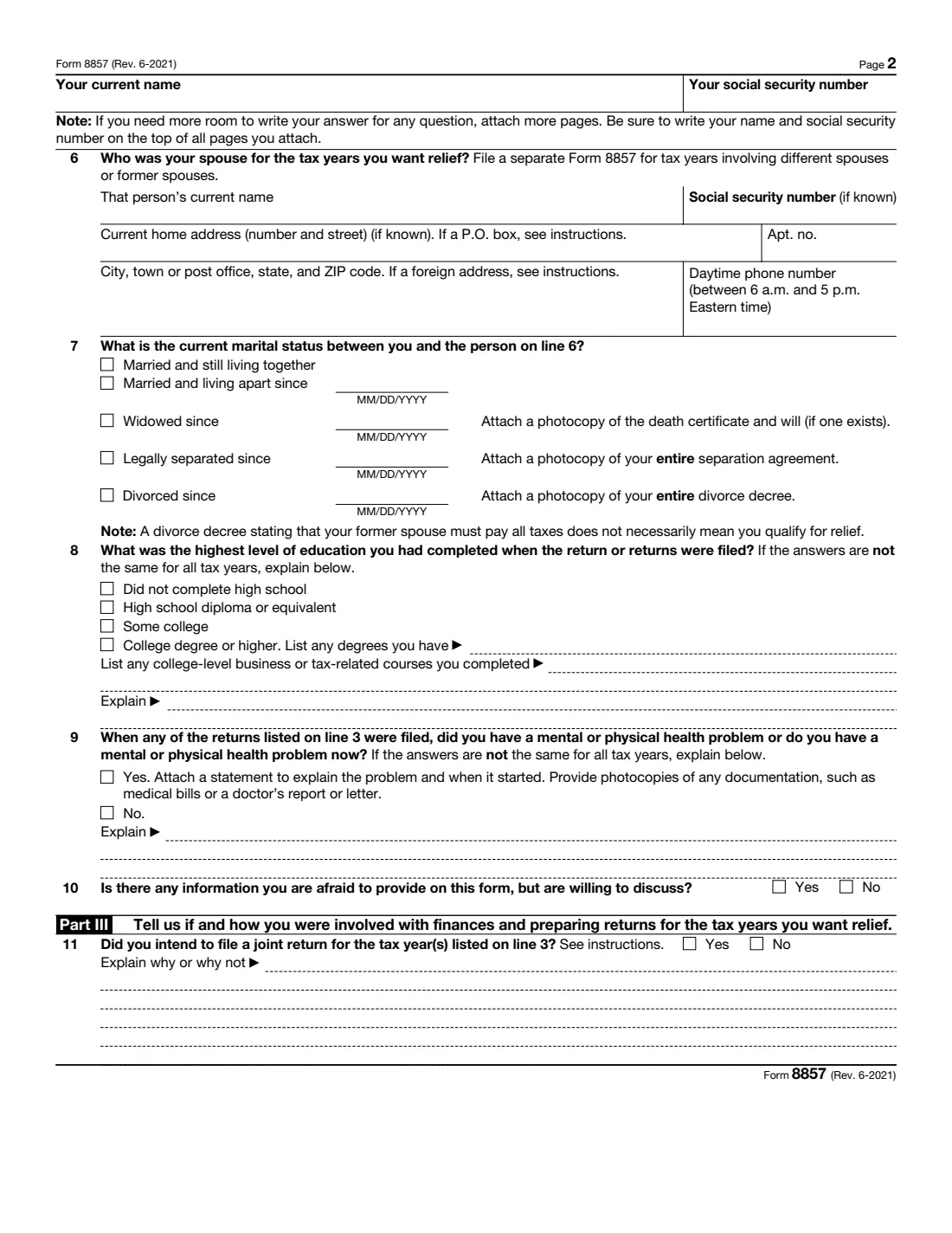
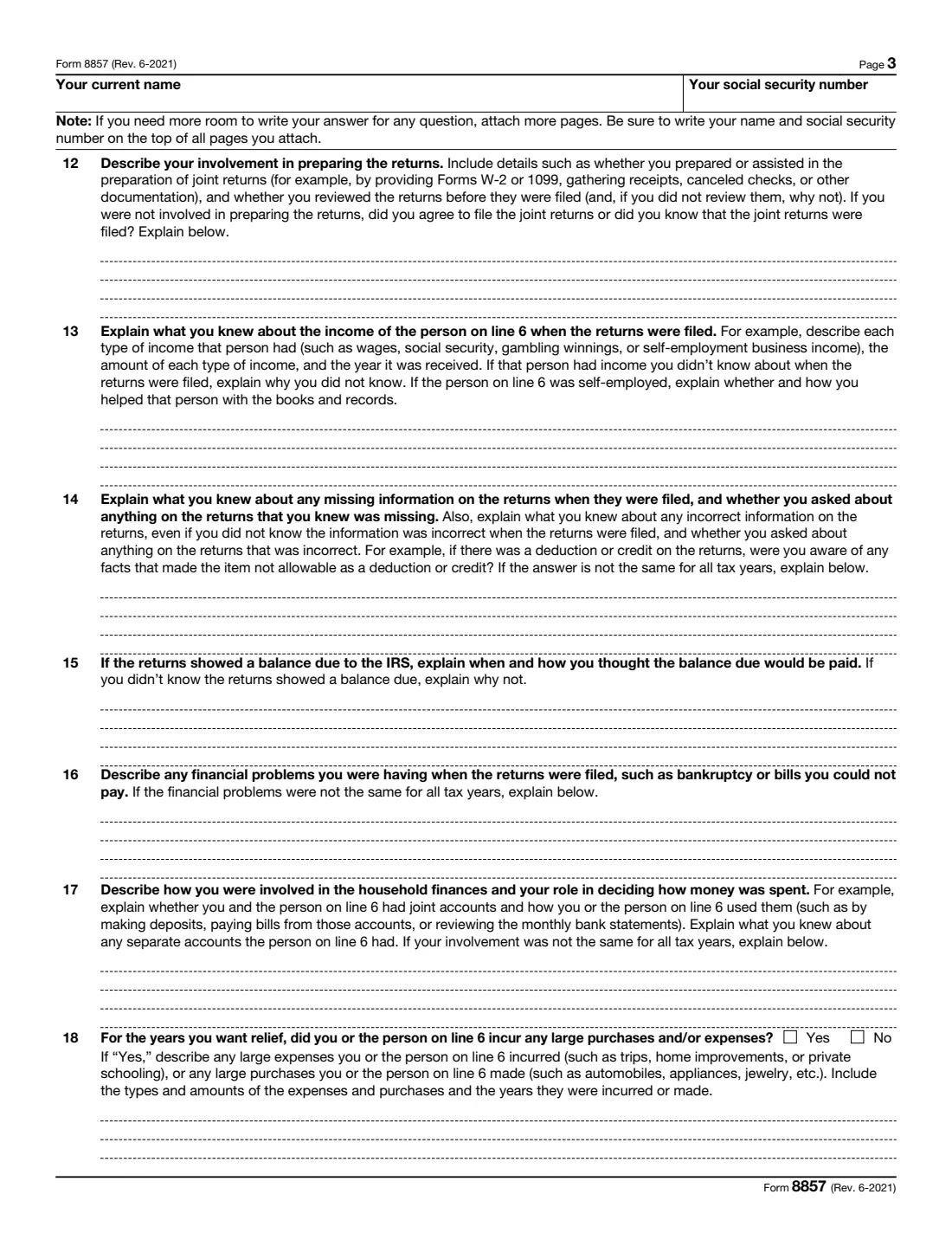
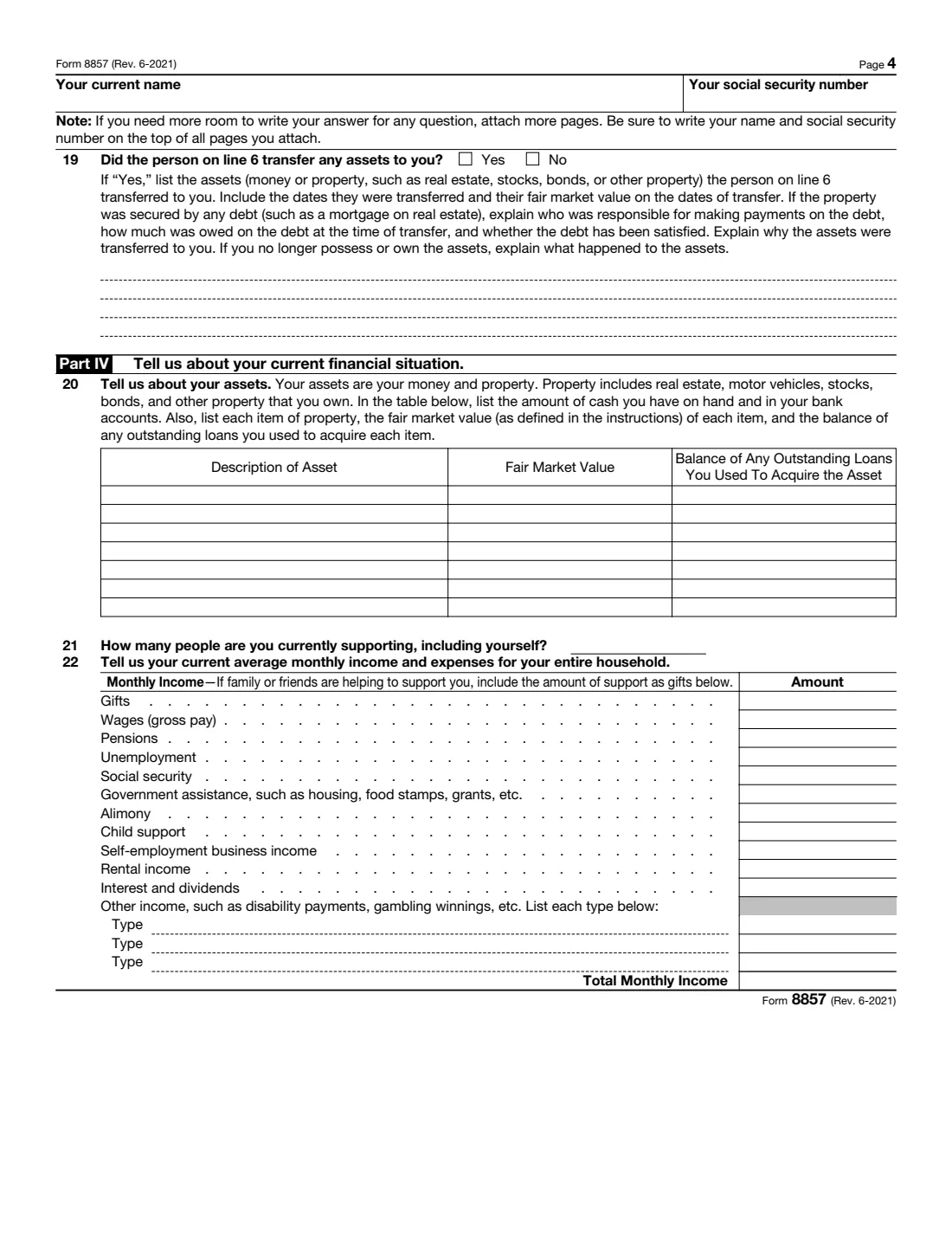
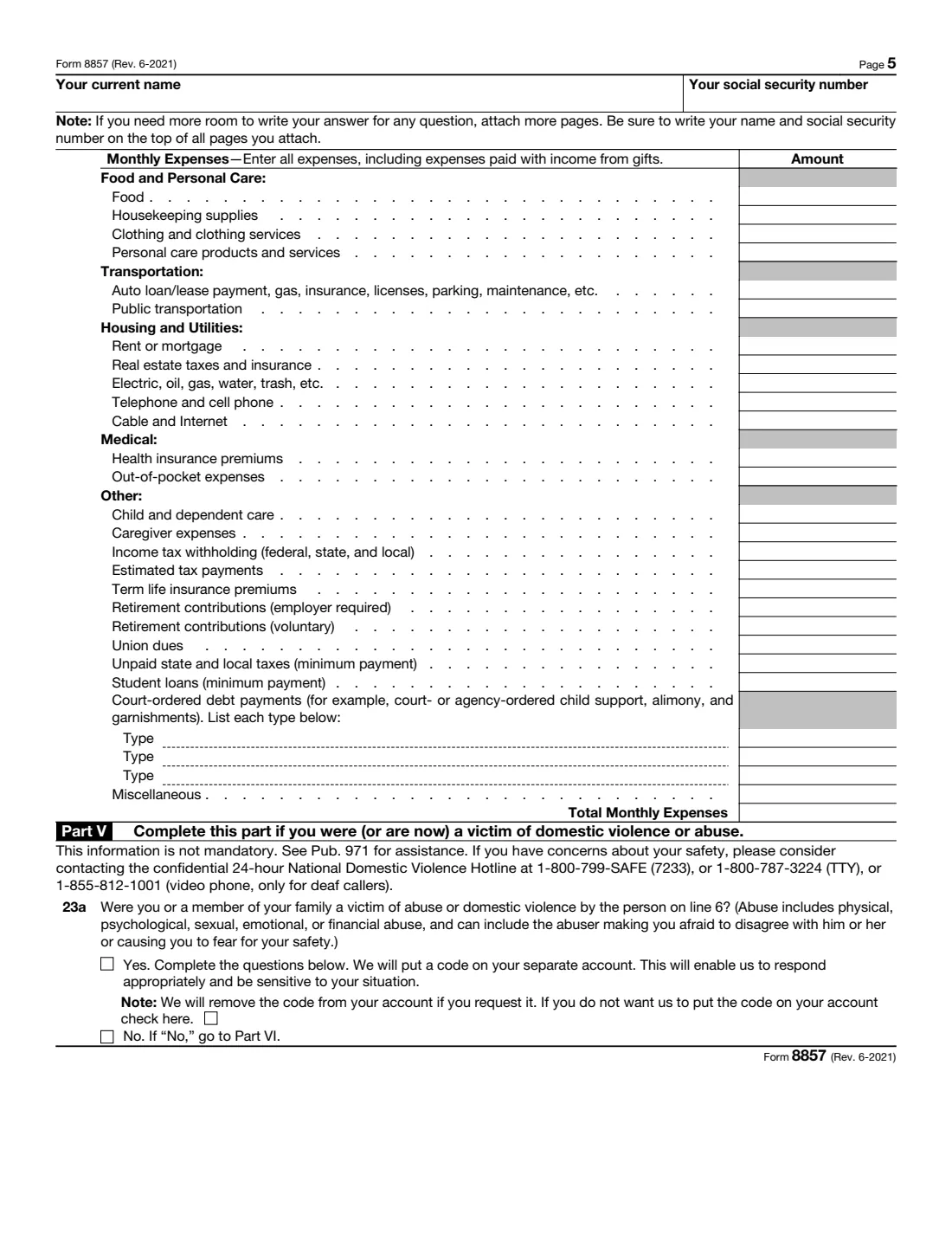
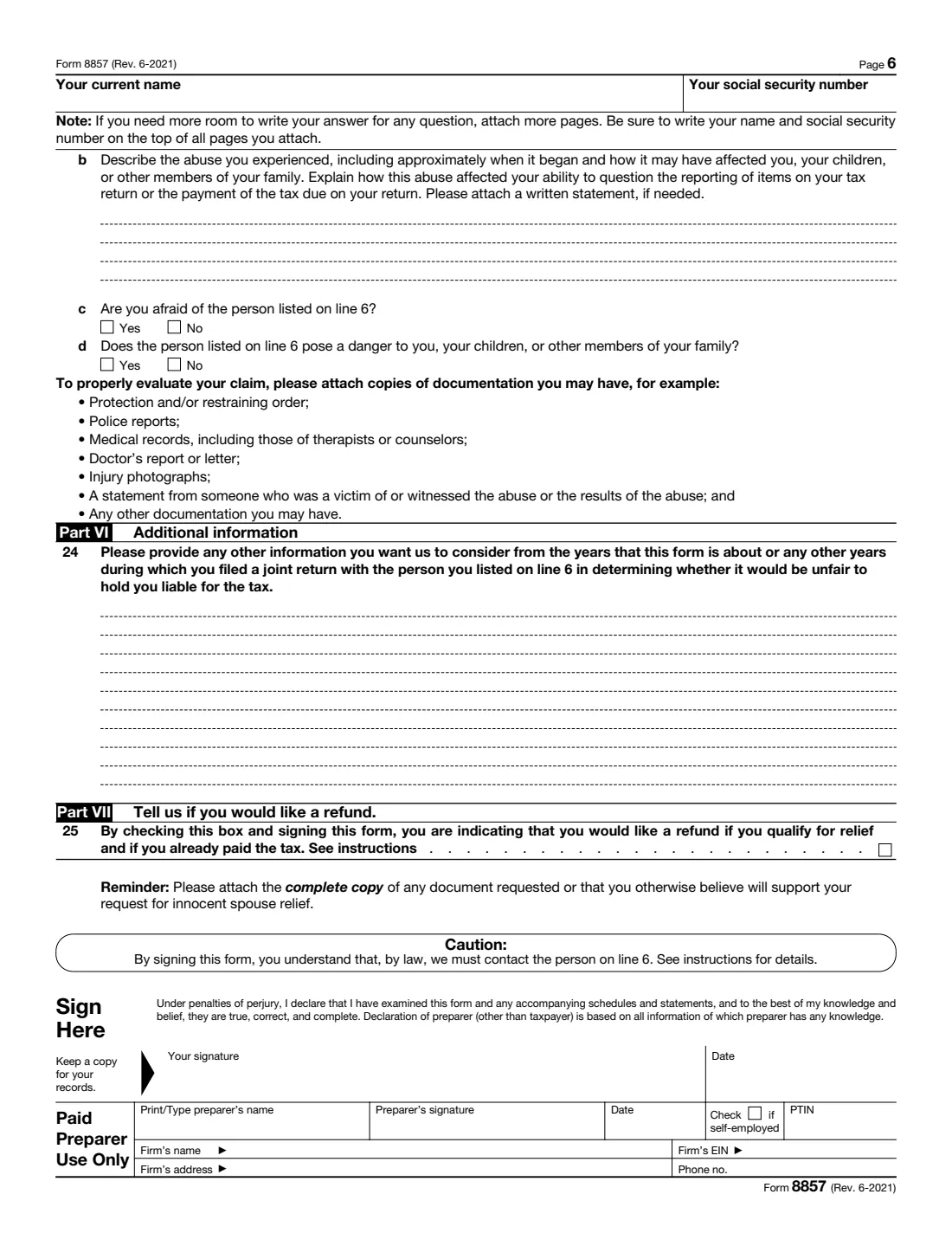
The six-page form asks about your situation and the tax years, the person you filed with, your education and health, how involved you were in preparing the returns and running the household finances, what you knew about their income, any large purchases or transfers, your current assets, income and expenses, and, if it applies, abuse or domestic violence. The IRS must tell the other person you've asked for relief, though it won't reveal your current name, address, phone numbers or employer.
FileIt takes you through each question in plain steps, adds up your monthly income and expenses, warns you when an answer won't fit on the form, prints everything into the IRS's own PDF and keeps it in your vault. You sign it and mail or fax it to the IRS yourself — FileIt never sends anything to the IRS.
- Who fills it
- A person who filed a joint return (or has community income in a community property state) and wants relief from the other spouse's tax.
- Sent to
- IRS, P.O. Box 120053, Covington, KY 41012, or by fax to 855-233-8558 — not with your tax return.
- Deadline
- Generally within 2 years of the IRS's first collection attempt against you; some kinds of relief allow longer.
- Signatures
- You sign and date it; a paid preparer signs too.
- Edition
- Rev. June 2021
- Agency
- Internal Revenue Service (IRS), Department of the Treasury
Who needs to fill out Form 8857?
- Divorced or separated people facing a tax bill from a joint return their former spouse prepared.
- Spouses who learned after filing that the other spouse hid income or claimed improper deductions or credits.
- People whose spouse promised to pay the balance due on a joint return and didn't.
- Survivors of domestic abuse or financial control who couldn't question what was on the return.
- Residents of community property states who filed separately and want relief from tax on community income.
When to use Form 8857
- As soon as you learn about a liability you believe only your spouse or former spouse should owe, such as an examination or an IRS notice.
- Within the deadline: generally no later than 2 years after the IRS first tries to collect the tax from you, so don't wait for every document.
- Not when the IRS only kept your share of a joint refund for your spouse's separate debt, such as past-due child support: that's Form 8379, Injured Spouse Allocation.
- Not attached to your tax return: it's mailed or faxed on its own.
What you need before you start
- The tax years you want relief for, and copies of the returns if you have them.
- Your current name and any former name on the returns, SSN, address and a safe daytime phone number.
- The other person's name, SSN if known, and last known address.
- Dates and documents for your marital status: the divorce decree, separation agreement, or death certificate and will.
- What you knew about their income, the returns and the household money, and any large purchases or asset transfers.
- Your current assets and your household's monthly income and expenses.
- Any documents that support your request, such as bank statements, and for abuse, protective orders, police or medical records.
What’s on Form 8857
The 2021 edition has 6 pages. FileIt asks for it in 8 parts, and it is signed by You (the requesting spouse) and Paid preparer:
- Part I: Should you file this form?You (the requesting spouse)
- Part II: About you (lines 4–5)You (the requesting spouse)
- Part II: The person you filed with (line 6) and your situationYou (the requesting spouse)
- Part III: Your involvement with finances and the returnsYou (the requesting spouse)
- Part IV: Your current financial situationYou (the requesting spouse)
- Part V: Domestic violence or abuse (not mandatory)You (the requesting spouse)
- Parts VI and VII: Anything else, and a refundYou (the requesting spouse)
- Paid preparerPaid preparer
How to fill out Form 8857, step by step
1 Part I: Should you file?
Line 1 asks whether a joint return or community income describes your situation; if not, the form says not to file. Line 2 points you to Form 8379 if the IRS took your share of a joint refund for your spouse's separate debt. Line 3 lists the tax years — the year of the liability, not the year a refund was taken.
2 Part II: You and the other person
Your preferred language, current name (with any former name in parentheses), SSN or ITIN, contact address and phone. Then the other person's details, your current marital status with its date, your education and any health problems, then whether there's anything you're afraid to put in writing.
3 Part III: Your involvement
Whether you meant to file jointly, how involved you were in preparing the returns, what you knew about the other person's income and anything missing or wrong on the returns, how you expected a balance due to be paid, any financial problems, your role in household finances, and any large purchases or asset transfers. FileIt shows how much room each answer has.
4 Part IV: Your finances now
Your assets with their value and any loans, how many people you support, and your household's average monthly income and expenses. FileIt totals both.
5 Part V: Abuse (optional)
Only if you or your family were victims of abuse or domestic violence by the other person. The IRS adds a code to your account unless you ask it not to.
6 Parts VI and VII: More information and a refund
Add anything else the IRS should weigh, and tick line 25 if you want a refund of tax you've already paid, should you qualify.
7 Sign
Sign and date the form; the IRS returns an unsigned request. A paid preparer signs and adds their PTIN.
Common mistakes to avoid
- Filing Form 8857 with your tax return or with the Tax Court instead of sending it to the IRS address or fax number.
- Entering the year a refund was taken instead of the year of the joint liability on line 3.
- Waiting too long: the general deadline is 2 years from the IRS's first collection attempt against you.
- Leaving out documents the form asks for, such as the full divorce decree or separation agreement.
- Giving short answers in Part III. If you later go to the Tax Court, it may only consider what you gave the IRS.
- Forgetting to tick line 25 when you want a refund of payments you made.
- Not signing or dating the form.
After you fill it out
Print the PDF, sign and date it, and attach every document that supports your request, with your name and SSN on each page. Mail it to Internal Revenue Service, P.O. Box 120053, Covington, KY 41012 (a private delivery service uses 7940 Kentucky Drive, Stop 840F, Florence, KY 41042), or fax it with the attachments to 855-233-8558.
The IRS must contact the person on line 6 and give them a chance to take part. If you've received a notice of deficiency, the instructions say to also petition the Tax Court within its 90-day period and raise innocent spouse relief there.
FileIt keeps the request in your vault folder. Store the decree, statements and any IRS letters beside it, and note the date you sent it.
Fill out Form 8857 online with FileIt
- Pick the person. Choose someone from People and FileIt fills in their name, date of birth, address and other details it already knows.
- Answer plain-language questions. One part of the form at a time, with the official help text beside each question — 144 fields in all. Your answers save as you go.
- Check the live preview. Watch your answers land on the real Internal Revenue Service (IRS) form, and let FileIt do any worksheet arithmetic.
- Generate the official PDF. FileIt prints your answers into the agency’s own PDF and files it in that person’s folder in your vault. Sign it, or send it for e-signature.
FileIt fills the form — it never files or submits anything for you. Deliver the finished form to whoever asked for it, the way the form’s instructions say.
Start Form 8857 now — it’s freeForm 8857: frequently asked questions
What types of relief does Form 8857 cover?
One form requests all three: innocent spouse relief, separation of liability relief and equitable relief. The IRS decides which, if any, applies. Pub. 971 explains the conditions for each.
Will my former spouse find out?
Yes. The law requires the IRS to tell the person on line 6 and let them take part. The IRS says it won't give them your current name, address, phone numbers or employer.
How long do I have to file?
Generally no later than 2 years after the IRS's first attempt to collect the tax from you, such as applying your refund to the joint debt. The instructions describe longer deadlines for some kinds of relief.
Is this the same as injured spouse relief?
No. Injured spouse relief (Form 8379) gets back your share of a joint refund the IRS used for your spouse's separate past-due debt. Innocent spouse relief concerns tax on the joint return itself.
Can I get a refund if I already paid?
Possibly, under innocent spouse or equitable relief, but not separation of liability relief. You must tick line 25 and show you paid with your own money.
Can I fill out Form 8857 online?
With FileIt you answer guided questions and the answers are printed into the official IRS PDF, which you then sign and mail or fax to the IRS.
Official sources
- Blank form (PDF), published by Internal Revenue Service (IRS): https://www.irs.gov/pub/irs-pdf/f8857.pdf
- Official instructions and guidance: https://www.irs.gov/forms-pubs/about-form-8857
- Edition shown on this page: Rev. June 2021 (checked 2026-10-19).
FileIt is not affiliated with or endorsed by Internal Revenue Service (IRS) or any government. This page explains the form in general terms and is not legal, tax or immigration advice. Always read the official instructions, and check that you are using the edition the recipient accepts. Page last reviewed 2026-10-19.