
What is Form 433-D?
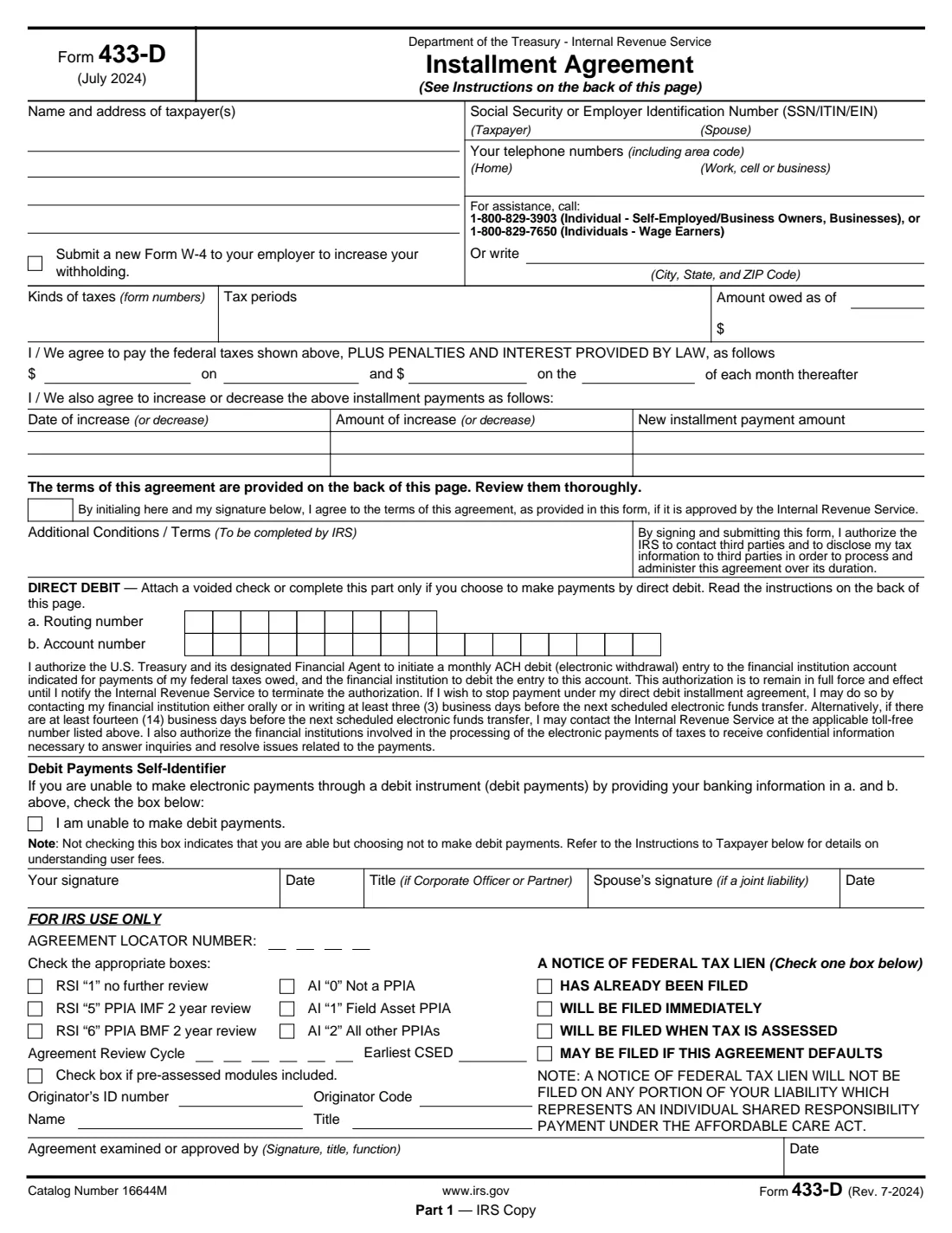
Form 433-D, Installment Agreement, is the IRS's written payment plan. It usually arrives with a letter after you've agreed a monthly amount with an IRS employee, sometimes partly filled in already. You complete the rest — your name and address, your SSN or EIN, phone numbers, the taxes and periods owed, the amount and day you'll pay each month, and optionally your bank details for direct debit — then initial the terms, sign and send back Part 1.
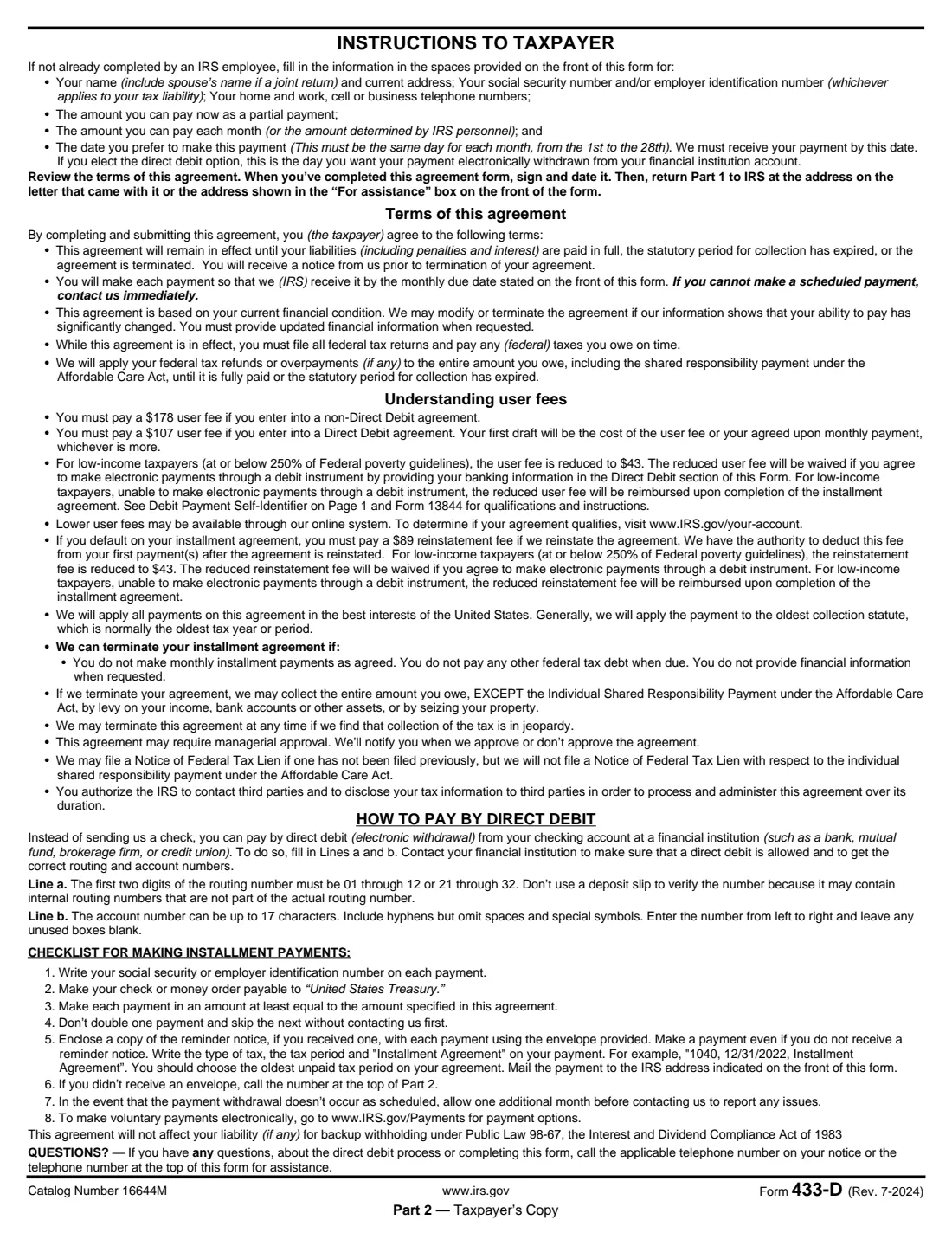
The agreement lasts until the debt is paid, the collection period ends or the IRS ends it. While it's in place you must file and pay future returns on time, your refunds go toward the balance, and missing a payment can put the agreement in default. The form also explains the user fees: in the July 2024 revision, $178 without direct debit, $107 with it, and $43 for low-income taxpayers.
FileIt walks you through what the IRS left blank, checks the payment day and amounts, prints your answers on both the IRS copy and your own copy of the official PDF, and keeps it in your vault. You return Part 1 to the IRS yourself — FileIt never submits anything to the IRS.
- Who fills it
- An individual or business that has agreed a monthly payment plan with the IRS (both spouses for a joint debt).
- Sent to
- The IRS address on the letter that came with it, or the one in the form's "For assistance" box.
- Payment day
- The same day each month, from the 1st to the 28th.
- Signatures
- You sign and initial; your spouse signs too for a joint liability.
- Edition
- Rev. July 2024
- Agency
- Internal Revenue Service (IRS), Department of the Treasury
Who needs to fill out Form 433-D?
- People who agreed a payment plan with an IRS collection employee by phone or in person and were sent Form 433-D to sign.
- Married couples paying off a balance from a joint return.
- Businesses and sole proprietors paying employment or other business taxes in instalments.
- Anyone switching an existing plan to direct debit or changing its terms, when the IRS asks for a new agreement.
When to use Form 433-D
- After the IRS has agreed a plan with you and sent the form, often with some lines already completed.
- When you want to set up direct debit for the payments, which also lowers the user fee.
- Not to request a plan from scratch: Form 9465 or the IRS's Online Payment Agreement is the usual starting point.
- Not instead of a financial statement: if the IRS asks about your finances first, that's Form 433-F or 433-A.
What you need before you start
- The IRS letter or notice with the kinds of tax, tax periods and amount owed.
- Your name and address, and your SSN, ITIN or EIN (and your spouse's SSN for a joint debt).
- The first payment you can make, the monthly amount and the day of the month you'll pay.
- For direct debit: your checking account's routing and account numbers from a check or your bank, or a voided check.
- Your phone numbers, and your title if you sign as a corporate officer or partner.
What’s on Form 433-D
The 2024 edition has 4 pages. FileIt asks for it in 7 parts, and it is signed by Taxpayer and Spouse (joint liability):
- Name, address and numbersTaxpayer
- Spouse (joint liability)Spouse (joint liability)
- What you oweTaxpayer
- How you'll payTaxpayer
- Planned increases or decreasesTaxpayer
- Direct debitTaxpayer
- Low-income fee and signingTaxpayer
How to fill out Form 433-D, step by step
1 Top: Who you are
Your name (both names for a joint return), current address, SSN or EIN and phone numbers. Leave "Or write" to the IRS: it's the office you correspond with.
2 What you owe
Copy the kinds of tax (form numbers, such as 1040 or 941), the tax periods, and the amount owed with its as-of date from your IRS letter.
3 The payment terms
Enter the first payment and its date, then the monthly amount and the day of the month. FileIt checks the day is between the 1st and the 28th and that no payment is larger than the debt.
4 Planned changes
If you've agreed to raise or lower the payment later, enter the date, the change and the new payment on up to two rows.
5 Initials and terms
Read the terms on the back, then initial the box. Leave Additional Conditions blank: the IRS fills that in.
6 Direct debit and the low-income box
For direct debit, enter the 9-digit routing number (starting 01–12 or 21–32, not from a deposit slip) and an account number of up to 17 characters. If you can't pay electronically at all, tick "I am unable to make debit payments" instead — that matters for the low-income fee reimbursement.
7 Sign
Sign and date the form, adding your title if you're signing for a corporation or partnership. For a joint liability your spouse signs too. Everything under For IRS Use Only stays blank.
Common mistakes to avoid
- Choosing a payment day after the 28th.
- Taking the routing number from a deposit slip, which can carry internal numbers.
- Forgetting to initial the terms box, or a spouse not signing a joint agreement.
- Ticking "unable to make debit payments" while also giving bank details.
- Filling in the For IRS Use Only area or Additional Conditions.
- Doubling one payment and skipping the next without contacting the IRS first.
- Missing a tax return or payment while the agreement is in place, which can end it.
After you fill it out
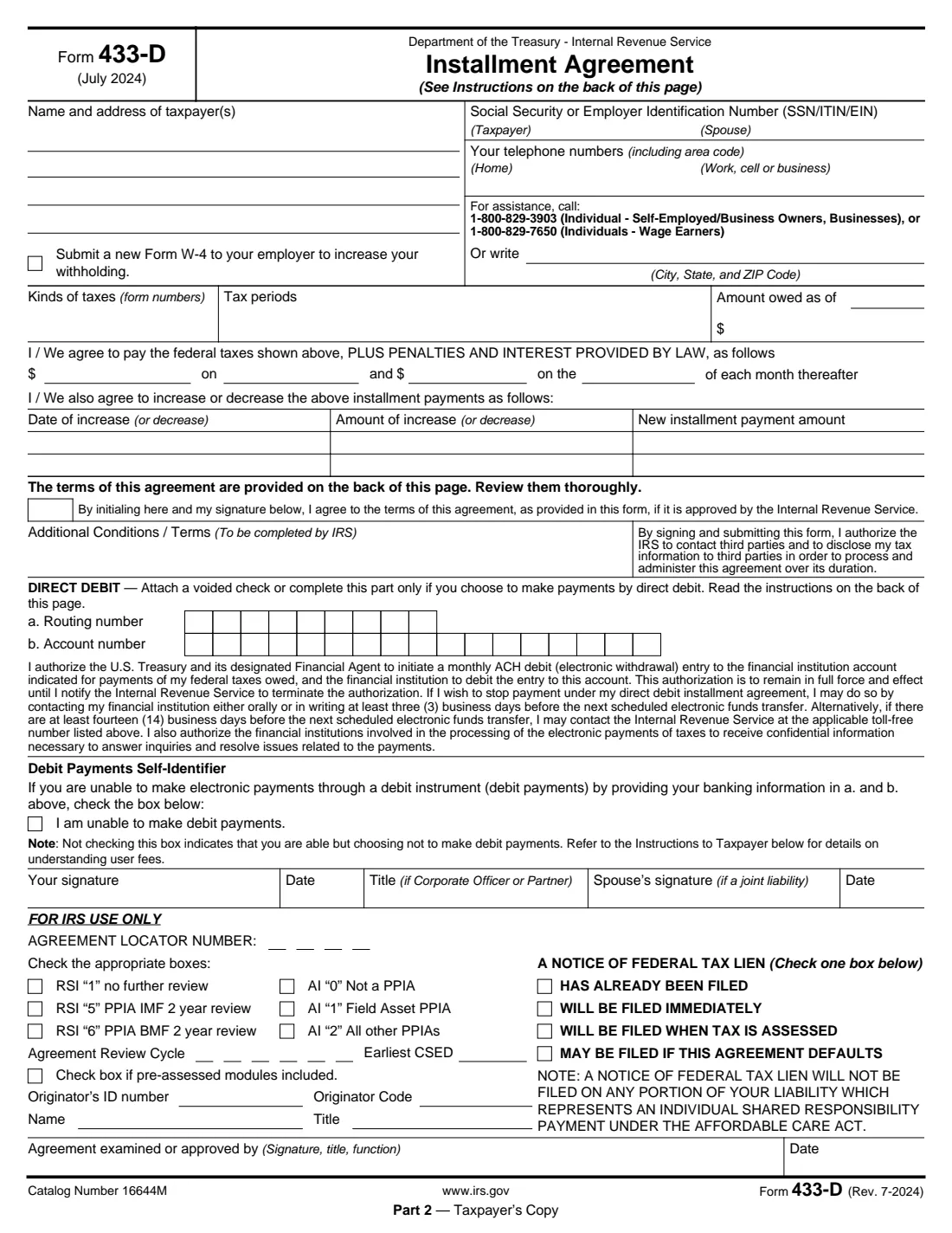
Print the PDF, sign and date it (both spouses for a joint debt) and return Part 1 to the IRS address on the letter that came with it, or the one in the "For assistance" box. Keep Part 2, the taxpayer's copy.
The IRS notifies you once the agreement is approved; some need managerial approval. If you aren't on direct debit, write your SSN or EIN, the type of tax, the period and "Installment Agreement" on each check or money order payable to "United States Treasury".
FileIt keeps the completed agreement in your vault. Set a monthly reminder for your payment day, and file the IRS approval letter beside the agreement.
Fill out Form 433-D online with FileIt
- Pick the person. Choose someone from People and FileIt fills in their name, date of birth, address and other details it already knows.
- Answer plain-language questions. One part of the form at a time, with the official help text beside each question — 29 fields in all. Your answers save as you go.
- Check the live preview. Watch your answers land on the real Internal Revenue Service (IRS) form, and let FileIt do any worksheet arithmetic.
- Generate the official PDF. FileIt prints your answers into the agency’s own PDF and files it in that person’s folder in your vault. Sign it, or send it for e-signature.
FileIt fills the form — it never files or submits anything for you. Deliver the finished form to whoever asked for it, the way the form’s instructions say.
Start Form 433-D now — it’s freeForm 433-D: frequently asked questions
What's the difference between Form 433-D and Form 9465?
Form 9465 asks the IRS for a payment plan. Form 433-D is the agreement itself, usually sent to you by the IRS once a plan has been worked out, for you to complete, sign and return.
What are the user fees?
The July 2024 form lists $178 for an agreement without direct debit, $107 with direct debit and $43 for low-income taxpayers (waived with direct debit, or reimbursed at the end if you can't pay electronically). Lower fees may be available online. Check your IRS letter for the current amounts.
Which day can I pay?
Any day from the 1st to the 28th, the same day every month. The IRS must receive the payment by that date, or with direct debit that's the day it's withdrawn.
Do interest and penalties stop?
No. You agree to pay the taxes plus penalties and interest provided by law, so they keep running until the balance is paid.
Can the IRS still file a tax lien?
Yes. The terms say the IRS may file a Notice of Federal Tax Lien if one hasn't been filed already, except for an Affordable Care Act shared responsibility payment.
Can I fill out Form 433-D online?
With FileIt you answer guided questions, and the answers are printed on both copies of the official IRS PDF. You then sign it and return Part 1 to the IRS yourself.
Official sources
- Blank form (PDF), published by Internal Revenue Service (IRS): https://www.irs.gov/pub/irs-pdf/f433d.pdf
- Official instructions and guidance: https://www.irs.gov/forms-pubs/about-form-433-d
- Edition shown on this page: Rev. July 2024 (checked 2026-10-19).
FileIt is not affiliated with or endorsed by Internal Revenue Service (IRS) or any government. This page explains the form in general terms and is not legal, tax or immigration advice. Always read the official instructions, and check that you are using the edition the recipient accepts. Page last reviewed 2026-10-19.