What is Form 9465?
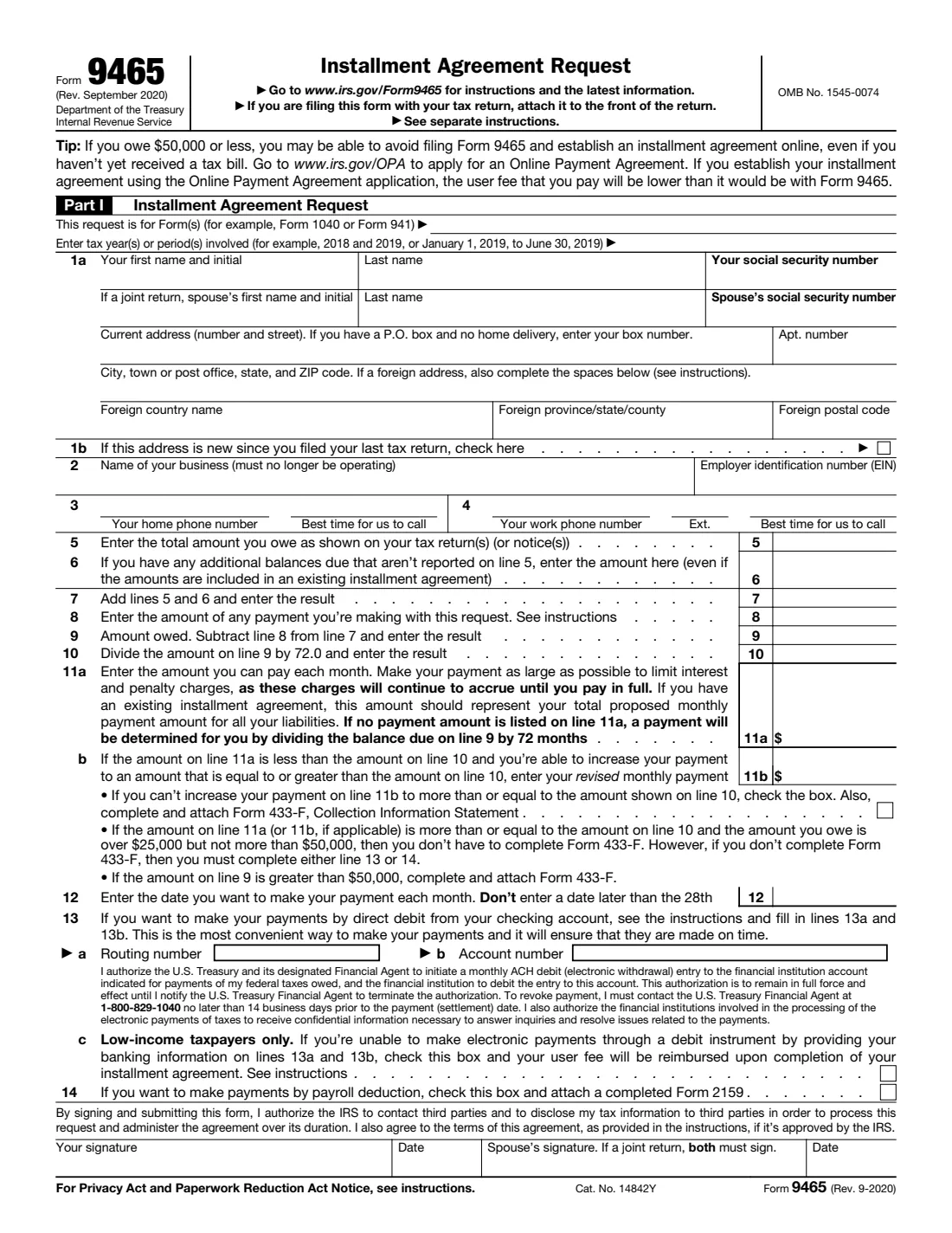
Form 9465, Installment Agreement Request, asks the Internal Revenue Service for a monthly payment plan for tax you owe on a return or a notice. Individuals use it for income tax on Form 1040 or 1040-SR, for a trust fund recovery penalty, for employment taxes from a sole proprietorship that has closed, or for an old Affordable Care Act shared responsibility payment. The current form is Rev. September 2020; its separate instructions were last revised in July 2024.
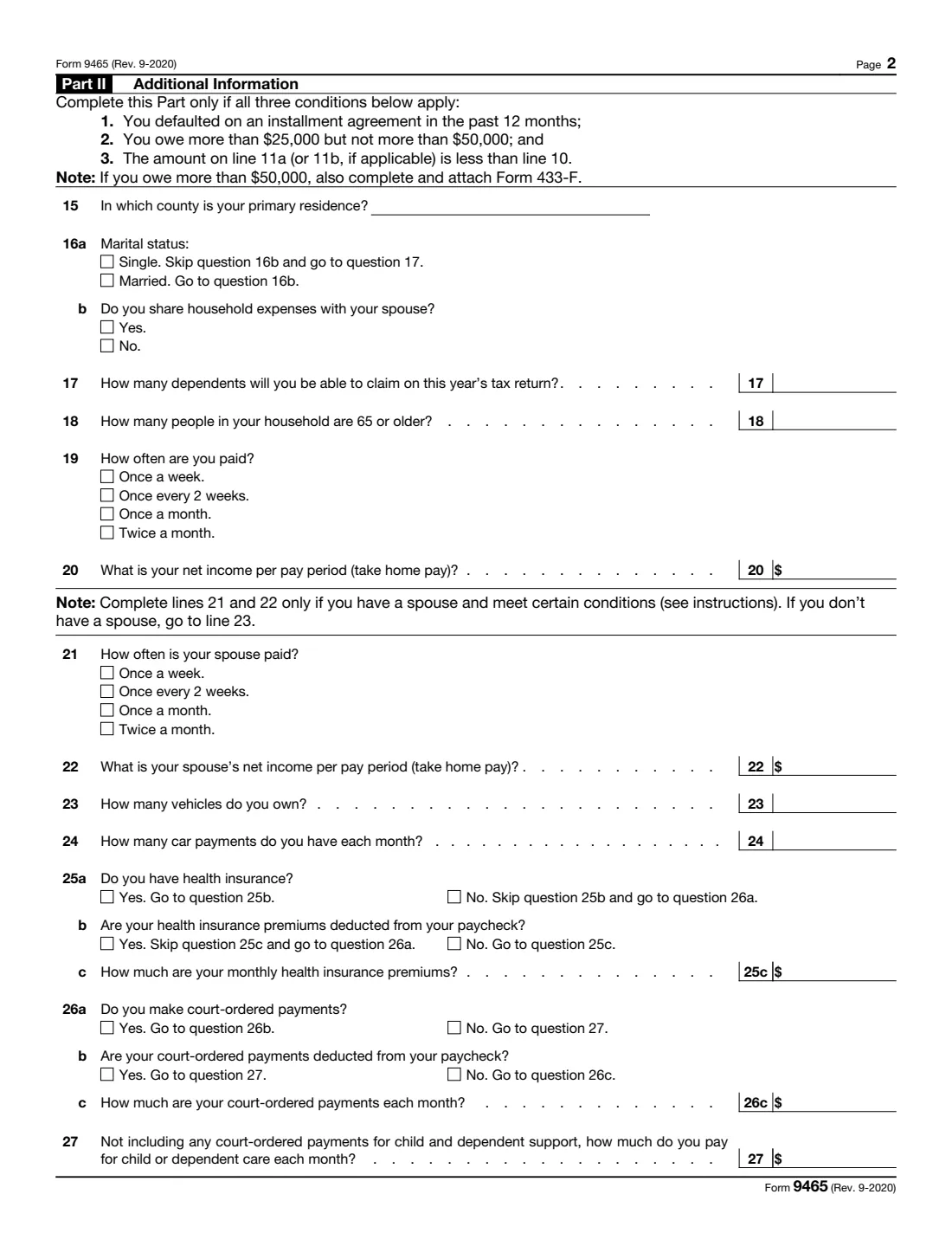
You tell the IRS how much you owe, how much you're paying now, how much you can pay each month and on which day, and how you'll pay — by direct debit from a checking account, by payroll deduction with Form 2159, or by another method. If you defaulted on an agreement in the past year and owe between $25,000 and $50,000, page 2 asks about your household, pay and regular expenses.
The form itself points out that if you owe $50,000 or less you may be able to skip it and apply online at www.irs.gov/OPA, where the user fee is lower. FileIt walks you through each line, works out lines 7, 9 and 10 for you, and prints your answers into the IRS's own PDF, saved in your vault. You then attach it to the front of your return, or mail it on its own — FileIt never submits anything to the IRS.
- Who fills it
- An individual who owes federal tax and can't pay it in full, with their spouse for a joint return.
- Sent to
- Attached to the front of your return, or on its own to the IRS service center for your state listed in the instructions.
- When
- When you file a return you can't pay in full, or when you get a notice with a balance due.
- Signatures
- You sign; for a joint return both spouses must sign.
- Edition
- Rev. September 2020 (instructions Rev. July 2024)
- Agency
- Internal Revenue Service (IRS), Department of the Treasury
Who needs to fill out Form 9465?
- People who owe income tax on a Form 1040 or 1040-SR and can't pay the full balance now.
- People who received an IRS notice showing a balance they can't pay in one go.
- Former sole proprietors who owe employment taxes from a business that is no longer operating.
- People who are, or may be, responsible for a trust fund recovery penalty.
- People who prefer a paper request to the Online Payment Agreement, or who owe more than the online limit.
When to use Form 9465
- When you file a return and can't pay what's due — attach Form 9465 to the front of the return.
- When you get a bill or notice you can't pay in full — send the form on its own to the address in the instructions.
- Not when you can pay in full within 180 days: the instructions say to call the IRS instead and avoid the user fee.
- Not when you're in bankruptcy or have an offer in compromise pending — call the IRS instead.
- Not when your business is still operating and owes employment or unemployment taxes — call the number on your notice.
What you need before you start
- The tax return or notice showing what you owe, and the tax years involved.
- Your name, social security number and address (and your spouse's name and SSN for a joint return).
- Any other balances you owe that aren't on that return or notice.
- How much you can pay now and each month, and the day of the month (1st to 28th) you want to pay.
- For direct debit: your checking account's routing number and account number, from a check or your bank.
- For payroll deduction: a completed Form 2159, signed by you and your employer.
- If you owe more than $50,000, or can't pay the line 10 amount: a completed Form 433-F, Collection Information Statement.
What’s on Form 9465
The 2020 edition has 2 pages. FileIt asks for it in 8 parts, and it is signed by Taxpayer and Spouse (joint return):
- What the request is forTaxpayer
- Line 1a: You (and your spouse, for a joint return)Taxpayer
- Line 1a–1b: Current addressTaxpayer
- Line 2: Closed business (only if the tax is from a business)Taxpayer
- Lines 3–4: Phone numbersTaxpayer
- Lines 5–12: What you owe and what you can payTaxpayer
- Lines 13–14: How you'll payTaxpayer
- Part II: Additional informationTaxpayer
How to fill out Form 9465, step by step
1 Top of the form: forms and years
Enter the tax form the request is for (for example Form 1040 or Form 941) and the tax years or periods involved, such as "2024 and 2025".
2 Line 1a–1b: Name, SSN and address
For a joint return, enter both names and SSNs in the same order as on the return. If you have a P.O. box and no home delivery, enter the box number. For a foreign address, enter only the city on the city line and complete the country, province and postal code boxes; don't abbreviate the country name. Check line 1b if the address is new since your last return.
3 Line 2: A business that has closed
Only if the tax comes from a business that is no longer operating: its name and employer identification number (EIN).
4 Lines 3–4: Phone numbers
Your home and work numbers and the best times to call.
5 Lines 5–10: What you owe
Line 5 is the total on your return(s) or notice(s). Line 6 adds any other balances not on line 5, even if they're already in an existing agreement. Line 7 adds them, line 8 is any payment you send with the request, and line 9 is what's left. Line 10 divides line 9 by 72 — roughly the monthly payment that clears the balance in six years. FileIt calculates lines 7, 9 and 10.
6 Lines 11a–11b: Your monthly payment
Enter the most you can pay each month; interest and penalties keep accruing until the balance is paid. If 11a is below line 10 and you can raise it to at least line 10, enter the revised amount on 11b. If you can't, check the box below 11b and attach Form 433-F. If line 9 is over $50,000, Form 433-F is required anyway. If 11a is blank, the IRS divides line 9 by 72 months to set your payment.
7 Line 12: Payment day
Choose a day from the 1st to the 28th. The IRS tells you when your first payment is due when it approves the request.
8 Lines 13–14: How you'll pay
For direct debit, give the 9-digit routing number and your checking account number (up to 17 characters, no check number). Low-income taxpayers who can't pay electronically check 13c so their user fee is reimbursed when the agreement is completed. For payroll deduction, check 14 and attach Form 2159. If you owe more than $25,000 but not more than $50,000 and don't attach Form 433-F, you must use line 13 or 14.
9 Part II (page 2)
Only if all three apply: you defaulted on an installment agreement in the past 12 months, you owe more than $25,000 but not more than $50,000, and line 11a (or 11b) is less than line 10. It asks for your county, marital status, dependents, pay and your spouse's pay where relevant, vehicles and car payments, health insurance, court-ordered payments and child care costs.
10 Signature
Sign and date the form; for a joint return both spouses must sign. A direct debit request isn't approved without both signatures on a joint request.
Common mistakes to avoid
- Filing Form 9465 when you could set up the plan online for a lower fee — check www.irs.gov/OPA first if you owe $50,000 or less.
- Leaving line 12 blank or entering a day after the 28th.
- Entering a check-number or a savings account on line 13 — direct debit is from a checking account, and the check number isn't part of the account number.
- Proposing less than line 10 without checking the Form 433-F box and attaching the statement.
- Owing over $50,000 and not attaching Form 433-F.
- Only one spouse signing a joint request.
- Forgetting that your refunds are still applied to the balance, and that a missed payment can put the agreement in default.
After you fill it out
Print the PDF and sign it (both spouses for a joint return). If you're filing it with your tax return, attach it to the front of the return. If the return is already filed or you're answering a notice, mail it on its own to the IRS address in the Form 9465 instructions for where you live — the address differs if you file Schedule C, E or F, or live outside the 50 states.
The instructions say the IRS usually tells you within 30 days whether the request is approved (longer for returns filed after March 31). If it's approved you'll get a notice with the terms and the user fee. Keep making payments on time and file and pay future returns, or the agreement can be terminated.
FileIt keeps a copy of the completed form in the person's vault folder. File the IRS approval notice beside it, and set a reminder for your monthly payment day if you're not paying by direct debit.
Fill out Form 9465 online with FileIt
- Pick the person. Choose someone from People and FileIt fills in their name, date of birth, address and other details it already knows.
- Answer plain-language questions. One part of the form at a time, with the official help text beside each question — 61 fields in all. Your answers save as you go.
- Check the live preview. Watch your answers land on the real Internal Revenue Service (IRS) form, and let FileIt do any worksheet arithmetic.
- Generate the official PDF. FileIt prints your answers into the agency’s own PDF and files it in that person’s folder in your vault. Sign it, or send it for e-signature.
FileIt fills the form — it never files or submits anything for you. Deliver the finished form to whoever asked for it, the way the form’s instructions say.
Start Form 9465 now — it’s freeForm 9465: frequently asked questions
Can I fill out Form 9465 online?
Yes — with FileIt you answer guided questions and the answers are printed into the official IRS PDF, with lines 7, 9 and 10 worked out for you. You then sign it and send it to the IRS yourself. Separately, the IRS's own Online Payment Agreement at www.irs.gov/OPA lets many people set up a plan without this form.
How much does an IRS installment agreement cost?
There's a user fee to set up the agreement. The Form 9465 instructions (Rev. July 2024) list fees in effect from July 1, 2024: $107 for direct debit and $178 for other payment methods when you don't use the online application, and $22 and $69 when you do. Low-income taxpayers can have fees reduced, waived or reimbursed. Check the current instructions before you file.
Do I have to use Form 9465 if I owe less than $50,000?
No. The form says that if you owe $50,000 or less you may be able to apply online instead, even before you get a bill, and the user fee is lower online.
What if I can pay within 180 days?
The instructions say not to use Form 9465 — call the IRS at 800-829-1040 and you can avoid the user fee. If you owe $100,000 or less you can also apply online for a short-term payment plan.
Do I still pay interest and penalties on a payment plan?
Yes. Interest and the late-payment penalty continue to accrue until the balance is paid in full, which is why the form asks you to pay as much as possible each month.
When do I need Form 433-F?
If you owe more than $50,000, or if your monthly payment is less than line 10 and you can't increase it. If you owe more than $25,000 but not more than $50,000, you can skip Form 433-F by paying through direct debit or payroll deduction.
How long does the IRS take to respond?
The instructions say the IRS usually lets you know within 30 days after it receives your request, though it may take longer for tax due on a return filed after March 31.
Official sources
- Blank form (PDF), published by Internal Revenue Service (IRS): https://www.irs.gov/pub/irs-pdf/f9465.pdf
- Official instructions and guidance: https://www.irs.gov/forms-pubs/about-form-9465
- Edition shown on this page: Rev. September 2020 (checked 2026-09-28).
FileIt is not affiliated with or endorsed by Internal Revenue Service (IRS) or any government. This page explains the form in general terms and is not legal, tax or immigration advice. Always read the official instructions, and check that you are using the edition the recipient accepts. Page last reviewed 2026-09-28.