What is Form 433-A?
Form 433-A is the full collection information statement for individuals: wage earners and sole proprietors who owe federal tax. A revenue officer usually asks for it to decide how a debt will be resolved — through an installment agreement, by finding the account currently not collectible, or alongside an offer in compromise. It goes much deeper than the two-page Form 433-F.
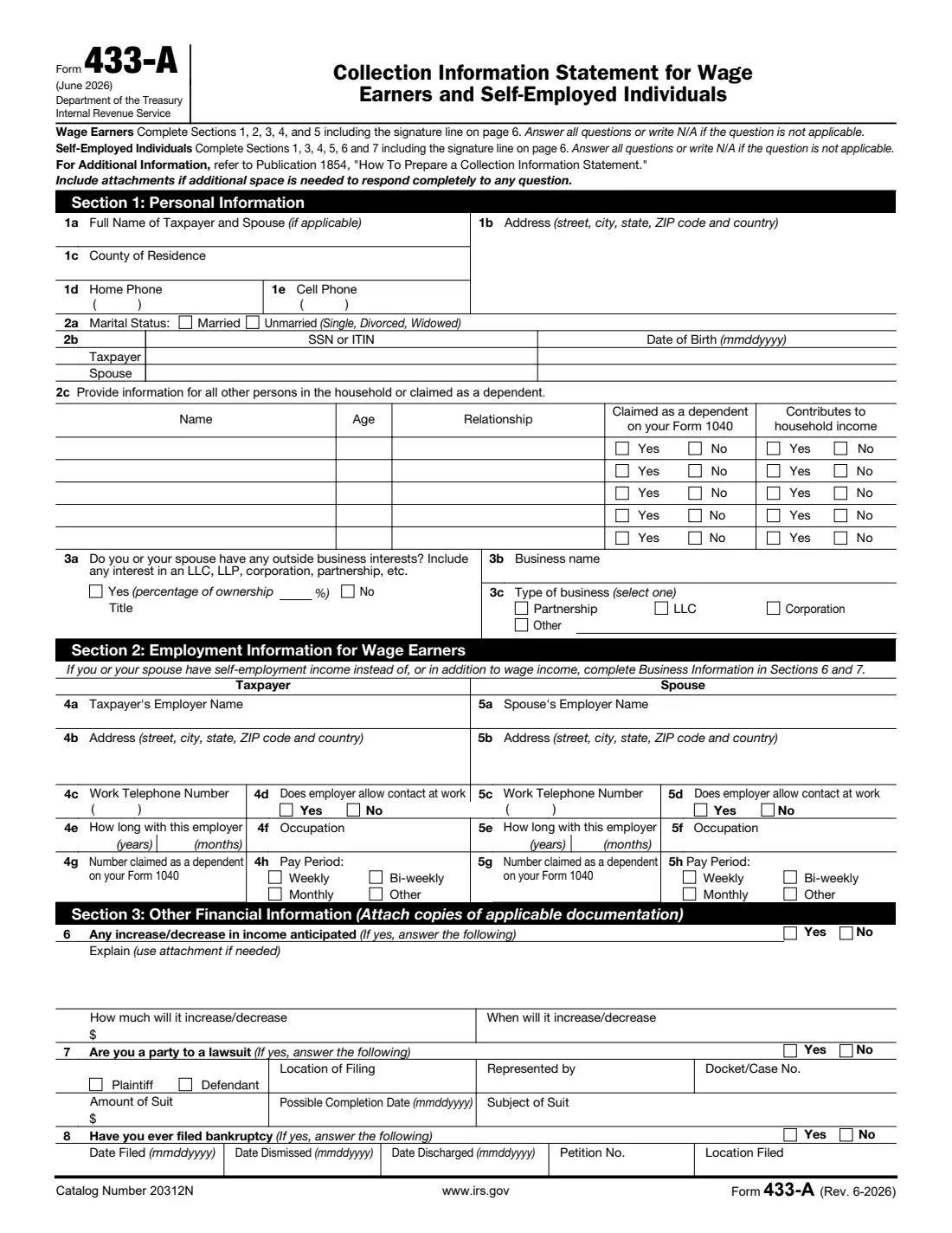
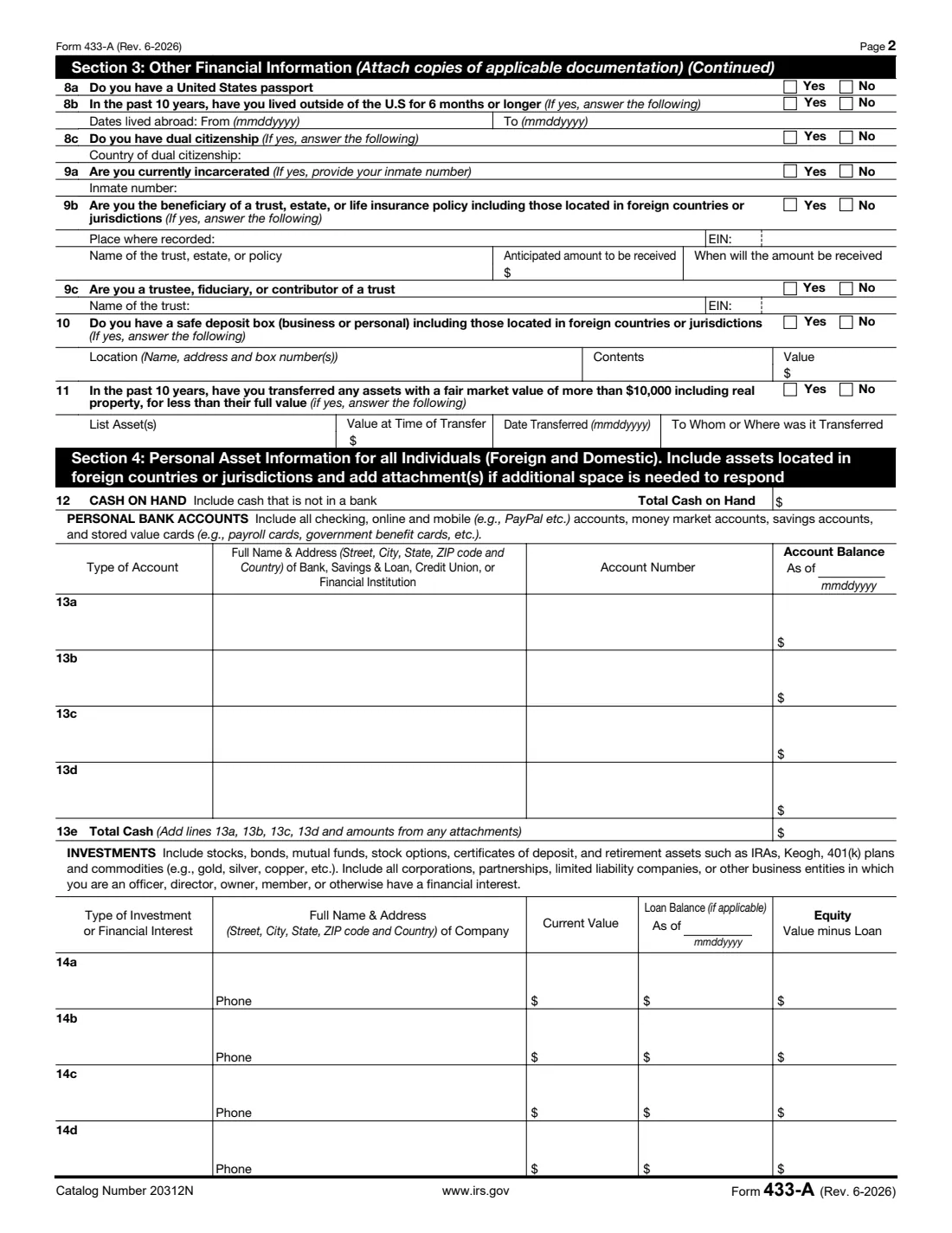
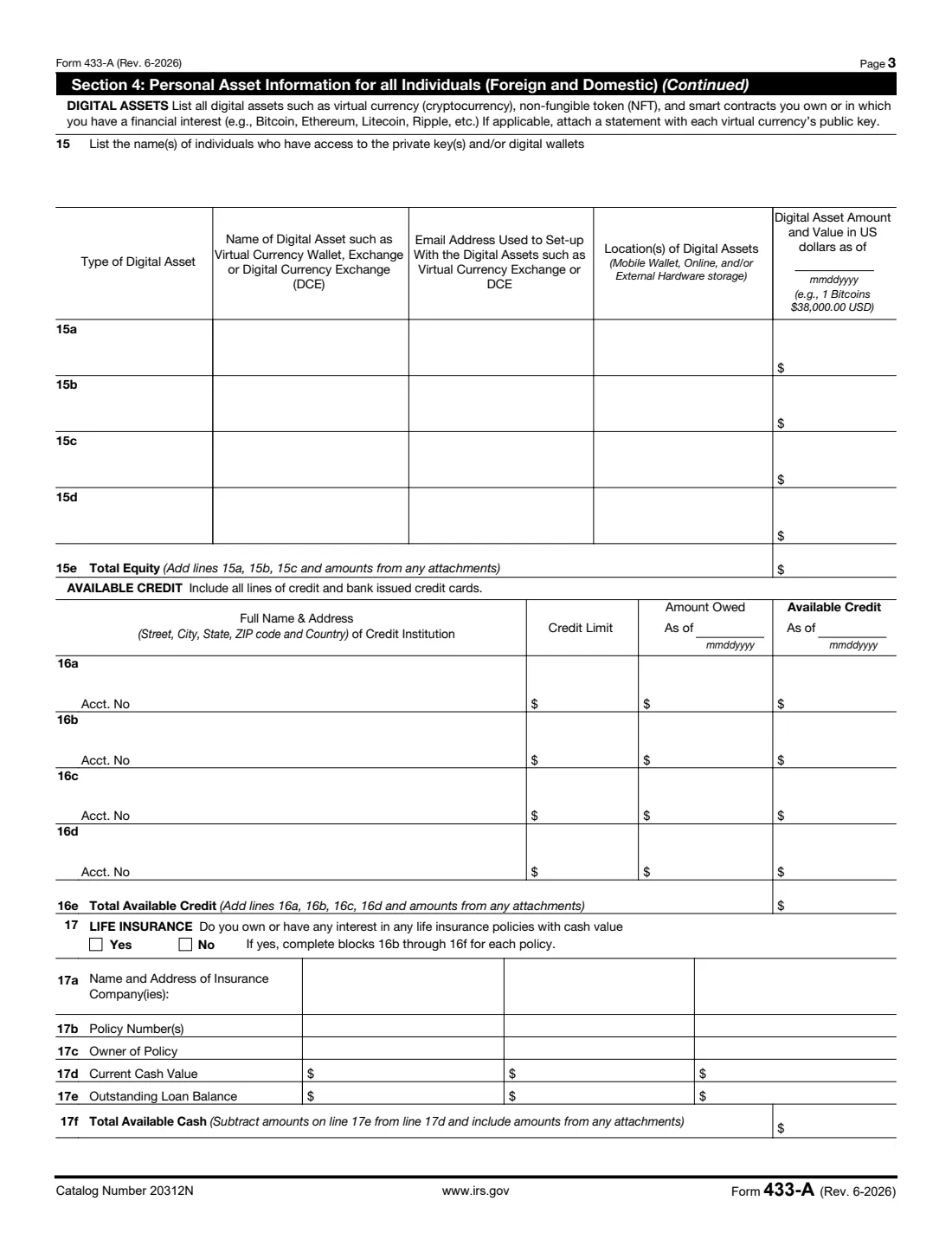
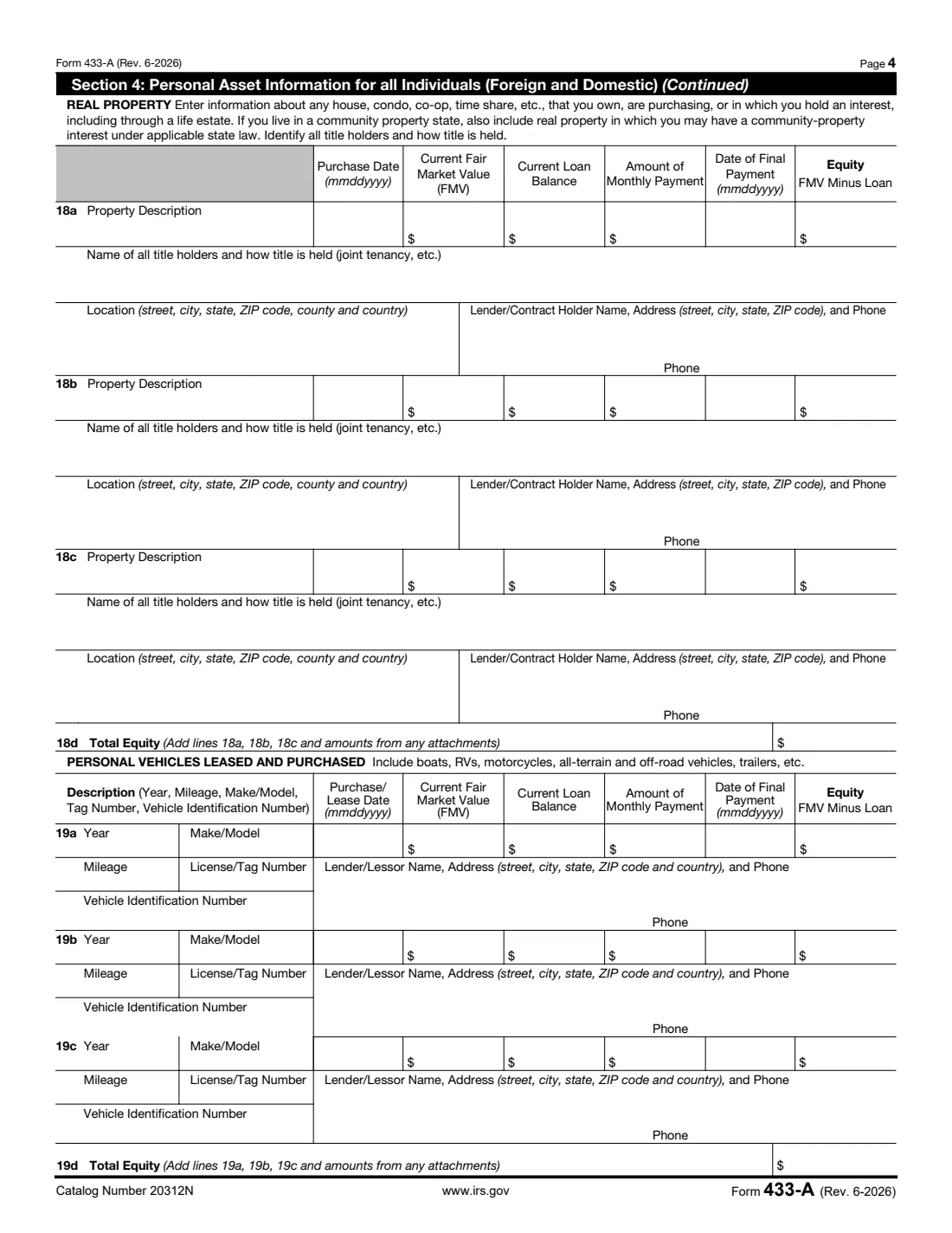
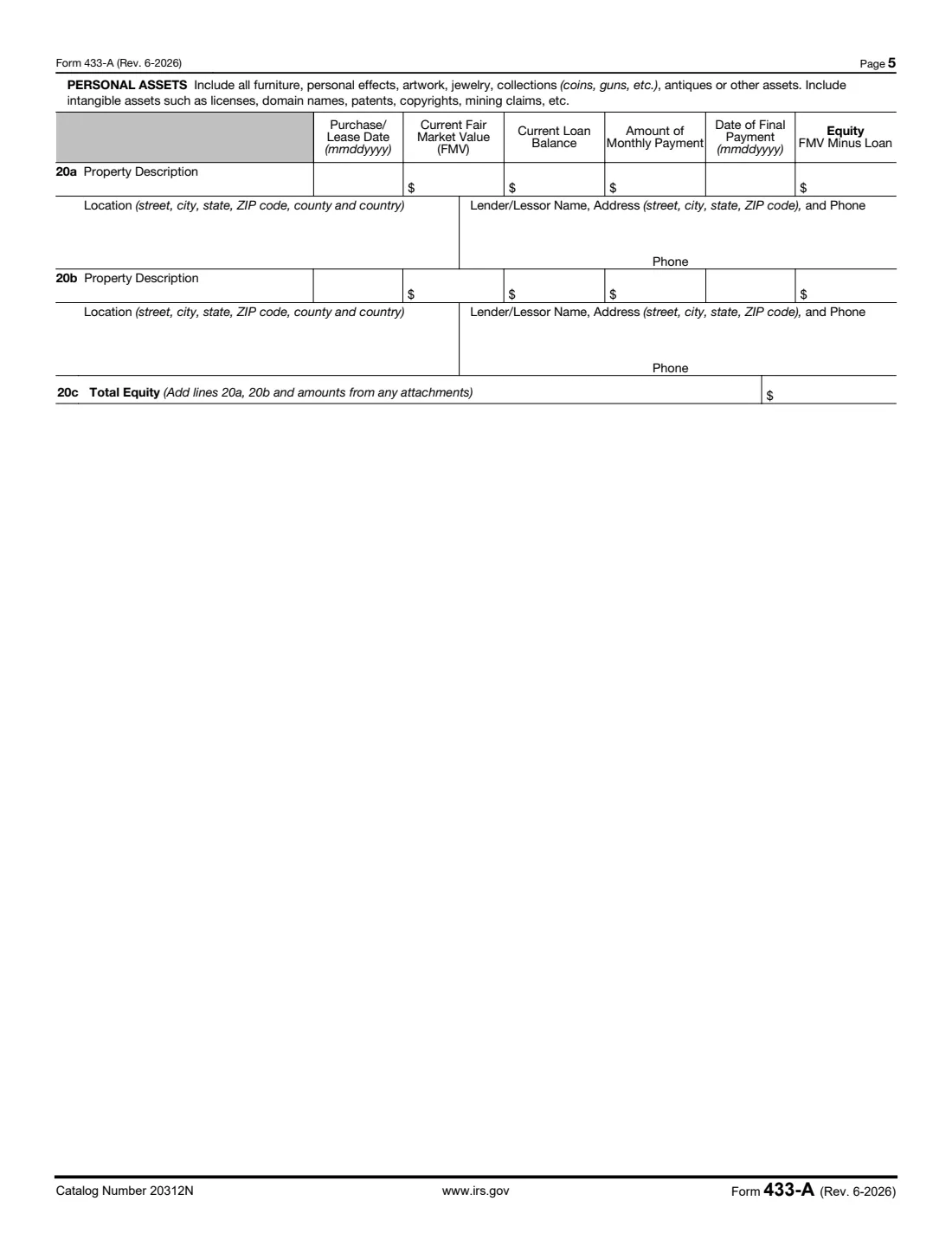
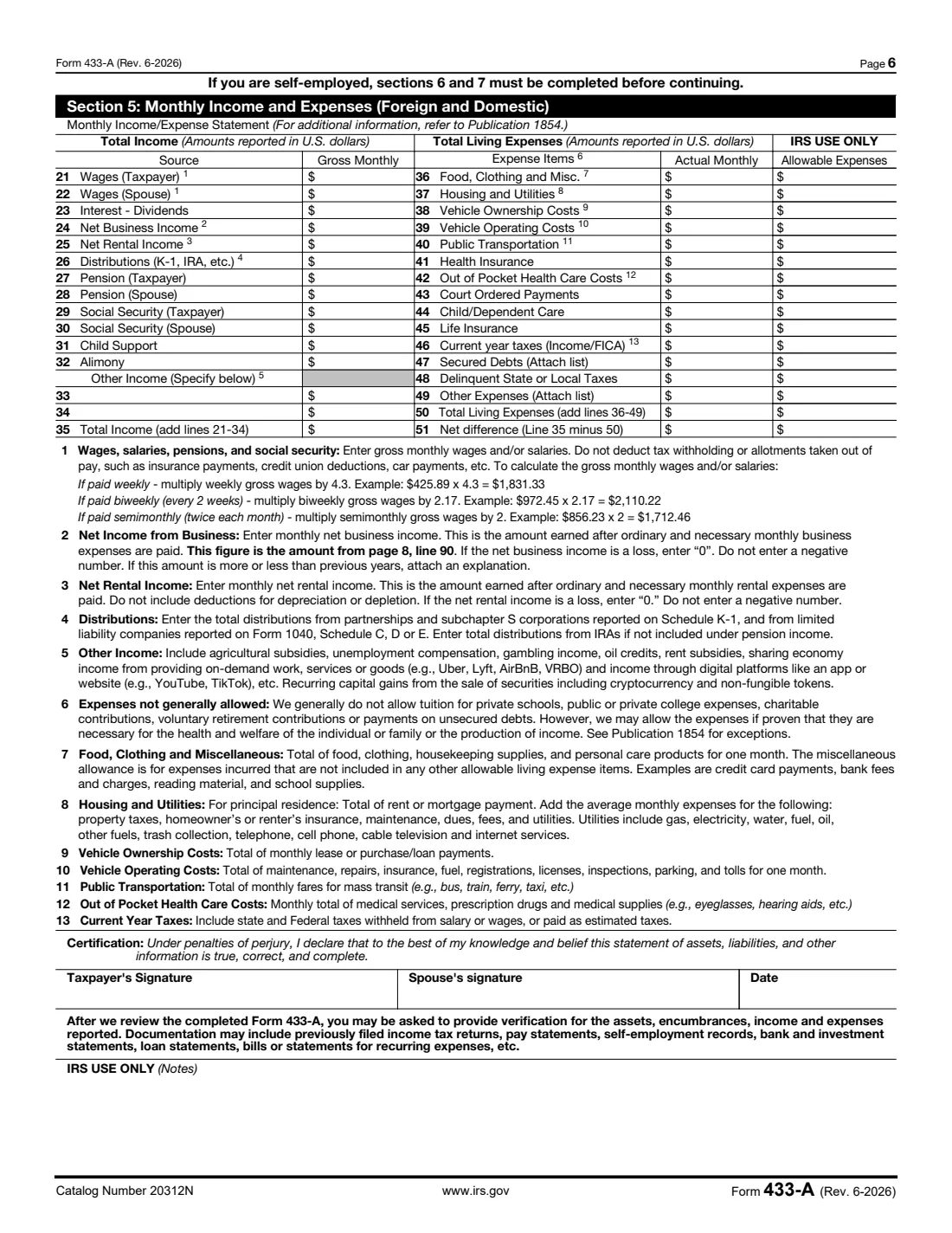
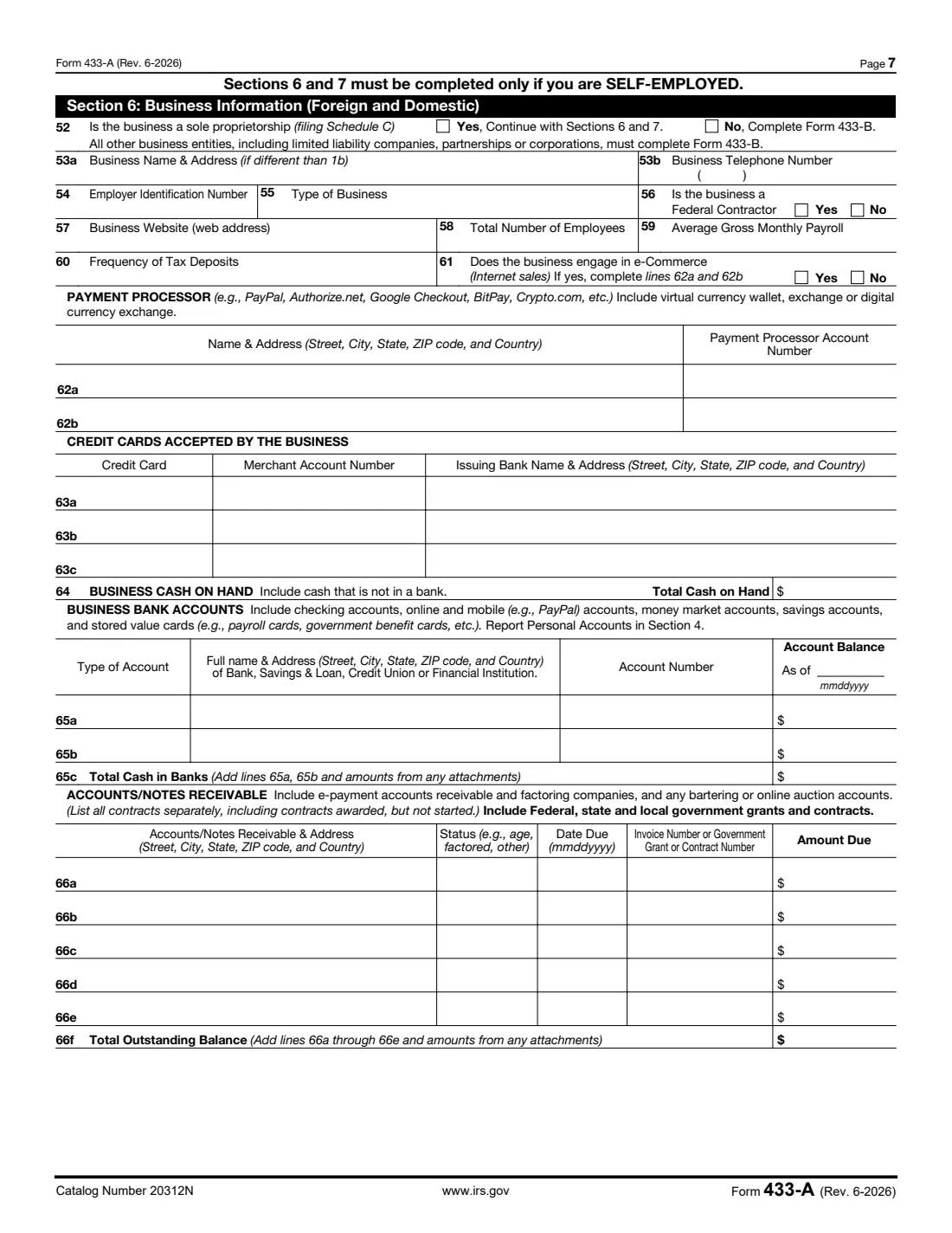
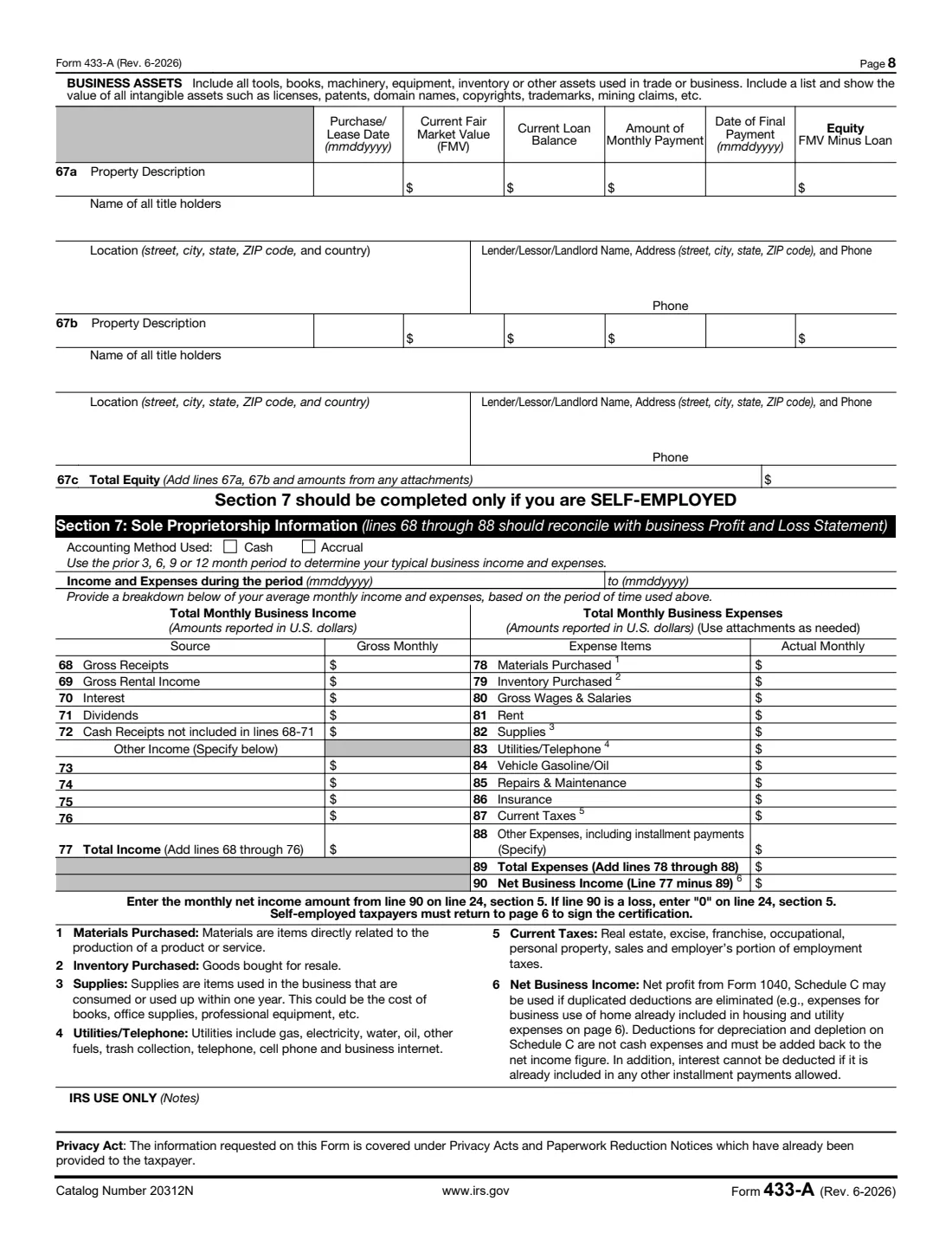
Sections 1 to 3 cover your household, employers, expected changes in income, lawsuits, bankruptcies, passports and time abroad, trusts, safe deposit boxes and large transfers in the past 10 years. Section 4 lists every asset, foreign and domestic: cash, bank accounts, investments, digital assets, credit lines, life insurance with cash value, real property, vehicles and other personal assets. Section 5 is your monthly household income and living expenses. Self-employed people also complete Section 6 (business accounts, payment processors, receivables and assets) and Section 7 (monthly business income and expenses).
FileIt guides you through every section, works out equity, available credit and every total, copies net business income into Section 5, prints your answers into the IRS's own PDF and keeps it in your vault. You sign it and give it to the IRS yourself — FileIt never submits anything to the IRS.
- Who fills it
- Individual wage earners and self-employed sole proprietors who owe federal tax, with their spouse.
- Sent to
- The IRS employee or office that asked for it, or with the request it supports.
- Sections
- Wage earners: 1 to 5. Self-employed: 1 and 3 to 7.
- Signatures
- You sign on page 6; your spouse signs too when married.
- Edition
- Rev. June 2026
- Agency
- Internal Revenue Service (IRS), Department of the Treasury
Who needs to fill out Form 433-A?
- Individuals whose case is with an IRS revenue officer and who have been asked for a full financial statement.
- Sole proprietors and other self-employed people with a tax debt, who complete the business sections too.
- People preparing an offer in compromise or asking to be placed in currently-not-collectible status.
- Married couples with a joint tax debt or a shared household budget.
When to use Form 433-A
- When the IRS asks for Form 433-A, often with a deadline in the letter or from the revenue officer.
- When your finances are too involved for Form 433-F, for example with a business, real estate or foreign assets.
- Not for an LLC, partnership or corporation: the business uses Form 433-B. Section 6 starts by checking this.
- Not when a streamlined installment agreement needs no financial statement — Form 9465 or the IRS's online application may be enough.
What you need before you start
- Personal details for you and your spouse, and everyone else in the household.
- Employer details, pay period and how long you've worked there.
- Statements for every bank, investment, retirement and digital asset account, with balances and the date they're as of.
- Credit card and credit line limits and balances, and any life insurance policies with cash value.
- For each property and vehicle: purchase date, current market value, loan balance, monthly payment and final payment date, plus lender details.
- Monthly household income and living expenses, and for the self-employed, business accounts, receivables, assets and a profit and loss statement.
What’s on Form 433-A
The 2026 edition has 8 pages. FileIt asks for it in 15 parts, and it is signed by Taxpayer and Spouse:
- Section 1: Personal informationTaxpayer
- Your spouseSpouse
- 2c. Others in the householdTaxpayer
- 3. Outside business interestsTaxpayer
- Section 2: Employment information for wage earnersTaxpayer
- Section 3: Other financial informationTaxpayer
- Section 4: Cash, bank accounts and investmentsTaxpayer
- Section 4: Digital assetsTaxpayer
- Section 4: Available credit and life insuranceTaxpayer
- Section 4: Real propertyTaxpayer
- Section 4: Personal vehicles, leased and purchasedTaxpayer
- Section 4: Personal assetsTaxpayer
- Section 5: Monthly income and expensesTaxpayer
- Section 6: Business information (self-employed only)Taxpayer
- Section 7: Sole proprietorship information (self-employed only)Taxpayer
How to fill out Form 433-A, step by step
1 Section 1: Personal information
Names, address, county, phones, marital status, SSNs or ITINs and dates of birth, then everyone else in your household (age, relationship, whether you claim them and whether they contribute). Line 3 asks about outside business interests such as an LLC or partnership.
2 Section 2: Employment
For wage earners: each employer's name, address and phone, whether they allow contact at work, how long you've been there, your occupation, dependents claimed and pay period. Self-employed income goes in Sections 6 and 7.
3 Section 3: Other financial information
Expected changes in income, lawsuits, bankruptcies, a US passport, time lived abroad, dual citizenship, incarceration, trusts and estates you benefit from or manage, safe deposit boxes, and any asset worth over $10,000 transferred for less than its value in the past 10 years.
4 Section 4: Personal assets
Cash on hand, bank accounts, investments, digital assets (and who can access the keys), available credit, life insurance cash value, real property, vehicles and other personal assets. FileIt subtracts loans from values for equity, works out available credit and adds up each total. Use the attached-pages box when you list more on separate sheets.
5 Section 5: Monthly income and expenses
Gross monthly wages and other income, then actual monthly living expenses. FileIt works out total income, total living expenses and the net difference. Leave the IRS Allowable Expenses column blank.
6 Sections 6 and 7: Self-employed
Business details, payment processors, card merchant accounts, business cash and bank accounts, receivables and business assets, then average monthly business income and expenses over a 3, 6, 9 or 12 month period. Net business income on line 90 is copied to line 24 (0 for a loss).
7 Sign
Sign and date the certification on page 6 under penalties of perjury; a spouse signs too. The IRS may then ask for documents to verify the figures.
Common mistakes to avoid
- Leaving questions blank instead of answering or writing N/A, which the form asks you to do.
- Leaving out foreign accounts, digital assets or payment apps like PayPal.
- Entering a negative number for business or rental losses instead of 0.
- Counting depreciation or depletion as a business expense, or counting business use of your home twice.
- Not converting weekly or bi-weekly pay to monthly (× 4.3 or × 2.17).
- Using Form 433-A for an LLC, partnership or corporation, which needs Form 433-B.
- Not keeping copies of the statements behind the figures; the IRS may ask for them.
After you fill it out
Print the PDF, sign and date page 6 (with your spouse if married), attach any extra sheets, and give it to the IRS employee or office that asked for it by their deadline.
The IRS may ask you to verify what you reported: tax returns, pay statements, self-employment records, bank and investment statements, loan statements and bills.
FileIt keeps the statement in your vault. Store the supporting documents beside it, and note the date you sent it and to whom.
Fill out Form 433-A online with FileIt
- Pick the person. Choose someone from People and FileIt fills in their name, date of birth, address and other details it already knows.
- Answer plain-language questions. One part of the form at a time, with the official help text beside each question — 462 fields in all. Your answers save as you go.
- Check the live preview. Watch your answers land on the real Internal Revenue Service (IRS) form, and let FileIt do any worksheet arithmetic.
- Generate the official PDF. FileIt prints your answers into the agency’s own PDF and files it in that person’s folder in your vault. Sign it, or send it for e-signature.
FileIt fills the form — it never files or submits anything for you. Deliver the finished form to whoever asked for it, the way the form’s instructions say.
Start Form 433-A now — it’s freeForm 433-A: frequently asked questions
What's the difference between Form 433-A and Form 433-F?
Both are collection information statements for individuals. Form 433-F is the shorter two-page version often used with payment plans; Form 433-A is the detailed eight-page version a revenue officer usually requests, with business sections for the self-employed.
Which sections do I complete?
The form says wage earners complete Sections 1 to 5, and self-employed individuals complete Sections 1 and 3 to 7, both including the signature on page 6.
Do I include foreign assets?
Yes. Sections 4 and 5 cover foreign and domestic assets, income and expenses, and Section 3 asks about time abroad and dual citizenship.
Do I have to list cryptocurrency?
Yes. Line 15 asks about every digital asset, including cryptocurrency, NFTs and smart contracts, and who has access to the private keys or wallets.
What if my business lost money?
Enter 0 for net business income on line 24 rather than a negative number. FileIt does this automatically when it copies line 90 from Section 7.
Can I fill out Form 433-A online?
With FileIt you answer guided questions, equity and totals are worked out, and everything is printed into the official IRS PDF for you to sign and hand in.
Official sources
- Blank form (PDF), published by Internal Revenue Service (IRS): https://www.irs.gov/pub/irs-pdf/f433a.pdf
- Official instructions and guidance: https://www.irs.gov/forms-pubs/about-form-433-a
- Edition shown on this page: Rev. June 2026 (checked 2026-10-19).
FileIt is not affiliated with or endorsed by Internal Revenue Service (IRS) or any government. This page explains the form in general terms and is not legal, tax or immigration advice. Always read the official instructions, and check that you are using the edition the recipient accepts. Page last reviewed 2026-10-19.