What is Form 14135?
When a Notice of Federal Tax Lien has been filed, it attaches to everything the taxpayer owns, which can stop a house sale or refinance in its tracks. Form 14135 asks the IRS for a certificate of discharge that removes the lien from one specific property. The rest of the lien stays in place. The application is usually made by the taxpayer, but a co-owner, buyer or lender can apply too.
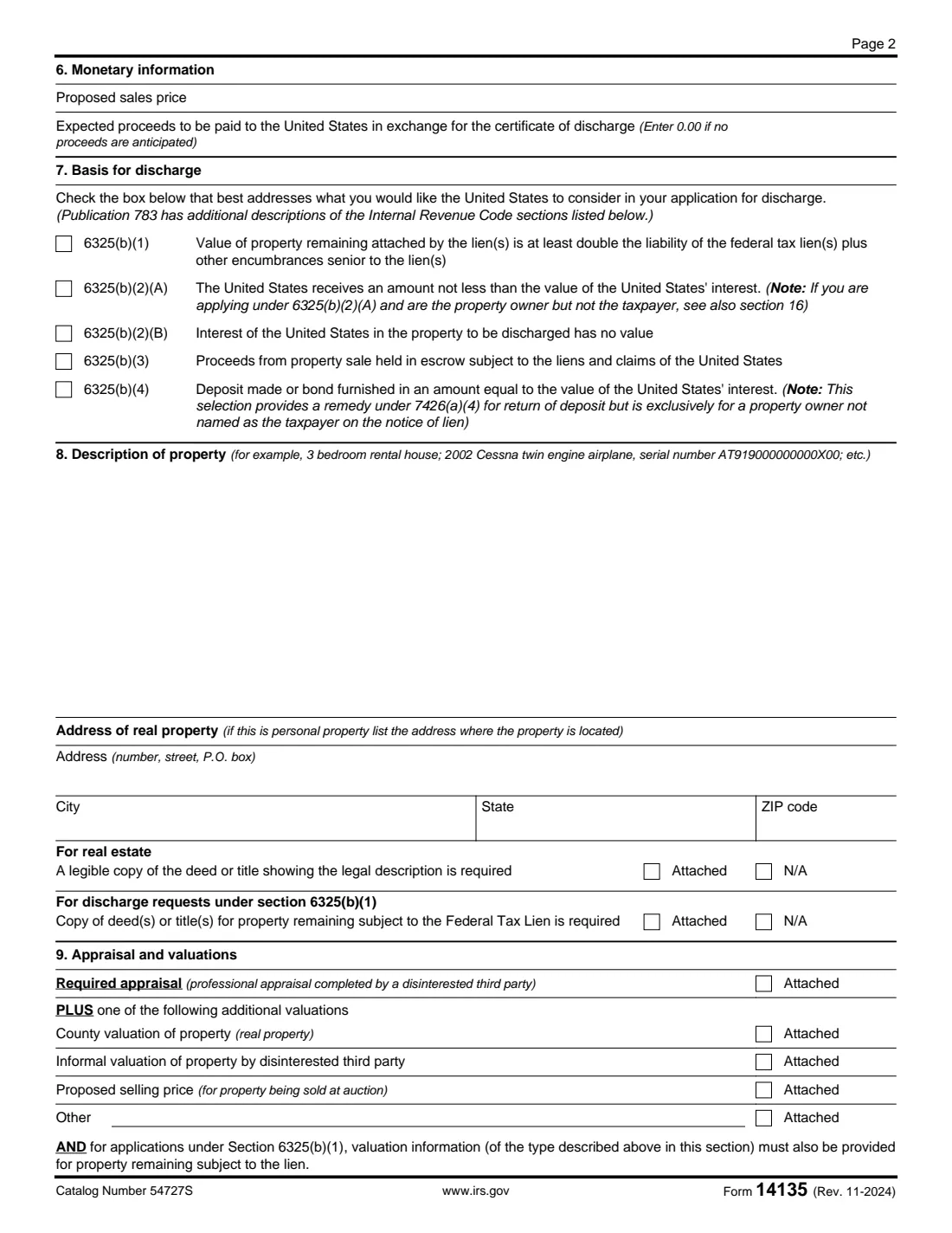
The form asks you to pick the section of the Internal Revenue Code that fits your case: for example 6325(b)(2)(A), where the United States receives at least the value of its interest from the sale, or 6325(b)(2)(B), where its interest has no value because senior debts use up the equity. You then describe the property and the deal, show the proposed price and what the IRS would receive, and attach an appraisal, an additional valuation, the deed and the sale, title and closing papers. Publication 783 explains each option and what to send.
FileIt takes you through all 17 sections, pre-fills the taxpayer's name from the People in your vault, hides the parts that don't apply, fits your longer descriptions into their boxes, and prints everything into the IRS's own PDF, saved in your vault. You and a second signer can sign on screen with FileIt eSignature. You send the package yourself; FileIt never files anything with the IRS.
- Who fills it
- The taxpayer named on the lien, or another applicant such as a co-owner, buyer or lender.
- Sent to
- The IRS Collection Advisory office for the area where the property is (see Publication 4235).
- When
- Well before the sale or closing date. Publication 783 asks for at least 45 days.
- Signatures
- The applicant, plus a second signer if needed, under penalties of perjury.
- Edition
- Rev. 11-2024 (November 2024)
- Agency
- Internal Revenue Service (IRS), Department of the Treasury
Who needs to fill out Form 14135?
- Homeowners selling a house that has a federal tax lien recorded against it.
- Taxpayers refinancing, where the lender needs the lien removed from the property.
- Co-owners or new owners who aren't the taxpayer but hold property the lien attaches to.
- Buyers, lenders and title or escrow companies arranging a closing on lien-encumbered property.
- Businesses selling equipment, vehicles or other personal property subject to a lien.
When to use Form 14135
- As soon as a sale or refinance is in view, so the IRS has time to review it before closing.
- When the lien should come off one property only. Paying the whole debt leads to a lien release instead, and the lien withdrawal and subordination are separate requests with their own forms.
- Before the property changes hands, with the proposed contract, title report and closing statement ready to attach where you have them.
What you need before you start
- The taxpayer's name, Social Security or employer identification number and address, as shown on the notice of lien.
- Details of the applicant, the buyer or new owner, any representative (with Form 8821 or 2848) and the lender or escrow company.
- The proposed sales price and how much the IRS is expected to receive.
- A description of the property and its address, and a legible copy of the deed or title.
- A professional appraisal by a disinterested third party, plus one more valuation such as the county assessment.
- A copy of the lien or its serial numbers, the sales contract, a current title report and the proposed closing statement, or the details they would show.
- An escrow agreement if you're applying under 6325(b)(3).
What’s on Form 14135
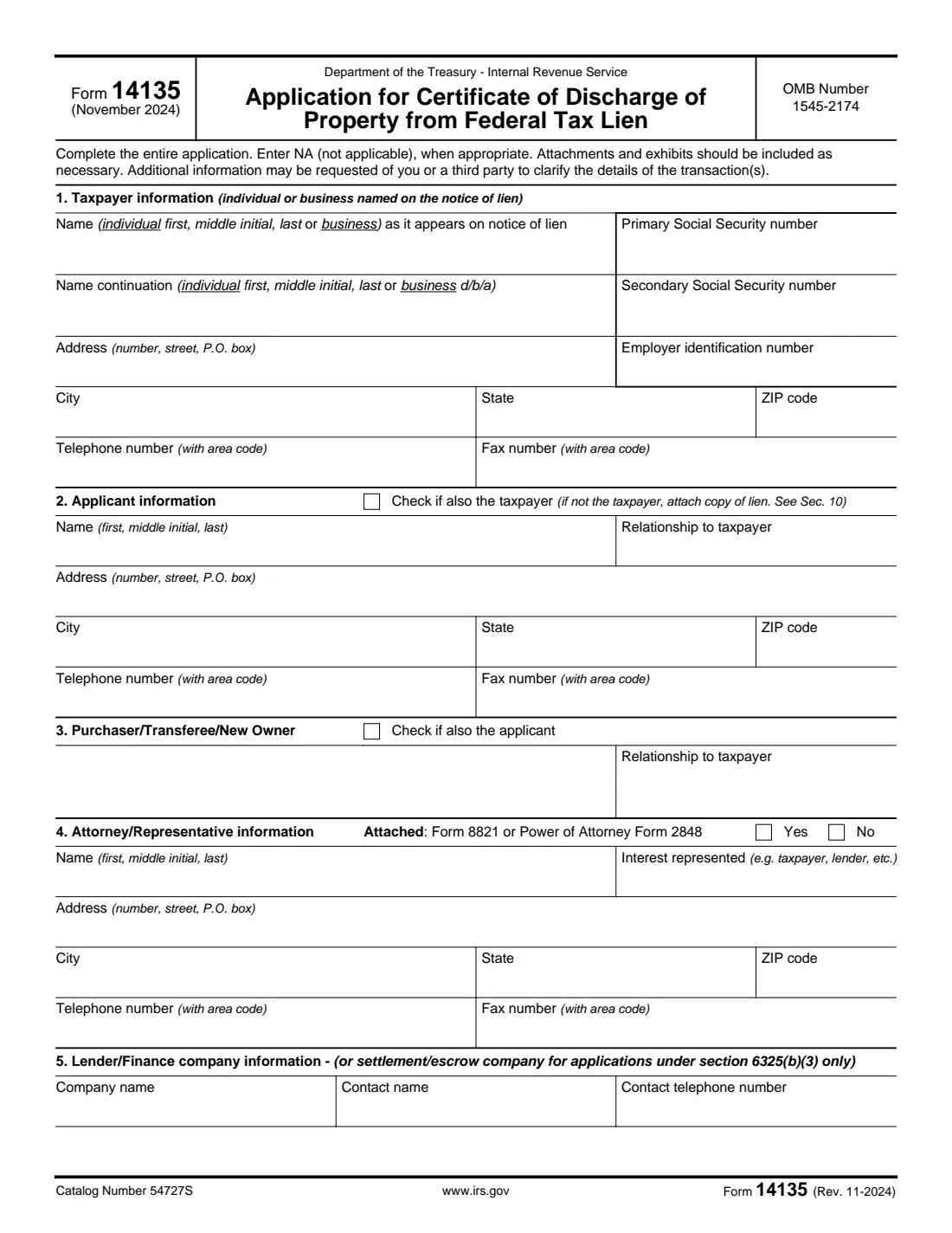
The 2024 edition has 3 pages. FileIt asks for it in 12 parts, and it is signed by Applicant and Second signer:
- 1. Taxpayer informationApplicant
- 2. Applicant informationApplicant
- 3. Purchaser / transferee / new ownerApplicant
- 4. Attorney / representativeApplicant
- 5. Lender / finance companyApplicant
- 6-7. Monetary information and basis for dischargeApplicant
- 8. Description of propertyApplicant
- 9. Appraisal and valuationsApplicant
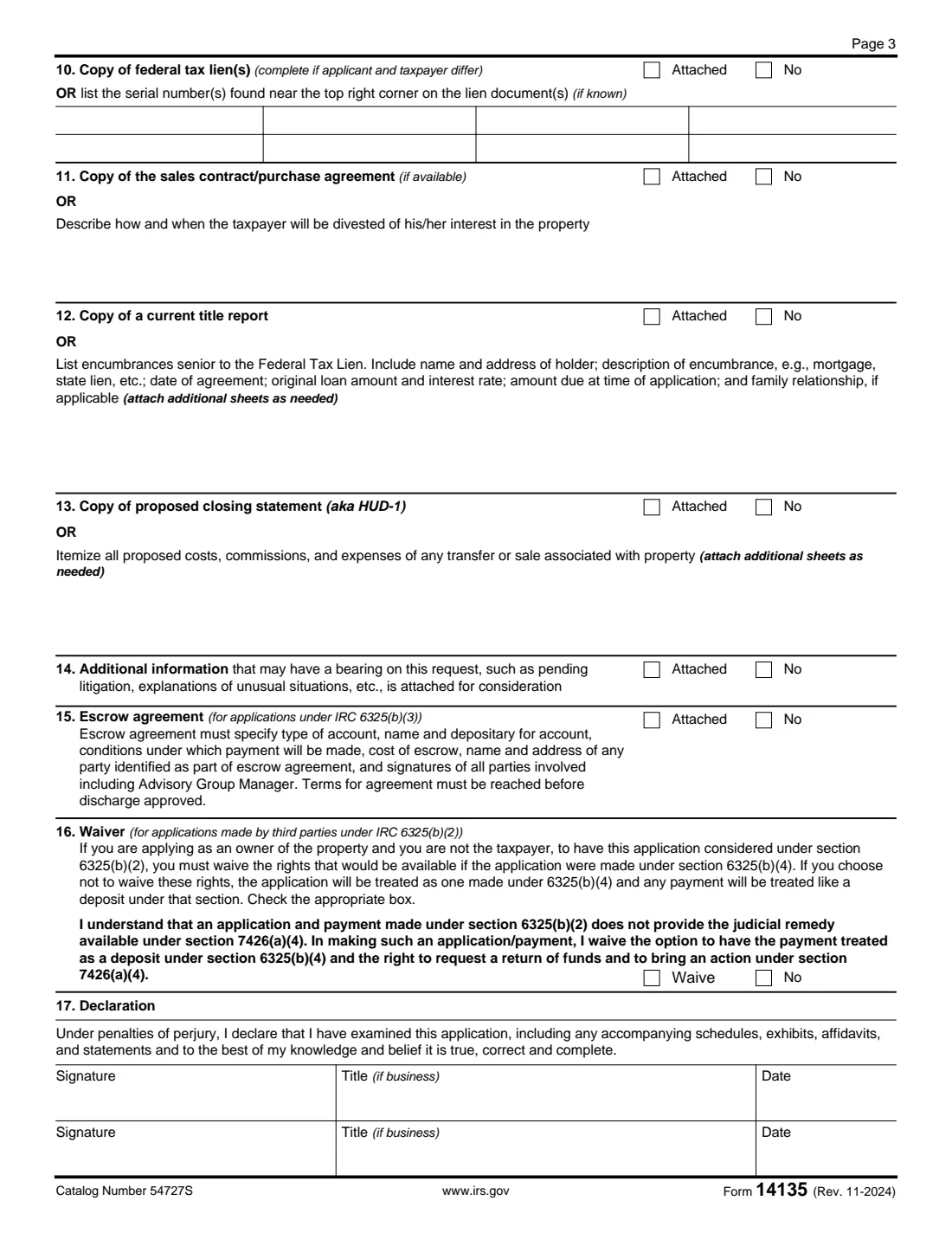
- 10-15. Lien, contract, title, closing and escrow papersApplicant
- 16. Waiver (third-party owners under 6325(b)(2))Applicant
- 17. DeclarationApplicant
- Second signerSecond signer
How to fill out Form 14135, step by step
1 Sections 1-5: The people involved
Start with the taxpayer exactly as named on the notice of lien, with Social Security or employer identification numbers. Then the applicant (tick the box if it's the taxpayer and FileIt skips the repeat), the purchaser or new owner, any attorney or representative, and the lender, finance, settlement or escrow company.
2 Sections 6-7: Money and basis
Enter the proposed sales price and the proceeds expected to go to the United States, or 0.00 if none. Then pick the one basis that best fits: double the value remaining, payment of the government's interest, no value to the government's interest, escrow of the proceeds, or a deposit or bond for a non-taxpayer owner.
3 Section 8: The property
Describe the property in plain terms, for example a 3-bedroom rental house with its legal description, and give its address. Say whether the deed or title is attached; it is required for real estate, and for 6325(b)(1) requests so is the deed for the property that stays under the lien.
4 Section 9: Appraisal and valuations
A professional appraisal by a disinterested third party is required, plus at least one more valuation: the county valuation, an informal valuation, the auction selling price or another source. FileIt reminds you if the second valuation is missing.
5 Sections 10-15: Supporting papers
For each item, say whether it's attached. If you don't have the sales contract, title report or closing statement, describe the divestment, list the senior encumbrances, or itemize the sale costs in the boxes provided. Add lien serial numbers if you're not attaching the lien.
6 Sections 16-17: Waiver and declaration
An owner who isn't the taxpayer and applies under 6325(b)(2) chooses whether to waive the 6325(b)(4) deposit treatment and the related court remedy. Then sign the declaration, adding a title if signing for a business.
Common mistakes to avoid
- Applying too close to closing. The IRS needs time to review the appraisal and papers.
- Sending only the appraisal. The form asks for at least one more valuation alongside it.
- Using a name that doesn't match the notice of lien.
- Choosing 6325(b)(4) when you are the taxpayer. It's only for owners not named on the lien.
- Leaving boxes blank instead of entering NA, which the form asks you to do where something doesn't apply.
- Forgetting Form 8821 or 2848 when you want the IRS to deal with your attorney, agent or title company.
After you fill it out
Download the signed PDF from your vault, put it together with the appraisal, valuations, deed, lien copy and sale papers, and send the package to the Collection Advisory office for the area where the property is. Keep a full copy.
An IRS advisor reviews the application and may ask you, the buyer or the title company for more information. If approved, the IRS tells you what it needs, usually a payment from the closing, before it issues the certificate.
Once you have the certificate of discharge, the title company can record it so the property passes free of the lien. The lien still applies to the taxpayer's other property.
Fill out Form 14135 online with FileIt
- Pick the person. Choose someone from People and FileIt fills in their name, date of birth, address and other details it already knows.
- Answer plain-language questions. One part of the form at a time, with the official help text beside each question — 71 fields in all. Your answers save as you go.
- Check the live preview. Watch your answers land on the real Internal Revenue Service (IRS) form, and let FileIt do any worksheet arithmetic.
- Generate the official PDF. FileIt prints your answers into the agency’s own PDF and files it in that person’s folder in your vault. Sign it, or send it for e-signature.
FileIt fills the form — it never files or submits anything for you. Deliver the finished form to whoever asked for it, the way the form’s instructions say.
Start Form 14135 now — it’s freeForm 14135: frequently asked questions
Can I fill out Form 14135 online?
Yes. FileIt guides you through every section and prints your answers into the official IRS PDF, saved in your vault and ready to sign. Filling forms is available on every FileIt account, including the free plan. You then send it yourself.
What's the difference between a lien discharge and a lien release?
A discharge removes the lien from one specific property, while the lien stays on everything else. A release ends the lien itself, generally when the debt is paid in full.
Do I need an appraisal?
Yes. The form calls for a professional appraisal by a disinterested third party, plus one additional valuation such as the county valuation of real property.
Can someone other than the taxpayer apply?
Yes. Section 2 is for the applicant, who may be a co-owner, buyer or other party. If the applicant isn't the taxpayer, attach a copy of the lien or list its serial numbers.
What if the sale won't pay the IRS anything?
Enter 0.00 as the expected proceeds. Section 6325(b)(2)(B) covers the case where the United States' interest in the property has no value, for example when senior mortgages use up the equity.
Where can I read more?
Publication 783, Instructions on How to Apply for Certificate of Discharge of Property From Federal Tax Lien, explains each section and what to attach.
Official sources
- Blank form (PDF), published by Internal Revenue Service (IRS): https://www.irs.gov/pub/irs-pdf/f14135.pdf
- Official instructions and guidance: https://www.irs.gov/pub/irs-pdf/p783.pdf
- Edition shown on this page: Rev. 11-2024 (November 2024) (checked 2026-10-19).
FileIt is not affiliated with or endorsed by Internal Revenue Service (IRS) or any government. This page explains the form in general terms and is not legal, tax or immigration advice. Always read the official instructions, and check that you are using the edition the recipient accepts. Page last reviewed 2026-10-19.