What is Form 12153?
Form 12153 is the request you send when the IRS has written to offer you a Collection Due Process (CDP) hearing under IRC 6320 or 6330: the letter that tells you a Notice of Federal Tax Lien was filed, or that the IRS intends to levy (or has levied) your wages, bank account or other property. The hearing is held by the IRS Independent Office of Appeals, which is separate from the collection office.
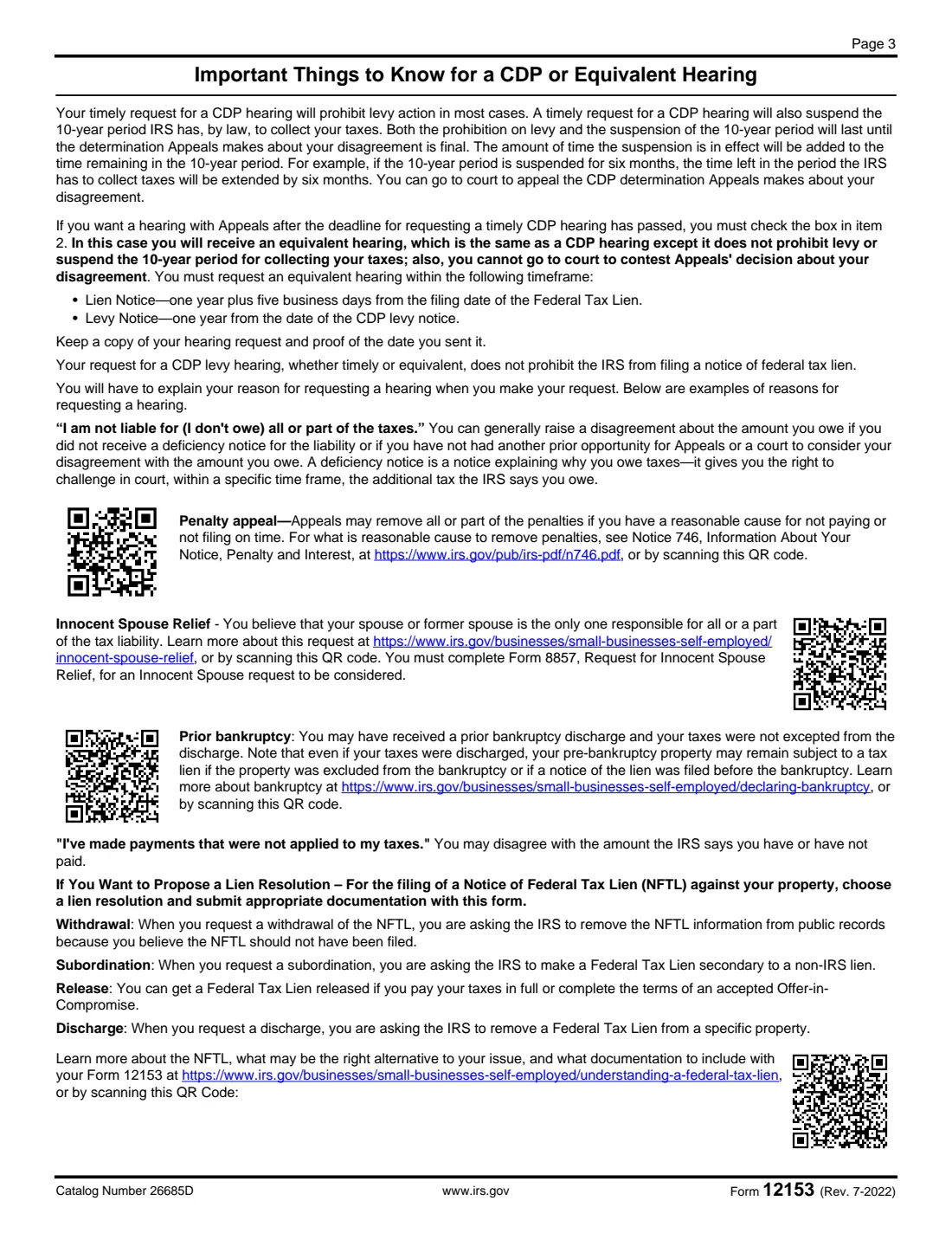
The form's own notes explain why timing matters. A timely CDP request in most cases stops levy action and suspends the 10-year period the IRS has to collect while Appeals decides, and you can go to court over Appeals' determination. If you miss that deadline, item 2 asks for an equivalent hearing instead, which doesn't stop a levy or pause the collection period and can't be taken to court. You must give a reason for the hearing, and you can propose an installment agreement, an offer in compromise or other alternatives.
FileIt walks you through all ten items, pre-fills Taxpayer 1's name from the People in your vault, splits your longer explanations across the form's lines, and prints your answers into the IRS's official PDF, which is saved in your vault. Both taxpayers, or your representative, can then sign on screen with FileIt eSignature. You send the request yourself; FileIt doesn't file anything with the IRS.
- Who fills it
- A taxpayer (or both, for a joint liability) who received a CDP lien or levy notice, or their representative.
- Sent to
- The address for requesting a hearing on your CDP notice, not the payment address, with a copy of the notice.
- When
- By the deadline on your CDP notice for a timely hearing; an equivalent hearing has a one-year window.
- Signatures
- Taxpayer 1, Taxpayer 2 on a joint request, or a representative instead (not both).
- Edition
- Rev. 7-2022 (July 2022)
- Agency
- Internal Revenue Service (IRS), Independent Office of Appeals
Who needs to fill out Form 12153?
- Anyone who received a letter offering a CDP hearing after a federal tax lien was filed against their property.
- People facing a notice of intent to levy, or an actual levy, on wages, bank accounts or other assets.
- Taxpayers who missed the CDP deadline but still want Appeals to hear them, through an equivalent hearing.
- Spouses with a joint liability making one joint request, where both must sign.
- Anyone who wants to propose an installment agreement, offer in compromise or currently-not-collectible status as part of the hearing.
- Representatives (attorneys, CPAs, enrolled agents) requesting a hearing for a client with a Form 2848.
When to use Form 12153
- As soon as you receive the CDP notice, and by the deadline it gives. A timely request is what stops most levy action and lets you go to court later.
- For an equivalent hearing: within one year plus five business days of the lien filing date, or within one year of the date of the CDP levy notice.
- Not for an audit you disagree with. Proposed examination changes go to Appeals with Form 12203 or a written protest.
What you need before you start
- Your CDP lien or levy notice, and a copy to send with the form.
- Each taxpayer's name, Taxpayer Identification Number, current address and a phone number with the best time to call.
- The type of tax, tax form number and tax periods from the notice (optional if you attach the notice).
- Your reasons for disagreeing, and any records that back them up, such as proof of payments.
- If you're proposing a collection alternative: a completed Form 433-A or 433-B financial statement helps, unless an exception applies.
- Form 8857 if you're claiming innocent spouse relief, and Form 2848 if a representative signs.
What’s on Form 12153
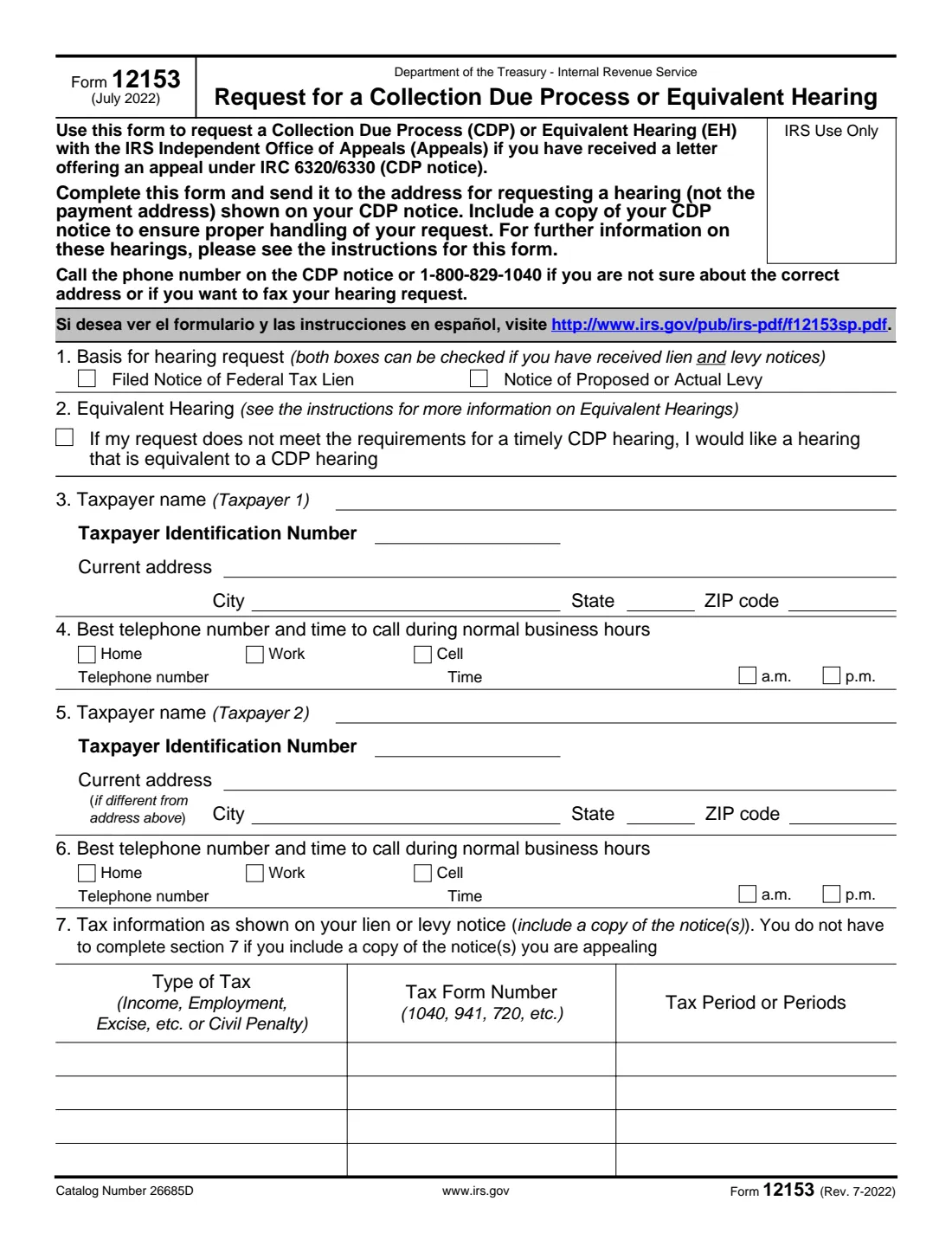
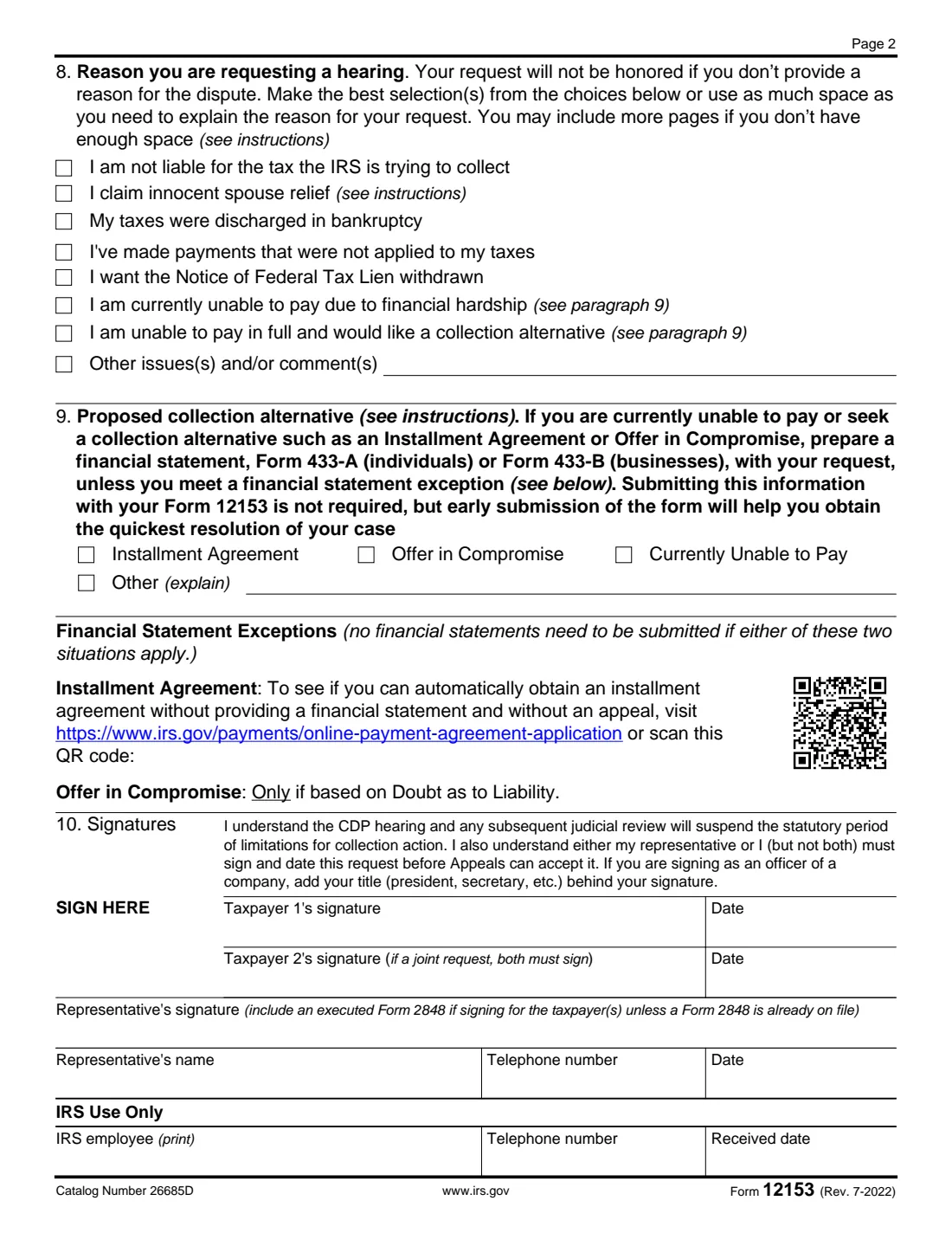
The 2022 edition has 4 pages. FileIt asks for it in 7 parts, and it is signed by Taxpayer 1 and Taxpayer 2 and Representative:
- Items 1-2: Basis for the hearingTaxpayer 1
- Items 3-4: Taxpayer 1Taxpayer 1
- Items 5-6: Taxpayer 2 (joint request)Taxpayer 2
- Item 7: Tax information from your noticeTaxpayer 1
- Item 8: Reason for the hearingTaxpayer 1
- Item 9: Proposed collection alternativeTaxpayer 1
- Item 10: RepresentativeRepresentative
How to fill out Form 12153, step by step
1 Items 1-2: Which notice, and equivalent hearing
Tick the Filed Notice of Federal Tax Lien box, the Notice of Proposed or Actual Levy box, or both if you received both. Tick item 2 if you'd like an equivalent hearing in case your request turns out not to be timely for a CDP hearing.
2 Items 3-6: Taxpayers and phone numbers
Enter Taxpayer 1's name, identification number and current address, then the best phone number (home, work or cell) and a time to call during normal business hours, with a.m. or p.m. For a joint request, switch on Taxpayer 2; their address is only needed if it differs.
3 Item 7: Tax information
Copy up to four rows from your notice: the type of tax (income, employment, excise or civil penalty), the tax form number such as 1040 or 941, and the tax period. You can skip this item if you send a copy of the notice.
4 Item 8: Your reasons
Tick every reason that applies: you're not liable, innocent spouse relief, a bankruptcy discharge, payments not applied, a lien withdrawal, financial hardship, or wanting a collection alternative. Use Other issues for anything else. FileIt splits your explanation across the two printed lines and warns you if it needs an attached page.
5 Item 9: Collection alternative
If you want to settle the debt another way, tick installment agreement, offer in compromise, currently unable to pay, or other. The form recommends sending Form 433-A or 433-B with the request, though it isn't required.
6 Item 10: Signatures
Taxpayer 1 signs and dates; on a joint request Taxpayer 2 must sign too. A representative can sign instead, adding their name and phone number, with a Form 2848 unless one is already on file. An officer signing for a company adds their title after the signature.
Common mistakes to avoid
- Sending the form to the payment address. The form says to use the address for requesting a hearing on your CDP notice.
- Leaving item 8 blank. A request without a reason for the dispute won't be honored.
- Waiting too long. Missing the CDP deadline means only an equivalent hearing, without the levy protection or court review.
- Forgetting the copy of the CDP notice, which the form asks for to make sure your request is handled properly.
- Only one spouse signing a joint request; both must sign.
- Claiming innocent spouse relief without also completing Form 8857.
After you fill it out
Download the signed PDF from your vault and send it, with a copy of your CDP notice and any Form 433-A, 433-B, 8857 or 2848, to the hearing address on the notice. If you'd rather fax it or aren't sure of the address, call the number on the notice or 1-800-829-1040. Keep a copy and proof of the date you sent it.
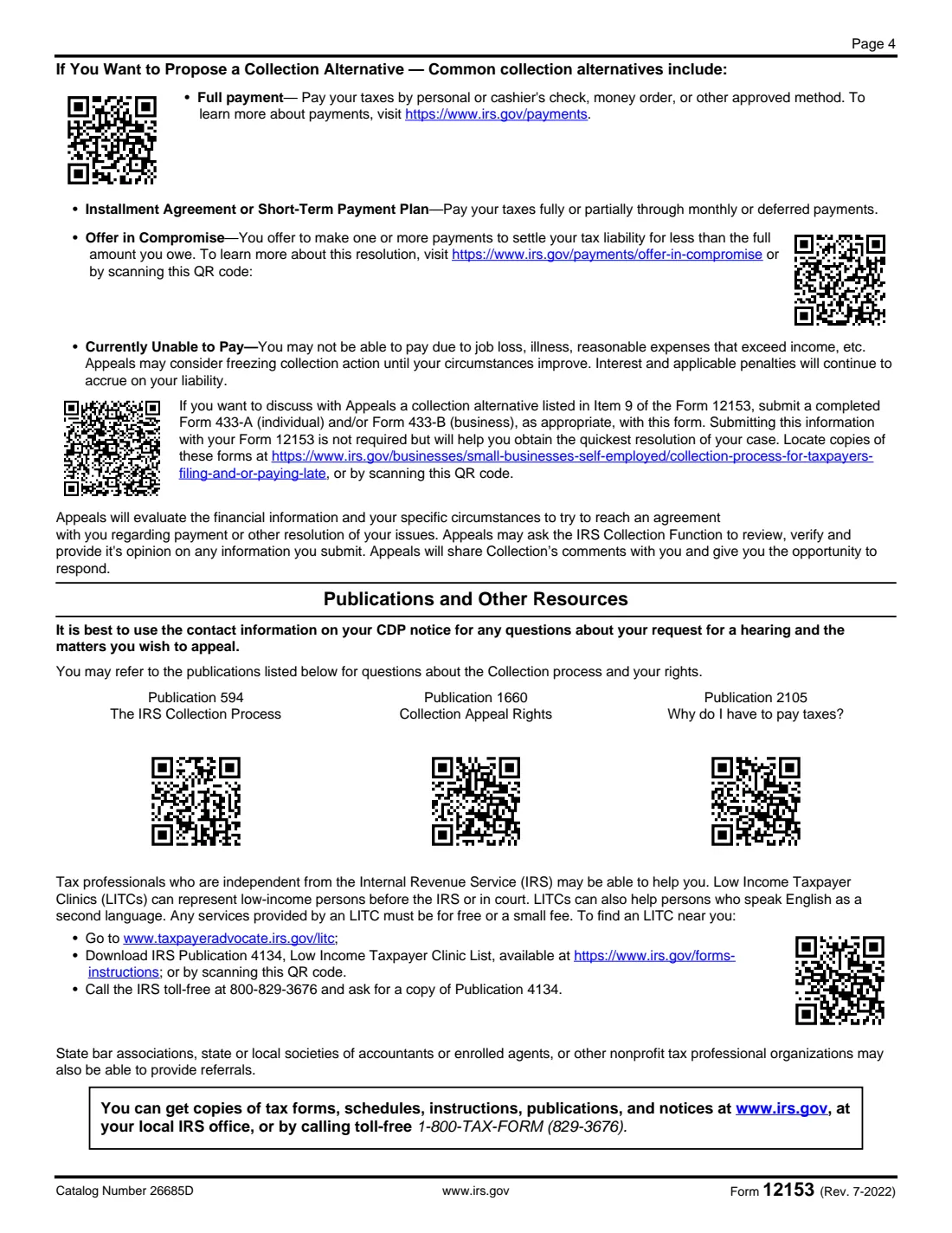
Appeals will contact you to schedule the hearing. It may ask the IRS Collection function to review the financial information you sent, and will share those comments with you so you can respond.
Interest and applicable penalties keep running while the hearing is pending. If you don't agree with Appeals' determination after a timely CDP hearing, you can take it to court.
Fill out Form 12153 online with FileIt
- Pick the person. Choose someone from People and FileIt fills in their name, date of birth, address and other details it already knows.
- Answer plain-language questions. One part of the form at a time, with the official help text beside each question — 55 fields in all. Your answers save as you go.
- Check the live preview. Watch your answers land on the real Internal Revenue Service (IRS) form, and let FileIt do any worksheet arithmetic.
- Generate the official PDF. FileIt prints your answers into the agency’s own PDF and files it in that person’s folder in your vault. Sign it, or send it for e-signature.
FileIt fills the form — it never files or submits anything for you. Deliver the finished form to whoever asked for it, the way the form’s instructions say.
Start Form 12153 now — it’s freeForm 12153: frequently asked questions
Can I fill out Form 12153 online?
Yes. FileIt guides you through every item and prints your answers into the official IRS PDF, saved in your vault, ready to sign and send. Filling forms is available on every FileIt account, including the free plan. FileIt doesn't submit it for you.
What's the difference between a CDP hearing and an equivalent hearing?
The form explains that an equivalent hearing is the same as a CDP hearing except that it doesn't prohibit levy or suspend the 10-year collection period, and you can't go to court to contest Appeals' decision.
Where do I send Form 12153?
To the address for requesting a hearing shown on your CDP notice. That isn't the payment address. Include a copy of the notice.
Does a CDP request stop a tax lien from being filed?
No. The form notes that a request for a CDP levy hearing, timely or equivalent, doesn't prohibit the IRS from filing a notice of federal tax lien.
Do I need a financial statement?
Only if you're proposing a collection alternative, and even then it isn't required. The form says early submission helps the quickest resolution, and lists two exceptions: an installment agreement you can get automatically online, and an offer in compromise based only on doubt as to liability.
Who signs, me or my representative?
The form says either you or your representative signs, but not both. On a joint request both taxpayers sign.
Official sources
- Blank form (PDF), published by Internal Revenue Service (IRS): https://www.irs.gov/pub/irs-pdf/f12153.pdf
- Official instructions and guidance: https://www.irs.gov/forms-pubs/about-form-12153
- Edition shown on this page: Rev. 7-2022 (July 2022) (checked 2026-10-19).
FileIt is not affiliated with or endorsed by Internal Revenue Service (IRS) or any government. This page explains the form in general terms and is not legal, tax or immigration advice. Always read the official instructions, and check that you are using the edition the recipient accepts. Page last reviewed 2026-10-19.