
What is N323 Warrant of control?
If someone hasn't paid money a court ordered them to pay, GOV.UK explains that you can apply for a 'warrant of control': it gives court enforcement agents the authority to take goods from the debtor's home or business to settle the debt. Form N323 is the request you send to the court.
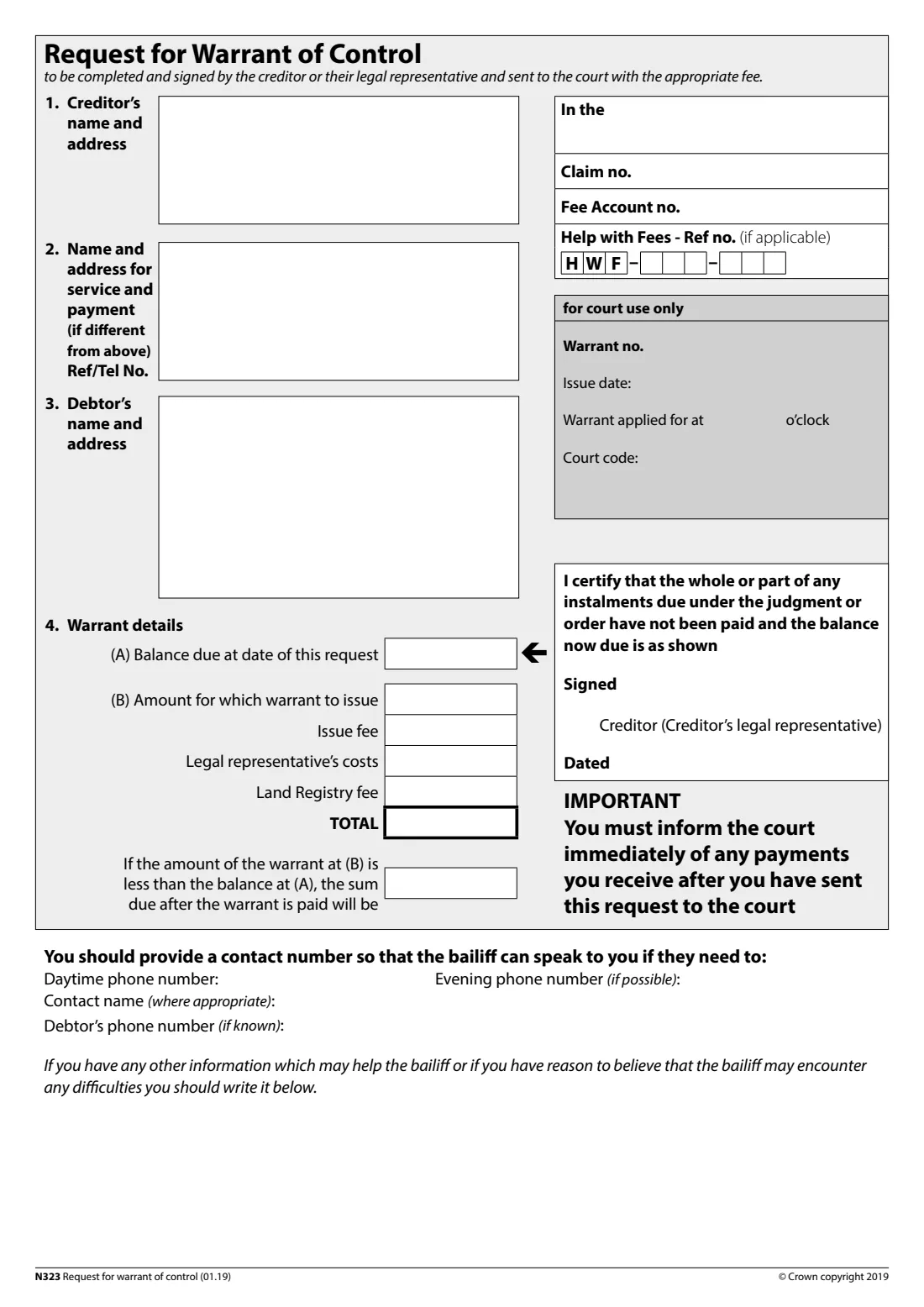
It asks for the court and claim number, your name and address (and a different address for service and payment, if any), the debtor's name and address, the balance due, the amount you want the warrant for, the fees and costs, and contact numbers for the enforcement agent, plus anything that may help them.
FileIt asks for each answer in plain English, adds up the total, works out what will still be owed if the warrant is for less than the balance, strikes out the signer wording that doesn't apply, and fills HMCTS's own N323 PDF (01.19 edition). You sign it and send it to the court with the fee. FileIt never sends anything for you.
- Who fills it
- The judgment creditor or their legal representative
- Sent to
- The court that issued the judgment, with the fee
- County Court fee
- £94 (GOV.UK, July 2026)
- Limits
- Not for £10 or less; up to £5,000 in the County Court
- Signature
- Signed by the creditor or their legal representative
- Edition
- N323 Request for warrant of control (01.19)
Who needs to fill out N323 Warrant of control?
- A creditor with a County Court judgment or order that hasn't been paid.
- A creditor whose debtor has fallen behind with at least one instalment.
- A solicitor or legal representative enforcing a judgment for a client.
- Not for the High Court: there it's a writ of control, requested on form N293A.
When to use N323 Warrant of control
- When the debtor has failed to pay what they were ordered to pay, or has fallen behind with at least one payment.
- After reading the GOV.UK guidance (EX321) on what to do if a defendant doesn't pay, and deciding a warrant is likely to recover the money and the fee.
- If you started your claim online, GOV.UK says you can apply and pay online instead.
What you need before you start
- The judgment or order, for the court and claim number.
- The balance still owed today, and how much you want the warrant for.
- The debtor's address where they have goods that could be sold.
- The fee (or a Help with Fees reference), and any legal representative's costs or Land Registry fee.
- A phone number so the enforcement agent can contact you.
What’s on N323 Warrant of control
The 2019 edition has 2 pages. FileIt asks for it in 5 parts, and it is signed by Judgment creditor (or their legal representative):
- The court and the claimJudgment creditor (or their legal representative)
- Creditor and debtorJudgment creditor (or their legal representative)
- 4. Warrant detailsJudgment creditor (or their legal representative)
- Certificate and signatureJudgment creditor (or their legal representative)
- Contact numbers and other informationJudgment creditor (or their legal representative)
How to fill out N323 Warrant of control, step by step
1 Court and parties
Give the court and claim number, your name and address, any different address for service and payment, and the debtor's name and address.
2 Warrant details
Enter (A) the balance due today and (B) the amount the warrant is for, then the issue fee and any costs. FileIt works out the TOTAL and, if (B) is less than (A), what will still be due.
3 Certificate and signature
By signing you certify that the whole or part of any instalments due haven't been paid and the balance is as shown. FileIt strikes out 'Creditor' or '(Creditor's legal representative)' to match who signs.
4 Contact details
Give daytime and evening numbers, a contact name, the debtor's number if you know it, and anything that may help the enforcement agent.
Common mistakes to avoid
- Asking for less than GOV.UK's minimum: the largest of one monthly instalment, four weekly instalments, or £50.
- Asking for more than £5,000 in the County Court (unless it's a regulated consumer credit agreement): GOV.UK says to transfer to the High Court for more.
- Giving an address where the debtor has no goods: the warrant only helps if they have money or goods there.
- Not telling the court straight away about payments you receive after sending the request.
After you fill it out
Download and check the filled PDF, then sign it by hand or with FileIt's eSignature.
Send it to the court that issued the judgment, with the fee (GOV.UK says by cheque or postal order payable to 'HM Courts and Tribunal Service'), and a stamped addressed envelope if you want confirmation and the warrant number.
Tell the court immediately about any payments you receive afterwards.
Keep the judgment and the request together in your FileIt vault.
Fill out N323 Warrant of control online with FileIt
- Pick the person. Choose someone from People and FileIt fills in their name, date of birth, address and other details it already knows.
- Answer plain-language questions. One part of the form at a time, with the official help text beside each question — 25 fields in all. Your answers save as you go.
- Check the live preview. Watch your answers land on the real HM Courts & Tribunals Service form, and let FileIt do any worksheet arithmetic.
- Generate the official PDF. FileIt prints your answers into the agency’s own PDF and files it in that person’s folder in your vault. Sign it, or send it for e-signature.
FileIt fills the form — it never files or submits anything for you. Deliver the finished form to whoever asked for it, the way the form’s instructions say.
Start N323 Warrant of control now — it’s freeN323 Warrant of control: frequently asked questions
What does a warrant of control do?
GOV.UK says it gives court enforcement agents the authority to take goods from the defendant's home or business to settle the debt.
How much does it cost?
GOV.UK lists £94 for a warrant of control in the County Court, £114 in the family court and £80 for a writ of control in the High Court (guidance updated July 2026). Check before you apply.
Can I ask for only part of the debt?
Yes. GOV.UK says the minimum is the largest of part of the amount owed, one monthly instalment, four weekly instalments, or £50. FileIt works out what will still be due after the warrant.
Is there an upper limit?
In the County Court the enforcement agents can try to get up to £5,000, except under a regulated consumer credit agreement. Between £600 and £5,000 you can choose the County Court or the High Court.
Does FileIt send it to the court?
No. FileIt fills the official PDF; you sign it and send it with the fee.
Official sources
- Blank form (PDF), published by HM Courts & Tribunals Service: https://assets.publishing.service.gov.uk/media/6966257be8b93f59c3aecd4b/n323-eng.pdf
- Official instructions and guidance: https://www.gov.uk/guidance/apply-for-a-warrant-of-control
- Edition shown on this page: N323 Request for warrant of control (01.19) (checked 2026-10-25).
FileIt is not affiliated with or endorsed by HM Courts & Tribunals Service or any government. This page explains the form in general terms and is not legal, tax or immigration advice. Always read the official instructions, and check that you are using the edition the recipient accepts. Page last reviewed 2026-10-25.