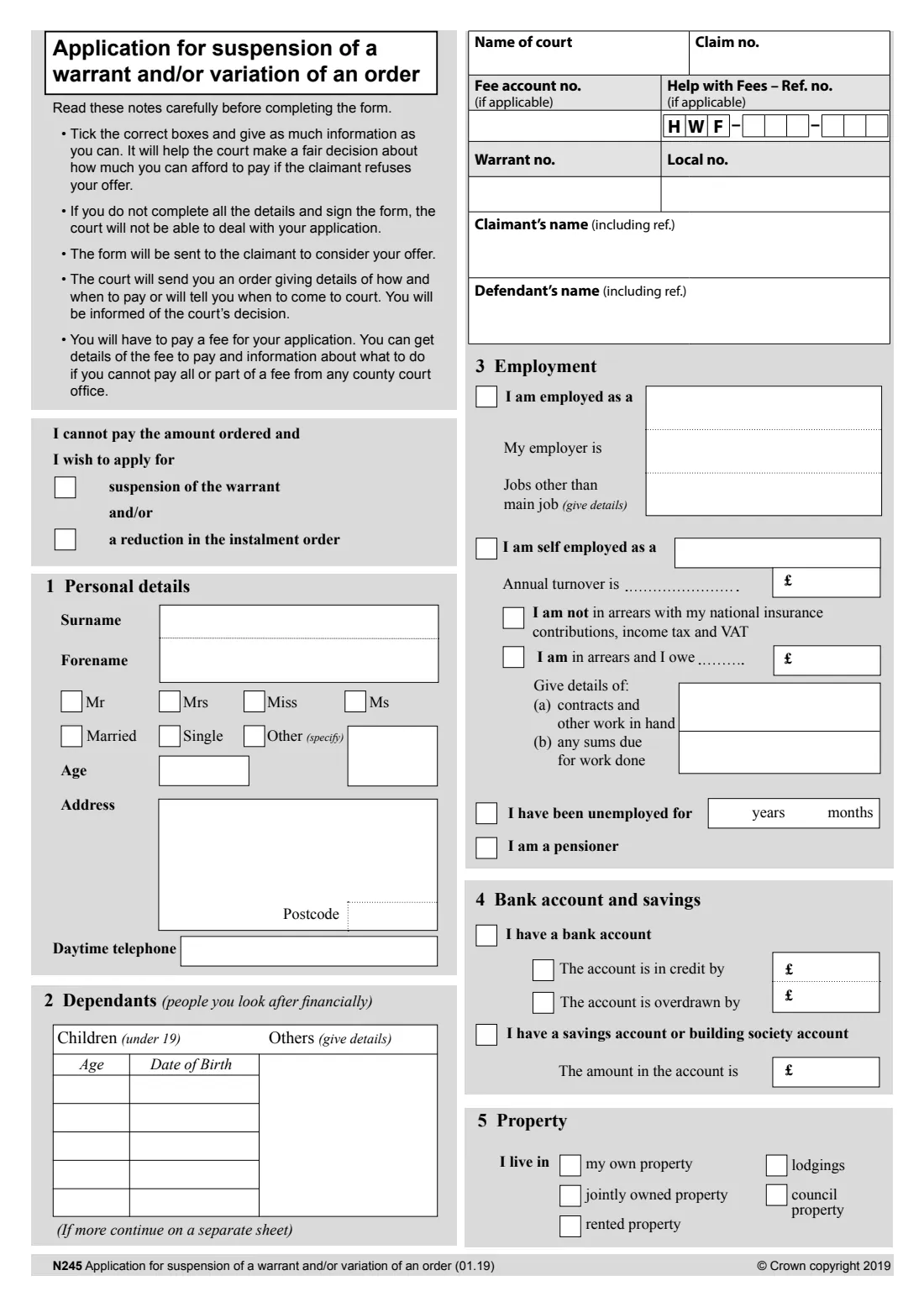
What is N245 Suspend a warrant or vary an order?
If you owe money under a County Court judgment and can't keep up with what the court ordered, form N245 lets you ask for a warrant of control to be suspended, for the instalments to be reduced, or both. It's sent to the claimant to consider your offer, and the court then sends you an order or tells you when to come to court.
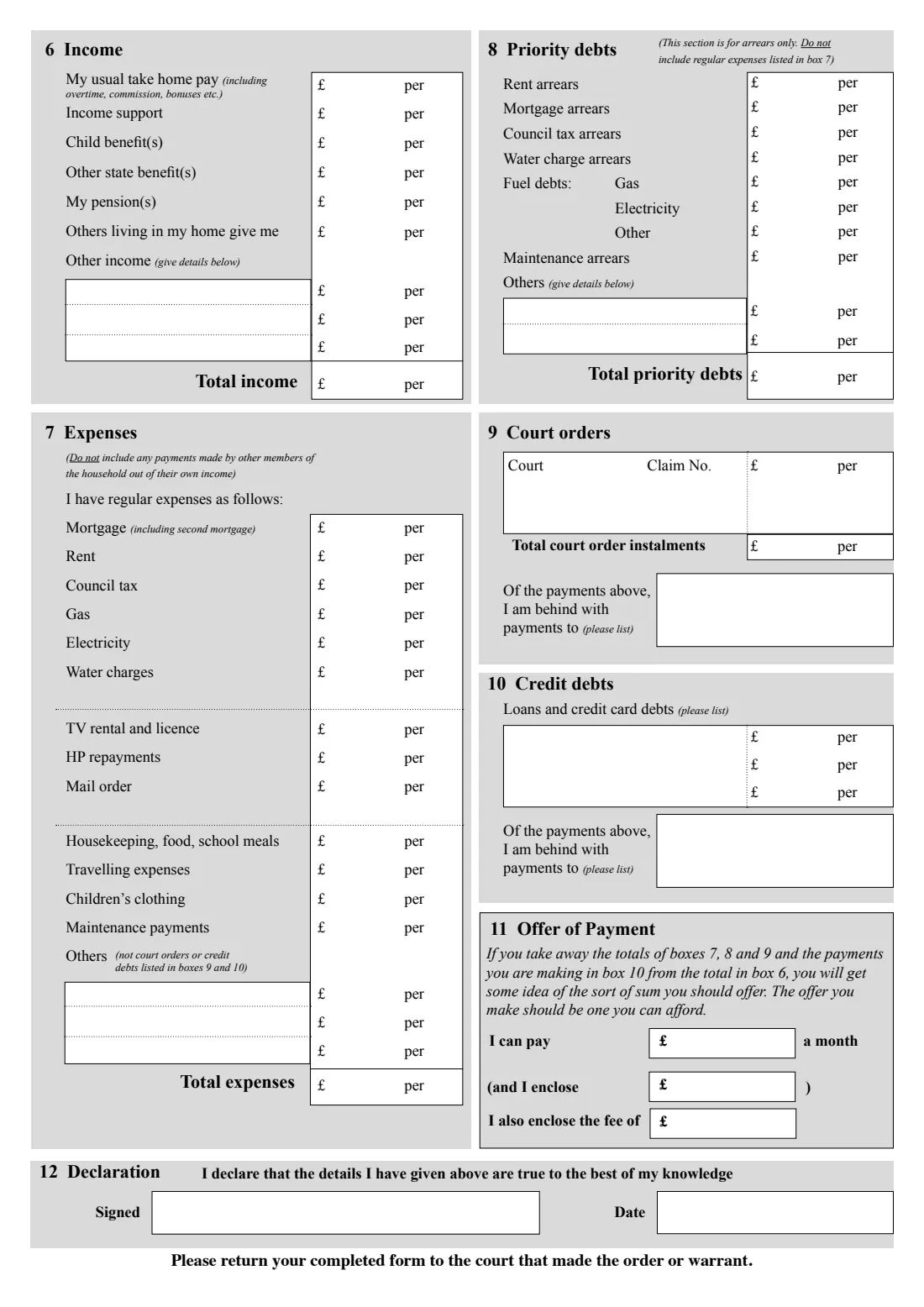
Most of the form is a statement of your finances: your personal details and dependants, your work, bank and savings accounts and home, then your income, regular expenses, priority debts (arrears of rent, mortgage, council tax, fuel and so on), other court orders and credit debts. At the end you say how much you can afford to pay each month.
FileIt asks for each amount and how often it's paid, turns weekly, fortnightly, quarterly and yearly figures into monthly totals for boxes 6 to 9, and shows how much is left over as a guide to your offer. It prints everything into HMCTS's official N245 PDF. You choose the offer, sign the declaration and send the form to the court with the fee yourself.
- Who fills it
- The person who owes the money (the defendant)
- Asks for
- A warrant suspended, instalments reduced, or both
- Sent to
- The court that made the order or issued the warrant
- Fee
- Payable, unless you get Help with Fees
- Edition
- N245 (01.19)
Who needs to fill out N245 Suspend a warrant or vary an order?
- Anyone facing a warrant of control (bailiffs) for a County Court judgment debt they can't pay in full.
- Someone whose circumstances have changed so the ordered instalments are no longer affordable.
- People on benefits, low wages or a reduced income after losing work or falling ill.
- Self-employed people whose turnover has dropped.
When to use N245 Suspend a warrant or vary an order
- As soon as you know you can't pay what the order says, or when you receive notice of a warrant.
- When you can offer a realistic, lower monthly payment.
- Not to dispute the judgment itself; that needs a different application, such as N244 to set it aside.
What you need before you start
- The court name, claim number and any warrant number, from the order or warrant.
- Your pay slips, benefit letters and pension statements.
- Your bills: rent or mortgage, council tax, gas, electricity, water, TV, travel, food and childcare costs.
- Any arrears you're paying off, other court orders and loans or credit cards.
- Your bank and savings balances.
- The fee, or a Help with Fees reference.
What’s on N245 Suspend a warrant or vary an order
The 2019 edition has 2 pages. FileIt asks for it in 14 parts, and it is signed by Defendant:
- Court and case detailsDefendant
- What you are applying forDefendant
- 1. Personal detailsDefendant
- 2. Dependants (people you look after financially)Defendant
- 3. EmploymentDefendant
- 4. Bank account and savingsDefendant
- 5. PropertyDefendant
- 6. IncomeDefendant
- 7. ExpensesDefendant
- 8. Priority debtsDefendant
- 9. Court ordersDefendant
- 10. Credit debtsDefendant
- 11. Offer of paymentDefendant
- 12. DeclarationDefendant
How to fill out N245 Suspend a warrant or vary an order, step by step
1 Case details and what you want
Copy the court, claim, warrant and local numbers and the parties, then tick suspension of the warrant, a reduction in the instalments, or both.
2 About you (1-5)
Your name, title, marital status, age, address and phone; children under 19 and others you support; your work (employed, self-employed, unemployed or retired); your bank and savings; and where you live.
3 Income (6)
Take-home pay, benefits, pensions and money others in your home give you, each with how often you get it. FileIt adds them up as a monthly total.
4 Expenses (7)
Your regular bills and living costs. Don't include payments others in the household make from their own income, or court orders and credit debts.
5 Debts and court orders (8-10)
What you pay towards priority arrears, other court orders and credit debts, and which of them you're behind with. FileIt totals the priority debts and court orders monthly.
6 Offer and declaration (11-12)
FileIt shows what's left after boxes 7 to 10 as a guide. Enter the monthly amount you can afford, any payment you're enclosing and the fee, then sign and date.
Common mistakes to avoid
- Leaving sections blank: the court can't deal with a form that isn't complete and signed.
- Mixing weekly and monthly figures without saying which is which.
- Counting the same payment twice, for example rent in box 7 and again as arrears in box 8.
- Offering more than you can actually afford, which can lead to missed payments.
- Forgetting to enclose the fee or a Help with Fees application.
After you fill it out
Sign the declaration and send the form to the court that made the order or warrant, with the fee. FileIt doesn't send it for you.
The form is passed to the claimant to consider your offer. The court will then send you an order with how and when to pay, or tell you when to come to court.
Keep a copy with your judgment papers in your FileIt vault, and carry on paying what you can while you wait.
Fill out N245 Suspend a warrant or vary an order online with FileIt
- Pick the person. Choose someone from People and FileIt fills in their name, date of birth, address and other details it already knows.
- Answer plain-language questions. One part of the form at a time, with the official help text beside each question — 164 fields in all. Your answers save as you go.
- Check the live preview. Watch your answers land on the real HM Courts & Tribunals Service form, and let FileIt do any worksheet arithmetic.
- Generate the official PDF. FileIt prints your answers into the agency’s own PDF and files it in that person’s folder in your vault. Sign it, or send it for e-signature.
FileIt fills the form — it never files or submits anything for you. Deliver the finished form to whoever asked for it, the way the form’s instructions say.
Start N245 Suspend a warrant or vary an order now — it’s freeN245 Suspend a warrant or vary an order: frequently asked questions
Will N245 stop the bailiffs?
It asks the court to suspend the warrant on terms you can afford. The form doesn't stop enforcement by itself; the court decides once it has your application and the claimant's response.
Do I have to pay a fee?
Yes, the form says there is a fee for the application. If you can't pay all or part of it, you can apply for Help with Fees and give the reference on the form.
How does FileIt work out the totals?
You give each amount with how often it's paid. FileIt converts weekly (x 52 / 12), fortnightly, 4-weekly, quarterly and yearly amounts to monthly ones and adds them up for boxes 6 to 9.
How much should I offer?
Box 11 suggests taking your expenses, priority debts, court orders and credit payments away from your income to get an idea. FileIt shows that figure, but the offer should be one you can afford.
What if my partner pays some of the bills?
Don't include payments other members of the household make out of their own income in your expenses. Money they give you goes in your income.
Official sources
- Blank form (PDF), published by HM Courts & Tribunals Service: https://assets.publishing.service.gov.uk/media/5e4cf8e686650c10e96037fe/n245-eng.pdf
- Official instructions and guidance: https://www.gov.uk/government/publications/form-n245-application-for-suspension-of-a-warrant-and-or-variation-of-an-order
- Edition shown on this page: N245 (01.19) (checked 2026-10-19).
FileIt is not affiliated with or endorsed by HM Courts & Tribunals Service or any government. This page explains the form in general terms and is not legal, tax or immigration advice. Always read the official instructions, and check that you are using the edition the recipient accepts. Page last reviewed 2026-10-19.