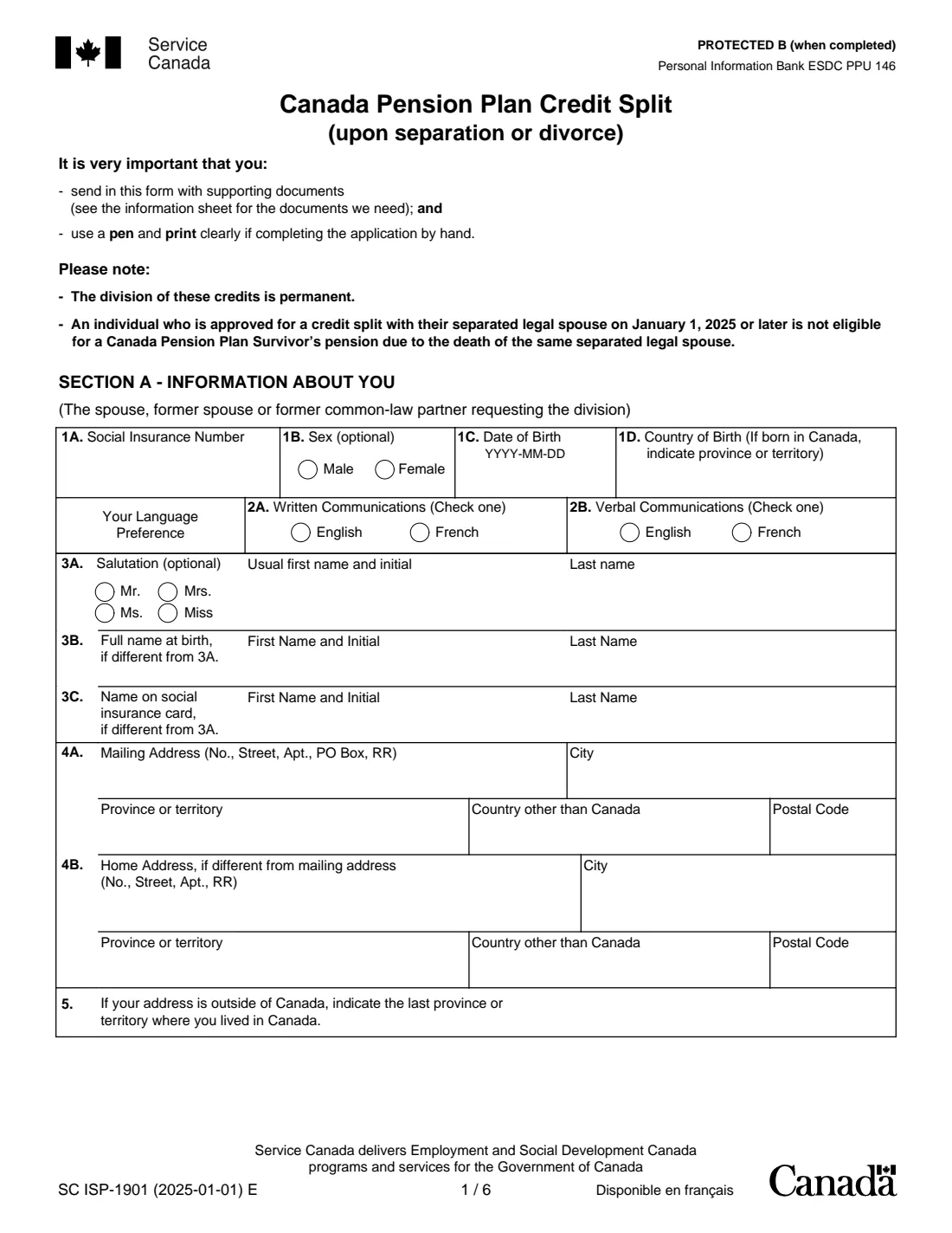
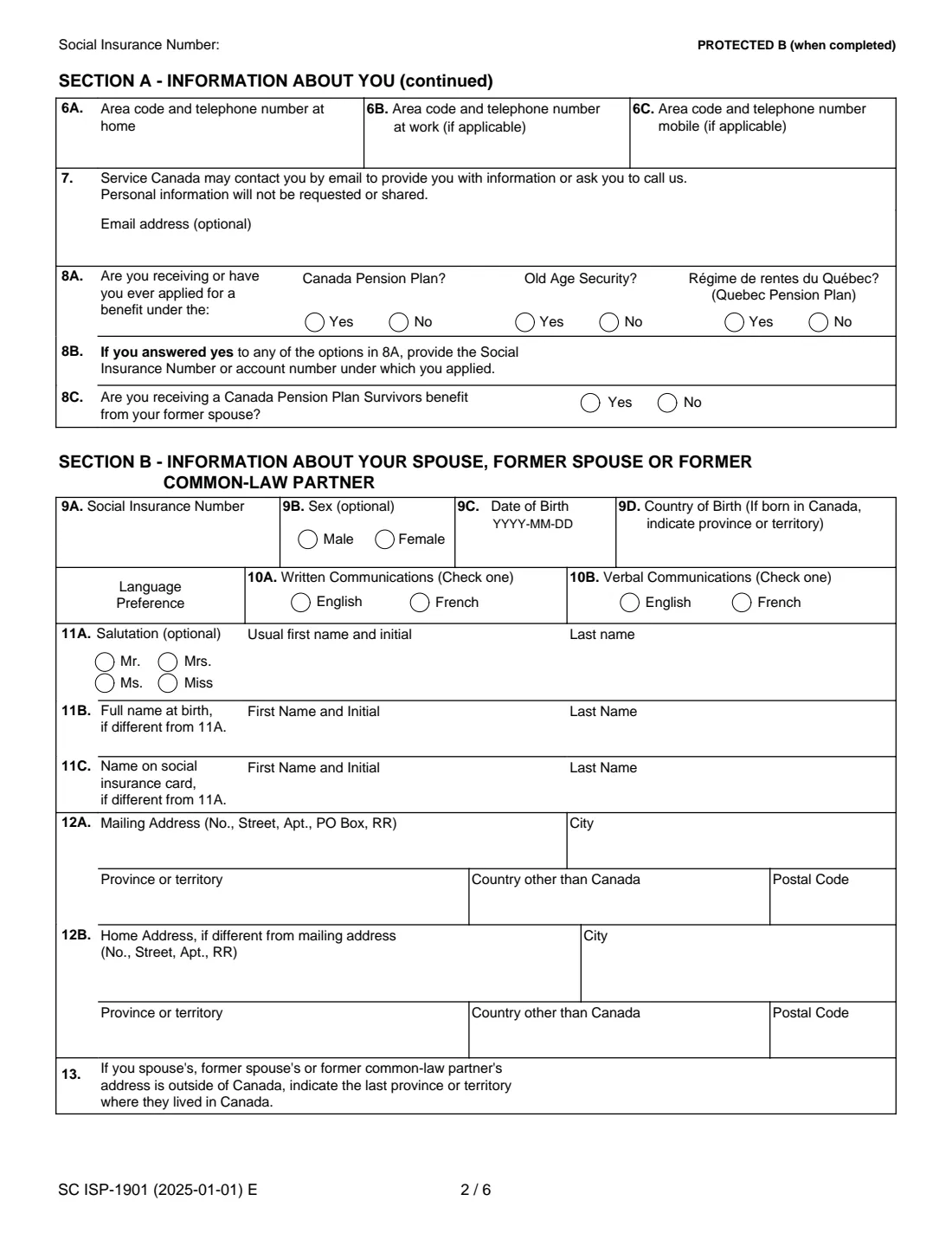
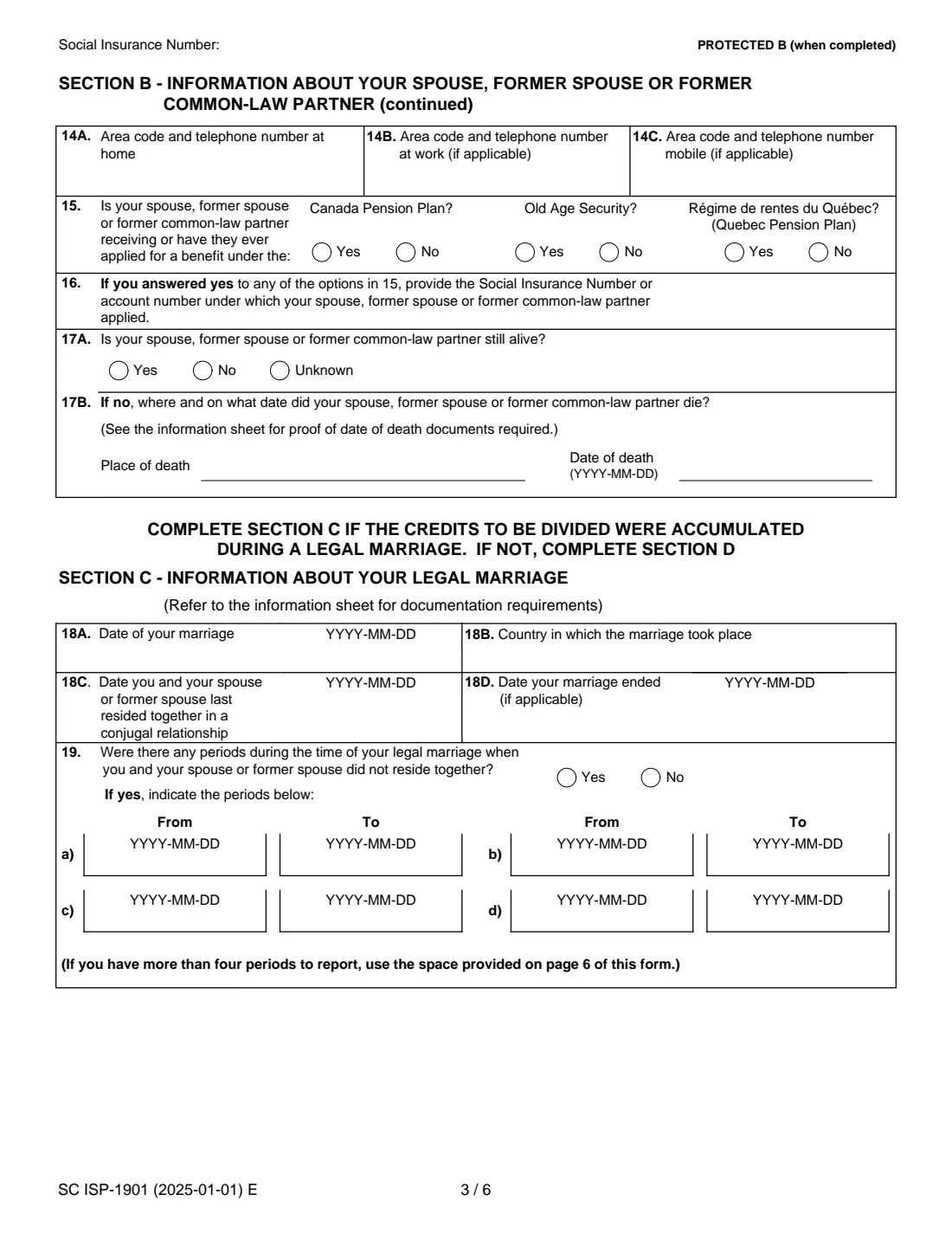
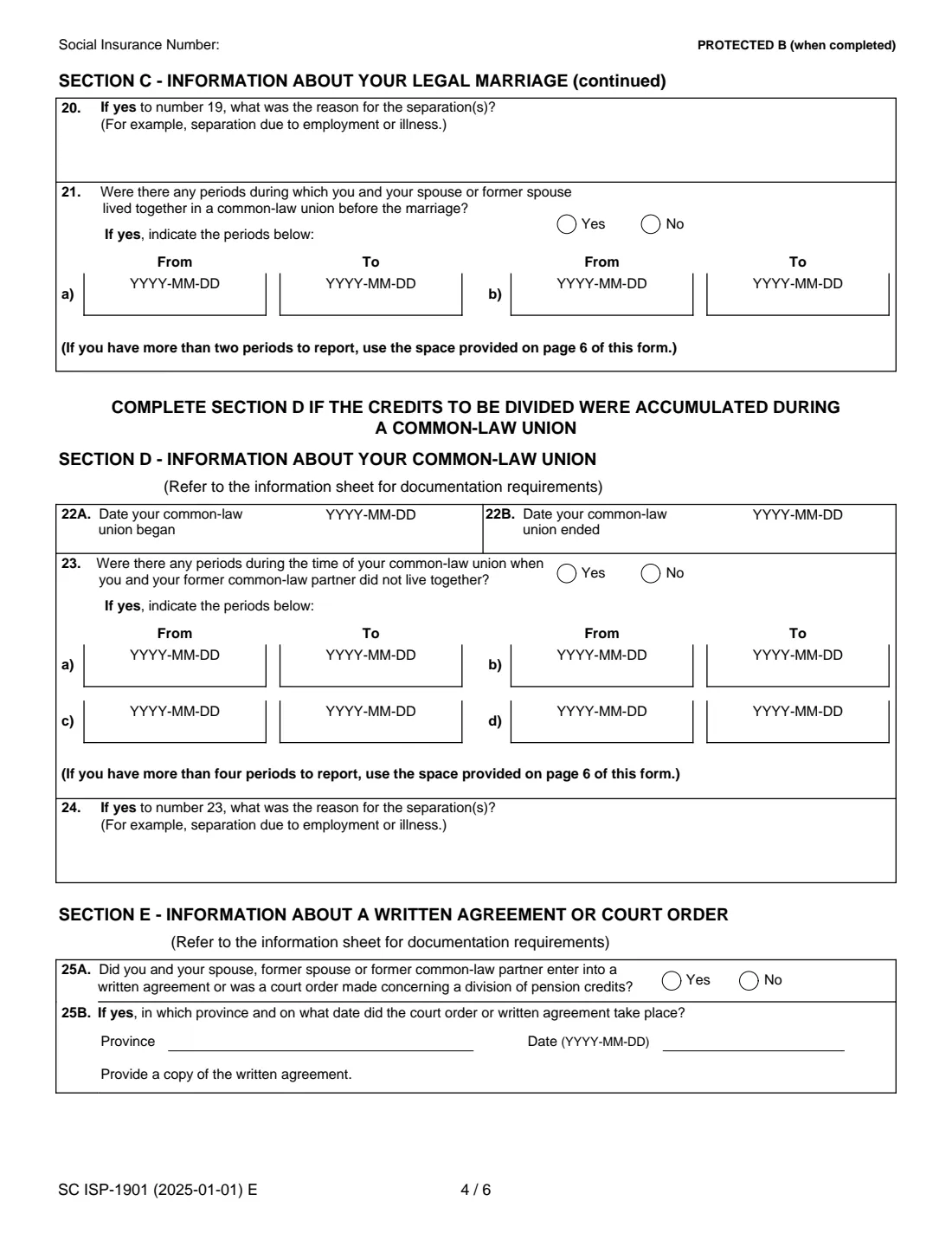
What is ISP-1901 CPP credit split?
Form ISP-1901 asks Service Canada to split Canada Pension Plan (CPP) credits, a provision the law calls the Division of Unadjusted Pensionable Earnings. According to the information sheet (ISP-1901A), the CPP credits that you and your spouse, former spouse or former common-law partner built up while you lived together are divided equally, even if one of you did not contribute. A split may help you qualify for a CPP benefit or increase it, although in some cases it can decrease it. The division is permanent.
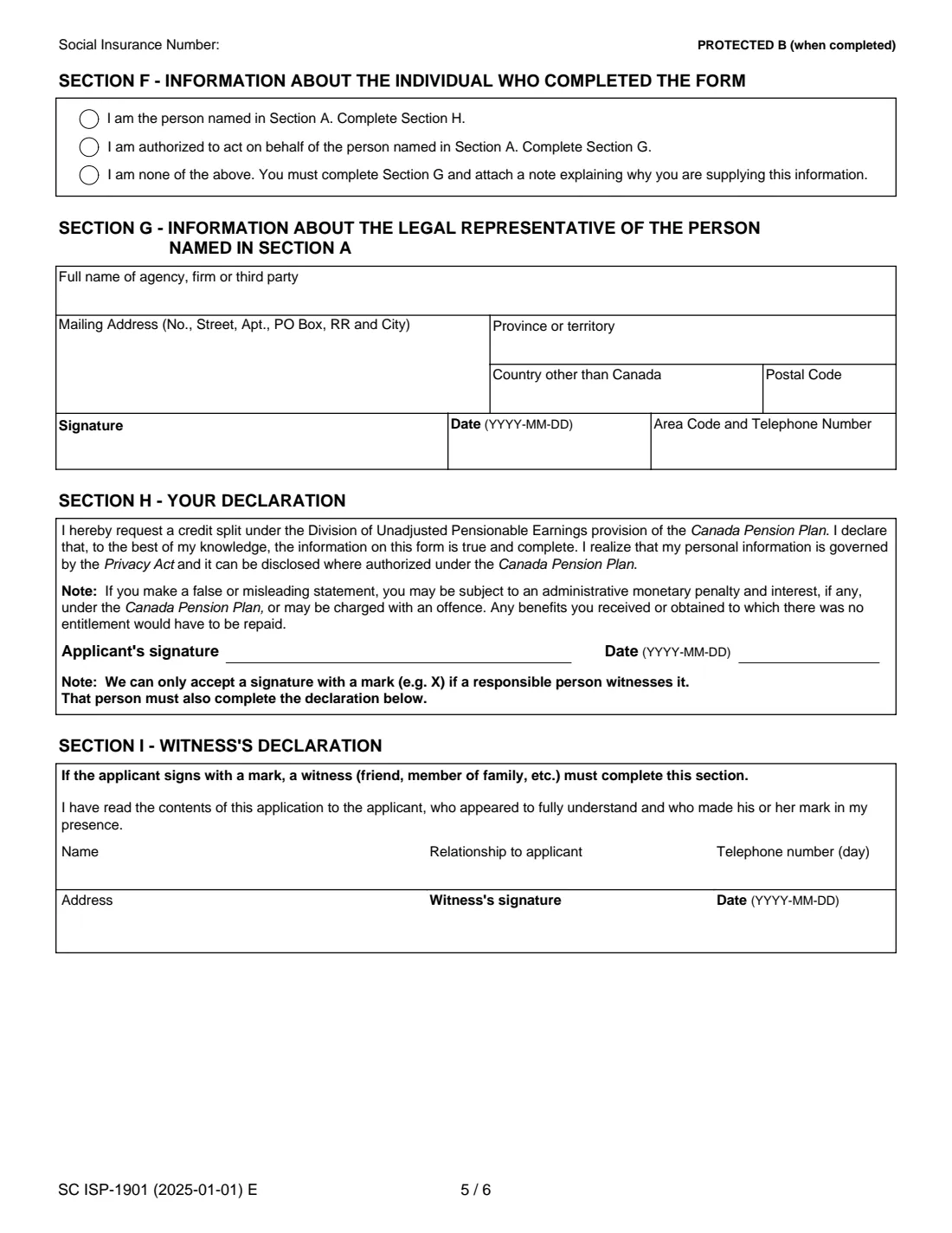
The form has six pages (plus the Service Canada office list): Section A about you, Section B about your spouse, former spouse or former common-law partner, Section C for a legal marriage or Section D for a common-law union (with periods apart), Section E about any written agreement or court order, Section F on who completed the form, Section G for a legal representative, Section H your declaration, and Section I for a witness.
FileIt walks you through each section in plain English and prints your answers into Service Canada's official ISP-1901 PDF. It shows only the marriage or common-law section that applies, checks that your dates are in order, and prints accented names correctly. The finished PDF is saved in your vault, ready to print and sign in pen. You then mail it with your documents: FileIt never submits it.
- Who fills it
- A spouse, former spouse or former common-law partner asking for the division, or their legal representative
- Given to
- Service Canada, by mail (office addresses on the last page)
- Documents
- Marriage certificate, divorce or annulment judgment, or the statutory declarations the information sheet lists
- Permanent
- Yes: the form says the division of credits is permanent
- Edition
- SC ISP-1901 (2025-01-01) E
- Survivor's pension
- A credit split approved with a separated legal spouse on or after January 1, 2025 rules out a CPP survivor's pension on that spouse's death
Who needs to fill out ISP-1901 CPP credit split?
- Divorced people, or people whose marriage was annulled, who lived with their former spouse for at least 12 consecutive months.
- Married people who have been separated for at least 12 consecutive months after living together for at least 12 consecutive months.
- Former common-law partners who lived together for at least 12 consecutive months and have lived apart for at least 12 consecutive months.
- A legal representative acting for the person asking for the split.
When to use ISP-1901 CPP credit split
- After a divorce or annulment on or after January 1, 1987: the information sheet says there is no time limit.
- After a separation from a legal spouse: no time limit, unless the spouse dies, in which case you must apply within 36 months of the death.
- After a common-law union ends: within 48 months of the date you began living apart, unless your former partner is alive and agrees in writing to waive that limit.
- As soon as possible in any case, as the information sheet recommends.
What you need before you start
- Both people's Social Insurance Numbers (or what you know of your former spouse's details), dates of birth and addresses.
- The date of your marriage and the country where it took place, or the dates your common-law union began and ended.
- The date you last lived together, and the date your marriage ended if it has.
- Any periods when you did not live together, and any common-law period before the marriage.
- Details of any written agreement or court order about dividing pension credits, and a copy of the written agreement.
- Your marriage certificate and divorce judgment, or the Statutory Declaration of Legal Marriage, Separation of Legal Spouses or Common-law Union.
What’s on ISP-1901 CPP credit split
The 2025 edition has 7 pages. FileIt asks for it in 6 parts:
- Section A: Information about youApplicant
- Section B: Your spouse, former spouse or former common-law partnerApplicant
- Sections C and D: Your marriage or common-law unionApplicant
- Section E: Written agreement or court orderApplicant
- Sections F, G and H: Who completed the form, and the declarationApplicant
- Section I: Witness's declarationWitness
How to fill out ISP-1901 CPP credit split, step by step
1 Section A: Information about you (1 to 8)
Your Social Insurance Number, sex (optional), date and country of birth, language preferences, names, addresses, the last province you lived in if you live abroad, telephone numbers, email, and whether you have applied for CPP, Old Age Security or QPP benefits or receive a CPP survivor's benefit from your former spouse.
2 Section B: Your spouse, former spouse or former common-law partner (9 to 17)
The same identity details for the other person, their benefits, and whether they are still alive (with the place and date of death if not; proof of death is required). The information sheet notes that separated spouses are still spouses, not former spouses.
3 Section C: A legal marriage (18 to 21)
The date and country of the marriage, the date you last lived together, the date the marriage ended if it has, up to four periods apart during the marriage with the reason, and up to two common-law periods before the marriage.
4 Section D: A common-law union (22 to 24)
Only if the credits were built up in a common-law union: the dates it began and ended, and up to four periods apart with the reason. FileIt shows Section C or Section D depending on your answer, as the form instructs.
5 Section E: Written agreement or court order (25)
Whether you entered into a written agreement, or a court order was made, about dividing pension credits, and if so the province and date. The form asks for a copy of the written agreement.
6 Sections F to I: Who completed the form, and signatures
Section F says whether you are the person in Section A (you sign Section H) or a representative (Section G). Section I is completed by a witness only if the applicant signs with a mark.
Common mistakes to avoid
- Missing the time limit for a common-law union (48 months after you began living apart) or after a separated spouse's death (36 months).
- Applying before being separated for at least 12 consecutive months, where that rule applies.
- Forgetting the marriage certificate, divorce judgment or statutory declaration.
- Leaving out periods when you did not live together, since the credits are split only for the years you lived together.
- Not realising the split is permanent and, for a separated legal spouse approved on or after January 1, 2025, ends eligibility for a CPP survivor's pension on that spouse's death.
After you fill it out
Print the PDF and sign Section H in pen (or the representative signs Section G).
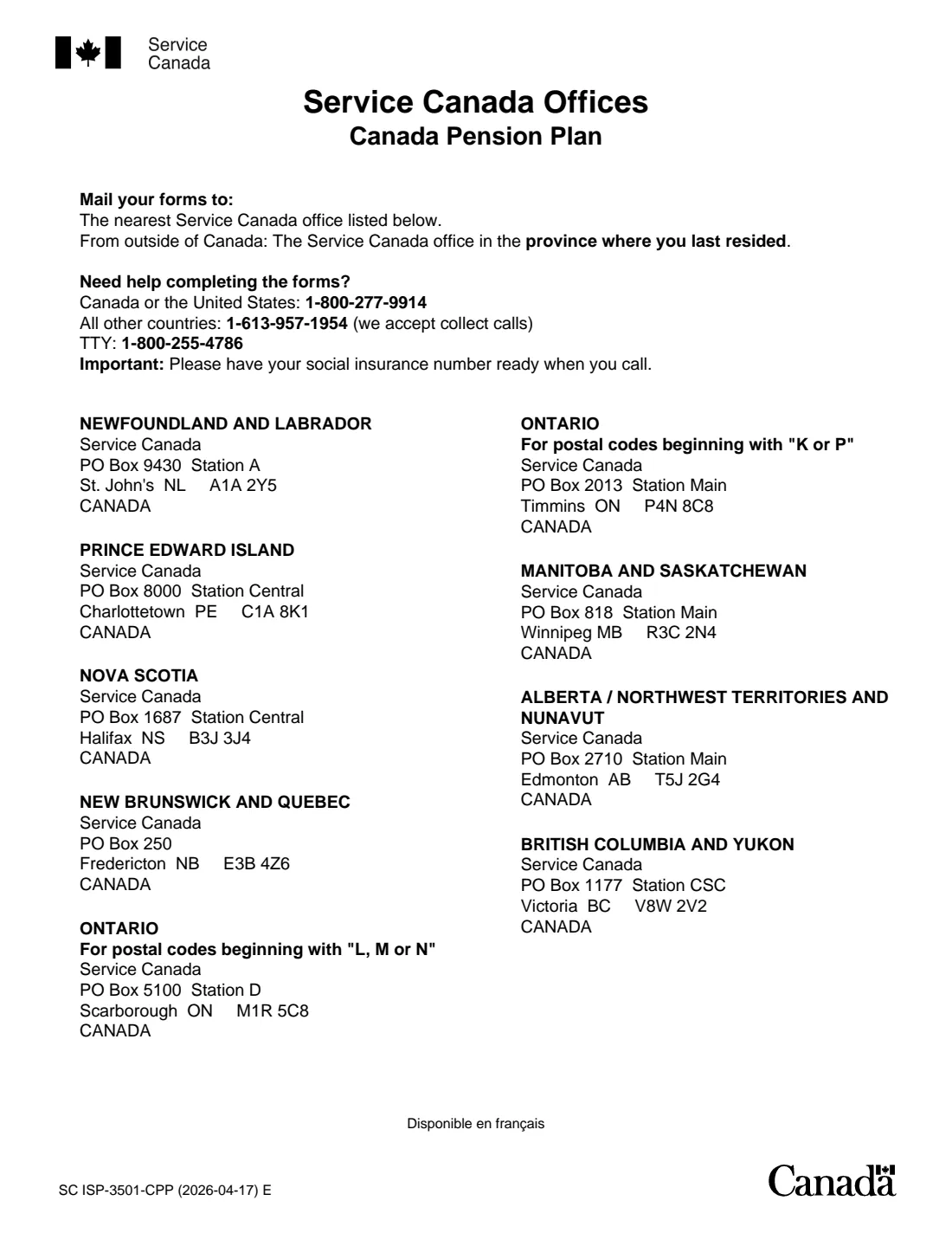
Mail it to the nearest Service Canada office listed on the last page, with the documents the information sheet lists. FileIt does not send anything to Service Canada.
Keep the completed PDF in your FileIt vault. The information sheet says the division takes effect on the first day of the month after the Minister receives the necessary information.
Fill out ISP-1901 CPP credit split online with FileIt
- Pick the person. Choose someone from People and FileIt fills in their name, date of birth, address and other details it already knows.
- Answer plain-language questions. One part of the form at a time, with the official help text beside each question — 121 fields in all. Your answers save as you go.
- Check the live preview. Watch your answers land on the real Service Canada, for Employment and Social Development Canada (ESDC) form, and let FileIt do any worksheet arithmetic.
- Generate the official PDF. FileIt prints your answers into the agency’s own PDF and files it in that person’s folder in your vault.
FileIt fills the form — it never files or submits anything for you. Deliver the finished form to whoever asked for it, the way the form’s instructions say.
Start ISP-1901 CPP credit split now — it’s freeISP-1901 CPP credit split: frequently asked questions
What is a CPP credit split?
It is the equal division of the Canada Pension Plan credits that you and your spouse, former spouse or former common-law partner built up during the time you lived together, after a divorce, annulment, separation or the end of a common-law union.
Is there a time limit to apply?
After a divorce or annulment on or after January 1, 1987, and after a separation from a legal spouse, there is no time limit, unless the separated spouse dies, in which case you must apply within 36 months. After a common-law union ends, you must apply within 48 months of the date you began living apart, unless your former partner agrees in writing to waive it.
Can a credit split lower my pension?
Yes, in some cases. The information sheet says a split may help you qualify for a benefit or increase it, but can sometimes decrease the amount you receive. The division is permanent.
Does my former spouse have to agree?
No signature from them is needed on this form. After a divorce or annulment, the credits must be split once Service Canada has the information, unless there is a valid written agreement signed in a province that allows such agreements.
Can I cancel a credit split?
After a separation or the end of a common-law union (not a divorce or annulment), the information sheet says the applicant can ask to withdraw within 60 days of being notified of the split.
Can I fill out ISP-1901 online with FileIt?
Yes. FileIt guides you through every section and prints your answers into Service Canada's official PDF. You then print it, sign it in pen and mail it. FileIt never submits it.
Official sources
- Blank form (PDF), published by Service Canada, for Employment and Social Development Canada (ESDC): https://catalogue.servicecanada.gc.ca/apps/EForms/pdf/en/ISP-1901.pdf
- Official instructions and guidance: https://www.canada.ca/en/services/benefits/publicpensions/cpp/cpp-credit-split.html
- Edition shown on this page: SC ISP-1901 (2025-01-01) E (checked 2026-09-28).
FileIt is not affiliated with or endorsed by Service Canada, for Employment and Social Development Canada (ESDC) or any government. This page explains the form in general terms and is not legal, tax or immigration advice. Always read the official instructions, and check that you are using the edition the recipient accepts. Page last reviewed 2026-09-28.