What is ISP-1200 CPP death benefit?
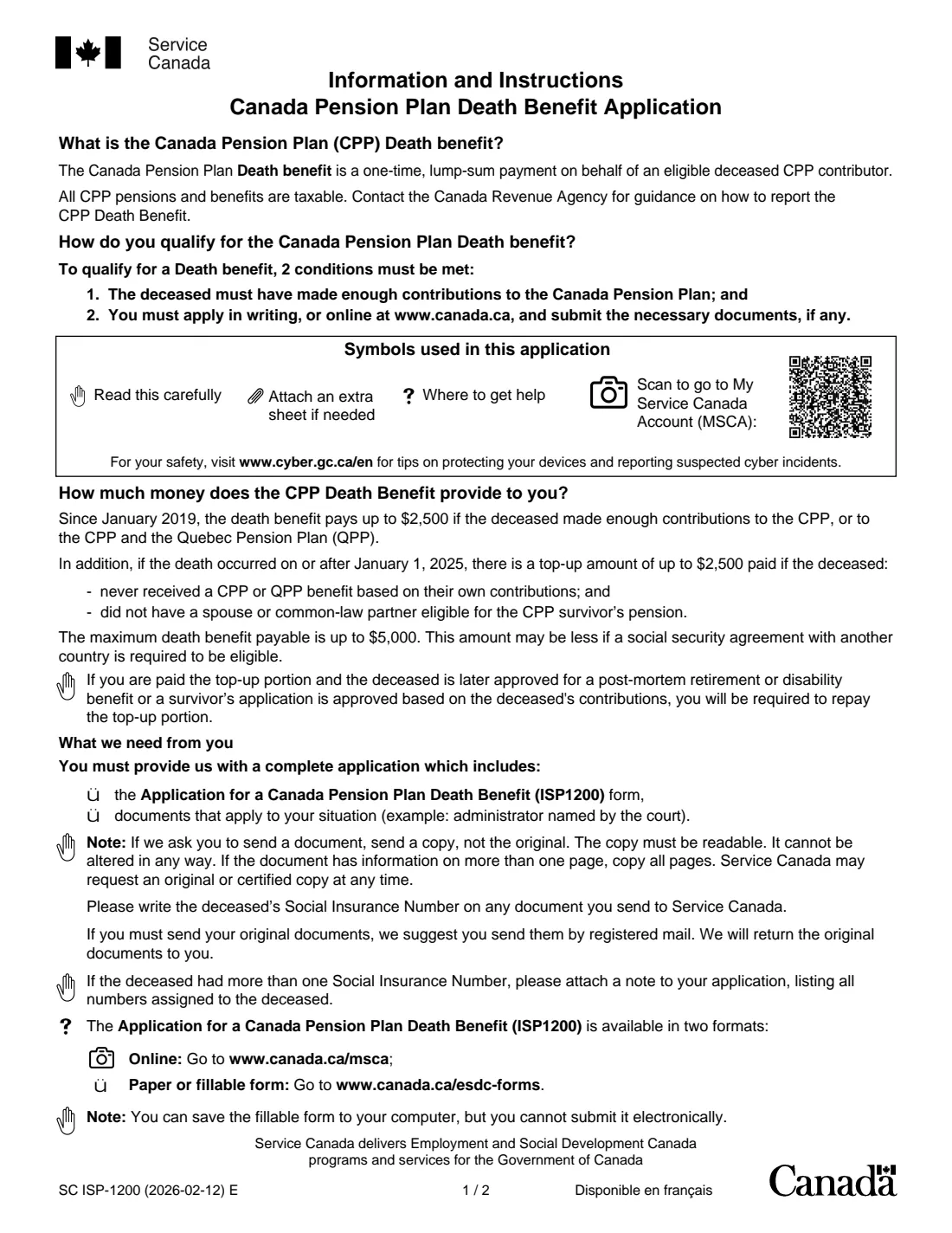
Form ISP-1200 applies for the Canada Pension Plan (CPP) death benefit, a one-time, lump-sum payment on behalf of a deceased contributor who made enough CPP contributions. The form's information sheet says the benefit pays up to $2,500, and that for deaths on or after January 1, 2025 a top-up of up to $2,500 may be paid if the deceased never received a CPP or QPP benefit based on their own contributions and had no spouse or common-law partner eligible for the survivor's pension, for a maximum of $5,000.
The application runs seven pages within a 12-page file that also contains information pages and the Service Canada office list. It asks about the deceased (Section A), any life or work in another country (B), the will, executor and funeral expenses and who is applying (C), tax slips and anyone higher in priority choosing not to apply (D), your declaration (E), a witness (F) and a checklist.
FileIt walks you through each part in plain English and prints your answers into Service Canada's official ISP-1200 PDF. The deceased's details can be pre-filled from their People record in your vault, accented names print correctly, and FileIt checks that your basis for applying matches your answers about the will and the funeral. The finished PDF is saved in the deceased's vault folder, ready to print and sign in pen. You then mail it or drop it off: FileIt never submits it.
- Who fills it
- The executor or court-appointed administrator; otherwise the funeral payer, the surviving spouse or partner, or the next of kin
- Given to
- Service Canada, by mail or at an office (addresses on the last page)
- Amount
- Up to $2,500, plus a possible top-up of up to $2,500 for deaths on or after January 1, 2025 (maximum $5,000)
- Executor timing
- The executor should apply within 60 days of the death, after which others can be considered
- Edition
- SC ISP-1200 (2026-02-12) E
- Signatures
- The applicant, in pen; a witness only for a signature by mark
Who needs to fill out ISP-1200 CPP death benefit?
- The executor named in the will, or the administrator appointed by the court, applying for the estate.
- The person or institution responsible for the funeral expenses, when there is no will or 60 days have passed since the death.
- The surviving spouse or common-law partner, when they did not pay for the funeral.
- The next of kin, when none of the above applies.
When to use ISP-1200 CPP death benefit
- Soon after the death of someone who contributed to the Canada Pension Plan.
- Within 60 days of the death if you are the executor or court-appointed administrator.
- After 60 days, if the executor has not applied, when you paid for the funeral or are the surviving spouse or next of kin.
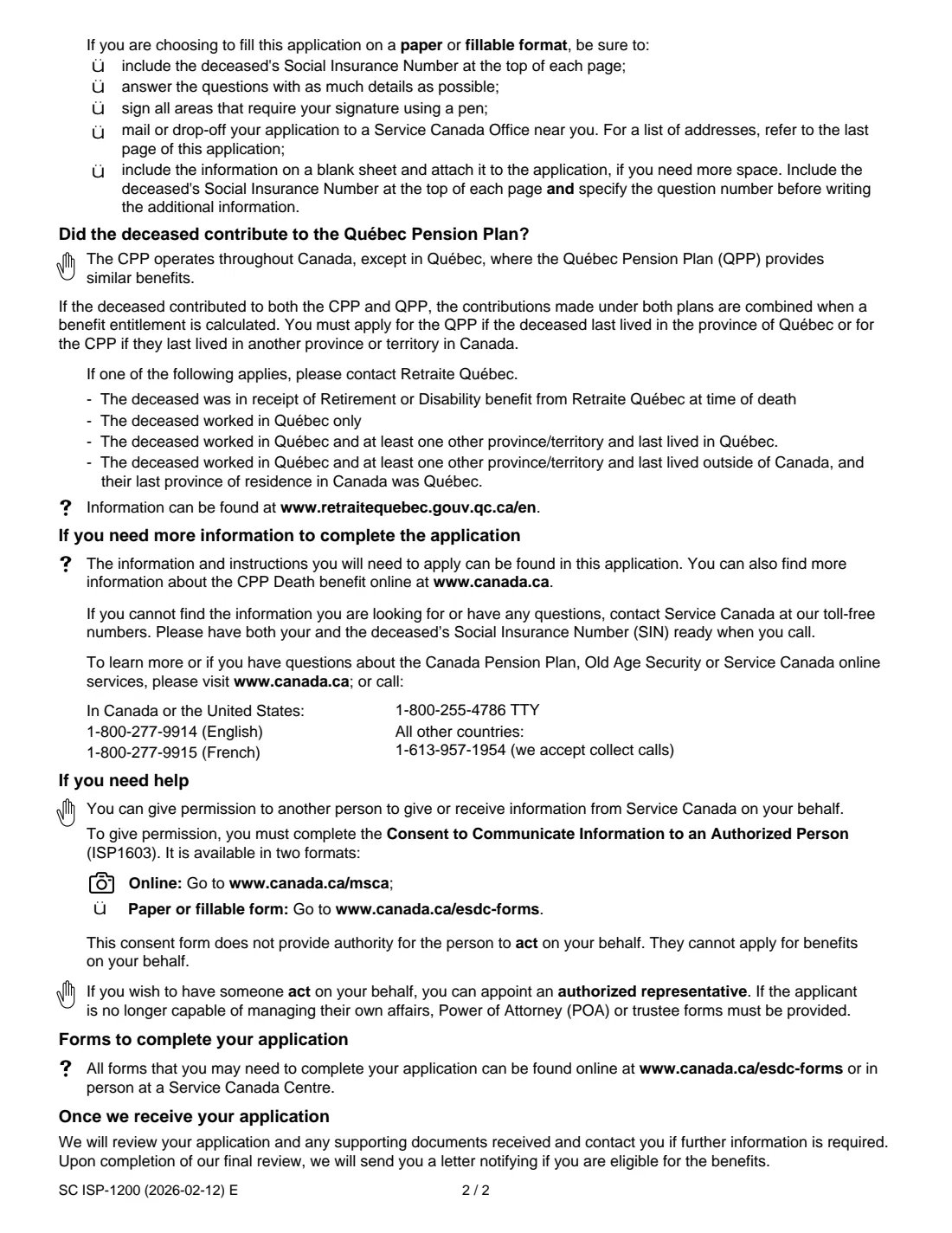
- Not when the deceased last lived in Quebec or worked only in Quebec: the form says to contact Retraite Québec in those cases.
What you need before you start
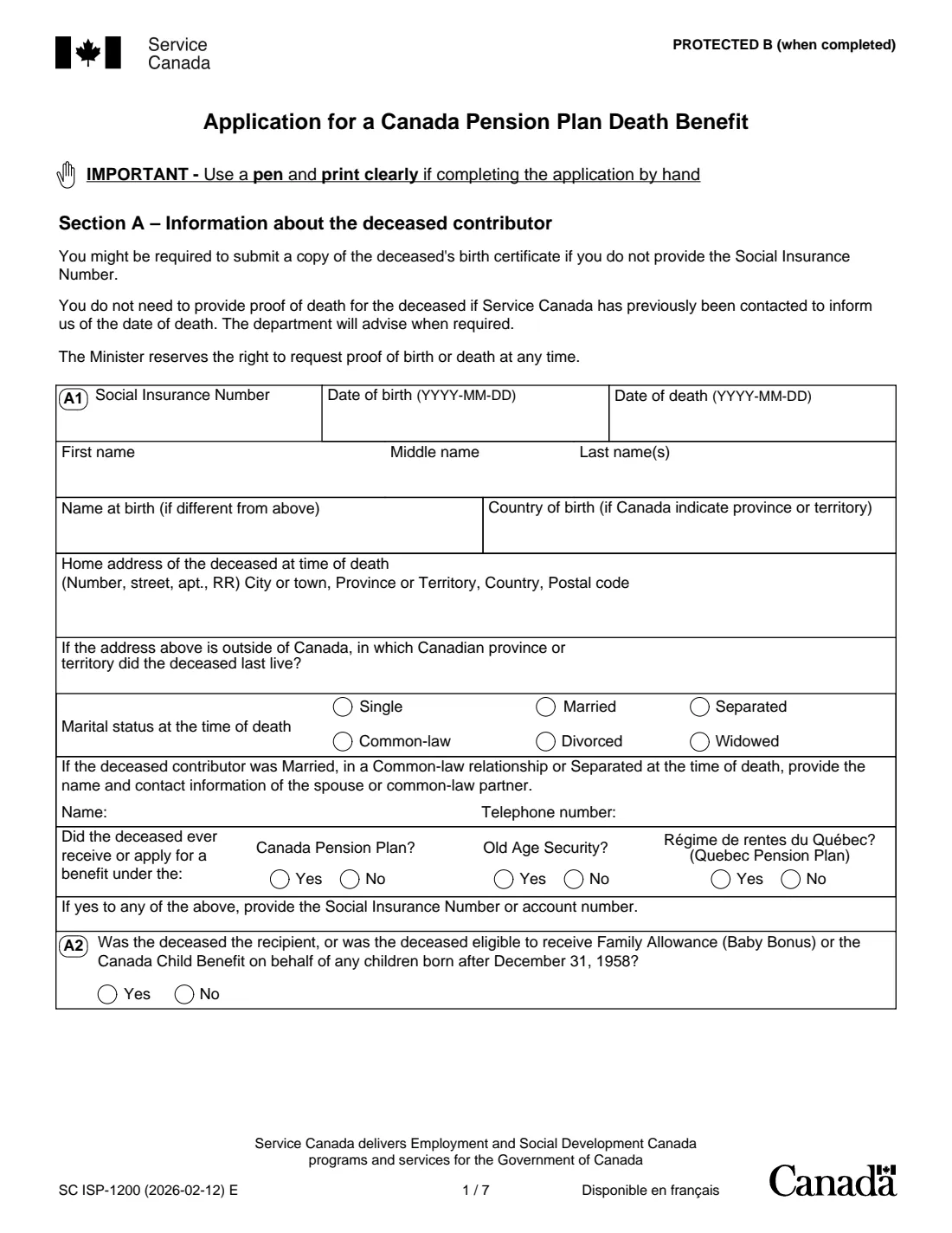
- The deceased's Social Insurance Number, date of birth, date of death, names, country of birth and last home address.
- The deceased's marital status and their spouse's or partner's name and telephone number, if any.
- Whether the deceased received CPP, Old Age Security or QPP benefits, and the number they were under.
- Countries where the deceased lived or worked, with dates and their identification number there.
- Whether there is a will and who the executor is, and the funeral expenses total and provider if you paid.
- Your own contact details and, for direct deposit, the bank details of an account in your name (an estate account for an executor).
- Proof of death, only if Service Canada has not already been told of the death.
What’s on ISP-1200 CPP death benefit
The 2026 edition has 12 pages. FileIt asks for it in 9 parts:
- Section A: The deceased contributorApplicant
- Section B: Living or working in another countryApplicant
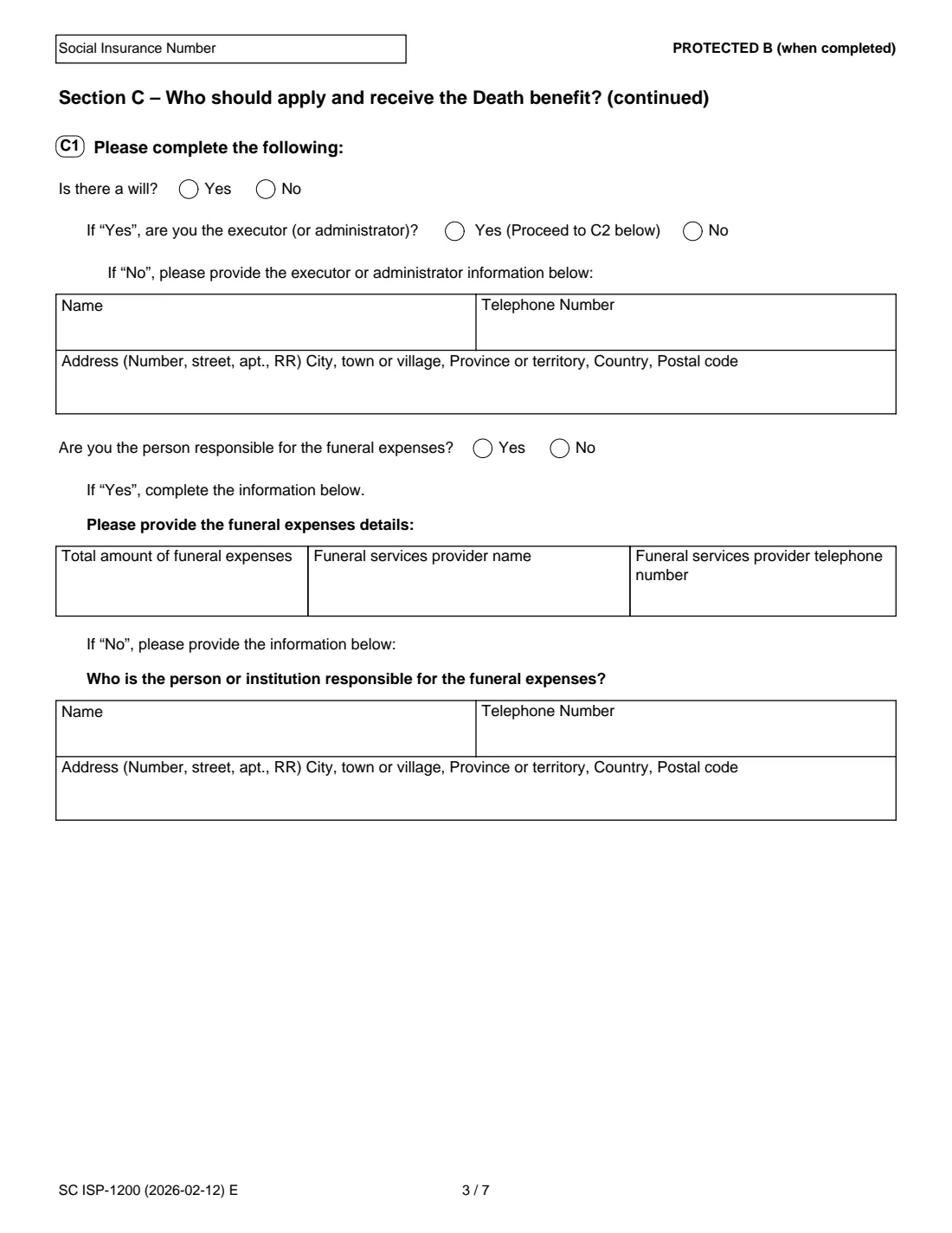
- Section C1: The will, the executor and the funeral expensesApplicant
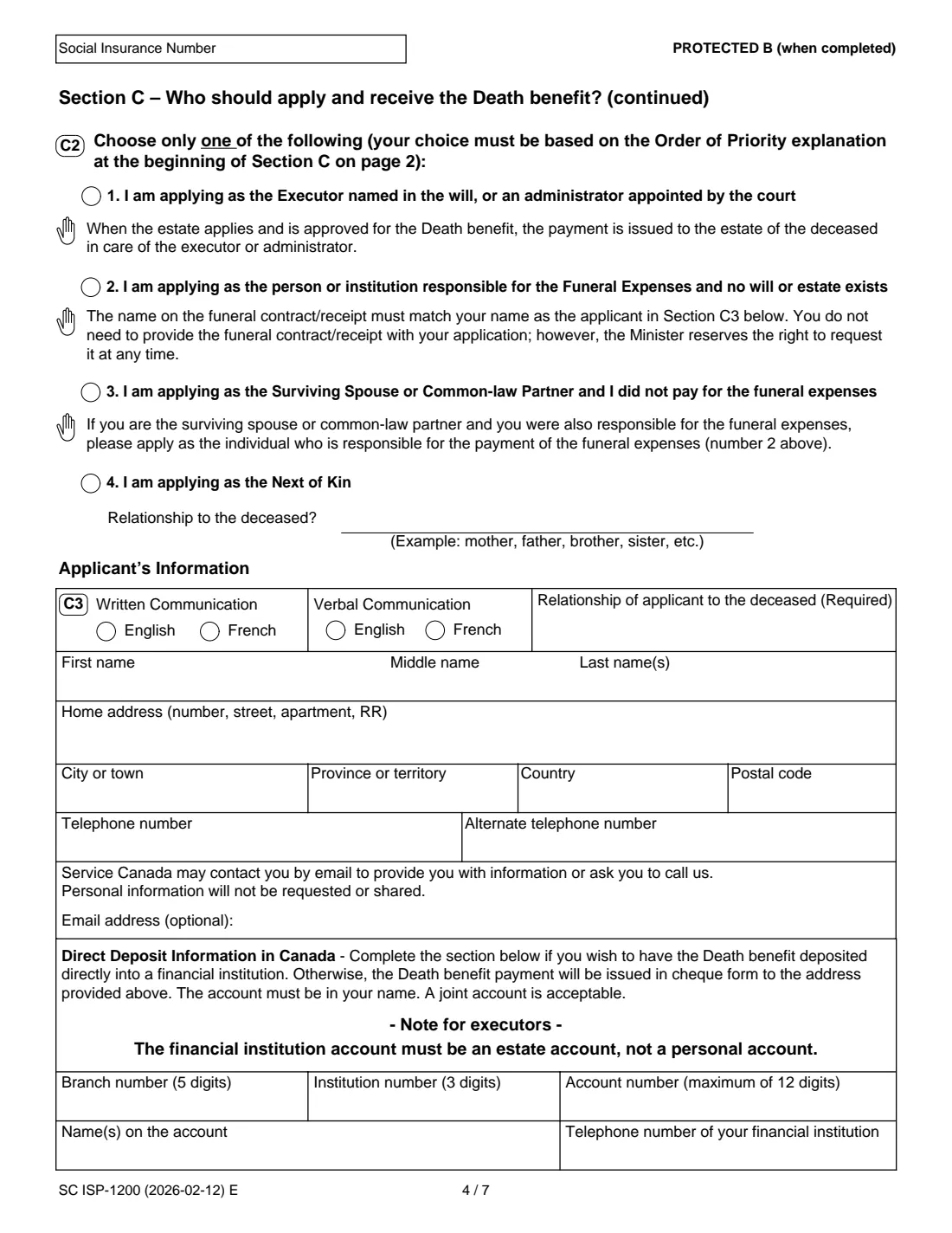
- Sections C2 and C3: You, the applicantApplicant
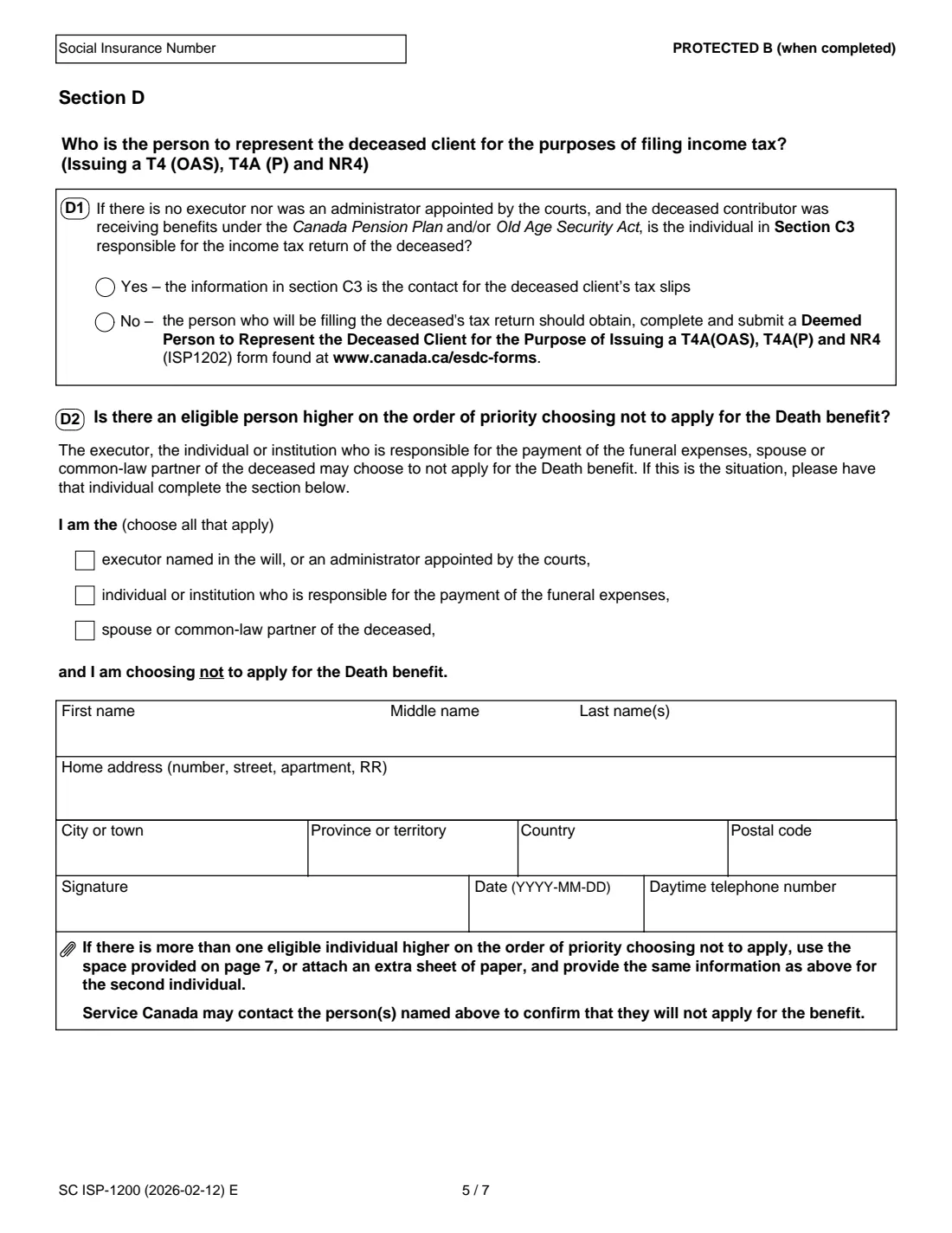
- Section D1: Tax slips for the deceasedApplicant
- Section D2: A person higher in priority choosing not to applyPerson choosing not to apply
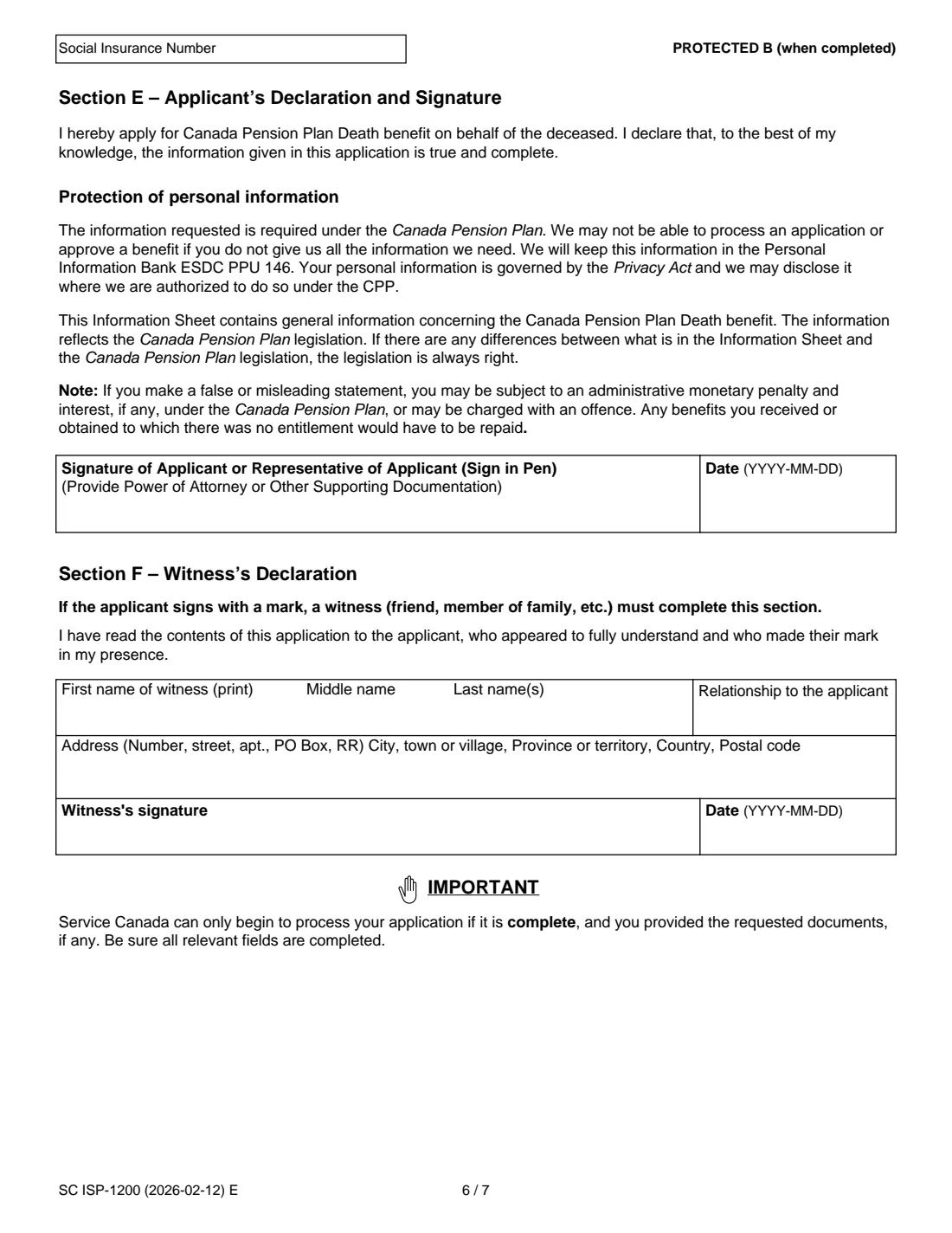
- Section E: Your declarationApplicant
- Section F: Witness's declarationWitness
- Checklist and more informationApplicant
How to fill out ISP-1200 CPP death benefit, step by step
1 Section A: The deceased contributor
The deceased's Social Insurance Number, dates of birth and death, names, name at birth, country of birth, home address at the time of death, the last province lived in if the address was abroad, marital status, the spouse's or partner's name and telephone number, their CPP, OAS and QPP benefits, and question A2 on Family Allowance or the Canada Child Benefit (the child-rearing provision).
2 Section B: Another country
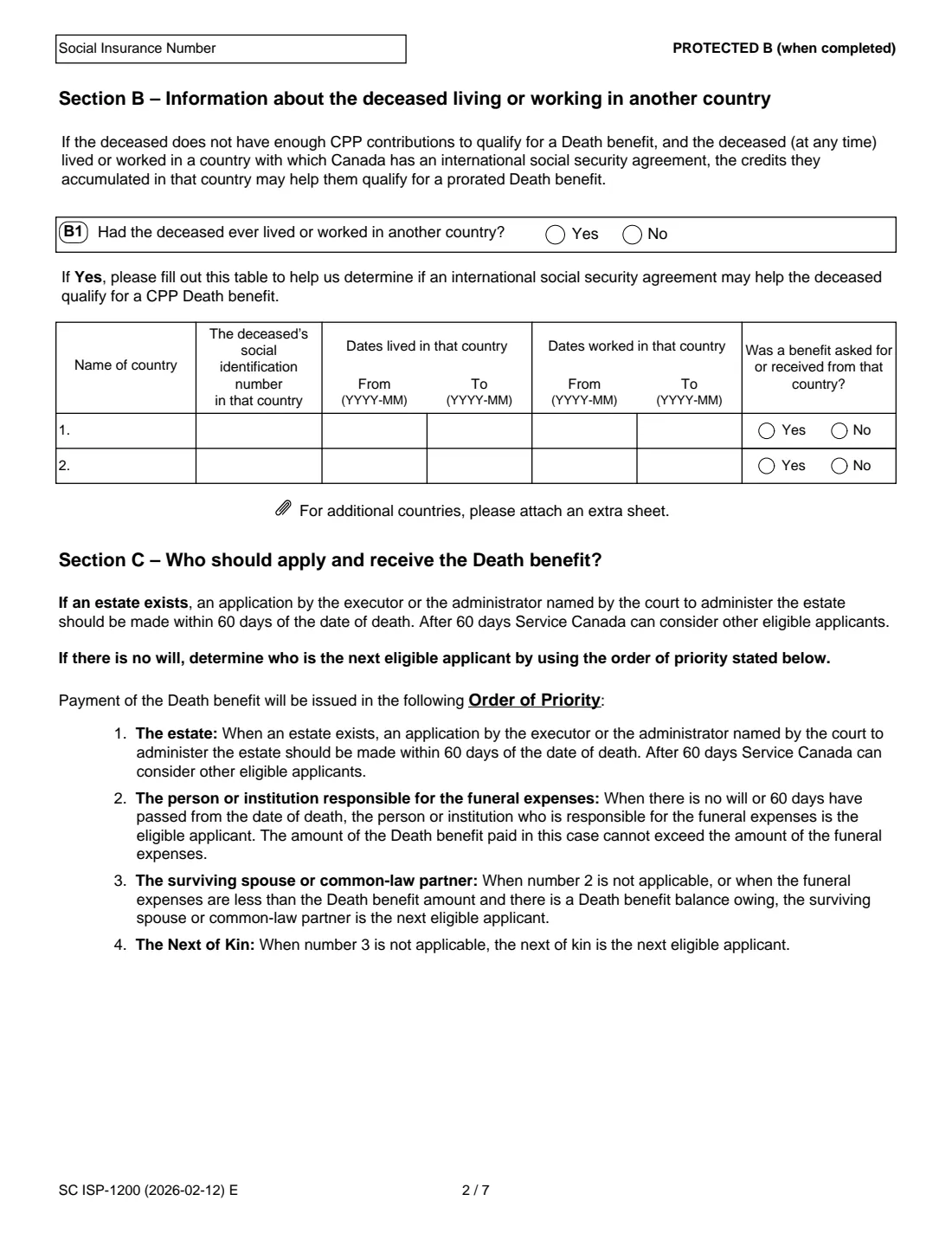
Whether the deceased ever lived or worked in another country and, if so, up to two countries with their identification number, the months lived and worked there, and whether a benefit was asked for. A social security agreement may help them qualify for a prorated benefit.
3 Section C1: Will, executor and funeral
Whether there is a will and whether you are the executor (if not, the executor's details), and whether you are responsible for the funeral expenses (if yes, the total, the funeral provider and its telephone number; if not, who is).
4 Sections C2 and C3: You, the applicant
Choose one basis for applying, following the order of priority: executor, person responsible for the funeral expenses, surviving spouse or partner who did not pay for the funeral, or next of kin. Then give your language preferences, relationship to the deceased, name, address, telephone numbers, email and optional direct deposit details.
5 Section D: Tax slips and waivers
D1 asks whether you are responsible for the deceased's tax return when there is no executor. D2 is completed and signed by a person higher in priority, such as the executor or the spouse, who is choosing not to apply.
6 Sections E and F, and the checklist
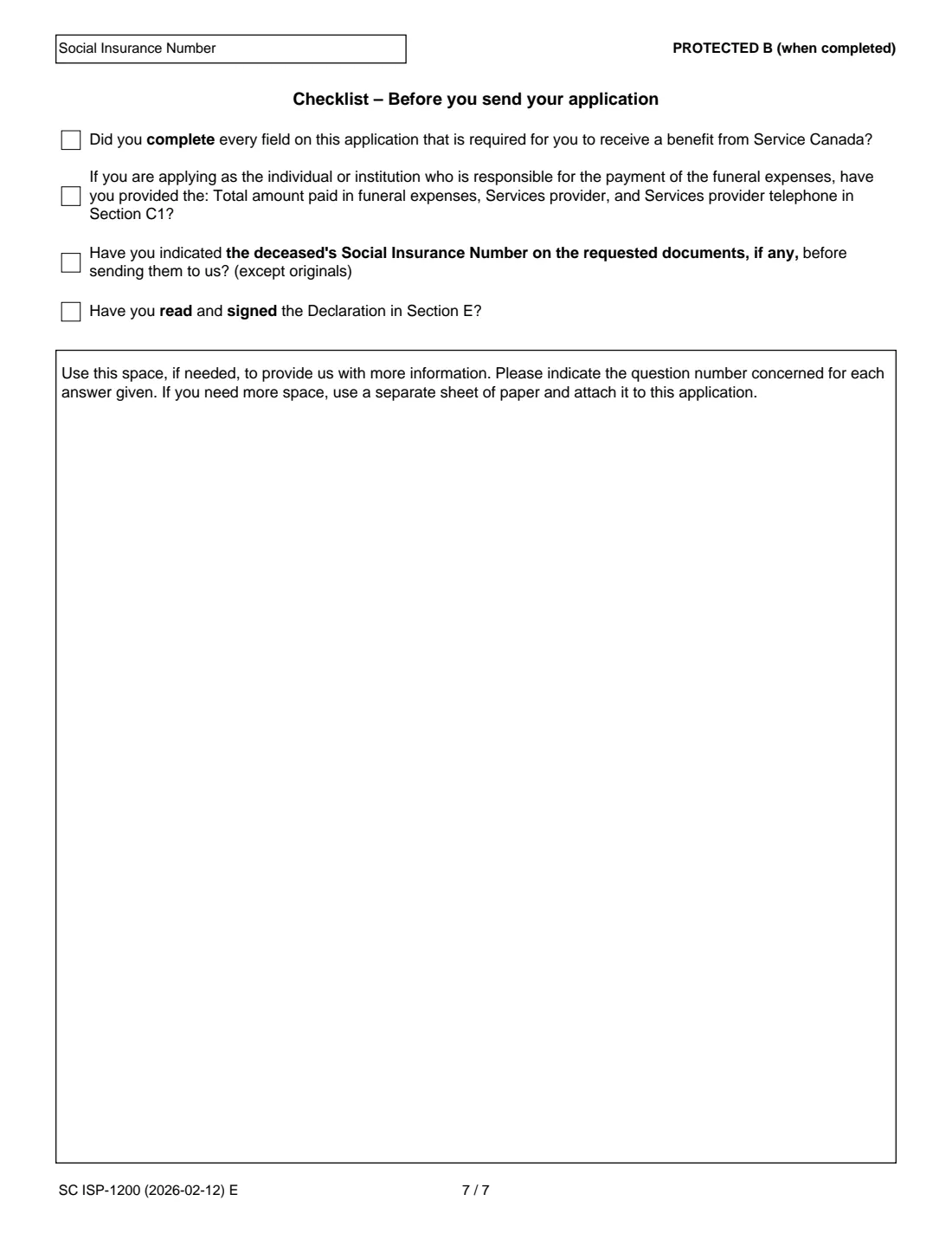
You sign the declaration in pen (a representative provides a power of attorney or other documentation). A witness completes Section F only for a signature by mark. The checklist and a page for more information end the application.
Common mistakes to avoid
- Choosing a basis for applying that skips someone higher in the order of priority, without their Section D2 waiver.
- Applying as the surviving spouse when you also paid for the funeral: the form says to apply as the person responsible for the funeral expenses.
- Leaving out the funeral expenses total, provider and telephone number when applying as the funeral payer.
- An executor giving a personal bank account instead of an estate account.
- Using this form when the deceased last lived in Quebec, where Retraite Québec handles the benefit.
After you fill it out
Print the PDF and sign Section E in pen.
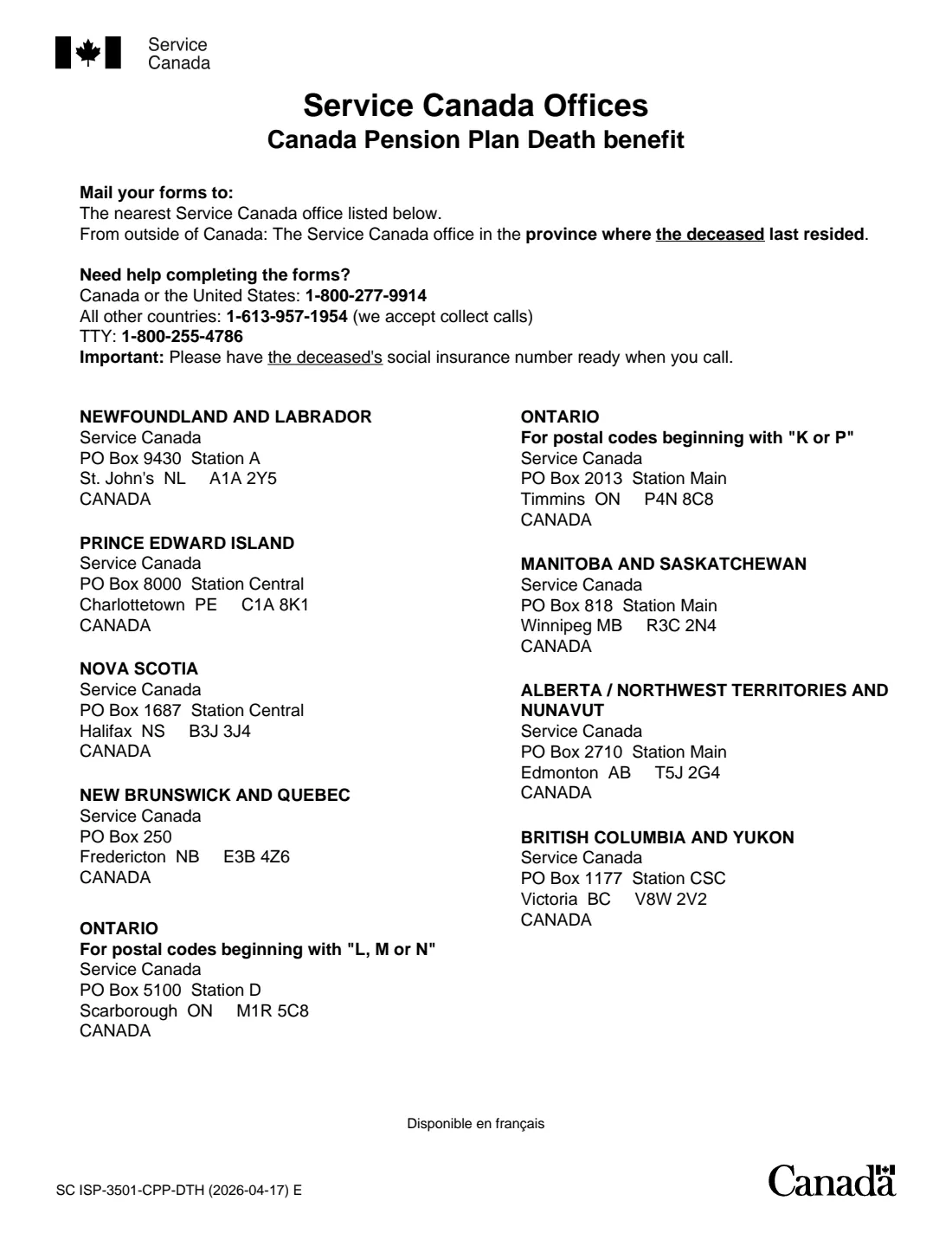
Mail it, or drop it off, at the nearest Service Canada office listed on the last page. From outside Canada, send it to the office for the province where the deceased last lived. Include any documents asked for, with the deceased's Social Insurance Number written on them. FileIt does not send anything to Service Canada.
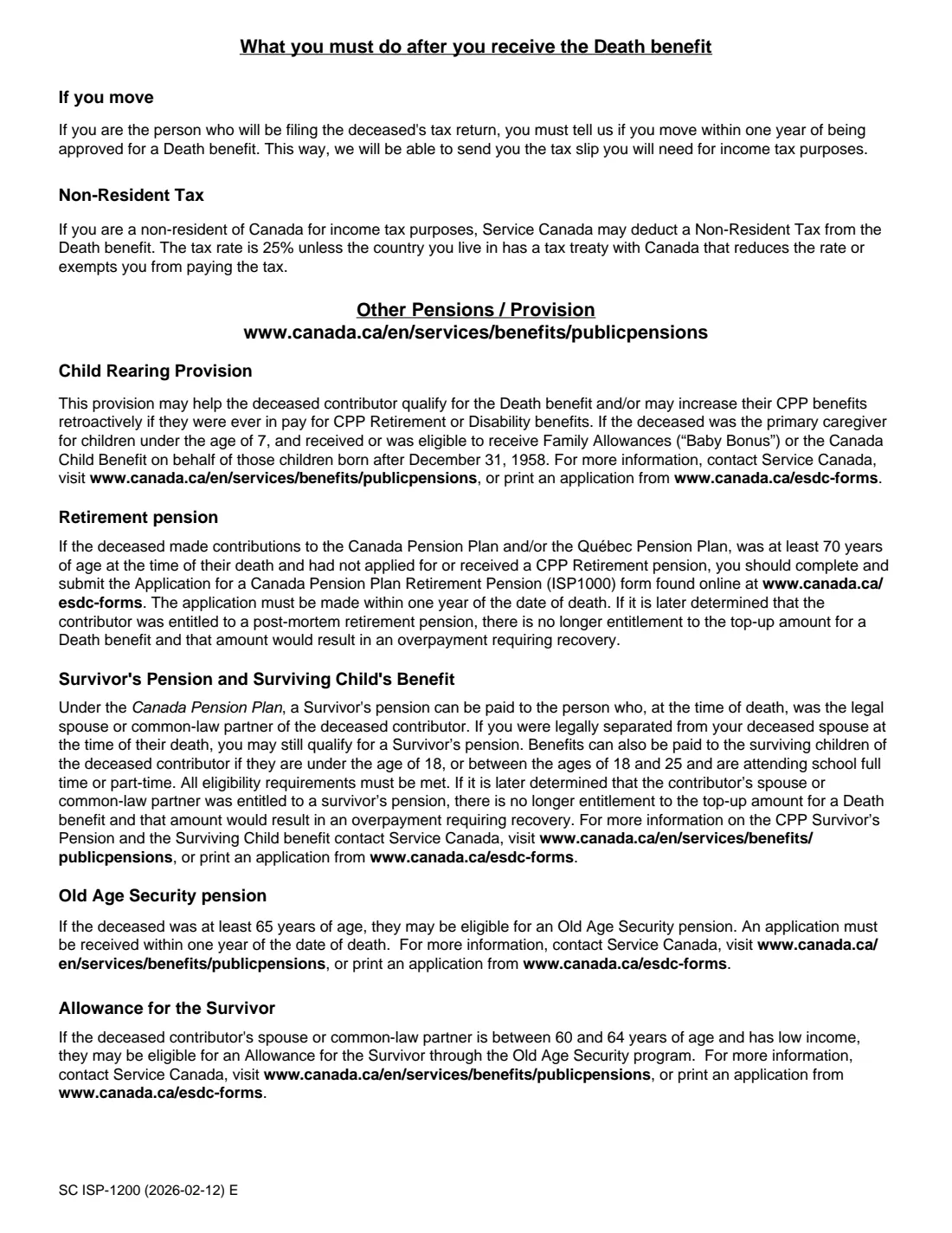
Keep the completed PDF in the deceased's folder in your FileIt vault. If you will file the deceased's tax return, tell Service Canada if you move within a year of approval, so the tax slip reaches you.
Fill out ISP-1200 CPP death benefit online with FileIt
- Pick the person. Choose someone from People and FileIt fills in their name, date of birth, address and other details it already knows.
- Answer plain-language questions. One part of the form at a time, with the official help text beside each question — 92 fields in all. Your answers save as you go.
- Check the live preview. Watch your answers land on the real Service Canada, for Employment and Social Development Canada (ESDC) form, and let FileIt do any worksheet arithmetic.
- Generate the official PDF. FileIt prints your answers into the agency’s own PDF and files it in that person’s folder in your vault.
FileIt fills the form — it never files or submits anything for you. Deliver the finished form to whoever asked for it, the way the form’s instructions say.
Start ISP-1200 CPP death benefit now — it’s freeISP-1200 CPP death benefit: frequently asked questions
How much is the CPP death benefit?
The form's information sheet says up to $2,500, plus, for deaths on or after January 1, 2025, a top-up of up to $2,500 if the deceased never received a CPP or QPP benefit based on their own contributions and had no spouse or partner eligible for the survivor's pension. The maximum is $5,000, and it may be less if a social security agreement is needed to qualify.
Who should apply?
The executor or court-appointed administrator of the estate, within 60 days of the death. If there is no will, or 60 days have passed, the person or institution responsible for the funeral expenses, then the surviving spouse or common-law partner, then the next of kin.
Is the death benefit taxable?
Yes. The information sheet says all CPP pensions and benefits are taxable and to contact the Canada Revenue Agency on how to report it.
Do I need to send a death certificate?
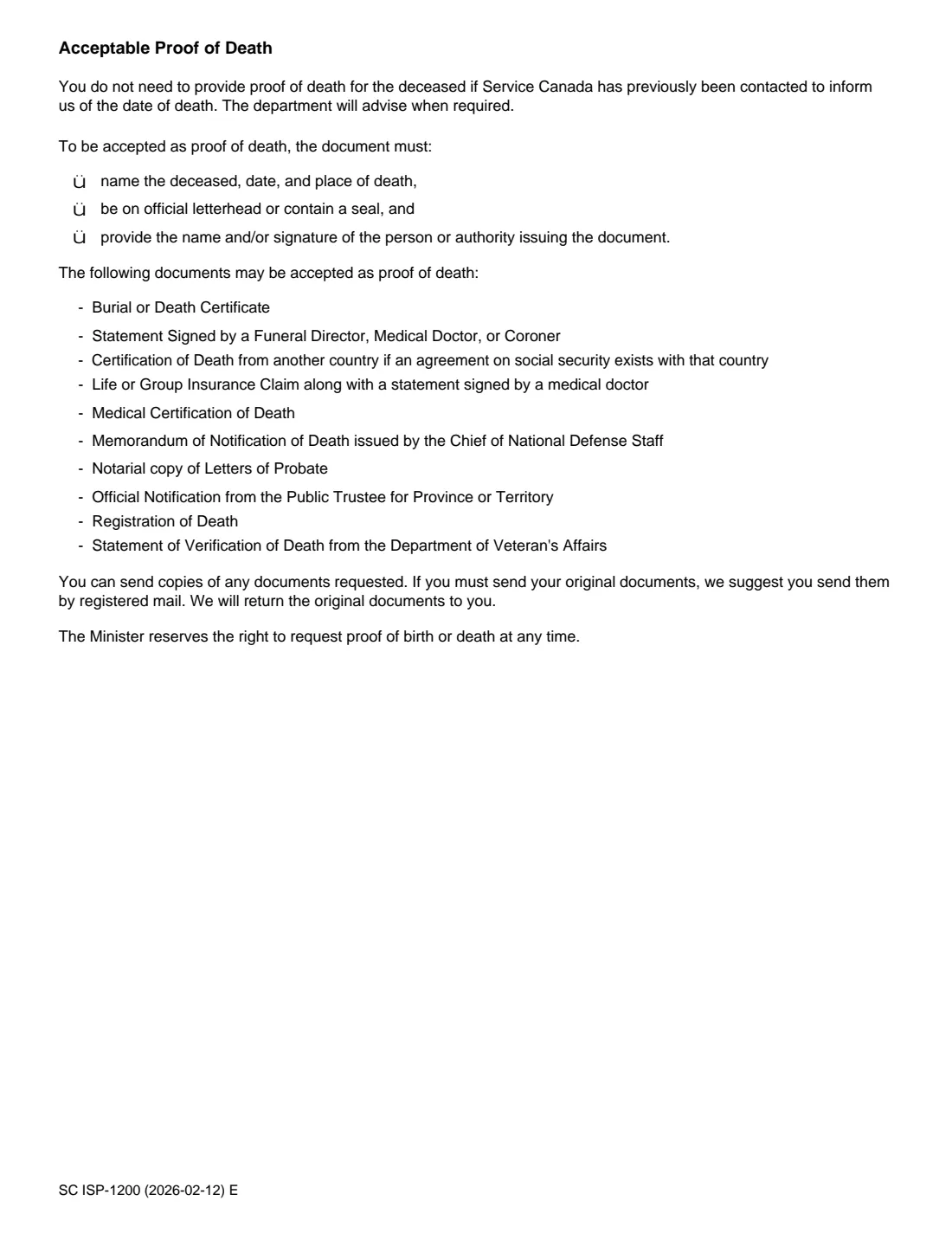
Not if Service Canada has already been told of the date of death; it will tell you if proof is needed. The form lists the documents accepted as proof of death.
Can I apply online instead?
Yes. The form mentions applying online through My Service Canada Account. The paper or fillable form cannot be submitted electronically, so it must be mailed or dropped off.
Can I fill out ISP-1200 with FileIt?
Yes. FileIt guides you through every section and prints your answers into Service Canada's official PDF. You then print it, sign it in pen and mail it. FileIt never submits it.
Official sources
- Blank form (PDF), published by Service Canada, for Employment and Social Development Canada (ESDC): https://catalogue.servicecanada.gc.ca/apps/EForms/pdf/en/ISP-1200.pdf
- Official instructions and guidance: https://www.canada.ca/en/services/benefits/publicpensions/cpp/cpp-death-benefit.html
- Edition shown on this page: SC ISP-1200 (2026-02-12) E (checked 2026-09-28).
FileIt is not affiliated with or endorsed by Service Canada, for Employment and Social Development Canada (ESDC) or any government. This page explains the form in general terms and is not legal, tax or immigration advice. Always read the official instructions, and check that you are using the edition the recipient accepts. Page last reviewed 2026-09-28.