What is ISP-3550 OAS and GIS application?
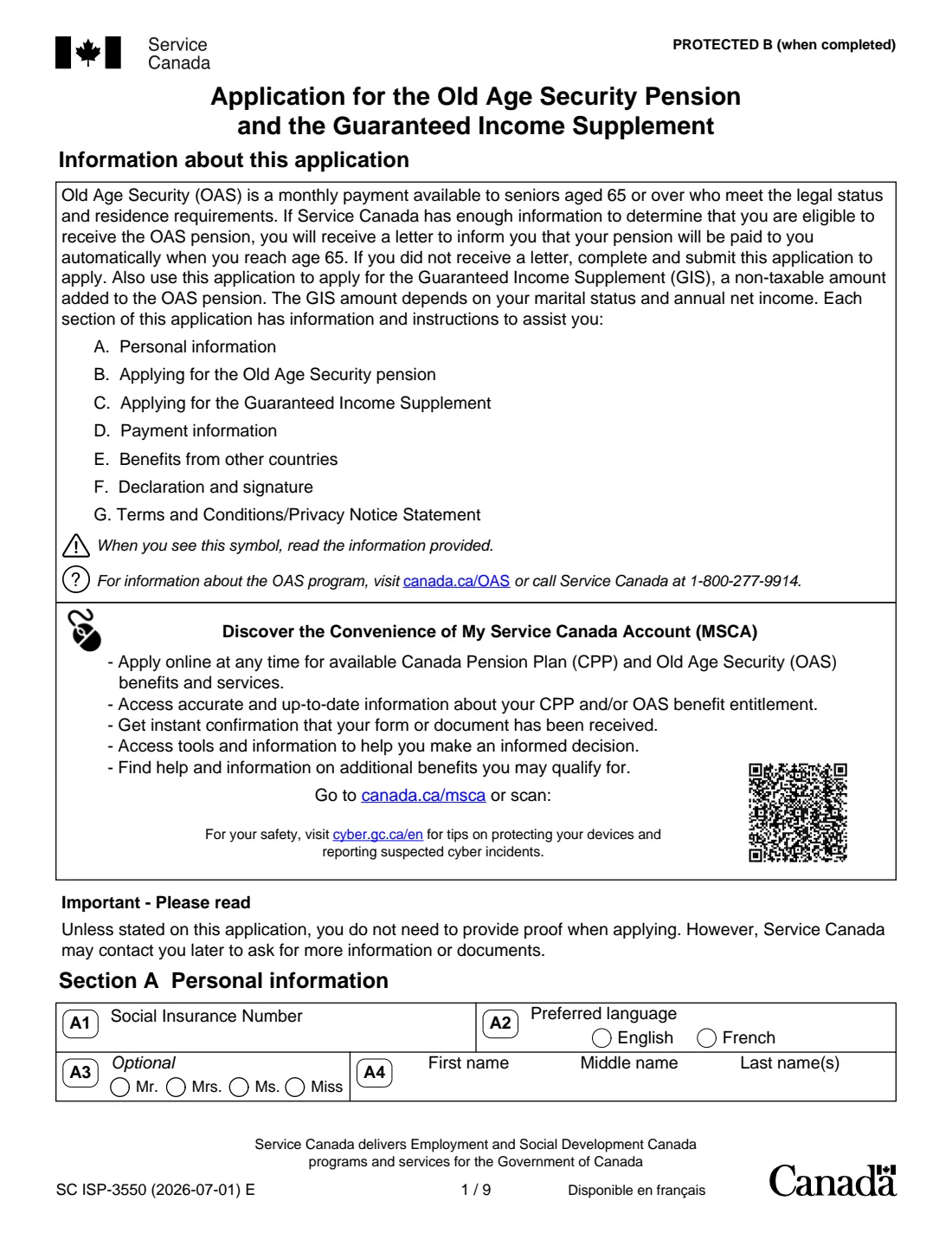
Form ISP-3550 is Service Canada's application for the Old Age Security (OAS) pension, the monthly payment for seniors aged 65 or over who meet the legal status and residence requirements. Many people never need it: when Service Canada already has enough information, it sends a letter saying the pension will start automatically at 65. If you did not receive that letter, this is the form you complete and send in. The same application also covers the Guaranteed Income Supplement (GIS), a non-taxable amount added to the OAS pension for people with lower incomes.
The form runs to nine pages (plus a list of Service Canada office addresses) and moves through personal information, your OAS start date, legal status, sponsorship and residence history, the GIS questions (including a part about your spouse or common-law partner), payment and tax choices, and the declarations. It is a paper form that you mail or drop off at a Service Canada office; Service Canada also offers an online application through My Service Canada Account.
FileIt walks you through each question in plain English and prints your answers into the official ISP-3550 PDF from Service Canada. Names, date of birth and email can be pre-filled from the People records in your FileIt vault, and your residence history, sponsorship details and banking information go into the right boxes. FileIt checks things the form itself states, such as the earliest month your pension can start and the 11-month limit on applying early. The finished PDF is saved in the person's vault folder, ready to print and sign by hand. You then mail it or take it to Service Canada yourself: FileIt never submits it for you.
- Who fills it
- A person aged 65 or over (or about to turn 65) who did not receive a letter saying their OAS pension will start automatically
- Given to
- Service Canada, by mail or in person at a Service Canada office
- When
- Up to 11 months before the month you want your OAS pension to start
- Signatures
- The applicant (F1); the spouse or common-law partner too when applying for the GIS (F2); a witness or authorized person only in special cases (F3)
- Edition
- SC ISP-3550 (2026-07-01) E
- Also covers
- The Guaranteed Income Supplement (GIS), unless you tick the box to opt out
Who needs to fill out ISP-3550 OAS and GIS application?
- People turning 65, or already 65 or older, who have not received a letter from Service Canada saying their OAS pension will be paid automatically.
- Anyone who wants to choose a later start date for the OAS pension, up to age 70, rather than starting as soon as they are eligible.
- Seniors with lower incomes who want to apply for the Guaranteed Income Supplement at the same time as the OAS pension.
- People who were born outside Canada, came to Canada under a sponsorship agreement, or lived abroad after age 18, since the form asks for their residence and immigration history.
- People living outside Canada who resided in Canada for at least 20 years after age 18, or who may qualify through a social security agreement.
- A family member acting under a power of attorney or trusteeship who is completing the application on someone's behalf.
When to use ISP-3550 OAS and GIS application
- When you are approaching 65 and have not received an automatic-enrolment letter from Service Canada.
- No earlier than 11 months before the date you want your OAS pension to start, as the form says.
- When you have decided to delay your pension: the form explains that each month of delay may increase it by 0.6% (7.2% a year) up to age 70, but that you cannot get the GIS while you delay.
- When your income has recently dropped, for example because you retired or a pension was reduced, and you want the GIS worked out on an estimate of your current income.
- After a change such as separation or your spouse moving into a long-term care facility, which the form asks about in the GIS section.
What you need before you start
- Your Social Insurance Number, and your spouse's or common-law partner's if you apply for the GIS.
- Your date of birth, last name at birth if different, home and mailing addresses, and telephone number.
- Documents that prove your legal status in Canada: the form says you must provide these.
- If you were born outside Canada: the date you first entered Canada and the type of immigration document you had.
- If you were sponsored: your IRCC Unique Client Identifier (UCI), the sponsorship category, the date you became a permanent resident and the length of the undertaking.
- A list of every country you have lived in since age 18, with dates, and any foreign insurance or identification numbers.
- Details of any foreign income you or your spouse receive, with the yearly amount in the currency it is paid.
- Your bank's branch, institution and account numbers for direct deposit, or a void cheque.
- Your spouse's or partner's date of birth and date of marriage or common-law union, if applying for the GIS.
What’s on ISP-3550 OAS and GIS application
The 2026 edition has 10 pages. FileIt asks for it in 7 parts:
- Section A: Personal informationApplicant
- Section B: Applying for the OAS pensionApplicant
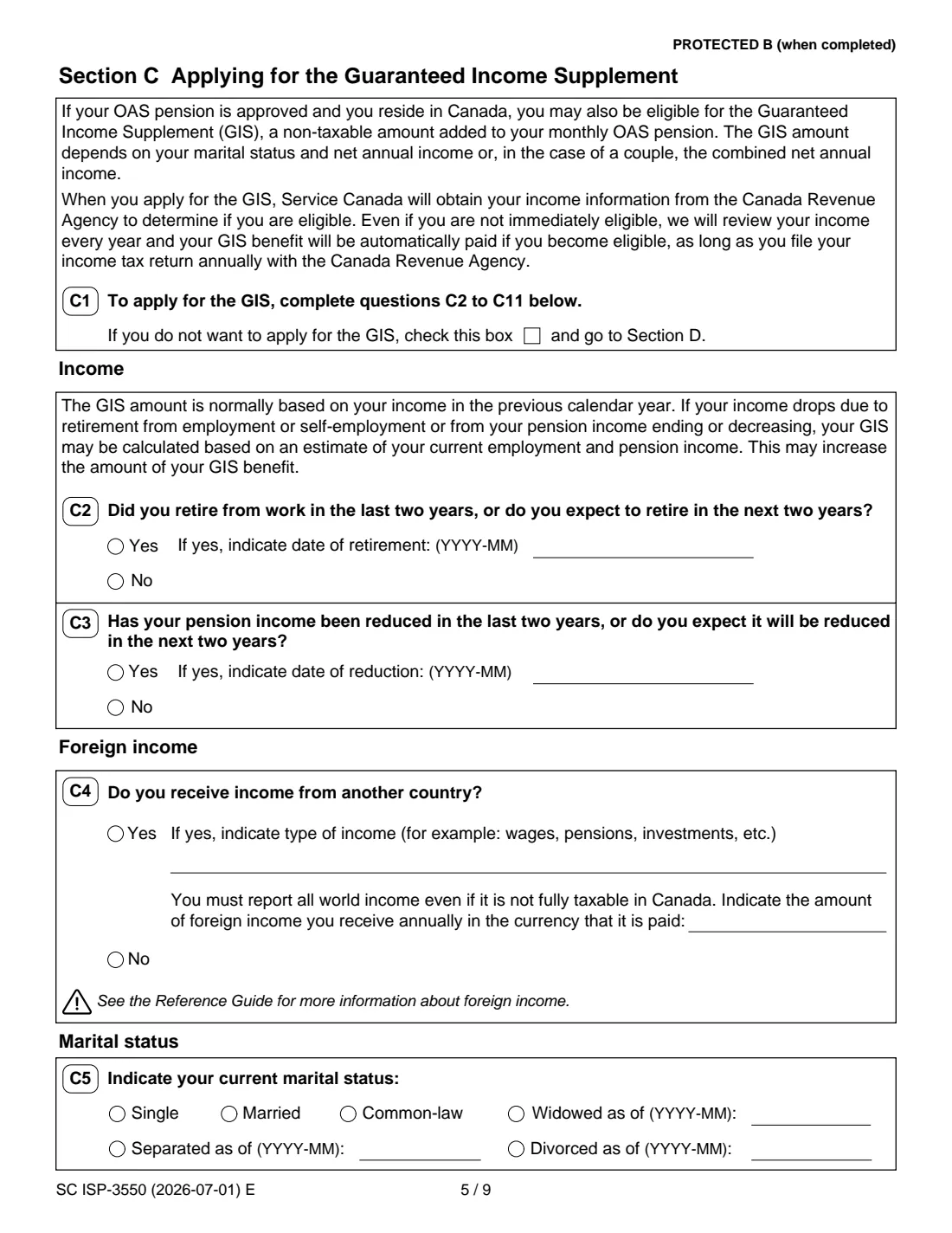
- Section C: Applying for the Guaranteed Income SupplementApplicant
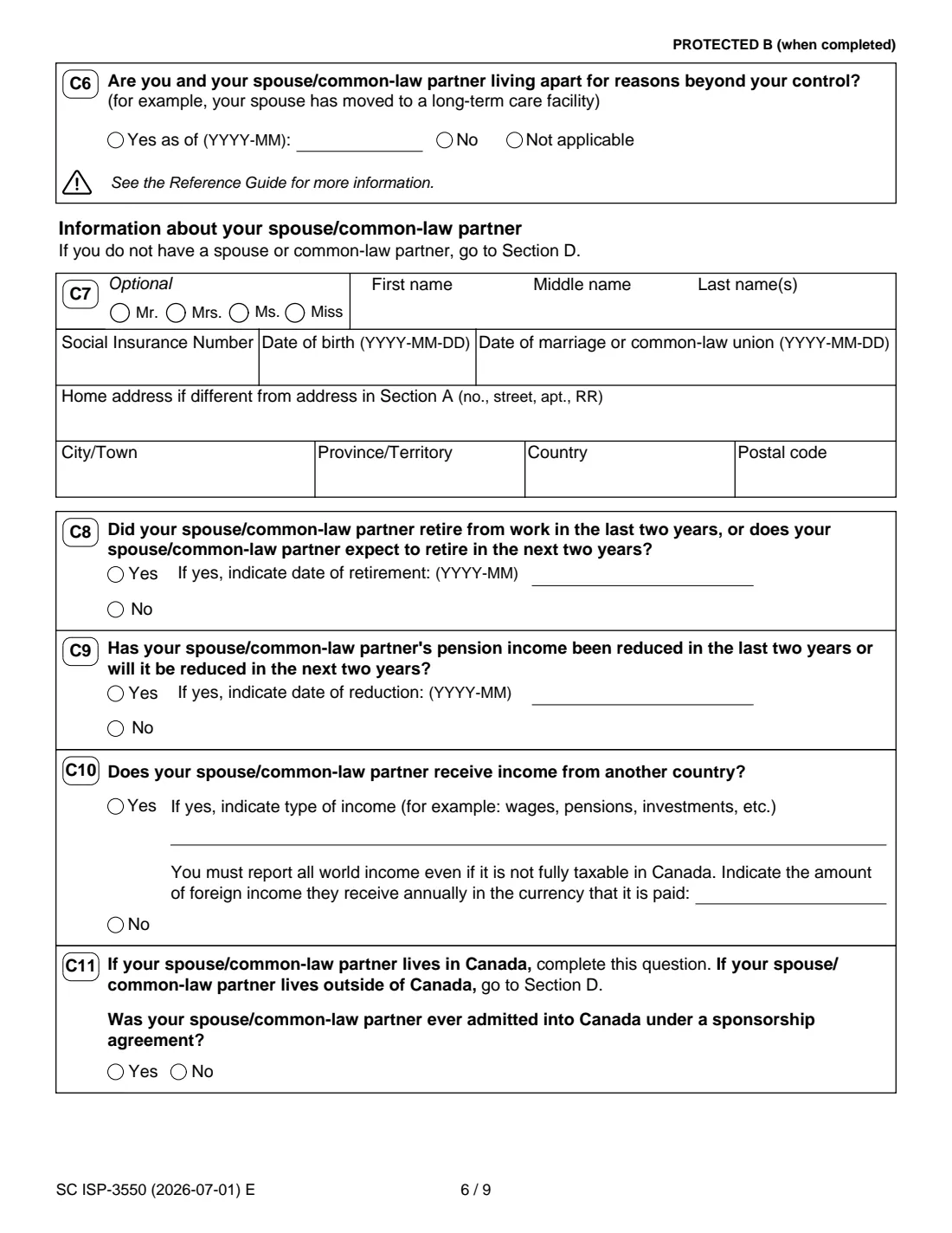
- Section C (C7–C11) and F2: Your spouse or common-law partnerSpouse or common-law partner
- Section D: Payment informationApplicant
- Section F: Declaration and signature (F1)Applicant
- F3: Witness or person authorized to act for the applicantWitness or authorized person
How to fill out ISP-3550 OAS and GIS application, step by step
1 Section A — Personal information
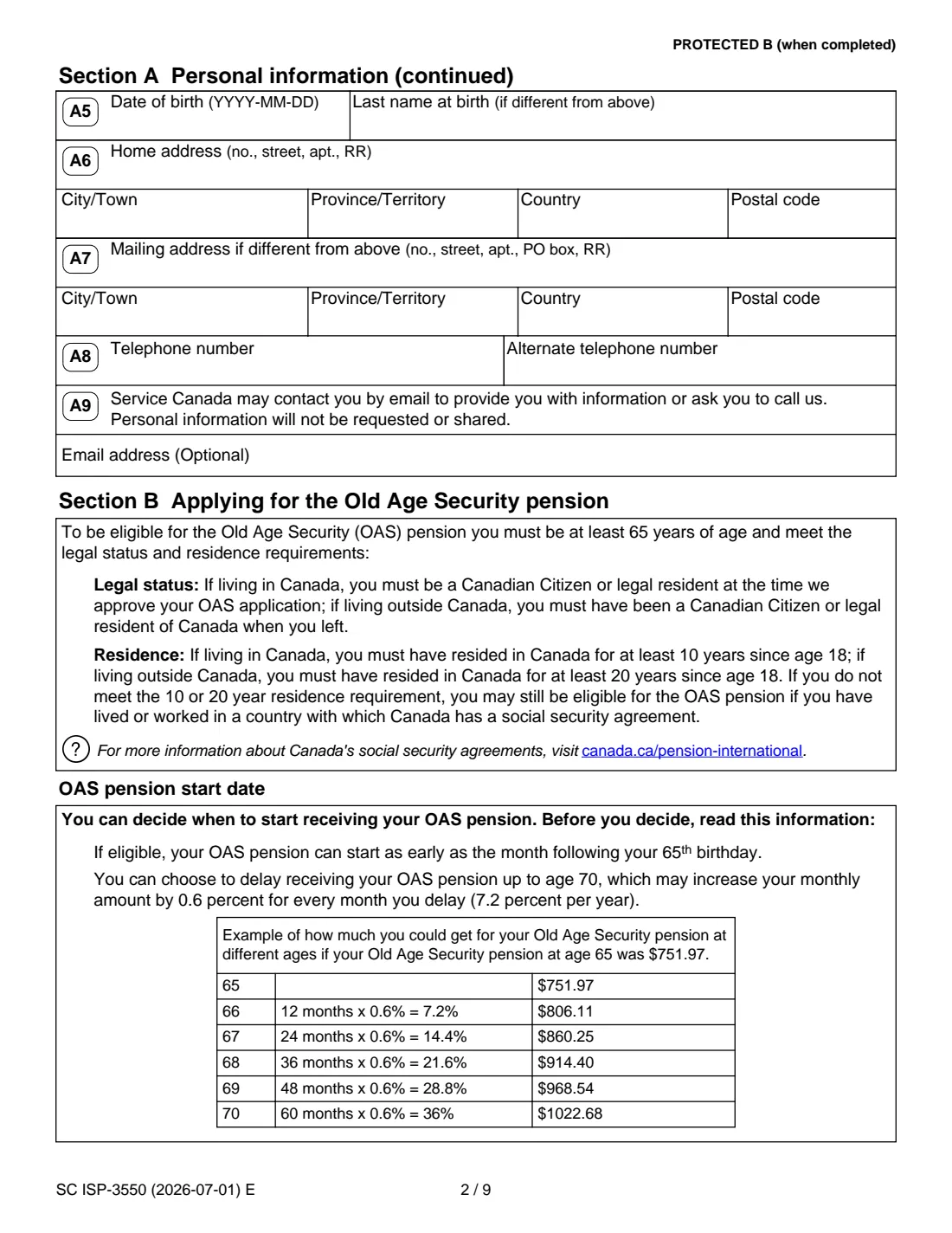
Questions A1 to A9 collect your Social Insurance Number, preferred language (English or French), optional title, full name, date of birth, last name at birth, home address, mailing address if different, telephone numbers and an optional email address.
Dates on this form are written year first (YYYY-MM-DD). FileIt formats them for you, so you only pick the date.
2 Section B — OAS pension start date (B1)
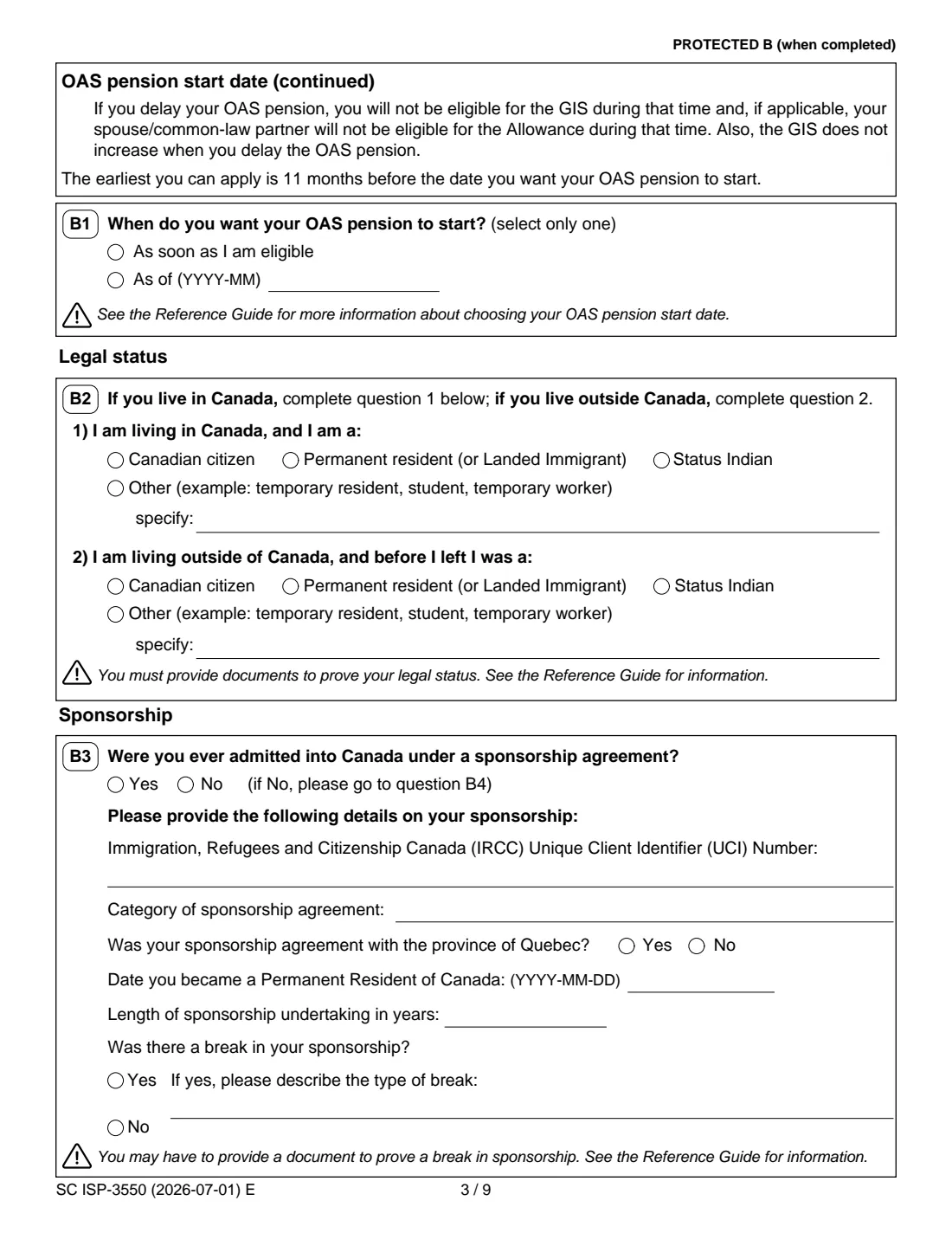
Choose whether your pension should start as soon as you are eligible (the month after your 65th birthday at the earliest) or from a later month you name. The form shows how delaying can raise the monthly amount by 0.6% for each month up to age 70.
Before choosing a later start, note what the form says: while you delay, you are not eligible for the GIS, your spouse or partner cannot receive the Allowance, and the GIS itself does not increase because you waited.
3 Legal status (B2) and sponsorship (B3)
B2 asks whether you live in Canada or abroad and your status: Canadian citizen, permanent resident (or landed immigrant), Status Indian or other. If you live outside Canada, you give your status before you left.
B3 asks whether you were ever admitted into Canada under a sponsorship agreement. If so, give your UCI number, the category of sponsorship, whether it was with Quebec, the date you became a permanent resident, the length of the undertaking and whether there was a break in the sponsorship. You may need to send a document proving a break.
4 Residence history (B4 to B7)
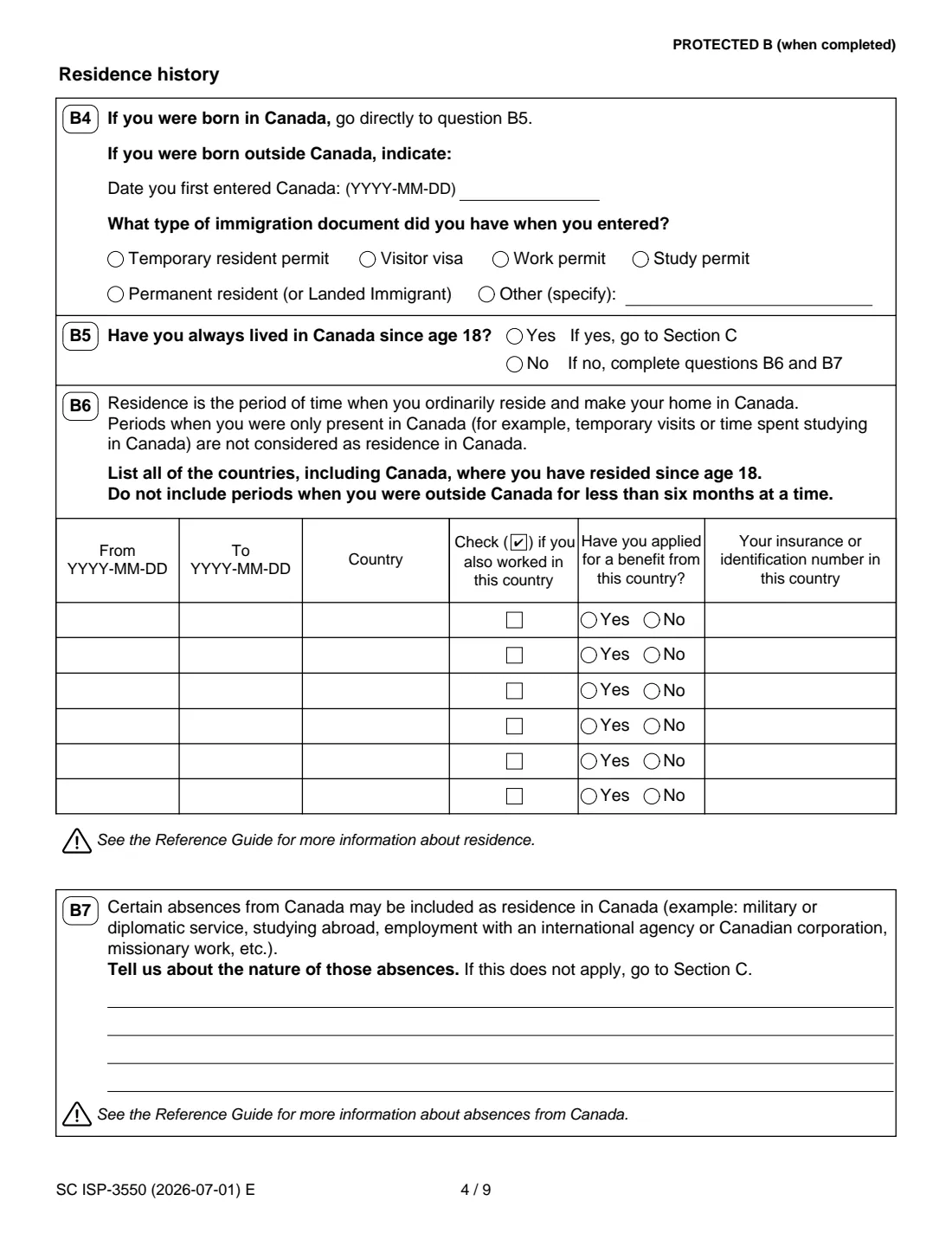
If you were born outside Canada, B4 asks when you first entered Canada and what immigration document you held. B5 asks whether you have always lived in Canada since age 18; if you have, you go straight to Section C.
If not, B6 is a table of every country where you have resided since 18, including Canada, with dates, whether you also worked there, whether you applied for a benefit there, and your insurance number there. Periods outside Canada of less than six months at a time are left out. B7 lets you describe absences that may still count as residence in Canada, such as military or diplomatic service, study abroad or work for a Canadian company. FileIt fits your B7 answer onto the form's four lines.
5 Section C — Guaranteed Income Supplement (C1 to C6)
If you do not want the GIS, you tick the box in C1 and skip to Section D. Otherwise, C2 to C4 ask whether you retired or your pension income was reduced in the last two years (or will be in the next two), and whether you receive income from another country. The form says you must report all world income, even if it is not fully taxable in Canada.
C5 records your marital status, with the date for widowed, separated or divorced. C6 asks whether you and your spouse or partner live apart for reasons beyond your control, such as a move to a long-term care facility. Service Canada gets your income figures from the Canada Revenue Agency, so there are no income amounts to enter here beyond foreign income.
6 Your spouse or common-law partner (C7 to C11)
Only for GIS applicants who are married or in a common-law relationship. Give your spouse's or partner's name, SIN, date of birth, date of marriage or union, and home address if different from yours, then answer the same retirement, pension-reduction and foreign-income questions for them. C11 asks whether they were ever sponsored into Canada, if they live in Canada.
In FileIt this is an optional part you switch on. FileIt reminds you to fill it in if you are applying for the GIS and are married or common-law.
7 Section D — Payment information and taxes
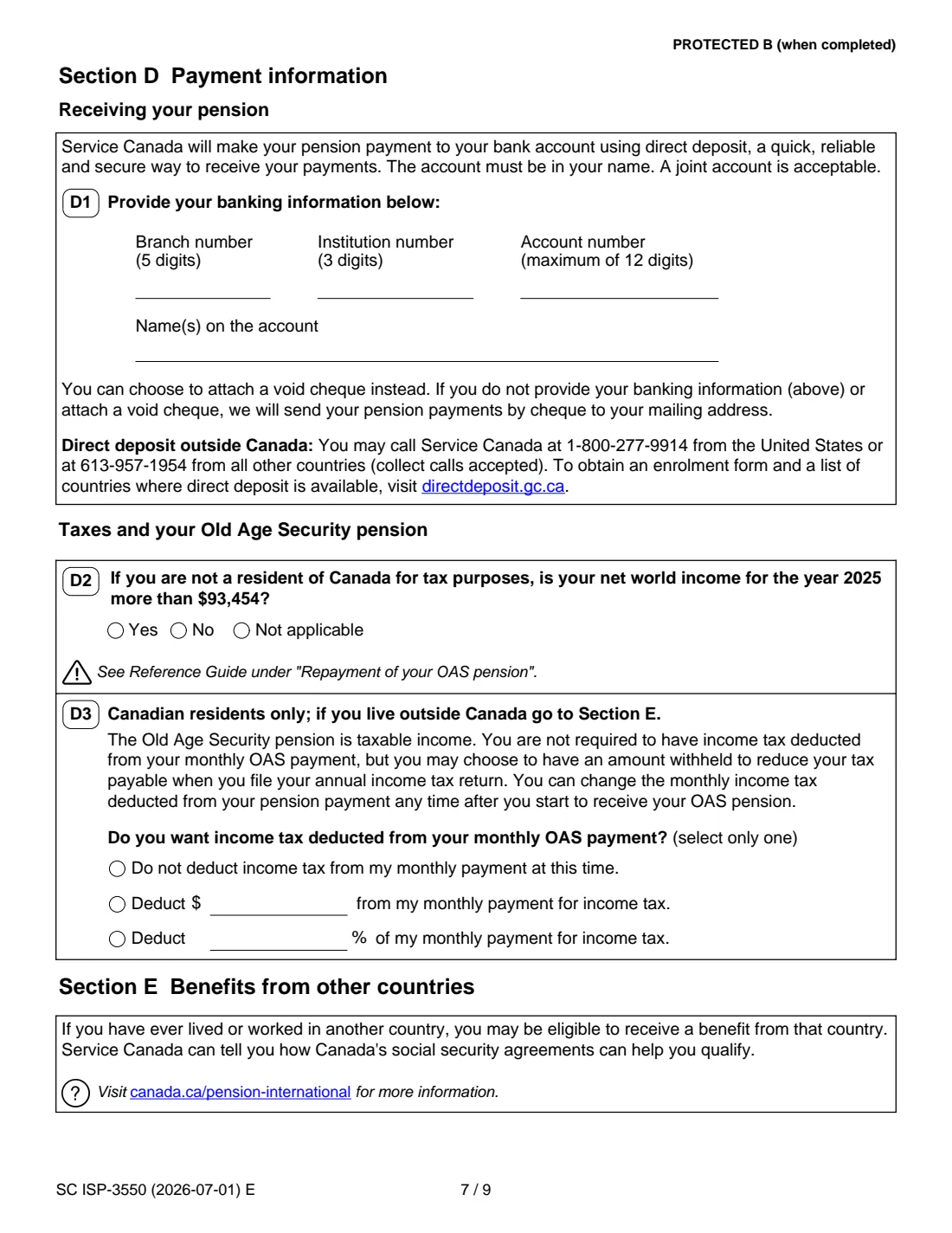
D1 takes your banking details for direct deposit: the 5-digit branch number, 3-digit institution number, account number and name(s) on the account. The account must be in your name; a joint account is acceptable. You can attach a void cheque instead, and without either, payments come by cheque.
D2 is for people who are not resident in Canada for tax purposes and asks whether their net world income for 2025 was more than $93,454 (the figure printed on the 2026-07-01 edition). D3, for Canadian residents, lets you ask for no tax deduction, a fixed dollar amount, or a percentage of each monthly payment.
8 Section E — Benefits from other countries
There is nothing to fill in here. The form reminds you that if you have lived or worked in another country, you may be entitled to a benefit from that country, and that Canada's social security agreements may help you qualify.
9 Section F — Declarations and signatures
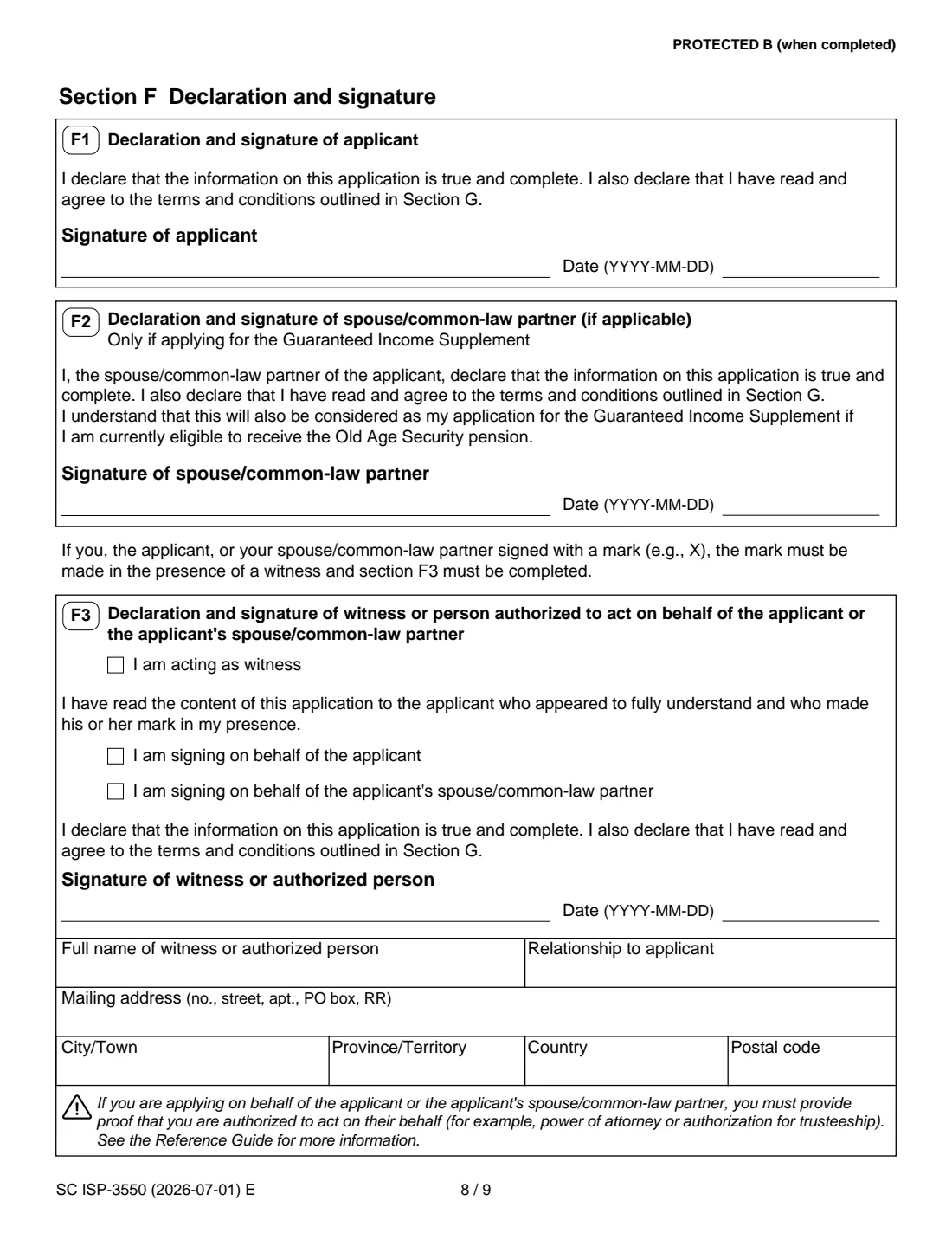
F1 is your declaration and signature, with the date. F2 is signed by your spouse or common-law partner only when you apply for the GIS; it also counts as their own GIS application if they already receive the OAS pension. F3 is for a witness, when you or your spouse sign with a mark such as an X, or for a person signing on your behalf, who must send proof that they are authorized, such as a power of attorney.
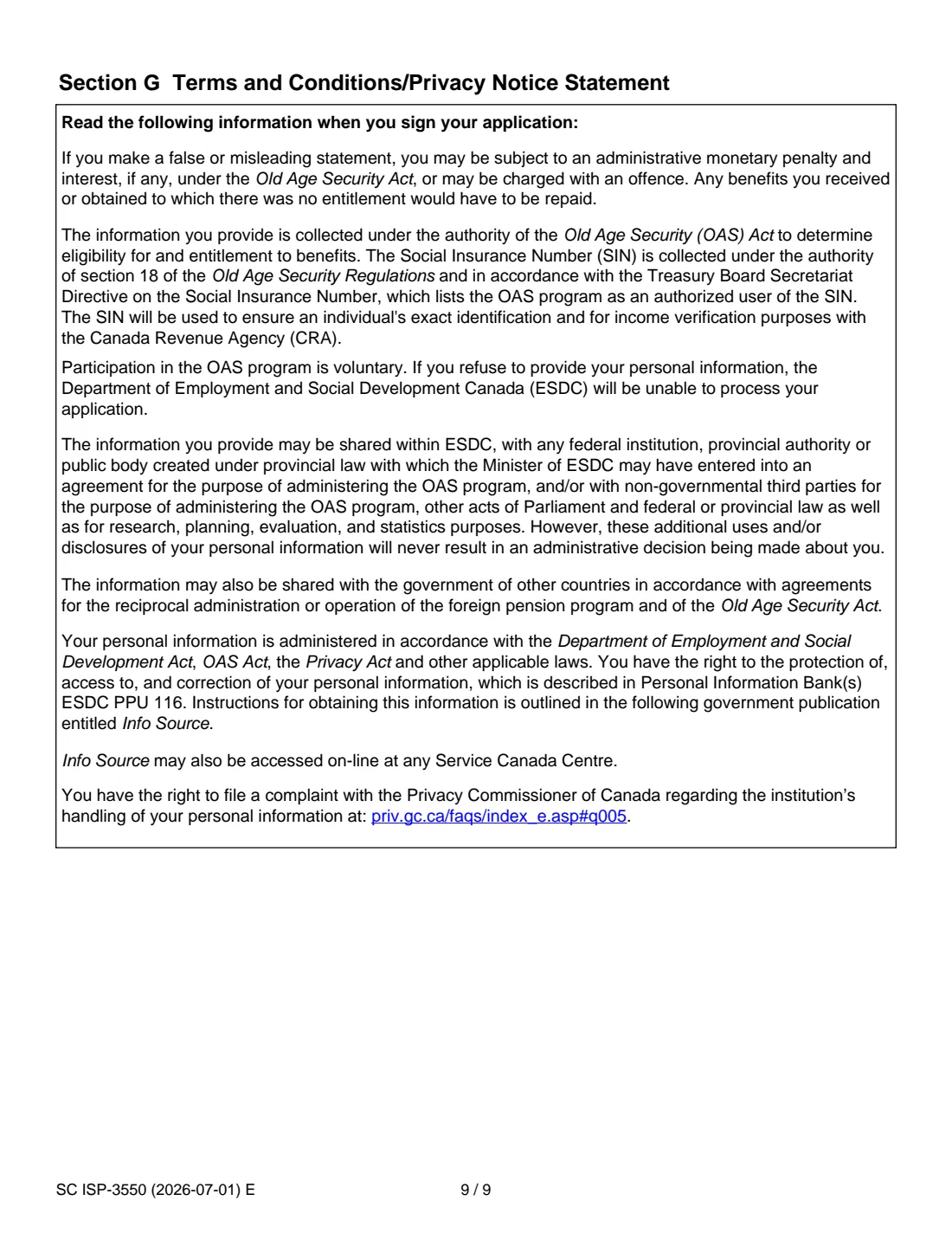
Section G sets out the terms and privacy notice you agree to when you sign.
Common mistakes to avoid
- Applying too early: the form says the earliest you can apply is 11 months before the month you want your pension to start.
- Choosing a start month before the month after your 65th birthday, which the pension cannot start before.
- Delaying the OAS pension without realising that you cannot receive the GIS for the months you delay.
- Leaving gaps in the B6 residence table, or forgetting to include Canada itself as one of the countries.
- Forgetting to report foreign pensions or income: the form asks for all world income, in the currency it is paid.
- Leaving out the spouse part (C7 to C11) and the spouse's signature in F2 when applying for the GIS as a married or common-law couple.
- Giving bank details for an account that is not in your name, or mixing up the branch and institution numbers.
- Forgetting to send proof of legal status, which the form says you must provide.
After you fill it out
Sign and date the declaration in F1, and have your spouse or common-law partner sign F2 if you are applying for the GIS. Print the PDF and sign it by hand, as Service Canada receives this form on paper. If either of you signs with a mark, the mark must be made in front of a witness who completes F3, so that version has to be signed on paper.
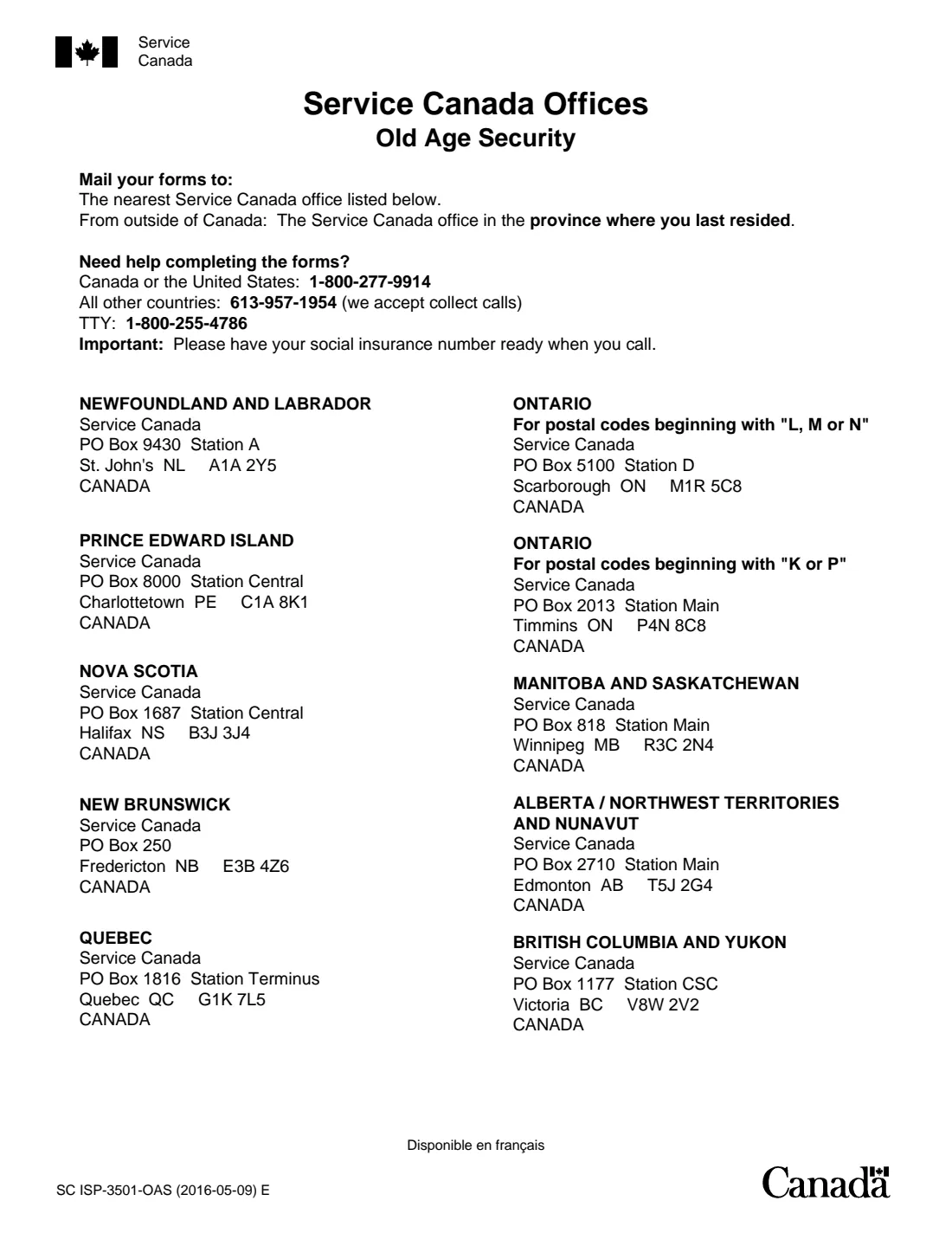
Mail the application, or drop it off, at a Service Canada office. The last page of the form lists the office addresses by province; if you live outside Canada, the form says to send it to the office for the province where you last lived. Include the documents the form asks for, such as proof of legal status, and a void cheque if you chose that instead of writing in your banking details. FileIt does not send anything to Service Canada; delivering the form is up to you.
Keep the completed PDF in your FileIt vault as your record of what you applied for and when. If your circumstances change later (your marital status, address, income from abroad or banking details), tell Service Canada. If you receive the GIS, the form says your eligibility is reviewed every year as long as you file your income tax return.
Fill out ISP-3550 OAS and GIS application online with FileIt
- Pick the person. Choose someone from People and FileIt fills in their name, date of birth, address and other details it already knows.
- Answer plain-language questions. One part of the form at a time, with the official help text beside each question — 137 fields in all. Your answers save as you go.
- Check the live preview. Watch your answers land on the real Service Canada, for Employment and Social Development Canada (ESDC) form, and let FileIt do any worksheet arithmetic.
- Generate the official PDF. FileIt prints your answers into the agency’s own PDF and files it in that person’s folder in your vault.
FileIt fills the form — it never files or submits anything for you. Deliver the finished form to whoever asked for it, the way the form’s instructions say.
Start ISP-3550 OAS and GIS application now — it’s freeISP-3550 OAS and GIS application: frequently asked questions
Do I need to fill out form ISP-3550 to get Old Age Security?
Not always. If Service Canada has enough information, it sends you a letter saying your OAS pension will be paid automatically at 65. If you did not receive that letter, you need to apply, and ISP-3550 is the paper application for doing so.
How early can I apply for the OAS pension?
The form says the earliest you can apply is 11 months before the date you want your pension to start. The pension itself can start as early as the month after your 65th birthday, or you can delay it up to age 70.
Does this form also apply for the Guaranteed Income Supplement?
Yes. Section C is the GIS application. If you do not want to apply for the GIS, you tick the box in C1 and go on to Section D. Service Canada gets your income information from the Canada Revenue Agency to decide whether you qualify.
Does my spouse have to sign the ISP-3550?
Only if you apply for the GIS and have a spouse or common-law partner. They sign declaration F2, which also counts as their own GIS application if they already receive the OAS pension.
Can I fill out ISP-3550 online with FileIt?
Yes. FileIt guides you through every section in plain English, pre-fills details from your vault, and prints your answers into Service Canada's official PDF. You then print it and sign it by hand. FileIt does not submit it; you mail it or drop it off yourself.
Where do I send the completed ISP-3550?
To a Service Canada office, by mail or in person. The last page of the form lists the mailing addresses by province and territory. From outside Canada, the form says to send it to the office in the province where you last lived.
What if I lived in other countries after age 18?
Answer No to B5 and list every country where you resided since age 18, including Canada, in the B6 table. Leave out periods abroad of less than six months at a time. Time in another country may also help you qualify through Canada's social security agreements.
Can I apply for OAS online instead of on paper?
Yes. The form itself mentions applying online through My Service Canada Account. The paper ISP-3550 is for people who prefer, or need, to apply by mail or in person.
Is there a fee to apply for Old Age Security?
The form does not mention any fee for applying. Filling it in with FileIt is also free on every FileIt account.
Official sources
- Blank form (PDF), published by Service Canada, for Employment and Social Development Canada (ESDC): https://catalogue.servicecanada.gc.ca/apps/EForms/pdf/en/ISP-3550.pdf
- Official instructions and guidance: https://www.canada.ca/en/services/benefits/publicpensions/old-age-security/apply.html
- Edition shown on this page: SC ISP-3550 (2026-07-01) E (checked 2026-09-26).
FileIt is not affiliated with or endorsed by Service Canada, for Employment and Social Development Canada (ESDC) or any government. This page explains the form in general terms and is not legal, tax or immigration advice. Always read the official instructions, and check that you are using the edition the recipient accepts. Page last reviewed 2026-09-26.