What is the wound assessment chart form template?
Wounds heal — or fail to heal — over weeks, and the only way to know which way one is going is to assess it the same way each time. A consistent wound chart records the size, what the wound bed looks like, how much it's leaking, the state of the surrounding skin, signs of infection, pain and the dressing applied, with photos where the patient agrees.
This template covers one wound per response. The first page identifies the patient, the assessor and the wound: its label, location, type — from pressure injury and surgical wounds to leg ulcers, diabetic foot ulcers, skin tears and burns — and a pressure injury category when relevant. The second records length, width, depth and undermining, the share of each tissue type in the wound bed, exudate amount and type, odour, surrounding skin and infection signs.
The last page records pain on a 0–10 scale, cleansing, the dressings applied, other treatment such as compression, how often to change the dressing, progress since last review, referrals, photos, the next review date and the assessor's signature. Every review is saved as a dated PDF in FileIt.
- Best for
- District and community nurses, practice nurses, care homes, wards and tissue viability teams
- Filled in by
- A nurse or trained clinician at each wound review
- Time to complete
- About 5 minutes per wound
- Includes
- Wound type and pressure category, measurements, tissue grid, exudate, skin and infection checklists, pain scale, dressing plan, photos and signature
Who uses a wound assessment chart form?
- District nurses reviewing leg ulcers at home
- Care homes charting pressure injuries
- Practice nurses following up surgical wounds
- Podiatry clinics monitoring diabetic foot ulcers
- Ward staff recording wounds on admission
- Building a photo and measurement history for a tissue viability referral
Questions on this wound assessment chart form
34 questions over 3 pages · includes signature, file upload, conditional questions, multiple pages, ratings.
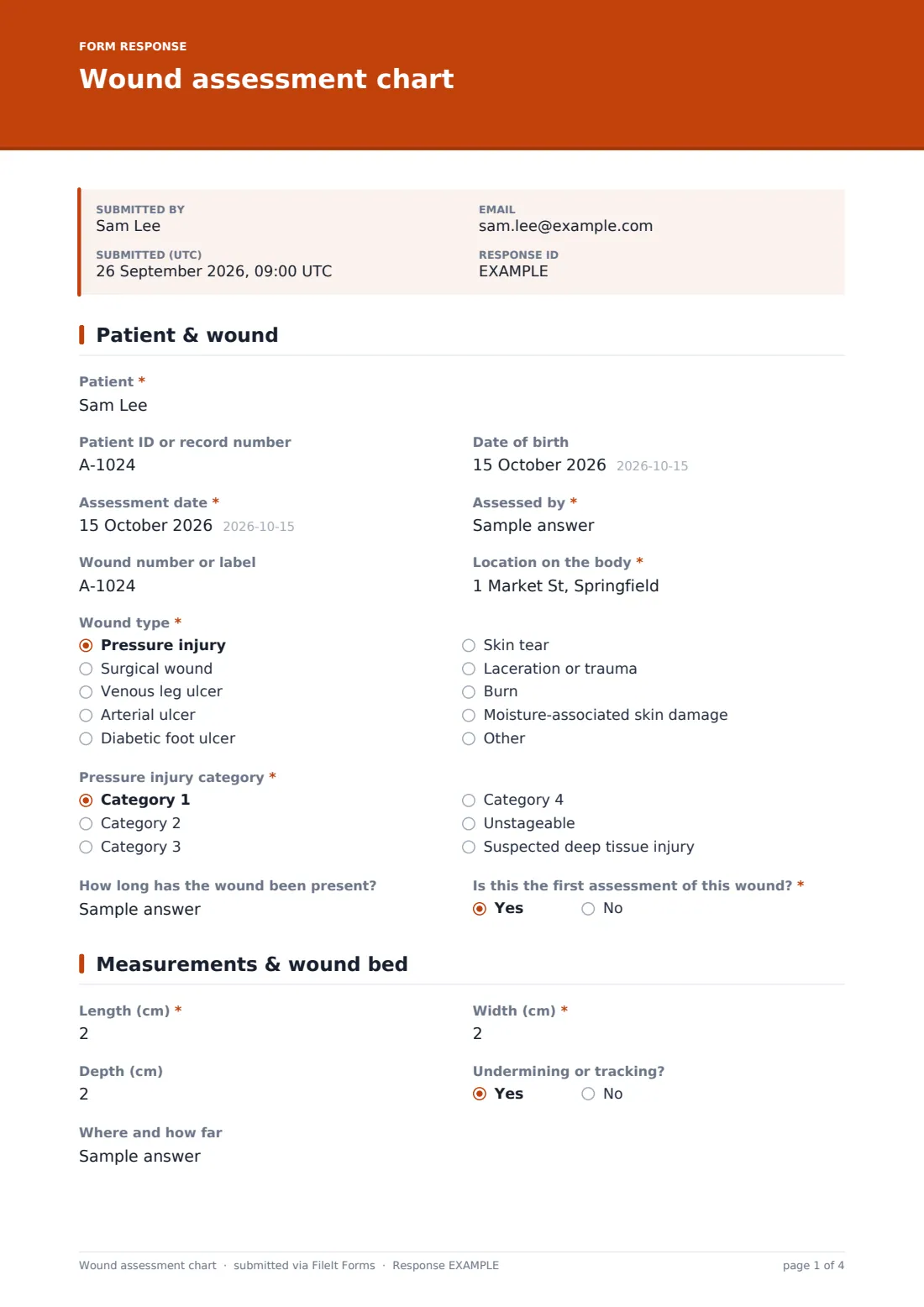
1 Patient & wound
- Patient*
- Patient ID or record number
- Date of birth
- Assessment date*
- Assessed by*
- Wound number or label
- Location on the body*
- Wound type* Pressure injury · Surgical wound · Venous leg ulcer · Arterial ulcer · Diabetic foot ulcer · Skin tear · Laceration or trauma · Burn · Moisture-associated skin damage · Other
- Pressure injury category* asked only when it applies Category 1 · Category 2 · Category 3 · Category 4 · Unstageable · Suspected deep tissue injury
- How long has the wound been present?
- Is this the first assessment of this wound?*
2 Measurements & wound bed
- Length (cm)*
- Width (cm)*
- Depth (cm)
- Undermining or tracking?
- Where and how far asked only when it applies
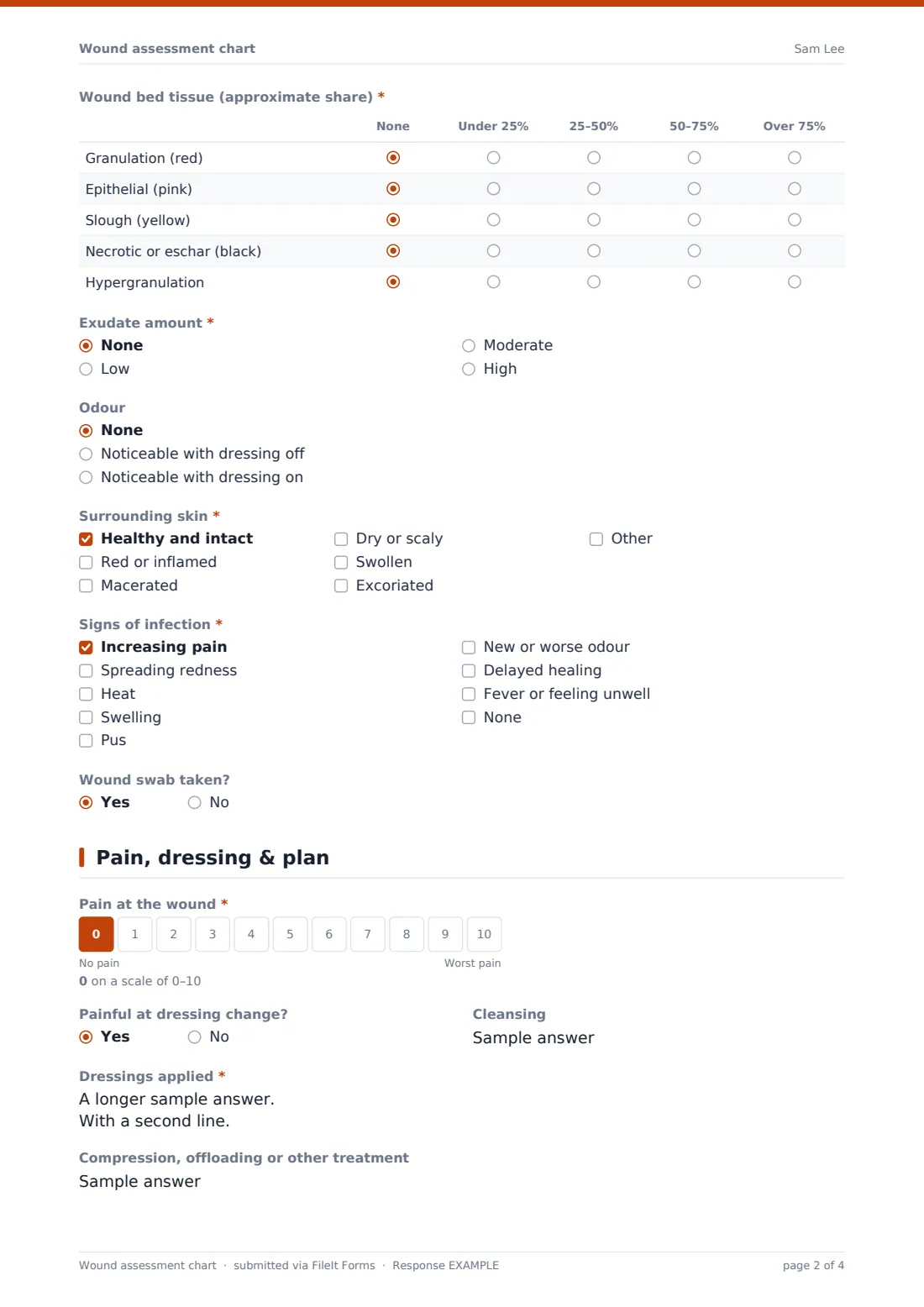
- Wound bed tissue (approximate share)* None · Under 25% · 25–50% · 50–75% · Over 75%
- Exudate amount* None · Low · Moderate · High
- Exudate type asked only when it applies Serous (clear) · Haemoserous (pink) · Blood-stained · Purulent (pus)
- Odour None · Noticeable with dressing off · Noticeable with dressing on
- Surrounding skin* Healthy and intact · Red or inflamed · Macerated · Dry or scaly · Swollen · Excoriated
- Signs of infection* Increasing pain · Spreading redness · Heat · Swelling · Pus · New or worse odour · Delayed healing · Fever or feeling unwell · None
- Wound swab taken?
3 Pain, dressing & plan
- Pain at the wound*
- Painful at dressing change?
- Cleansing
- Dressings applied*
- Compression, offloading or other treatment
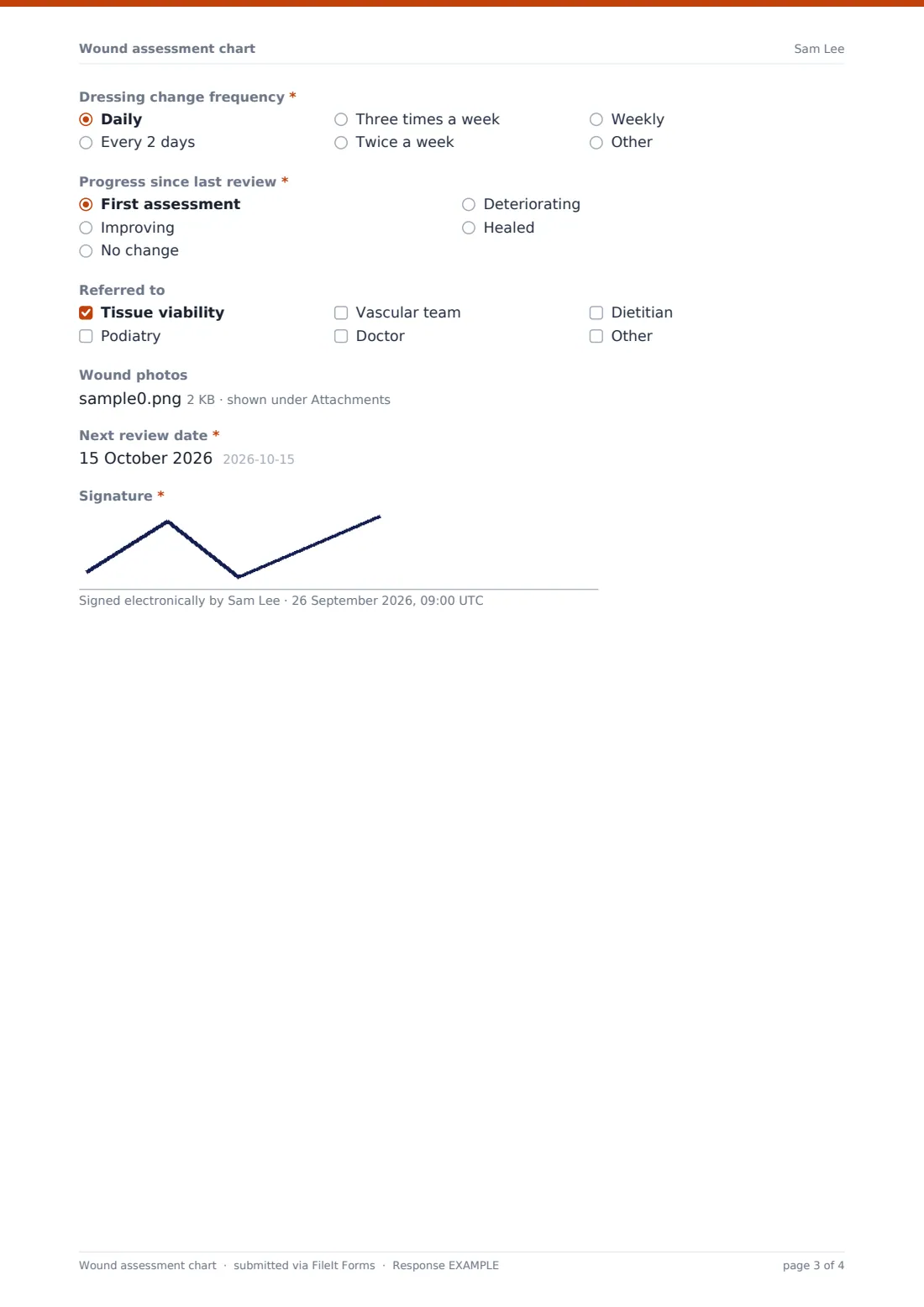
- Dressing change frequency* Daily · Every 2 days · Three times a week · Twice a week · Weekly · Other
- Progress since last review* First assessment · Improving · No change · Deteriorating · Healed
- Referred to Tissue viability · Podiatry · Vascular team · Doctor · Dietitian
- Wound photos
- Next review date* asked only when it applies
- Signature*
The wound assessment chart form, page by page
1 Patient & wound
Record the patient, their ID and date of birth, the assessment date and who assessed. Label the wound, give its location on the body and choose the type from ten options. Pressure injuries ask for a category from 1 to 4, unstageable or suspected deep tissue injury. The page ends with how long the wound has been present and whether this is the first assessment.
2 Measurements & wound bed
Enter length, width and depth in centimetres and whether there's undermining or tracking, with where and how far. A grid records the approximate share of granulation, epithelial, slough, necrotic and hypergranulation tissue, from none to over 75%. The assessor then records exudate amount and type, odour, the surrounding skin, signs of infection and whether a swab was taken.
3 Pain, dressing & plan
Pain at the wound is scored from 0 to 10, with a question about pain at dressing change. The assessor records cleansing, the dressings applied, any compression or offloading, how often the dressing is changed and progress since the last review. Referrals to tissue viability, podiatry, vascular, a doctor or dietitian can be ticked, up to four photos added, and — unless the wound has healed — the next review date set before signing.
Make the template yours
- Replace the wound types and categories with your organisation's classification
- Add your formulary dressings as a dropdown
- Add a body map image to the cover so locations are described consistently
- Prefill the patient with personal links so each chart files under the right person
- File each patient's wound charts in their own vault folder
- Add a question for the patient's consent to photography
Tips for a better wound assessment chart form
- Measure the longest length and the widest width at right angles, the same way every time
- Photograph from the same angle and distance, with a measuring guide in the frame
- Escalate signs of spreading infection promptly
- Ask about pain at every review — it often changes before the wound looks different
- Refer wounds that aren't improving as your policy sets out
- This chart supports your clinical judgement and local wound care guidance; it doesn't replace them
Every response becomes a PDF in your vault
Each review is saved as a dated PDF in the vault folder you choose, with photos attached. The account owner can be emailed each time a chart is saved.
In Responses, filter by patient to see a wound's reviews in date order, or export to CSV to compare length and width over time.
- Start from this template. It opens in the FileIt Forms designer — change any question, add pages, set the rules for when questions appear.
- Share it. Turn on a public link, or send it to people by email, each with their own link. They don’t need a FileIt account.
- Get the answers as PDFs. Each response is saved as a PDF in the vault folder you choose, with uploaded files attached — and listed in a Responses table you can export to CSV.
Wound assessment chart form: frequently asked questions
Is this wound assessment chart template free?
Yes. It's part of the Forms app, included with every FileIt account, the free plan too.
Does the form calculate the wound area?
No. It records length, width and depth. You can work out the area from these, or track the measurements over time in a CSV export.
Can I record several wounds for one patient?
Use one response per wound and the wound label field to tell them apart, so each wound has its own history.
Can photos be taken on a tablet?
Yes. Up to four photos can be taken and uploaded straight from a phone or tablet.
Can I use our own pressure injury classification?
Yes. Edit the category options in the designer to match the system your organisation uses.
Who can see the photos?
Photos are filed with the chart in your vault. Keep these in a folder only authorized clinical staff can open.