What is the research ethics application form template?
An ethics committee can only judge a study it can follow. Applications that arrive as free-form documents tend to miss the same things: how participants are recruited, how they can withdraw, where the recordings will be kept, and what happens with children or other vulnerable groups. Reviewers then send them back, and the study waits.
This template walks a researcher through the questions a research ethics committee or IRB typically asks, over four pages: the study and team, design and methods, participants and consent, then risks, data handling, funding and a signed declaration. Student applicants are asked for a supervisor, studies involving deception must explain the debrief, and including children, people who may lack capacity, the researcher's own students or other vulnerable groups brings up a targeted safeguards question.
Each application is saved as a PDF in your FileIt vault together with the information sheet, consent form and instruments the researcher uploads, so the committee has one complete file per study. It's a starting point for your own committee's process, not a substitute for its policies.
- Best for
- University research ethics committees, IRBs, departmental ethics panels and research hospitals
- Filled in by
- The principal investigator or student researcher
- Time to complete
- About 30-45 minutes, with the study documents ready
- Includes
- Supervisor details for students, deception and vulnerable-participant follow-ups, document upload, signed declaration
Who uses a research ethics application form?
- A master's student applies for approval of interview-based dissertation research
- A faculty member submits a survey study involving staff of the institution
- A department panel collects low-risk applications in one consistent format
- A PhD candidate applies for a school-based study involving children
- A research hospital screens a service-evaluation project before data collection
- A funded team records the grant reference alongside its ethics application
Questions on this research ethics application form
39 questions over 4 pages · includes signature, file upload, conditional questions, multiple pages, consent checkbox.
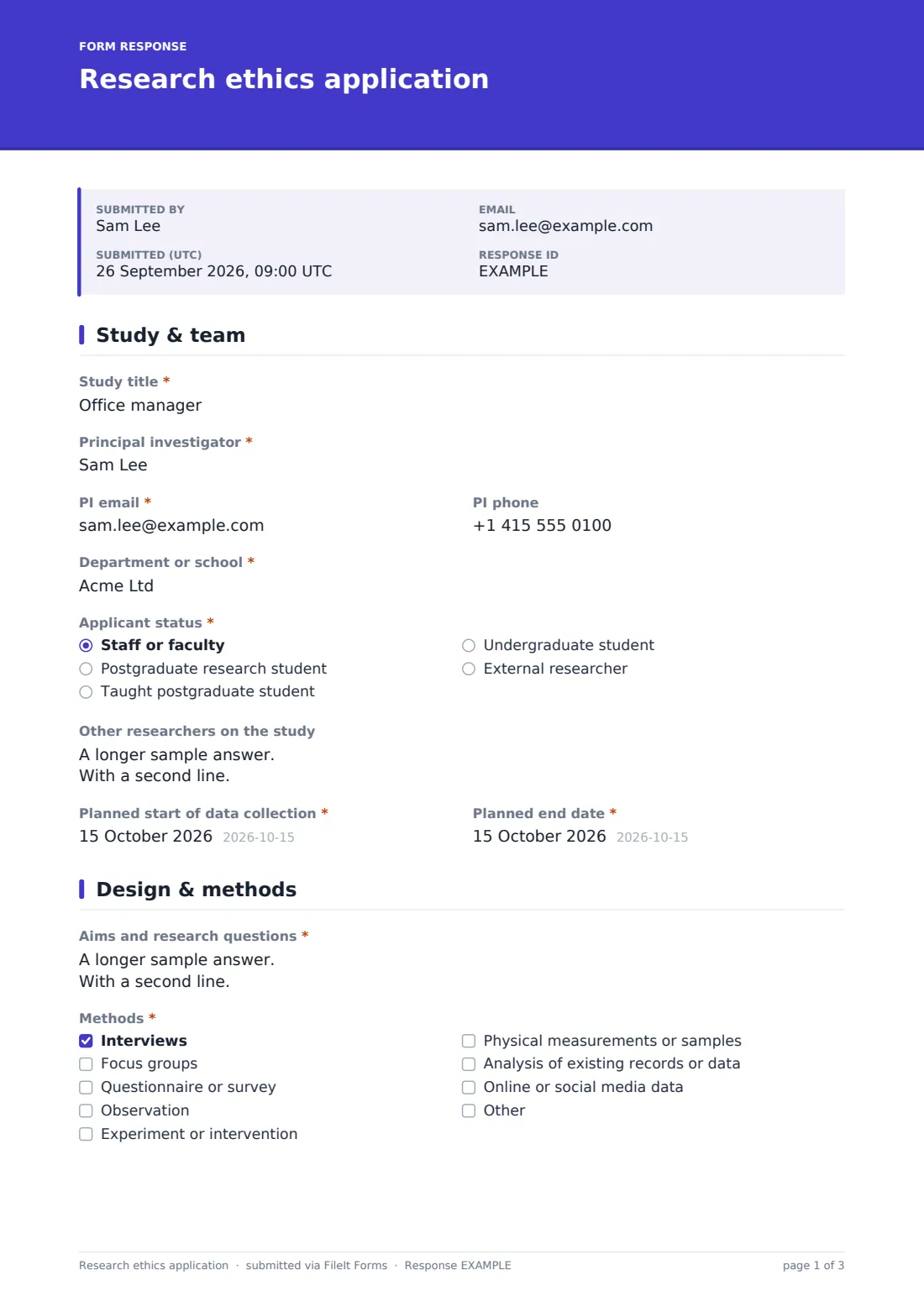
1 Study & team
- Study title*
- Principal investigator*
- PI email*
- PI phone
- Department or school*
- Applicant status* Staff or faculty · Postgraduate research student · Taught postgraduate student · Undergraduate student · External researcher
- Supervisor's name* asked only when it applies
- Supervisor's email* asked only when it applies
- Other researchers on the study
- Planned start of data collection*
- Planned end date*
2 Design & methods
- Aims and research questions*
- Methods* Interviews · Focus groups · Questionnaire or survey · Observation · Experiment or intervention · Physical measurements or samples · Analysis of existing records or data · Online or social media data
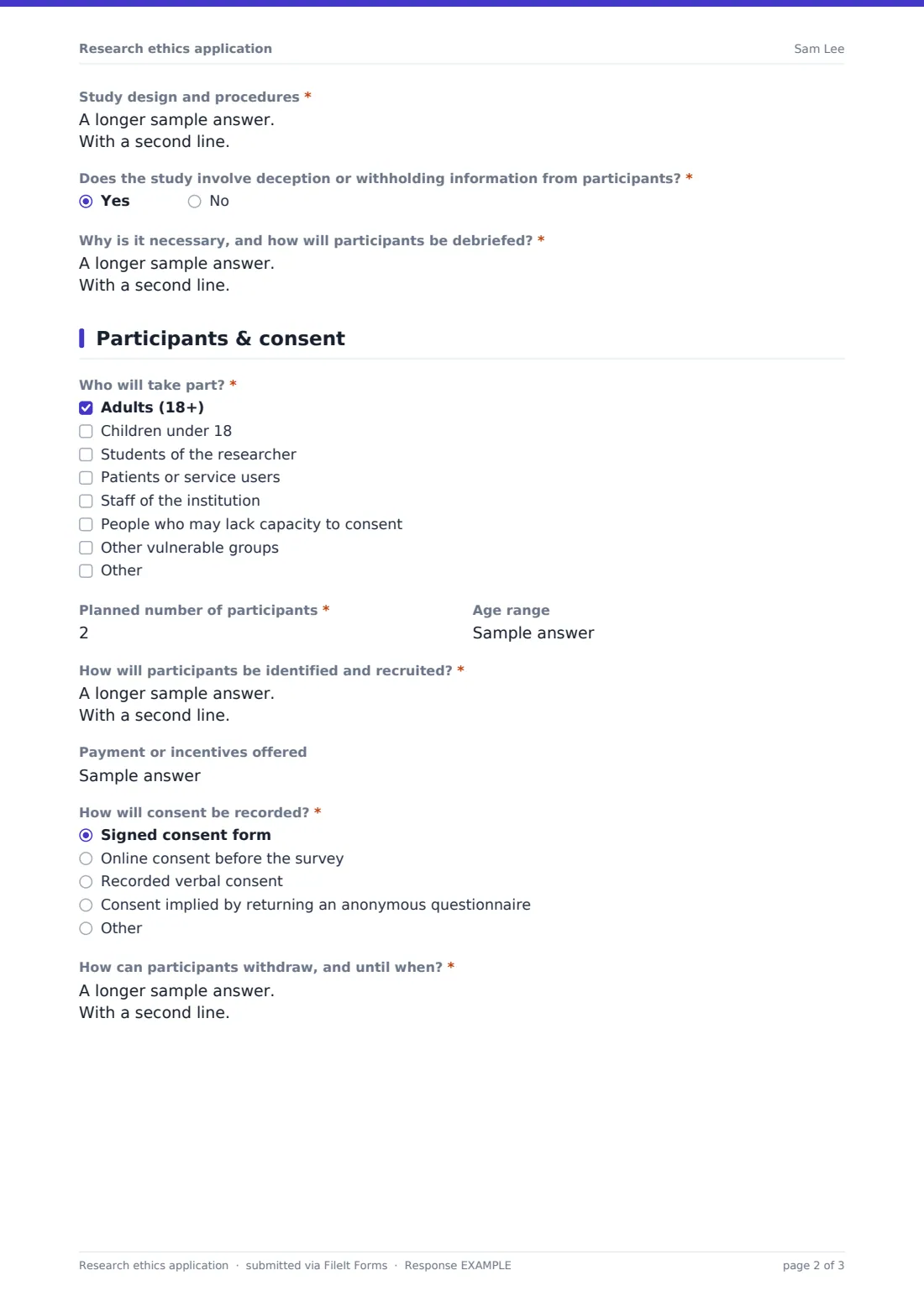
- Study design and procedures*
- Does the study involve deception or withholding information from participants?*
- Why is it necessary, and how will participants be debriefed?* asked only when it applies
3 Participants & consent
- Who will take part?* Adults (18+) · Children under 18 · Students of the researcher · Patients or service users · Staff of the institution · People who may lack capacity to consent · Other vulnerable groups
- Planned number of participants*
- Age range
- Extra safeguards for children taking part* asked only when it applies
- How will capacity be assessed, and who will advise or consent on their behalf?* asked only when it applies
- How will you avoid pressure on your own students to take part?* asked only when it applies
- Which other vulnerable groups, and what extra safeguards will you use?* asked only when it applies
- How will participants be identified and recruited?*
- Payment or incentives offered
- How will consent be recorded?* Signed consent form · Online consent before the survey · Recorded verbal consent · Consent implied by returning an anonymous questionnaire
- How can participants withdraw, and until when?*
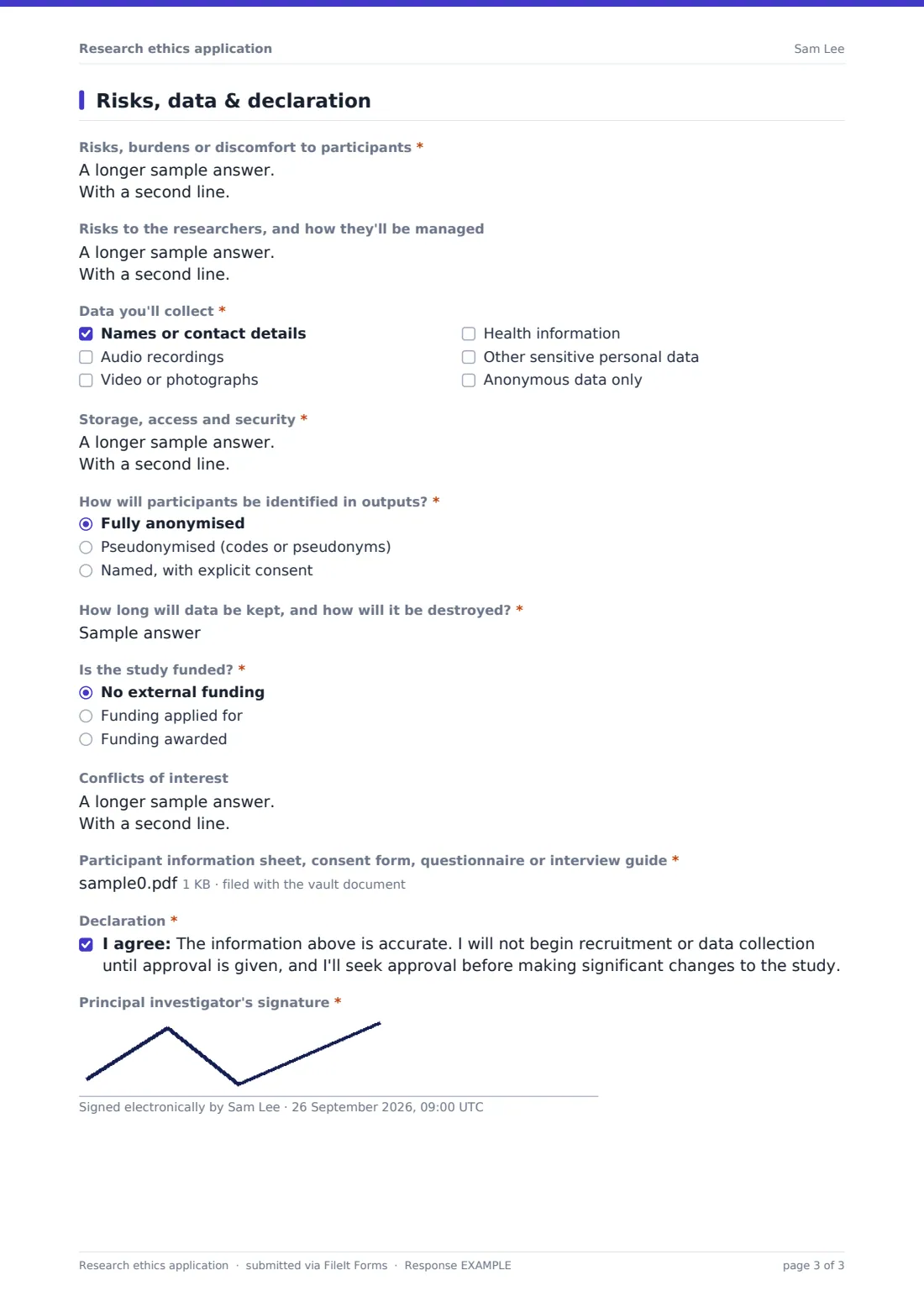
4 Risks, data & declaration
- Risks, burdens or discomfort to participants*
- Risks to the researchers, and how they'll be managed
- Data you'll collect* Names or contact details · Audio recordings · Video or photographs · Health information · Other sensitive personal data · Anonymous data only
- Storage, access and security*
- How will participants be identified in outputs?* Fully anonymised · Pseudonymised (codes or pseudonyms) · Named, with explicit consent
- How long will data be kept, and how will it be destroyed?*
- Is the study funded?* No external funding · Funding applied for · Funding awarded
- Funder and grant reference* asked only when it applies
- Conflicts of interest
- Participant information sheet, consent form, questionnaire or interview guide*
- Declaration*
- Principal investigator's signature*
The research ethics application form, page by page
1 Study & team
Required Study title, Principal investigator, PI email, Department or school and Applicant status. Any status other than staff or faculty adds a required Supervisor's name and email. Optional PI phone and Other researchers on the study, then the planned start of data collection and end date.
2 Design & methods
Aims and research questions in plain language, a Methods checklist (interviews, focus groups, surveys, observation, experiments, physical measurements, existing records, online data, or something else) and a description of the study design and procedures. If the study involves deception or withholding information, the applicant must explain why and how participants will be debriefed.
3 Participants & consent
Who will take part, from adults to children, the researcher's own students, patients or people who may lack capacity, plus the planned number and age range. Ticking children, people who may lack capacity, the researcher's own students or other vulnerable groups adds a required follow-up on safeguards, capacity or avoiding pressure to take part. Then recruitment, payment or incentives, how consent will be recorded, and how and until when participants can withdraw.
4 Risks, data & declaration
Risks to participants and how they'll be reduced, risks to the researchers, the kinds of data collected, storage and security, how participants appear in outputs, and retention and destruction. If funding is applied for or awarded, the form asks for the funder and grant reference. Conflicts of interest, a required upload for the information sheet, consent form and instruments, the declaration and the PI's signature close the form.
Make the template yours
- Rename the form to match your committee, such as IRB or REC application
- Add a risk-level question if your institution routes low-risk studies to a lighter review
- Link your own information sheet and consent form templates in a paragraph on the last page
- Add a supervisor signature for student applications
- Add questions for clinical or healthcare approvals if they apply to your studies
- Route applications to a committee folder in your vault and add the committee secretary to notifications
Tips for a better research ethics application form
- Ask applicants to write aims in plain language; lay members of the committee need to follow them
- Check that the uploaded information sheet matches what the form says about withdrawal and data retention
- Keep the decision letter in the same vault folder as the application
- Ask for an amendment, not a new application, when an approved study changes
- Have your institution's research governance team review the wording before you publish the form
Every response becomes a PDF in your vault
Each application becomes a signed PDF in your vault with the uploaded study documents attached, and the committee is emailed. Applicants get a copy when they give an email.
The Responses table lets the committee secretary see every application, filter by department or applicant status, and export a CSV for meeting agendas.
- Start from this template. It opens in the FileIt Forms designer — change any question, add pages, set the rules for when questions appear.
- Share it. Turn on a public link, or send it to people by email, each with their own link. They don’t need a FileIt account.
- Get the answers as PDFs. Each response is saved as a PDF in the vault folder you choose, with uploaded files attached — and listed in a Responses table you can export to CSV.
Research ethics application form: frequently asked questions
Is this research ethics application template free?
Yes. It's one of the Forms app's starter templates, available on every FileIt account, including the free plan.
Does this replace our IRB or ethics committee's own process?
No. It's a structured way to collect applications. Your committee's policies, review levels and decision process still apply, and you should edit the questions to match them.
What happens when a student applies?
Choosing any applicant status other than staff or faculty asks for the supervisor's name and email.
Can researchers attach their consent form and questionnaire?
Yes. The last page has a required upload for up to ten PDF or Word files.
Does the form handle studies with children?
Ticking children under 18 adds a required question about extra safeguards such as parental consent and child assent. Similar follow-ups appear for people who may lack capacity, the researcher's own students and other vulnerable groups.
Do applicants need a FileIt account?
No. They fill it in from a link, and you can email personal links to specific researchers.