What is the occupational therapy intake form template?
Occupational therapy is about the ordinary parts of life: getting dressed, having a shower, cooking a meal, writing in class, getting to the shops. A useful first session depends on knowing which of those are going wrong, where the client lives and what equipment is already in the house. Asking all of that in the room uses up time that could go on the assessment itself.
This intake template collects it beforehand. Clients, parents or carers describe the diagnosis or reason for referral, then rate nine everyday tasks in a single grid, from managing on their own to not being able to do it at the moment. The last page covers the home, the equipment in use, and the client's own goals, finishing with consent and a signature.
Choose pediatric as the service and a short development section appears: areas of concern such as grasping, handwriting, dressing or sensory reactions, when the child first sat up and walked, and the support they already get at school or nursery. Adult and older-adult clients never see those questions. Every completed intake is saved as a PDF in the vault folder you choose.
- Best for
- Private OT practices, pediatric OT clinics, community and home-visit therapists
- Filled in by
- The client, a parent or guardian, a carer or a referring professional
- Time to complete
- About 10 minutes
- Includes
- Referral and funding logic, a daily-living grid, pediatric milestones, home and equipment checklists, goals, consent and signature
Who uses a occupational therapy intake form?
- Adults referred after a stroke, injury or surgery who are struggling at home
- Parents asking for help with a child's handwriting, dressing or sensory needs
- Hospital discharge teams referring an older adult for a home assessment
- Schools or nurseries flagging a child's fine motor or coordination difficulties
- Case managers arranging OT under an insurance or compensation claim
- Therapists who visit clients at home and have no front desk to take details
Questions on this occupational therapy intake form
34 questions over 3 pages · includes signature, conditional questions, multiple pages, consent checkbox, ratings.
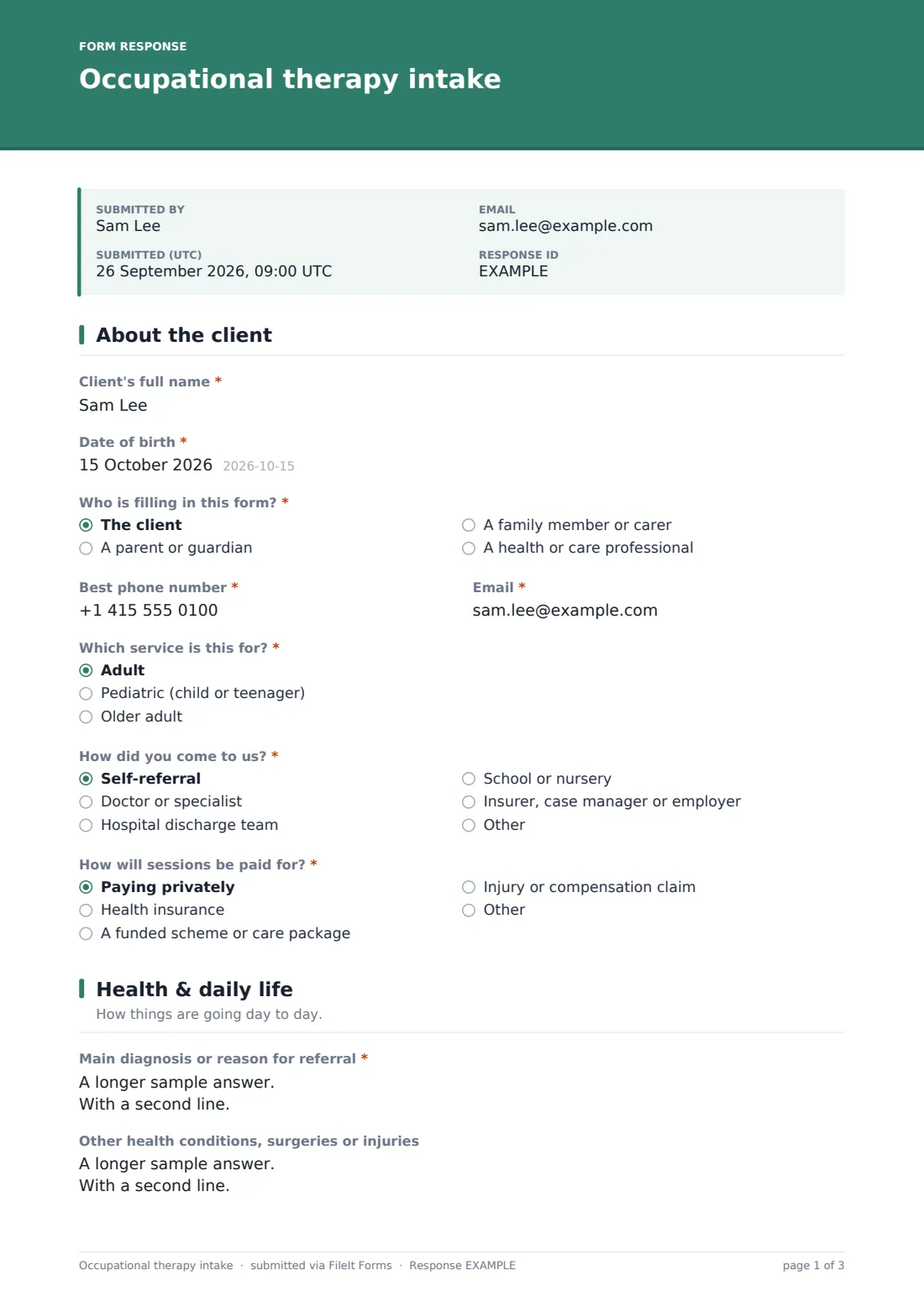
1 About the client
- Client's full name*
- Date of birth*
- Who is filling in this form?* The client · A parent or guardian · A family member or carer · A health or care professional
- Your name and relationship to the client* asked only when it applies
- Best phone number*
- Email*
- Which service is this for?* Adult · Pediatric (child or teenager) · Older adult
- How did you come to us?* Self-referral · Doctor or specialist · Hospital discharge team · School or nursery · Insurer, case manager or employer
- Referrer's name and contact details asked only when it applies
- How will sessions be paid for?* Paying privately · Health insurance · A funded scheme or care package · Injury or compensation claim
- Insurer, scheme or claim reference* asked only when it applies
2 Health & daily life
- Main diagnosis or reason for referral*
- Other health conditions, surgeries or injuries
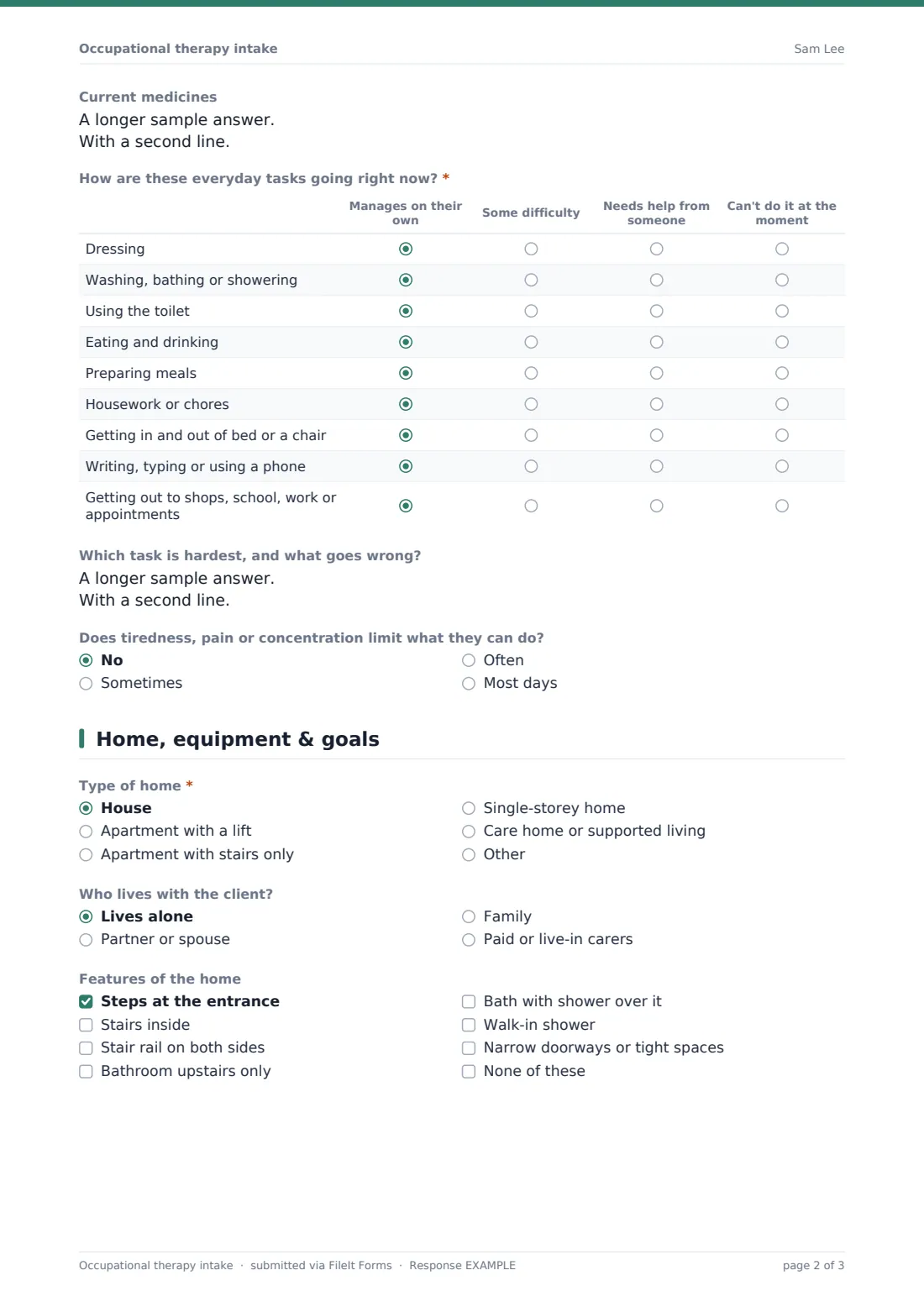
- Current medicines
- How are these everyday tasks going right now?* Manages on their own · Some difficulty · Needs help from someone · Can't do it at the moment
- Which task is hardest, and what goes wrong?
- Does tiredness, pain or concentration limit what they can do? No · Sometimes · Often · Most days
- Which areas are you concerned about?* asked only when it applies Sitting, crawling, walking or balance · Grasping, pointing or picking up small things · Using a spoon, fork or cup · Dressing themselves · Drawing, cutting or handwriting · Reactions to noise, textures, food or touch · Play skills or playing with others · Toilet training · No particular concerns
- Roughly how old were they when they first sat up and walked? asked only when it applies
- Were they born early or with any complications? asked only when it applies
- Please tell us a little more asked only when it applies
- School, nursery or childcare setting asked only when it applies
- Support they already get at school or nursery asked only when it applies
3 Home, equipment & goals
- Type of home* House · Apartment with a lift · Apartment with stairs only · Single-storey home · Care home or supported living
- Who lives with the client? Lives alone · Partner or spouse · Family · Paid or live-in carers
- Features of the home Steps at the entrance · Stairs inside · Stair rail on both sides · Bathroom upstairs only · Bath with shower over it · Walk-in shower · Narrow doorways or tight spaces · None of these
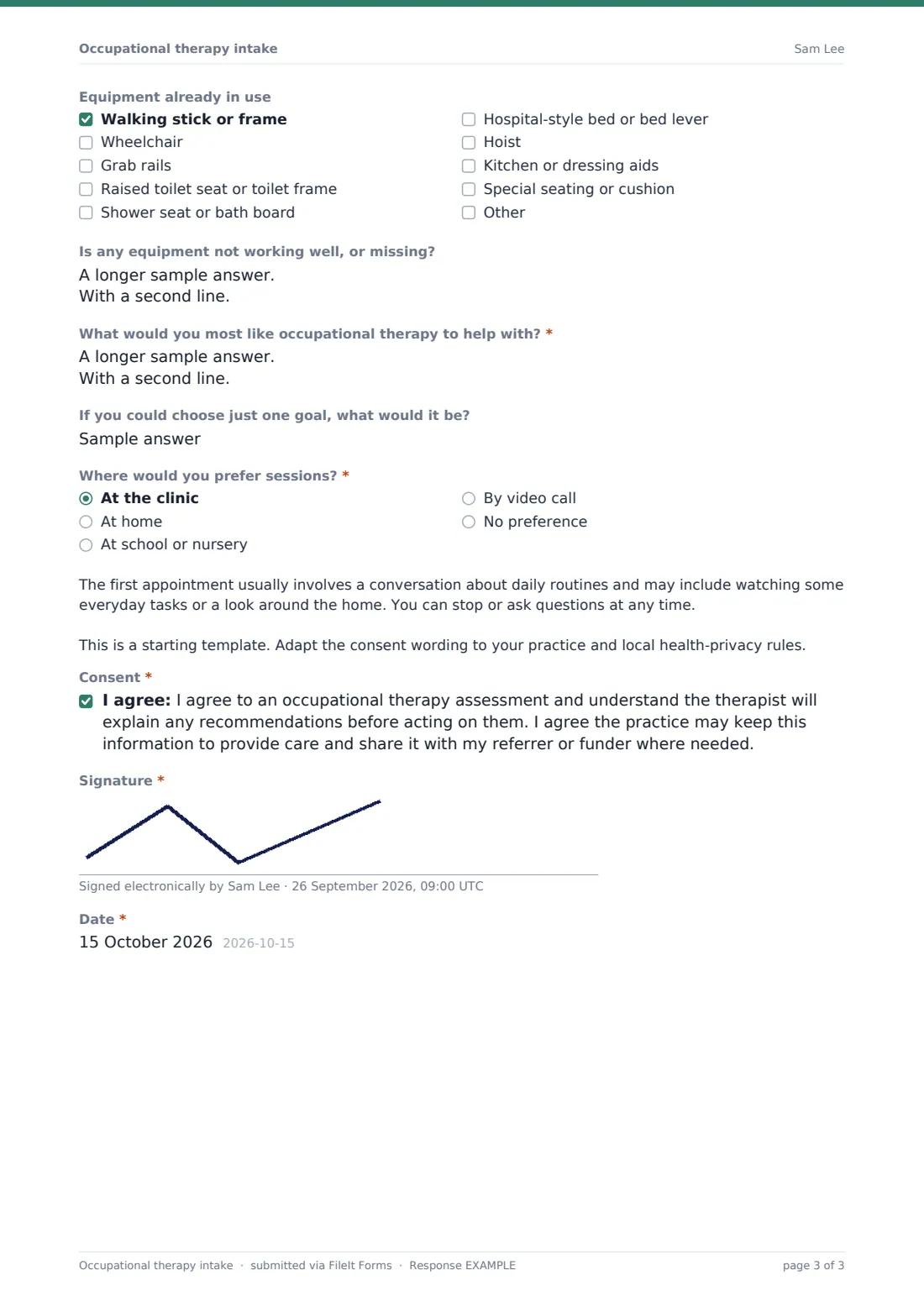
- Equipment already in use Walking stick or frame · Wheelchair · Grab rails · Raised toilet seat or toilet frame · Shower seat or bath board · Hospital-style bed or bed lever · Hoist · Kitchen or dressing aids · Special seating or cushion
- Is any equipment not working well, or missing?
- What would you most like occupational therapy to help with?*
- If you could choose just one goal, what would it be?
- Where would you prefer sessions?* At the clinic · At home · At school or nursery · By video call · No preference
- Consent*
- Signature*
- Date*
The occupational therapy intake form, page by page
1 About the client
The client's name and date of birth come first, then Who is filling in this form? Anyone other than the client gives their name and relationship. The service choice (adult, pediatric or older adult) drives what appears later. How did you come to us? records the referral route, with the referrer's contact details for anything other than self-referral, and How will sessions be paid for? asks for an insurer, scheme or claim reference unless the client is paying privately.
2 Health & daily life
The main diagnosis or reason for referral is required. Other conditions and current medicines are optional, with a prompt to mention anything affecting energy, balance or concentration. The grid How are these everyday tasks going right now? covers dressing, washing, using the toilet, eating, preparing meals, housework, transfers, writing or using a phone, and getting out to shops, school or appointments. A free-text question asks which task is hardest and what goes wrong.
For pediatric clients, Which areas are you concerned about? lists motor, self-care, handwriting, sensory, play and toilet-training concerns, followed by early milestones, birth complications, the child's school or nursery, and support already in place.
3 Home, equipment & goals
The client describes their type of home, who lives with them and features such as entrance steps, an upstairs-only bathroom or a shower over the bath. Equipment already in use ranges from a walking stick to a hoist, with a box for anything missing or not working well. What would you most like occupational therapy to help with? is required, and an optional question asks for the single most important goal. The client picks where they'd prefer sessions, reads a short note on what the first appointment involves, agrees to the consent statement and signs.
Make the template yours
- Rename the service options to match your caseload, such as hand therapy or mental health OT
- Add or remove rows in the daily-living grid for your specialty
- Edit the funding choices to reflect the schemes, insurers and payers you work with
- Add a file question for referral letters or previous reports
- Replace the consent wording with your practice's own
- Route pediatric and adult intakes to different vault folders by duplicating the form
Tips for a better occupational therapy intake form
- Read the hardest-task answer first; it often tells you where to start the assessment
- Use the client's own words from the goal questions when you write up their plan
- For home visits, check the home features answers so you bring the right measuring tools
- Send the form with your booking confirmation so it's back before the first visit
- Keep completed intakes in a vault folder only clinical staff can open
- This is a starting template; adapt it to your practice and local health-privacy rules
Every response becomes a PDF in your vault
Each intake becomes a PDF filed in the vault folder you pick, with the answers laid out page by page and the daily-living grid printed as a table. The practice is emailed when one arrives, and the client can be sent a copy.
In the Responses tab you can filter by service, referral route or funding, open any PDF before the appointment, and export everything to CSV.
- Start from this template. It opens in the FileIt Forms designer — change any question, add pages, set the rules for when questions appear.
- Share it. Turn on a public link, or send it to people by email, each with their own link. They don’t need a FileIt account.
- Get the answers as PDFs. Each response is saved as a PDF in the vault folder you choose, with uploaded files attached — and listed in a Responses table you can export to CSV.
Occupational therapy intake form: frequently asked questions
Is this occupational therapy intake template free?
Yes. It's one of the ready-made templates in FileIt's Forms app, which every account includes, the free plan too.
Do clients or parents need a FileIt account?
No. They open a link or an emailed request and fill it in on a phone or computer. Only the practice needs an account.
How do the pediatric questions work?
They only appear when the service chosen on the first page is pediatric. Adult and older-adult clients go straight from the daily-living questions to the home page.
Can a carer or another professional complete it?
Yes. Anyone who isn't the client is asked for their name and relationship, and the signature can come from an authorised representative.
Can I change the everyday tasks in the grid?
Yes. Rows and answer columns are both editable in the designer, so you can add tasks like driving or medication management.
Is the consent wording ready to use as it is?
Treat it as a starting point and adjust it to your practice, professional body and local privacy requirements.