What is the conveyancing intake form template?
Property transactions run on detail. A missing co-buyer's name, a lease with fewer years than expected or a gifted deposit nobody mentioned can each slow a matter by weeks. The sooner the lawyer has the facts, the sooner the right questions go to the other side.
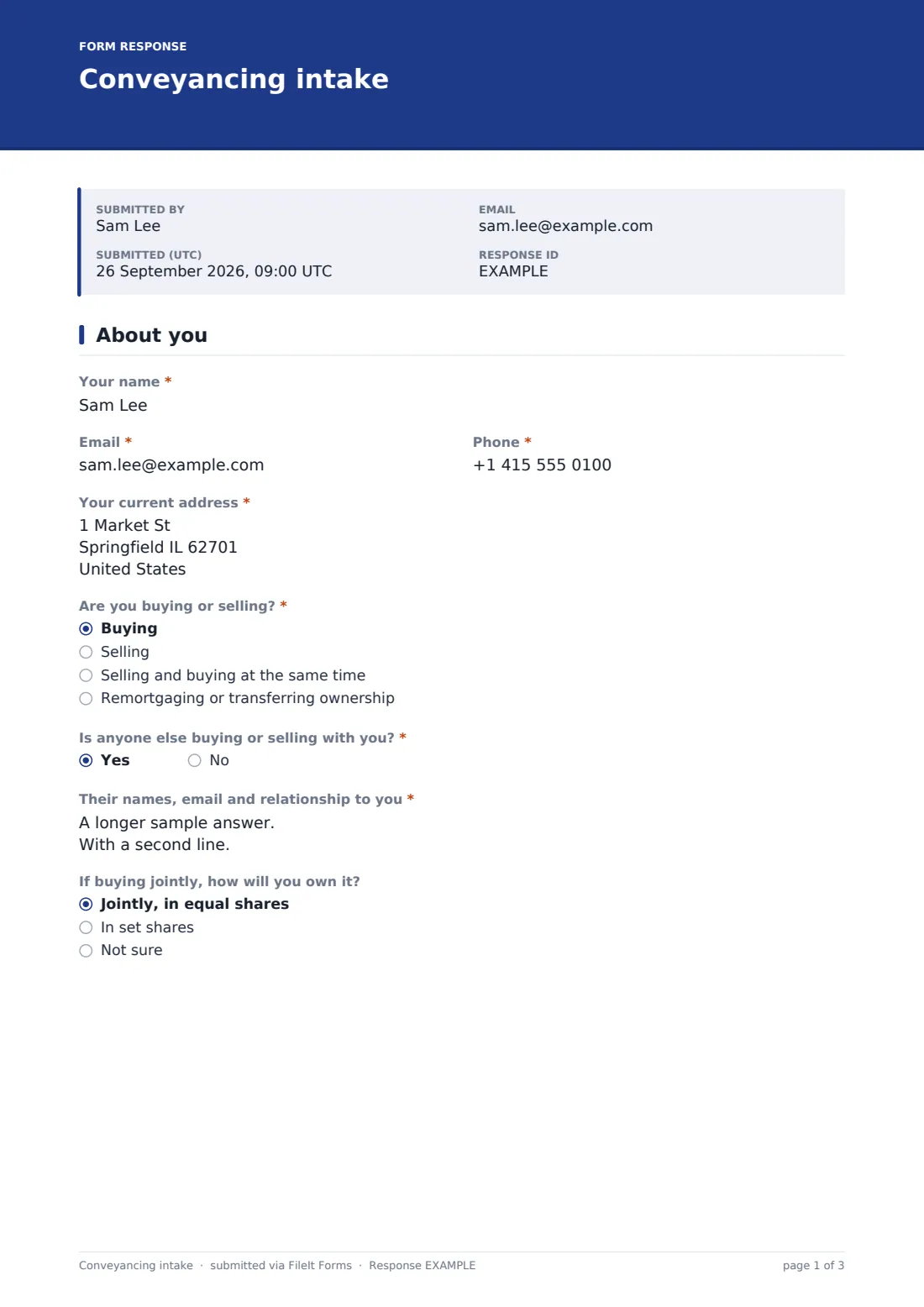
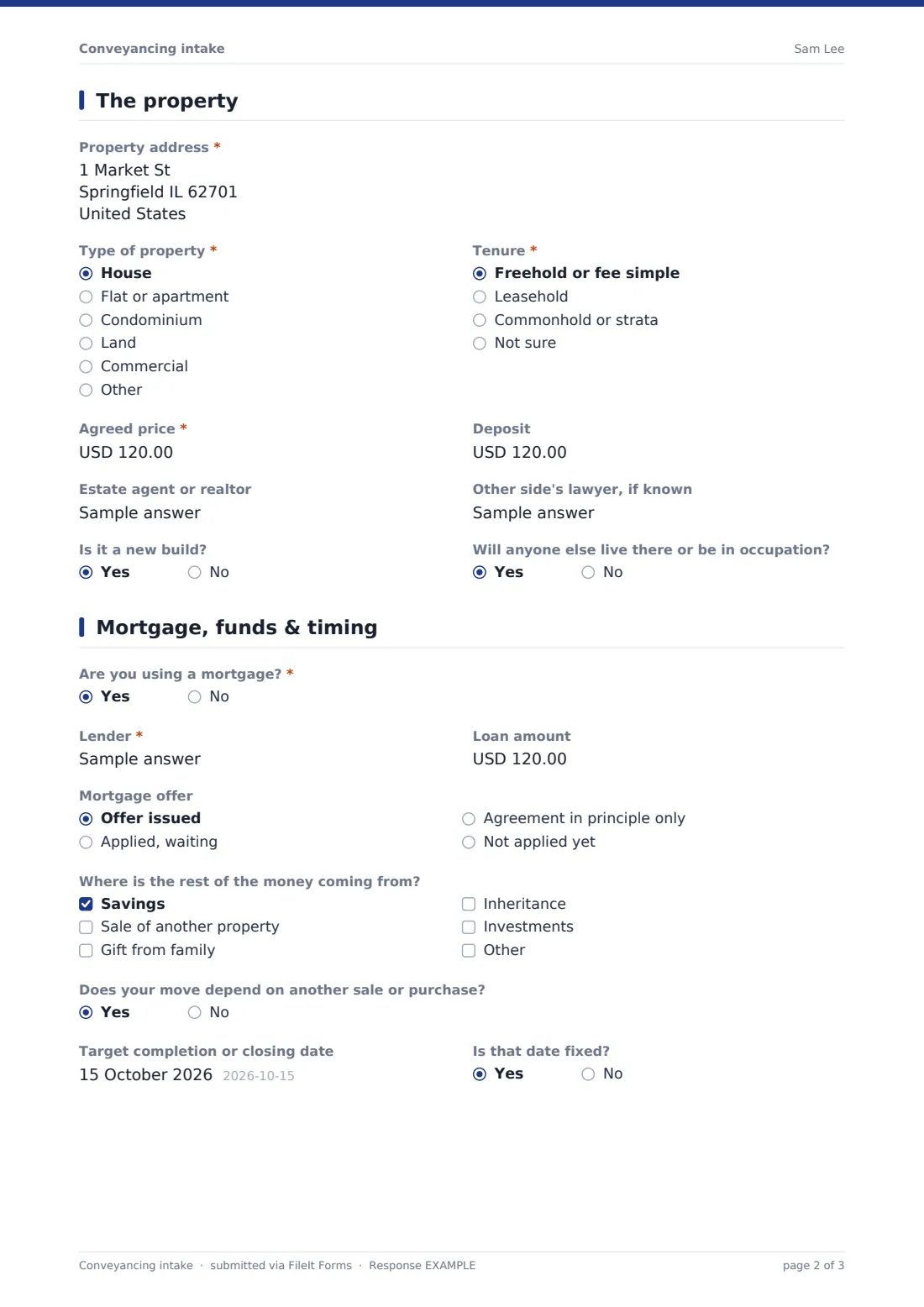
This four-page intake starts with the client, whether they're buying, selling, doing both or remortgaging, and anyone buying or selling with them. The property page covers the address, type, tenure, agreed price, deposit, the agent and the other side's lawyer, plus leasehold details — years left, ground rent, service charge and managing agent — when the property is leasehold.
Buyers are asked about their mortgage, lender, loan and offer status and where the rest of the money is coming from; sellers about any existing mortgage. Chain, target date and documents follow, with an acknowledgement that the firm isn't acting until terms are accepted. Each intake is saved as a PDF in your FileIt vault.
- Best for
- Conveyancers, property lawyers and real estate attorneys
- Filled in by
- Buyers, sellers and remortgaging clients
- Time to complete
- About 10-15 minutes
- Includes
- Parties, property and tenure, leasehold costs, mortgage, source of funds, chain, uploads
Who uses a conveyancing intake form?
- A first-time buyer instructing a conveyancer after an offer is accepted
- A seller opening a file as soon as the property goes on the market
- A couple selling one home and buying another at the same time
- A leasehold flat purchase where lease length and charges matter
- Transferring a share of a property between family members
- A firm sending one standard intake from its website
Questions on this conveyancing intake form
36 questions over 4 pages · includes file upload, conditional questions, multiple pages, consent checkbox.
1 About you
- Your name*
- Email*
- Phone*
- Your current address*
- Are you buying or selling?* Buying · Selling · Selling and buying at the same time · Remortgaging or transferring ownership
- Is anyone else buying or selling with you?*
- Their names, email and relationship to you* asked only when it applies
- If buying jointly, how will you own it? asked only when it applies Jointly, in equal shares · In set shares · Not sure
2 The property
- Property address*
- Address of the property you're selling* asked only when it applies
- Type of property* House · Flat or apartment · Condominium · Land · Commercial · Other
- Tenure* Freehold or fee simple · Leasehold · Commonhold or strata · Not sure
- Agreed price*
- Deposit
- Estate agent or realtor
- Other side's lawyer, if known
- Is it a new build?
- Will anyone else live there or be in occupation?
- Years left on the lease asked only when it applies
- Ground rent a year asked only when it applies
- Service charge a year asked only when it applies
- Landlord or managing agent asked only when it applies
3 Mortgage, funds & timing
- Are you using a mortgage?* asked only when it applies
- Lender* asked only when it applies
- Loan amount asked only when it applies
- Mortgage offer asked only when it applies Offer issued · Applied, waiting · Agreement in principle only · Not applied yet
- Where is the rest of the money coming from? asked only when it applies Savings · Sale of another property · Gift from family · Inheritance · Investments · Other
- Is there a mortgage on the property you're selling?* asked only when it applies
- Current lender asked only when it applies
- Does your move depend on another sale or purchase?
- Target completion or closing date
- Is that date fixed?
4 Documents
- Documents you have
- Best way to reach you Email · Phone · Text message
- Anything else we should know
- Before you submit*
The conveyancing intake form, page by page
1 About you
The client gives Your name, Email, Phone and Your current address, and says whether they're buying, selling, doing both, or remortgaging or transferring ownership. If someone else is involved, the form asks for their names and relationship, and how a joint purchase will be owned.
2 The property
Property address, Type of property, Tenure and Agreed price are required; clients selling and buying also give the address of the property they're selling. Deposit, Estate agent or realtor, the other side's lawyer, new build and occupation questions follow. For leasehold properties, Years left on the lease, Ground rent, Service charge and the landlord or managing agent appear under Leasehold details.
3 Mortgage, funds & timing
Unless the client is only selling, the form asks Are you using a mortgage? and, if so, the lender, loan amount and offer status, then where the rest of the money is coming from. Ticking a family gift shows a note about gift letters. Sellers are asked about an existing mortgage. The page ends with whether the move depends on another sale or purchase, the target completion date and whether it's fixed.
4 Documents
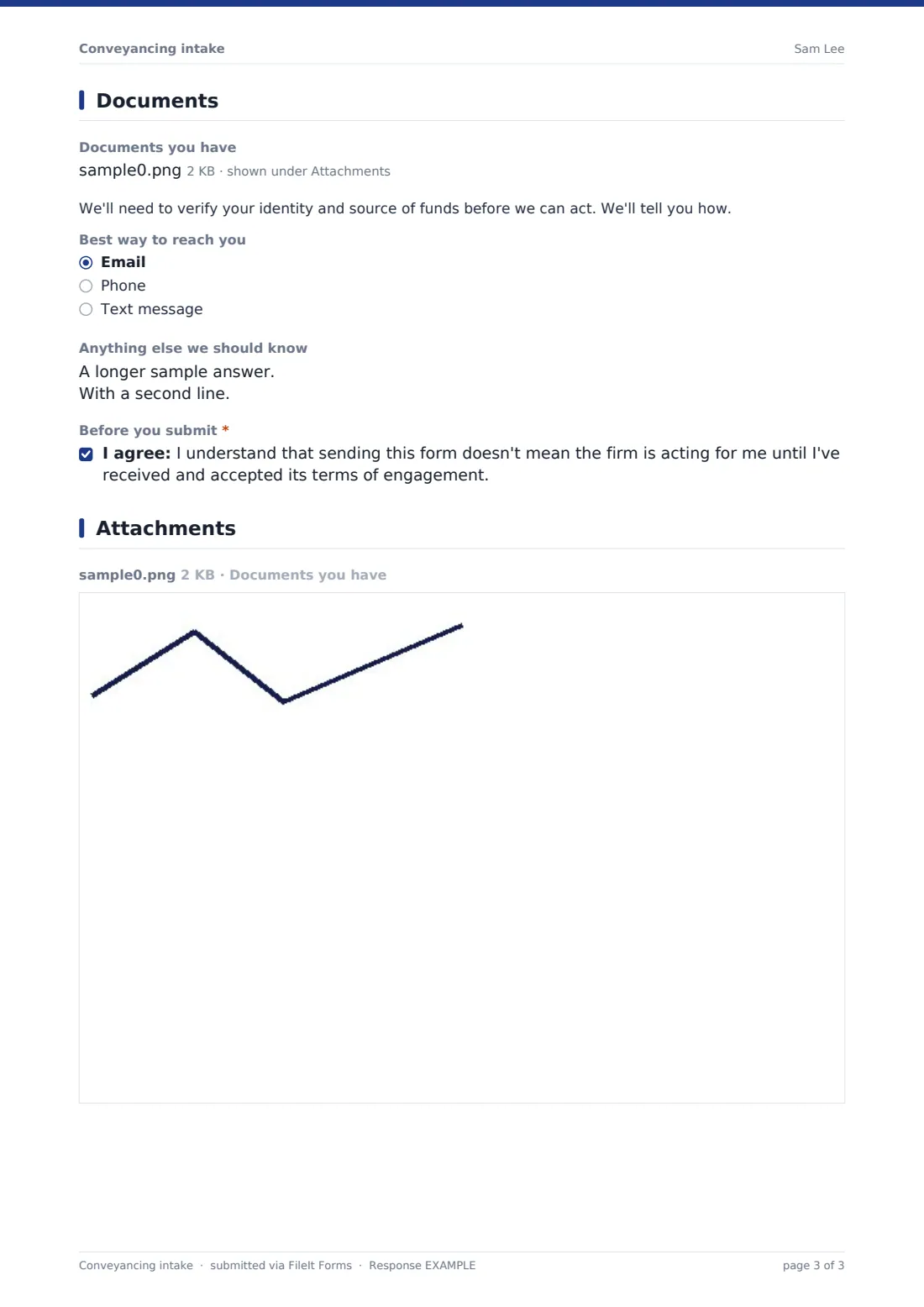
Clients can upload photo ID, the memorandum of sale or contract, mortgage offer, lease or title deeds. A note explains identity and source-of-funds checks. The client picks their preferred contact method, adds anything else the lawyer should know, and acknowledges the firm isn't acting until terms are accepted.
Make the template yours
- Rename tenure options to match your jurisdiction, such as fee simple or strata title
- Remove the leasehold section if you don't handle leasehold property
- Add a question about stamp duty or transfer tax reliefs, such as first-time buyer status
- Add a fee quote paragraph or link to your price list
- Send each submission into a new matter folder in your vault
- Change the currency fields to your local currency
Tips for a better conveyancing intake form
- Ask for the memorandum of sale or accepted offer as early as possible
- Raise lease length early — short leases can affect lending
- Request source-of-funds evidence at the start, not just before exchange or closing
- Confirm everyone on the title and on the mortgage is a client
- Check identity in line with your anti-money-laundering procedures before acting
Every response becomes a PDF in your vault
Each intake is saved as a PDF in the vault folder you choose, with uploaded documents attached. Your team is emailed straight away, and the client can get a copy.
Use the intake to run conflict and identity checks and send terms of engagement. The Responses table lets you see new instructions at a glance.
- Start from this template. It opens in the FileIt Forms designer — change any question, add pages, set the rules for when questions appear.
- Share it. Turn on a public link, or send it to people by email, each with their own link. They don’t need a FileIt account.
- Get the answers as PDFs. Each response is saved as a PDF in the vault folder you choose, with uploaded files attached — and listed in a Responses table you can export to CSV.
Conveyancing intake form: frequently asked questions
Is this conveyancing intake template free?
Yes. It's a starter template in the FileIt Forms app on every account.
Does submitting the form make the firm my lawyer?
No. The acknowledgement says the firm acts only once the client has accepted its terms of engagement.
Does the form verify identity?
No. It collects documents. Identity and source-of-funds checks should be done under your own procedures.
Can it be used outside the UK?
Yes. The wording covers both conveyancing and real estate closing terms. Adjust tenure options and wording for your jurisdiction.
Do clients need a FileIt account?
No. They use the link you share or a personal link.
Can I collect both buyers on one form?
Yes. The form asks for co-buyers' names and contact details. Send each one their own identity check separately.