What is the source of funds declaration form template?
Law firms, conveyancers, accountants and other regulated businesses often have to understand where a client's money comes from before a transaction goes ahead. This declaration asks for the amount and purpose first, then lets the client tick every source and answer the questions for each one.
Logic keeps it relevant. Savings ask how much and where the income came from. A property sale asks for the amount, address and completion date. A gift asks who's giving it, whether any of it is repayable or gives the giver a share, and where the giver's money came from. Loans ask for the lender, and inheritances ask whose estate. Overseas money and politically exposed person status each ask for detail.
Each declaration is signed and saved as a PDF in FileIt with the bank statements and other evidence attached. It doesn't replace your own checks or risk assessment.
- Best for
- Law firms, conveyancers, estate agents, accountants and wealth managers
- Filled in by
- Clients paying money into a transaction
- Time to complete
- About 15 minutes, plus gathering statements
- Includes
- Client and occupation, purpose, amount, paying account, other contributors, sources with details for each, evidence, overseas funds, PEP status, declaration, signature
Who uses a source of funds declaration form?
- A buyer's deposit coming from savings and a gift from parents
- Proceeds of a house sale going into the next purchase
- A business owner buying shares in another company
- A client paying a settlement from an inheritance
- An investor moving money from an overseas account
Questions on this source of funds declaration form
36 questions over 3 pages · includes signature, file upload, conditional questions, multiple pages, consent checkbox.
1 You & the transaction
- Your full name*
- Date of birth*
- Occupation*
- Email*
- Phone*
- Home address*
- Matter or file reference
- What is the money for?* Buying a property · Buying a business or shares · Paying off a mortgage or loan · An investment · A settlement or fees
- Total amount you'll be paying*
- Account it will come from*
- Is anyone else contributing money?*
- Who else, their relationship to you, and how much* asked only when it applies
2 Where the money comes from
- Sources of the money* Savings from income · Sale of a property · Sale of shares or investments · Sale of a business · A gift · A loan or mortgage · An inheritance · A pension lump sum · Compensation or a settlement
- Amount from savings* asked only when it applies
- Employer or business, and roughly how long you've been saving* asked only when it applies
- Amount from the property sale* asked only when it applies
- Completion date of the sale asked only when it applies
- Address of the property sold* asked only when it applies
- Amount from shares or investments* asked only when it applies
- What was sold, and through which provider* asked only when it applies
- The business sold, the buyer and the amount you received* asked only when it applies
- Amount of the gift* asked only when it applies
- Who is giving it, and their relationship to you* asked only when it applies
- Will any of the gift be repaid, or will the giver own a share of what you're buying?* asked only when it applies
- Where does the giver's money come from?* asked only when it applies
- Amount borrowed* asked only when it applies
- Lender* asked only when it applies
- Whose estate, date of death, and amount received* asked only when it applies
- Details of any other source
3 Evidence & declaration
- Supporting evidence*
- Is any of the money coming from outside the country?*
- Which country, and how it will be transferred* asked only when it applies
- Are you, or a close family member or associate, a politically exposed person?*
- Who, and what role* asked only when it applies
- Declaration*
- Signature*
The source of funds declaration form, page by page
1 You & the transaction
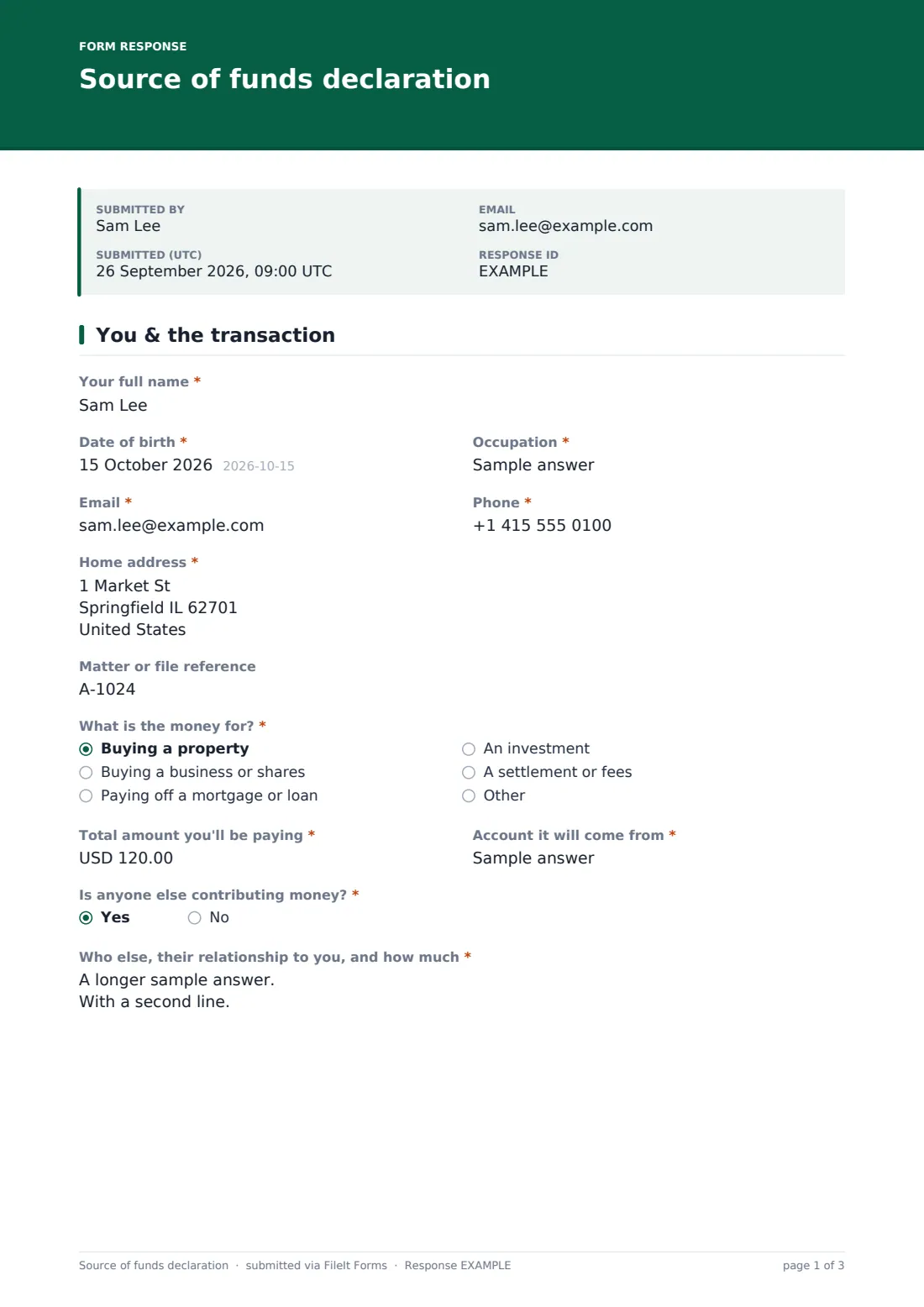
The client gives their name, date of birth, occupation, email, phone, address and matter reference. "What is the money for?" offers a property, a business or shares, paying off a loan, an investment, a settlement or fees, or another purpose. They give the total amount, the account it will come from, and whether anyone else is contributing, with who, their relationship and how much.
2 Where the money comes from
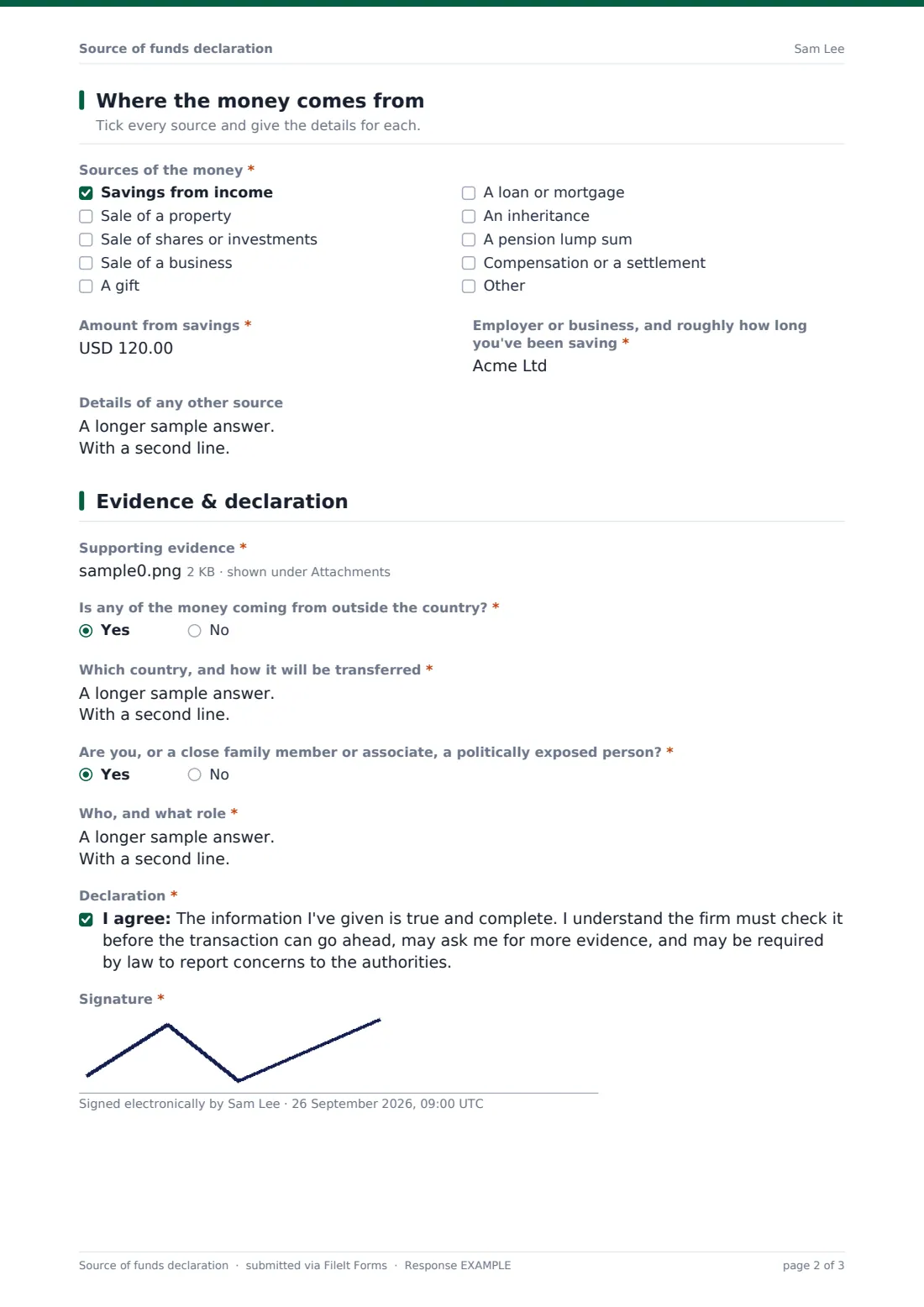
"Sources of the money" lists savings, a property sale, shares or investments, a business sale, a gift, a loan or mortgage, an inheritance, a pension lump sum, compensation, or something else. Most ticked sources ask their own questions: amounts, the employer and how long they've saved, the property address and completion date, what was sold and through whom, who is giving a gift and whether any of it is repayable or gives them a share, the lender, or whose estate. "Details of any other source" covers pension lump sums, compensation and anything ticked as Other.
3 Evidence & declaration
"Supporting evidence" is required and takes up to ten files. "Is any of the money coming from outside the country?" asks which country and how it will be sent. The PEP question explains the term and asks who and what role. The client signs a declaration that the information is true and that the firm may ask for more and may be required to report concerns.
Make the template yours
- Change the currency on the amount questions
- Add the sources you see most often, such as a cryptocurrency sale or a business dividend
- Send it with a personal link from the matter file so the client's details are prefilled
- Route declarations to your compliance team's folder
- Set the cover text to say how long you'll need to review it before completion
Tips for a better source of funds declaration form
- Check the evidence against each source and amount, not just the total
- Look closely at gifts: who gives them, whether they're repayable, and where the giver's money came from
- Compare the paying account with the bank statements uploaded
- Follow up any overseas source or PEP answer under your own procedures
- Ask for an updated declaration if the amount or sources change
Every response becomes a PDF in your vault
Each signed declaration is saved as a PDF in the folder you choose, with the evidence attached. Your team is emailed when one arrives.
The Responses table lists declarations by client and amount, and the CSV export lets compliance see which sources and overseas transfers come up most.
- Start from this template. It opens in the FileIt Forms designer — change any question, add pages, set the rules for when questions appear.
- Share it. Turn on a public link, or send it to people by email, each with their own link. They don’t need a FileIt account.
- Get the answers as PDFs. Each response is saved as a PDF in the vault folder you choose, with uploaded files attached — and listed in a Responses table you can export to CSV.
Source of funds declaration form: frequently asked questions
Is this source of funds template free?
Yes. It's one of the starter templates in the Forms app, included on every FileIt account, and you can edit any question.
Does this form meet our anti-money-laundering obligations?
It collects information, but your obligations depend on your regulator and the law where you work. Use it alongside your own risk assessment and checks.
What's the difference between source of funds and source of wealth?
Source of funds is where the money for this transaction comes from. Source of wealth is how the client built up their overall wealth. You can add questions if you need both.
Do clients need a FileIt account?
No. They open your link, answer the questions and submit. No account is needed.
Can clients upload bank statements?
Yes. The evidence question takes up to ten PDFs, images or Word documents.