What is a tenant improvement agreement?
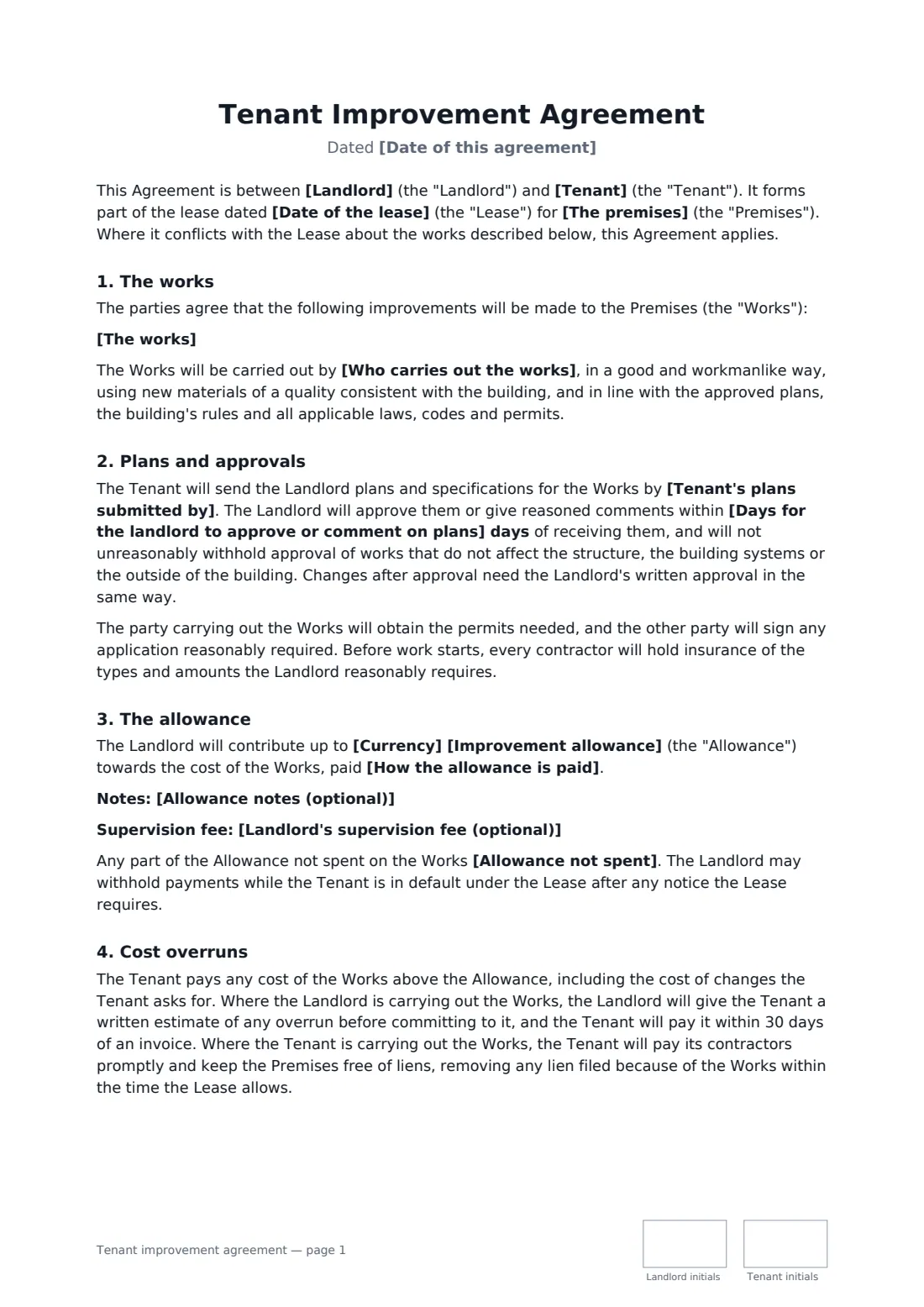
Most commercial leases need some building work before the tenant can move in: walls, lighting, a kitchen, cabling. A tenant improvement agreement, sometimes called a work letter, says what will be built, who builds it, how much the landlord pays towards it and what happens if it costs more.
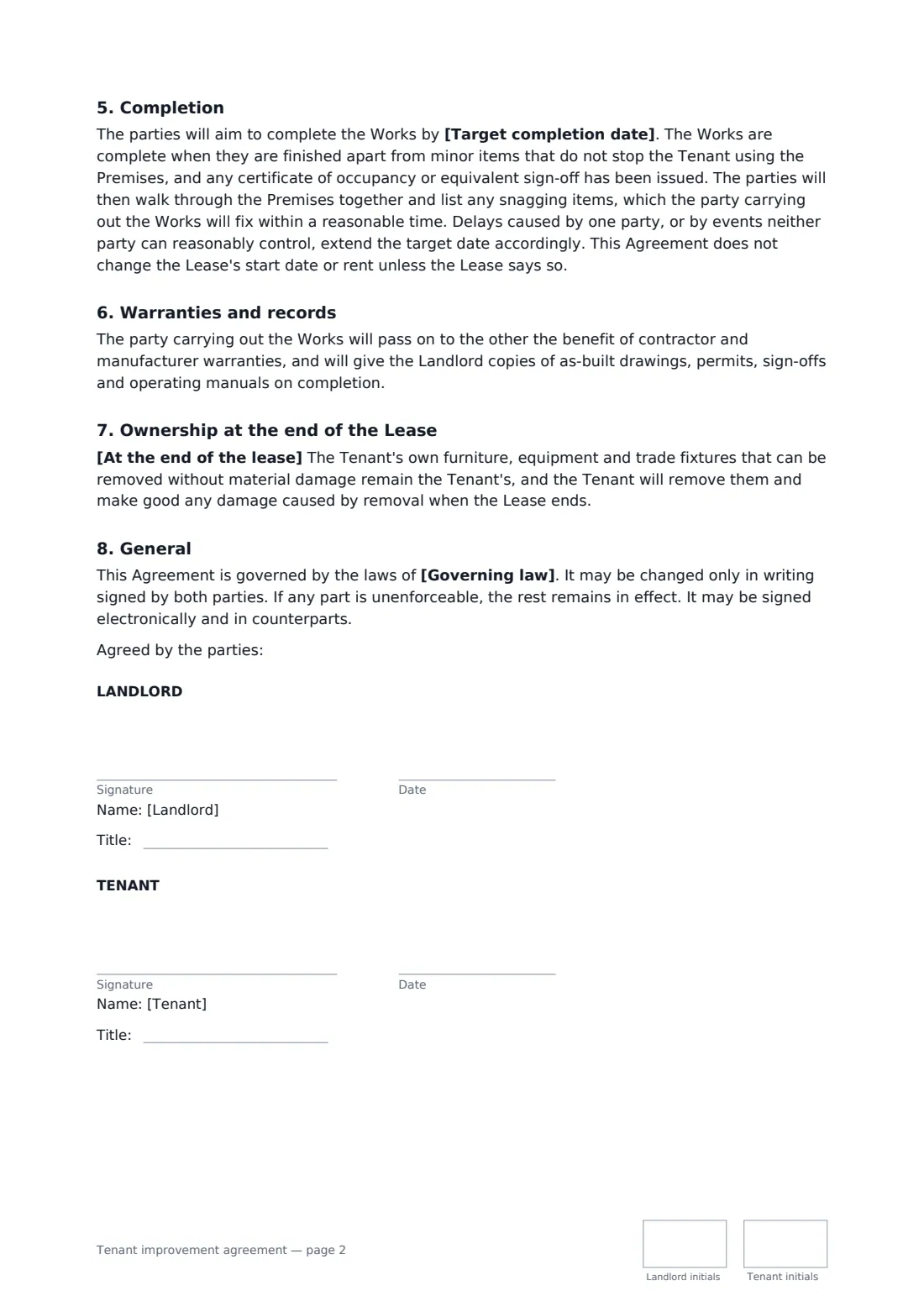
This template describes the works and whether the tenant or the landlord manages them, and sets dates for plans and for the landlord's approval. It sets the allowance and one of three payment methods, says what happens to unspent money and any supervision fee, and puts overruns on the tenant. It covers permits, contractor insurance, liens, completion and the snag list, warranties and as-built drawings, and three options for what happens to the works when the lease ends.
- Best for
- Office, retail, restaurant or clinic fit-outs under a commercial lease
- Signed by
- Landlord and tenant, with job titles, initialled on every page
- Allowance paid
- Progress payments, one payment at completion, or landlord pays contractors
- Length
- 2-3 pages
When to use a tenant improvement agreement
- A tenant building out a shell unit with a landlord contribution
- A landlord delivering a turnkey office before the start date
- Agreeing whether unspent allowance can be used for cabling or furniture
- Recording that a restaurant fit-out must be removed at lease end
- Adding a work letter to a lease that was signed before the plans were ready
What you fill in
18 blanks, then the name and email of each person who signs: landlord, tenant.
1 The lease
- Date of this agreement*
- Landlord*
- Tenant*
- The premises*
- Date of the lease*
2 The works
- The works*
- Who carries out the works* the Tenant, using contractors the Landlord has approved · the Landlord, using the Landlord's contractors
- Tenant's plans submitted by*
- Days for the landlord to approve or comment on plans*
- Target completion date*
3 The allowance
- Currency*
- Improvement allowance*
- Allowance notes (optional)
- How the allowance is paid* in monthly progress payments against contractor invoices and lien waivers, with 10% held back until completion · in one payment after completion, on receipt of final invoices, lien waivers and the certificate of occupancy or equivalent · by the Landlord paying the Landlord's contractors directly, as the works are done
- Allowance not spent* stays with the Landlord · may be credited against base rent, up to the amount stated in the notes · may be used for moving costs, furniture or cabling, up to the amount stated in the notes
- Landlord's supervision fee (optional)
4 End of lease
- At the end of the lease* The works become the Landlord's property and stay in the premises, unless the Landlord asked for removal of specific items in writing when approving the plans. · The Tenant will remove the works and restore the premises to the condition before the works, apart from normal wear and tear. · The works become the Landlord's property and stay in the premises.
- Governing law*
5 Who signs
- Landlord signature and date, job title, initials on every page · The owner of the premises, or the person authorised to sign for the owner.
- Tenant signature and date, job title, initials on every page · The person signing for the tenant business.
What the tenant improvement agreement covers
- The works
- Plans and approvals
- The allowance
- Cost overruns
- Completion
- Warranties and records
- Ownership at the end of the Lease
- General
Using the tenant improvement agreement, step by step
1 Link it to the lease
Enter the landlord, tenant, premises and lease date.
2 Describe the works
Set out the scope, choose who carries it out, and set the dates for plans, approval and completion.
3 Set the allowance
Enter the allowance and any rate notes, choose how it is paid and what happens to unspent money, and add a supervision fee if there is one.
4 Decide the end of the lease and sign
Choose whether the works stay or are removed when the lease ends, add the governing law and send it for initials and signatures.
Tips before you send it
- Attach or reference the approved plans once they exist, and keep them in your vault with this agreement and the lease.
- Ask for lien waivers with every progress payment, so the building stays free of contractor claims.
- Agree long-lead items such as HVAC equipment early. They are a common reason for late completion.
- If the lease start date depends on completion, make sure the lease says so. This agreement does not change it on its own.
Sign it online in minutes
- Fill in the blanks. Names, dates and amounts go straight into the agreement — the preview shows exactly where.
- Name who signs. Tick “This is me” for your own part. FileIt builds the PDF with every signature, date and initials box on the right line, and you can check or move anything before sending.
- Send it. Each signer gets a secure link and signs from any device — no account needed. The signed PDF, with an audit trail and a Certificate of Completion, is filed in your vault and emailed to everyone.
Tenant improvement agreement: frequently asked questions
Who pays if the works cost more than the allowance?
The tenant. Where the landlord is building, the tenant gets a written estimate of the overrun before it is committed and pays within 30 days of an invoice. Where the tenant builds, they pay their contractors and keep the premises free of liens.
Can the landlord refuse the plans?
The landlord must approve or comment with reasons within the days you set, and won't unreasonably withhold approval for works that don't affect the structure, building systems or exterior.
What happens to the improvements at the end?
You choose: they stay as the landlord's property unless the landlord asked for removal of specific items when approving the plans, the tenant removes them and restores the premises, or they always stay. Trade fixtures remain the tenant's.
Can a fit-out agreement be e-signed with the lease?
Yes, you can send it in the same way as the lease. Commercial contracts like this are routinely e-signed, and FileIt records each signer's title, every page's initials and the signing times.