What is a commercial lease letter of intent?
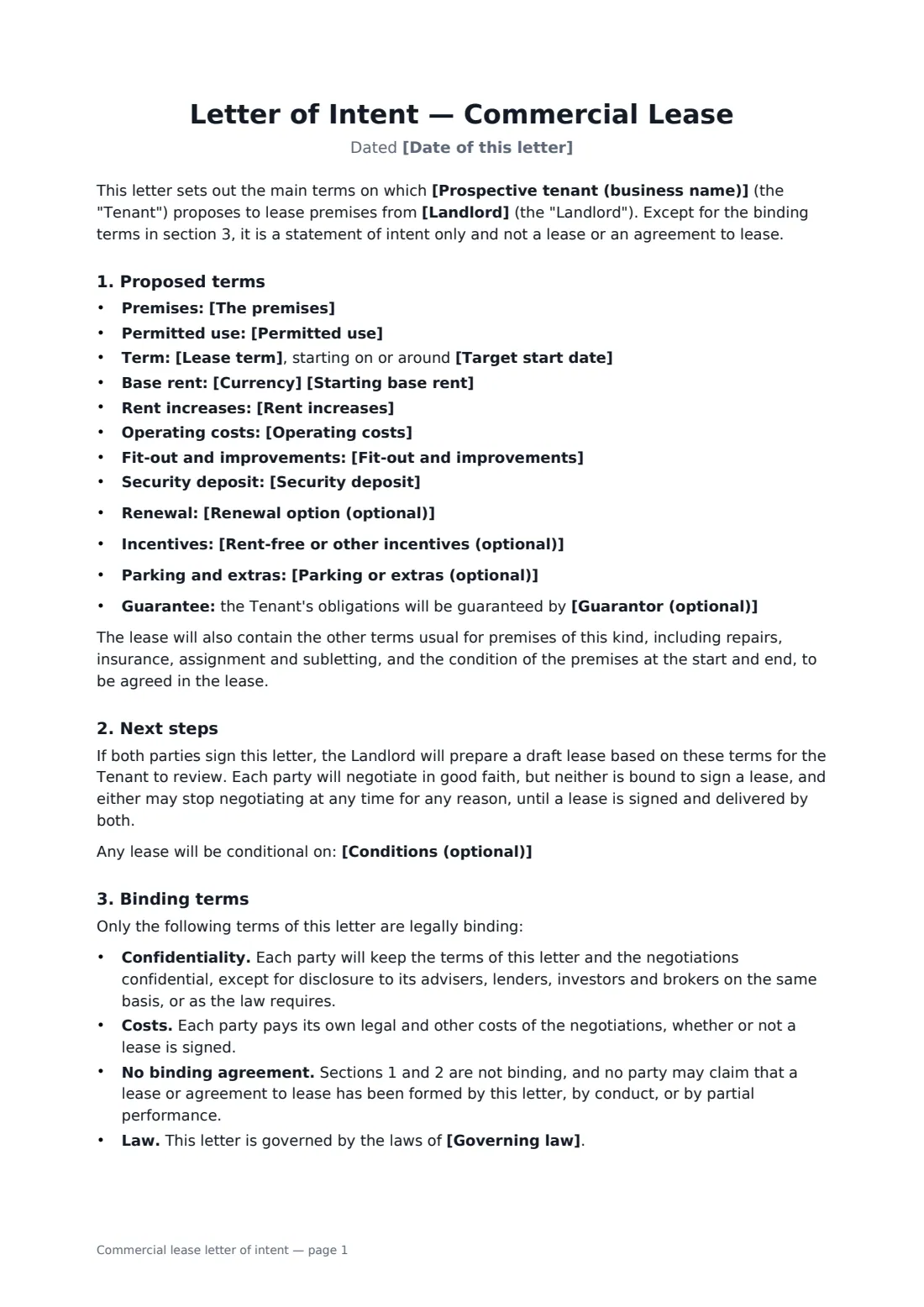
Before anyone pays for a full commercial lease, the landlord and the prospective tenant usually agree the big points on a page or two: the space, the term, the rent and how it rises, who pays operating costs, what the landlord contributes to the fit-out and how much deposit is needed. That letter of intent, also called heads of terms, becomes the brief for the lease.
This template lists those terms, with optional lines for a renewal option, rent-free months, parking and signage, and a guarantor. It explains the next step and records any conditions. It says plainly that the commercial terms are not binding, and makes only confidentiality, own costs, governing law and an optional short exclusivity period binding. It lapses if not signed by a set date.
- Best for
- Office, retail, industrial or medical space before the lease is drafted
- Signed by
- Prospective tenant and landlord, with job titles
- Binding parts
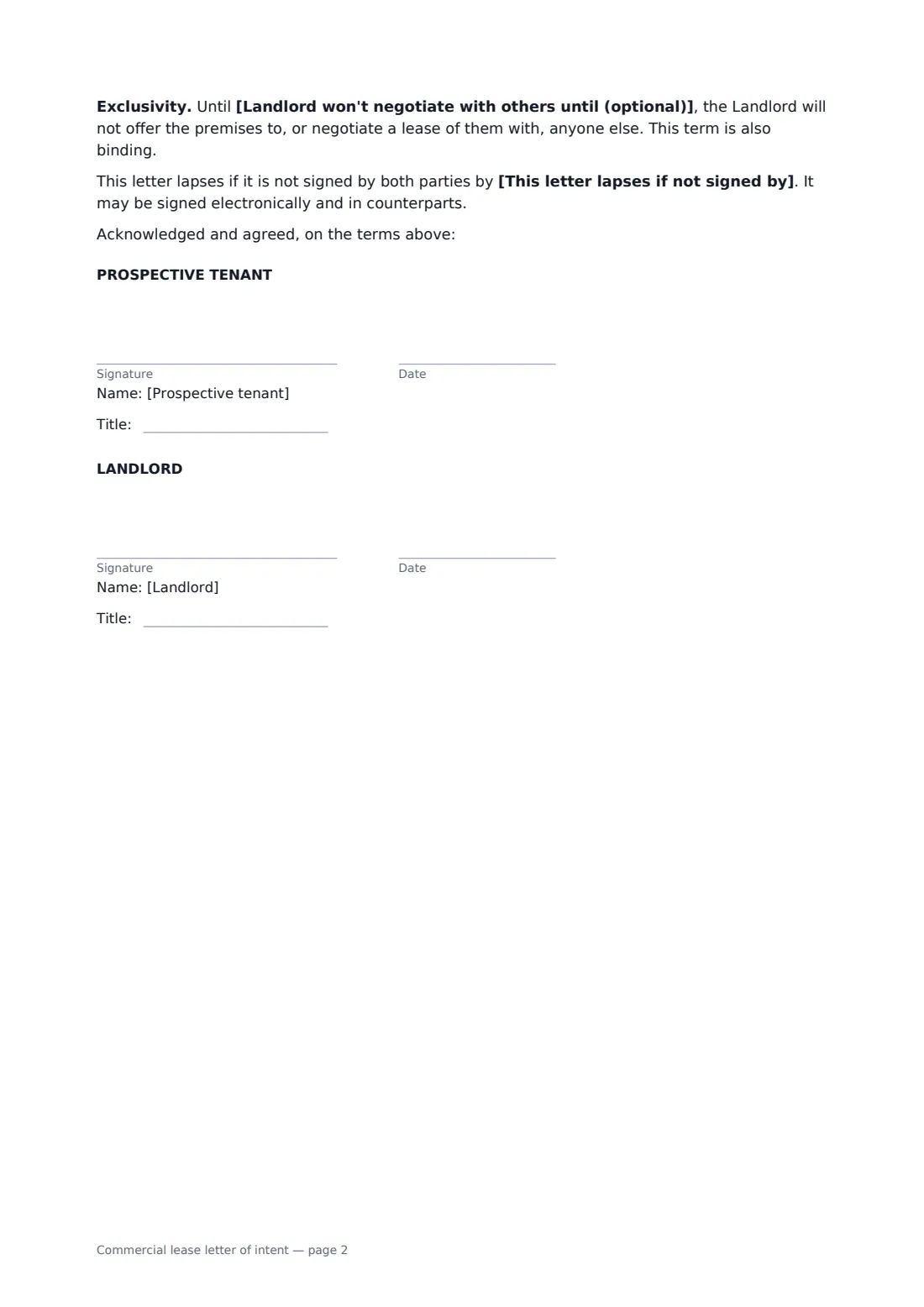
- Confidentiality, costs, governing law, optional exclusivity
- Length
- 2 pages
When to use a commercial lease letter of intent
- A growing company taking its first office suite
- A restaurant agreeing a fit-out allowance for a shell unit
- A broker turning a landlord's proposal into a signed term sheet
- Locking in a short exclusivity period while a lender reviews the deal
- A clinic setting the conditions it needs before committing to a site
What you fill in
21 blanks, then the name and email of each person who signs: prospective tenant, landlord.
1 The parties
- Date of this letter*
- Prospective tenant (business name)*
- Landlord*
- Guarantor (optional)
2 The premises
- The premises*
- Permitted use*
- Parking or extras (optional)
3 Term and rent
- Lease term*
- Target start date*
- Renewal option (optional)
- Currency*
- Starting base rent*
- Rent increases*
- Operating costs* a net lease, with the Tenant paying its share of operating costs, taxes and insurance in addition to base rent · a gross lease, with operating costs, taxes and insurance included in the base rent · a modified gross lease, with the Tenant paying increases in operating costs over a base year
- Rent-free or other incentives (optional)
4 Fit-out and deposit
- Fit-out and improvements*
- Security deposit*
- Conditions (optional)
5 Binding terms
- Landlord won't negotiate with others until (optional)
- This letter lapses if not signed by*
- Governing law*
6 Who signs
- Prospective tenant signature and date, job title · The person signing for the business that wants to lease the premises.
- Landlord signature and date, job title · The owner of the premises, or the person authorised to sign for the owner.
What the commercial lease letter of intent covers
- Proposed terms
- Next steps
- Binding terms
Using the commercial lease letter of intent, step by step
1 Name the parties
Enter the business that wants to lease, the landlord and an optional guarantor.
2 Describe the space and deal
Describe the premises and use, then the term, start date, base rent, increases and operating-cost model. Add a renewal option, incentives and parking if they apply.
3 Fit-out, deposit and conditions
Describe the fit-out and any allowance, the deposit or letter of credit, and any conditions such as board approval.
4 Set the binding terms and send
Add an exclusivity date if agreed, the date the letter lapses and the governing law, then send it to the landlord to sign.
Tips before you send it
- Be specific about how the space is measured — rentable or usable — and say which in the premises description.
- Agree who manages the fit-out and what happens to unspent allowance before signing; it is often the hardest point later.
- Keep exclusivity short. A few weeks is usually enough to draft and review a lease.
- Store the signed letter with the draft lease in your vault, so the lawyers work from the agreed terms.
Sign it online in minutes
- Fill in the blanks. Names, dates and amounts go straight into the agreement — the preview shows exactly where.
- Name who signs. Tick “This is me” for your own part. FileIt builds the PDF with every signature, date box on the right line, and you can check or move anything before sending.
- Send it. Each signer gets a secure link and signs from any device — no account needed. The signed PDF, with an audit trail and a Certificate of Completion, is filed in your vault and emailed to everyone.
Commercial lease letter of intent: frequently asked questions
Is a letter of intent binding?
Not the commercial terms. This template says that only confidentiality, costs, governing law and any exclusivity period are binding, and that no lease is formed by the letter, conduct or partial performance. Courts in some places look closely at the wording, so keep the non-binding language intact.
What is the difference between net and gross?
In a net lease the tenant pays its share of operating costs, taxes and insurance on top of base rent. In a gross lease those are included. A modified gross lease charges increases over a base year. You choose one.
Can either side walk away after signing?
Yes. Either party may stop negotiating at any time until a lease is signed and delivered by both, while still keeping the binding confidentiality and exclusivity terms.
Can a letter of intent be signed electronically?
Yes. Letters of intent are commonly e-signed, and electronic signatures are accepted for documents like this under the US ESIGN Act, eIDAS and UK law. FileIt records each signer's job title and the signing times.