What is a session musician agreement?
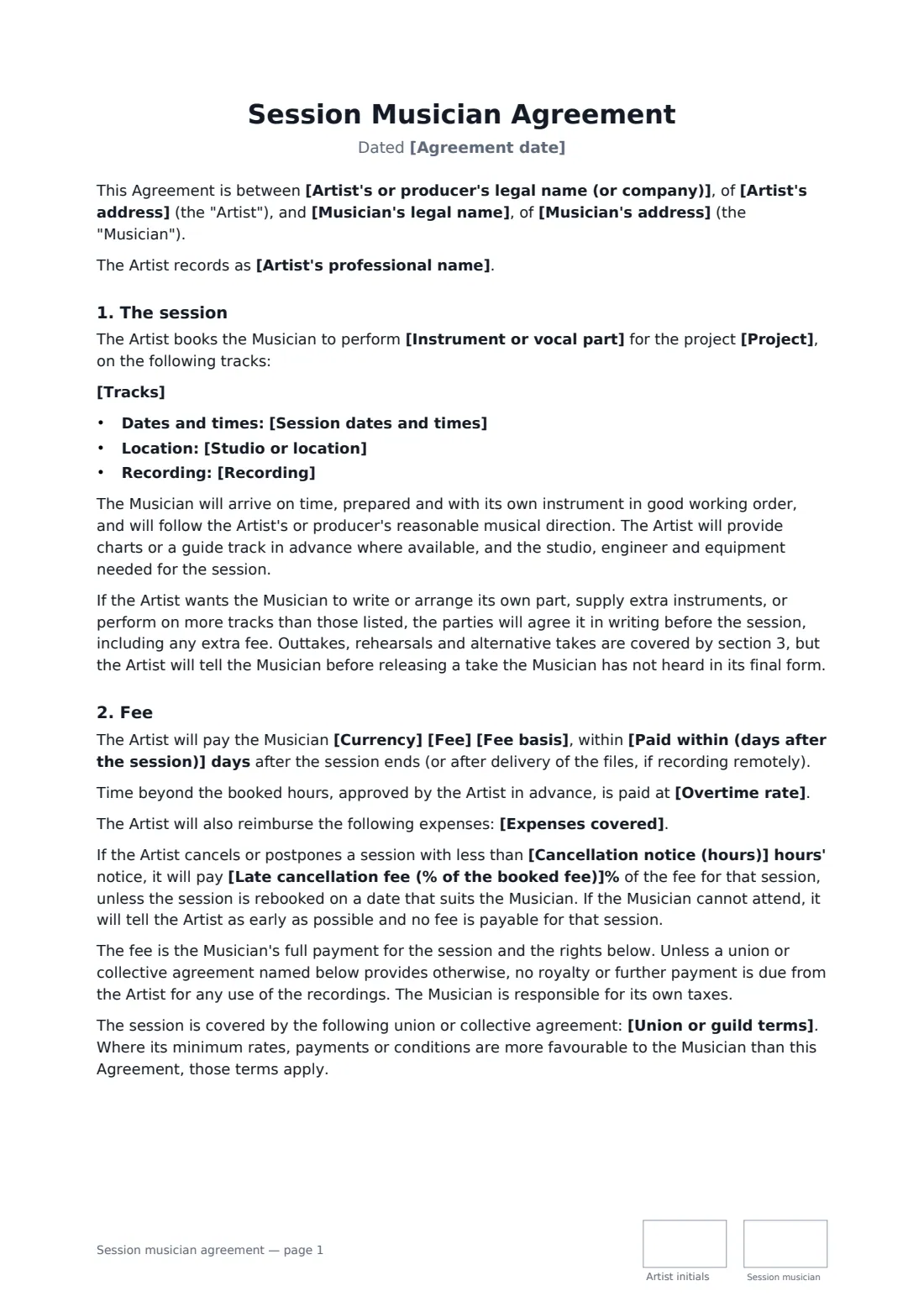
A session musician agreement (sometimes called a session player release or performer consent) is signed when an artist, producer or label books a player or vocalist to perform on a recording. The main point is simple: the person paying for the session needs the musician's consent to use the recorded performance, and the musician needs to know what they are paid, how they are credited and what the recordings may be used for.
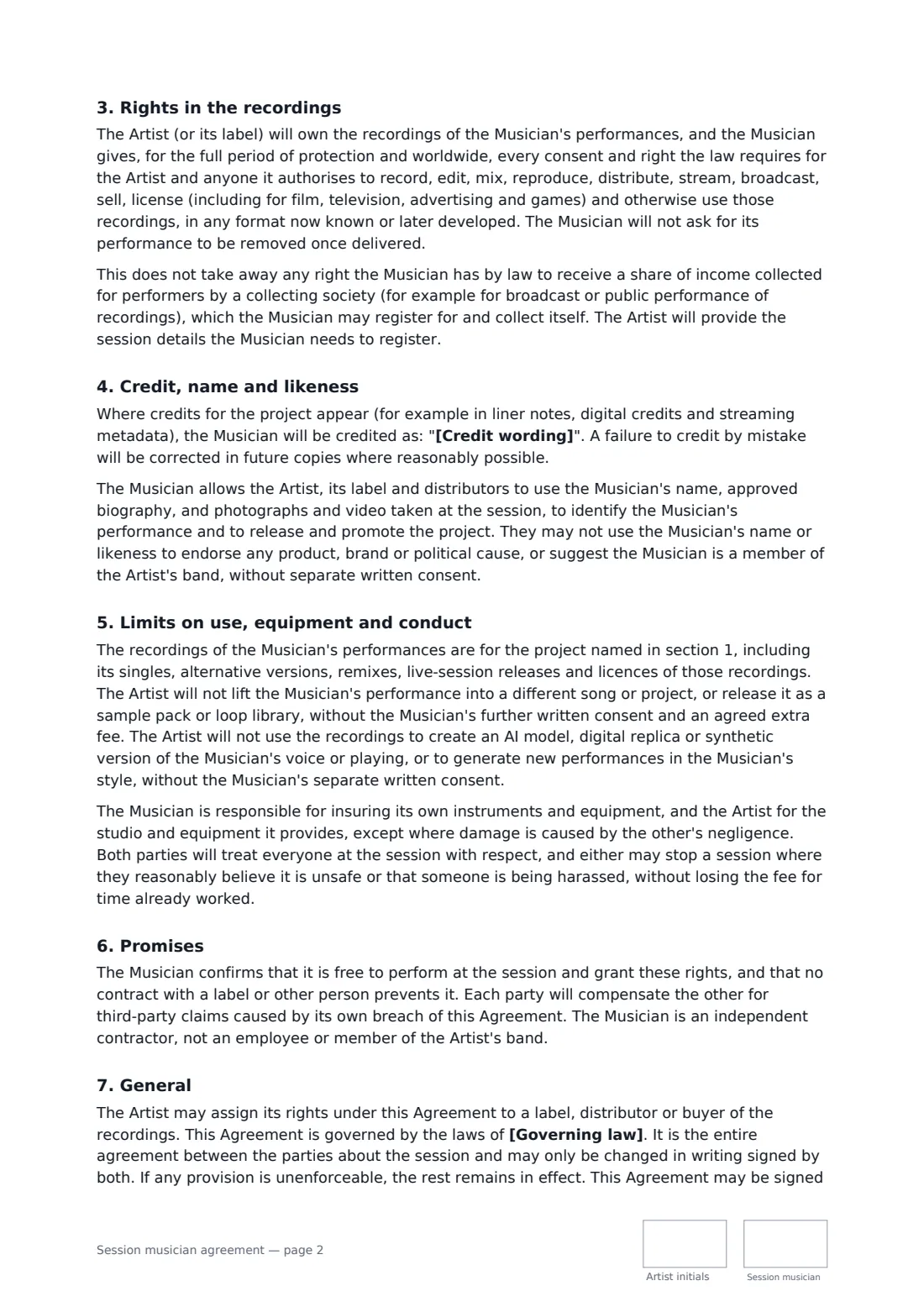
This template covers the project and tracks, the instrument or vocal part, dates, location and in-person or remote recording, the fee by day, track, hour or engagement, overtime, expenses and a late-cancellation fee, the artist owning the recordings with the consents needed to release and license them, the musician's right to collect performer income from collecting societies, songwriting, credit wording, use of name, photos and session footage, any union or collective agreement, limits on reusing the performance in other songs or sample packs, no AI voice or playing models without consent, equipment and conduct, and promises.
- Best for
- Artists, producers and labels booking session players, backing vocalists and remote session musicians
- Signed by
- The artist (or producer or label) and the session musician
- Fee basis
- Per session day, per track, per hour or for the whole engagement
- Length
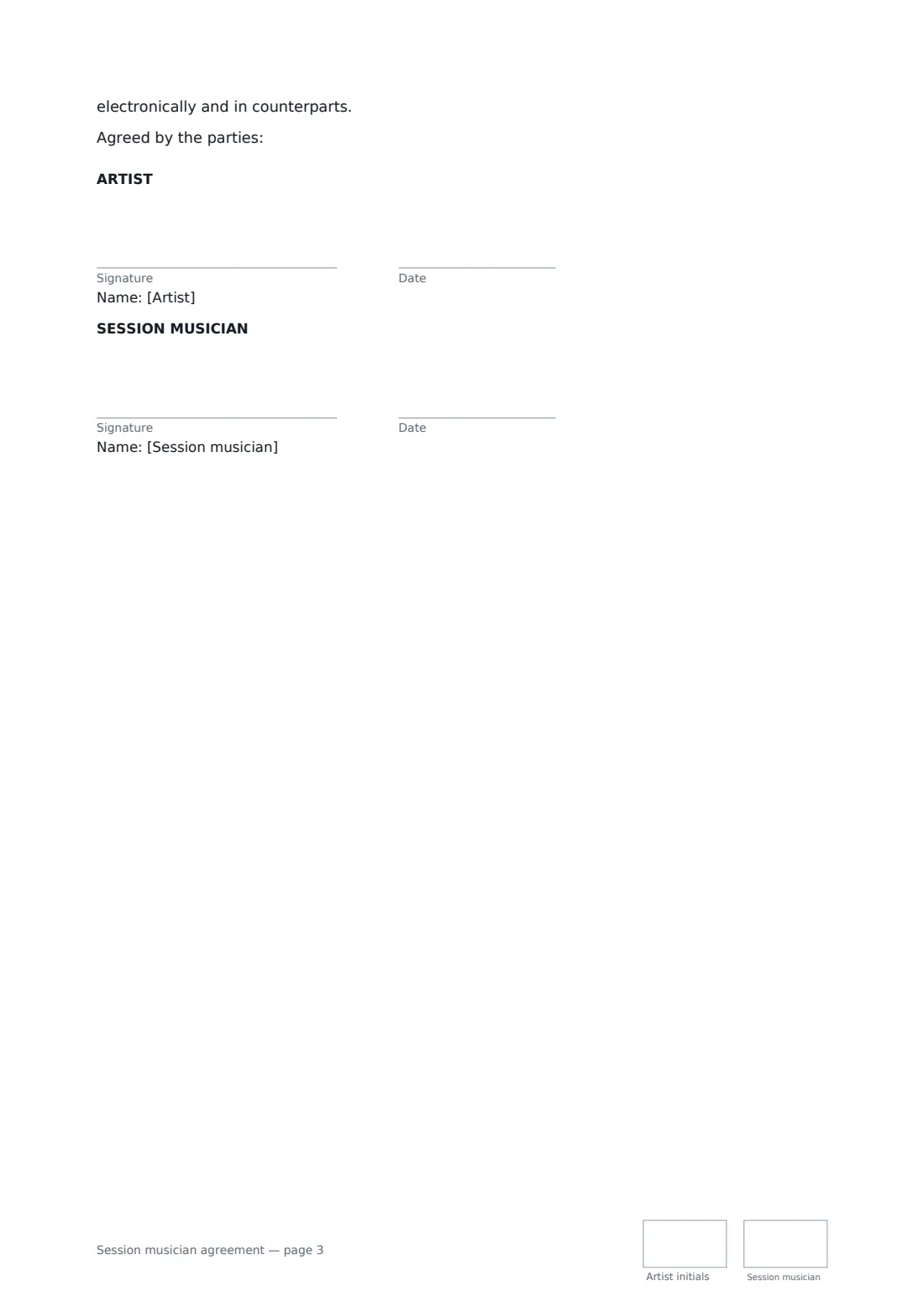
- 3 pages, initialled on every page
When to use a session musician agreement
- Booking a bassist and drummer for two days of album tracking
- Hiring a backing vocalist for a single
- Commissioning a remote string or horn part delivered as files
- A producer adding a guitarist to a client's EP
- Getting a written performer consent from a friend who played on a release
What you fill in
26 blanks, then the name and email of each person who signs: artist, session musician.
1 The parties
- Agreement date*
- Artist's or producer's legal name (or company)*
- Artist's professional name
- Artist's address
- Musician's legal name*
- Musician's name for the credit*
- Musician's address
2 The session
- Project*
- Tracks*
- Instrument or vocal part*
- Session dates and times*
- Studio or location*
- Recording* in person at the studio · remotely, with the Musician delivering files
- Files (if remote)
3 Fee
- Currency*
- Fee basis* per session day · per track · per hour · for the whole engagement
- Fee*
- Overtime rate
- Expenses covered
- Paid within (days after the session)*
- Cancellation notice (hours)*
- Late cancellation fee (% of the booked fee)*
4 Rights and credit
- Union or guild terms
- Credit wording*
- Songwriting* The Musician is performing only and is not a writer · If the Musician contributes to the writing, a split sheet will be agreed
- Governing law*
5 Who signs
- Artist signature and date, initials on every page · The artist, producer or label booking the session. For a band or company, an authorised person signs.
- Session musician signature and date, initials on every page · The player or vocalist performing on the recording.
What the session musician agreement covers
- The session
- Fee
- Rights in the recordings
- Credit, name and likeness
- Limits on use, equipment and conduct
- Promises
- General
Using the session musician agreement, step by step
1 Describe the session
Name the project and tracks, the instrument or vocal part, the dates and times, the studio, and whether the musician records in person or remotely — with the file format if remote.
2 Set the fee
Choose the fee basis and amount, an overtime rate, any expenses covered (such as cartage), how many days after the session payment is made, and the late-cancellation notice and percentage.
3 Credit and songwriting
Write the credit exactly as it should appear, and confirm whether the musician is performing only or may contribute to the writing (in which case a split sheet follows).
4 Union terms
If a union or collective agreement covers the session, name it. Where its rates or conditions are better for the musician, they apply.
5 Send for signature
Send it to the musician before the session. Once signed, it is filed in your vault — distributors and sync clients may ask for performer consents.
Tips before you send it
- Get the agreement signed before the session, not after release. It is much harder to get consent once a track is earning money.
- Musicians may be entitled to performer income from collecting societies for broadcast and public performance. The template keeps that right and asks the artist to give them the session details to register.
- Under the template, lifting a performance into a different song or sample pack needs further consent and an agreed fee.
- Playing a part someone else wrote doesn't usually make a musician a songwriter. If they write their own part, agree the split in writing.
Sign it online in minutes
- Fill in the blanks. Names, dates and amounts go straight into the agreement — the preview shows exactly where.
- Name who signs. Tick “This is me” for your own part. FileIt builds the PDF with every signature, date and initials box on the right line, and you can check or move anything before sending.
- Send it. Each signer gets a secure link and signs from any device — no account needed. The signed PDF, with an audit trail and a Certificate of Completion, is filed in your vault and emailed to everyone.
Session musician agreement: frequently asked questions
Who owns the recordings?
The artist (or its label) owns the recordings of the musician's performances, and the musician gives every consent the law requires for them to be released, streamed, broadcast, sold and licensed — including for film, TV, ads and games — as part of the project.
Does the musician get royalties?
Not from the artist, unless a union or collective agreement named in the agreement says otherwise — the fee is full payment. The musician keeps any legal right to performer income collected by collecting societies.
Can the artist use the recordings to train an AI voice model?
No. The template forbids using the recordings to create an AI model, digital replica or synthetic version of the musician's voice or playing, or generating new performances in their style, without the musician's separate written consent.
Can a session musician agreement be signed electronically?
In most countries, including the US (ESIGN Act and UETA), the UK, the EU (eIDAS) and Canada, an electronic signature is generally valid for an ordinary commercial contract like this one. FileIt keeps an audit trail and a Certificate of Completion with the signed PDF as evidence of who signed and when.
Is this template free?
Yes. The template is free to use with the eSignature app in FileIt, and the people you send it to don't need a FileIt account to sign.