What is a savings circle agreement?
A rotating savings circle is one of the oldest ways to save. Everyone pays the same amount each round, and each round one member takes home the whole pot, until everyone has had a turn. It runs on trust, and it usually works. When it goes wrong, it's almost always for the same reasons: someone stops paying after they've had their payout, nobody is sure of the order, or the organiser's records are in their head.
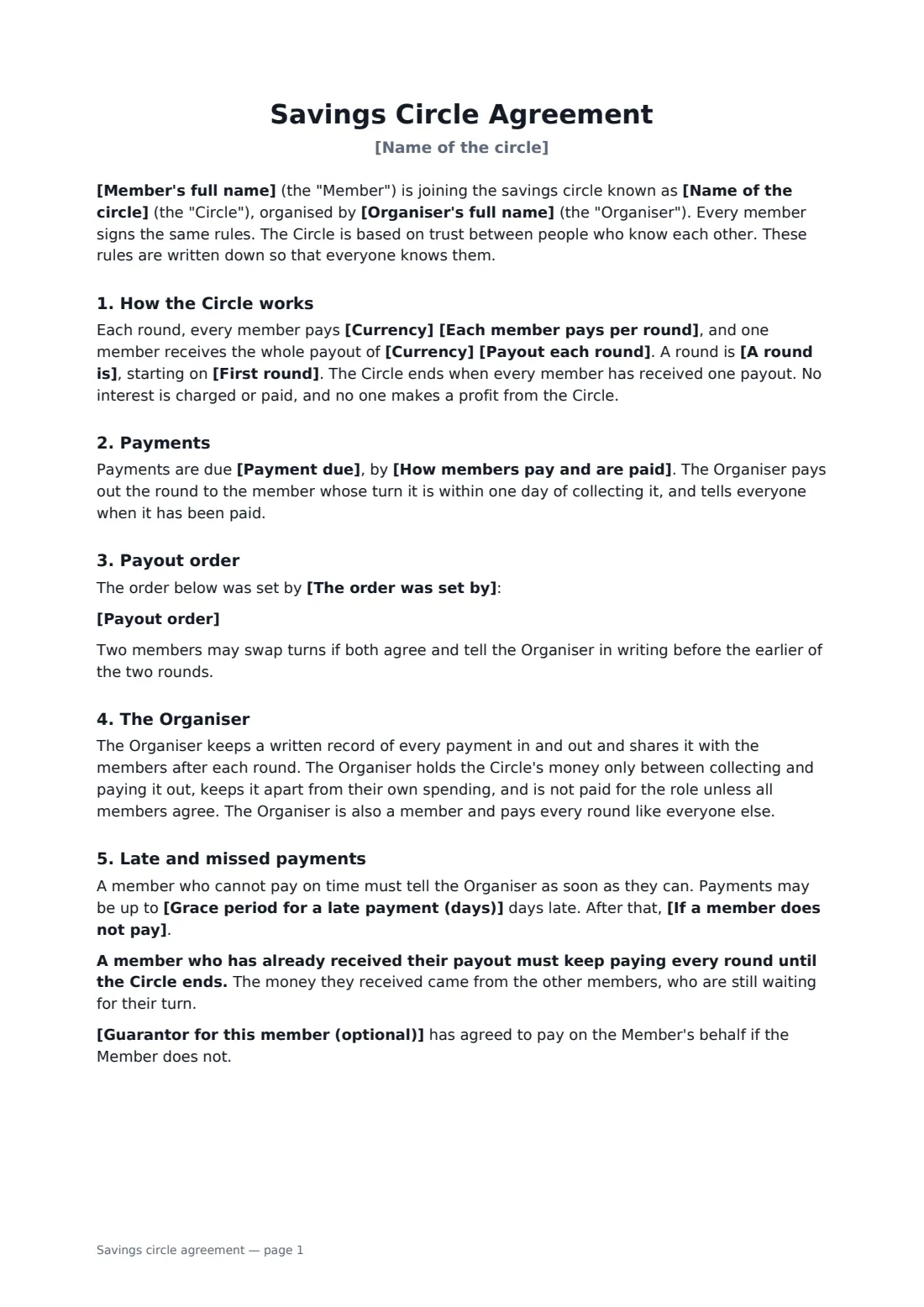
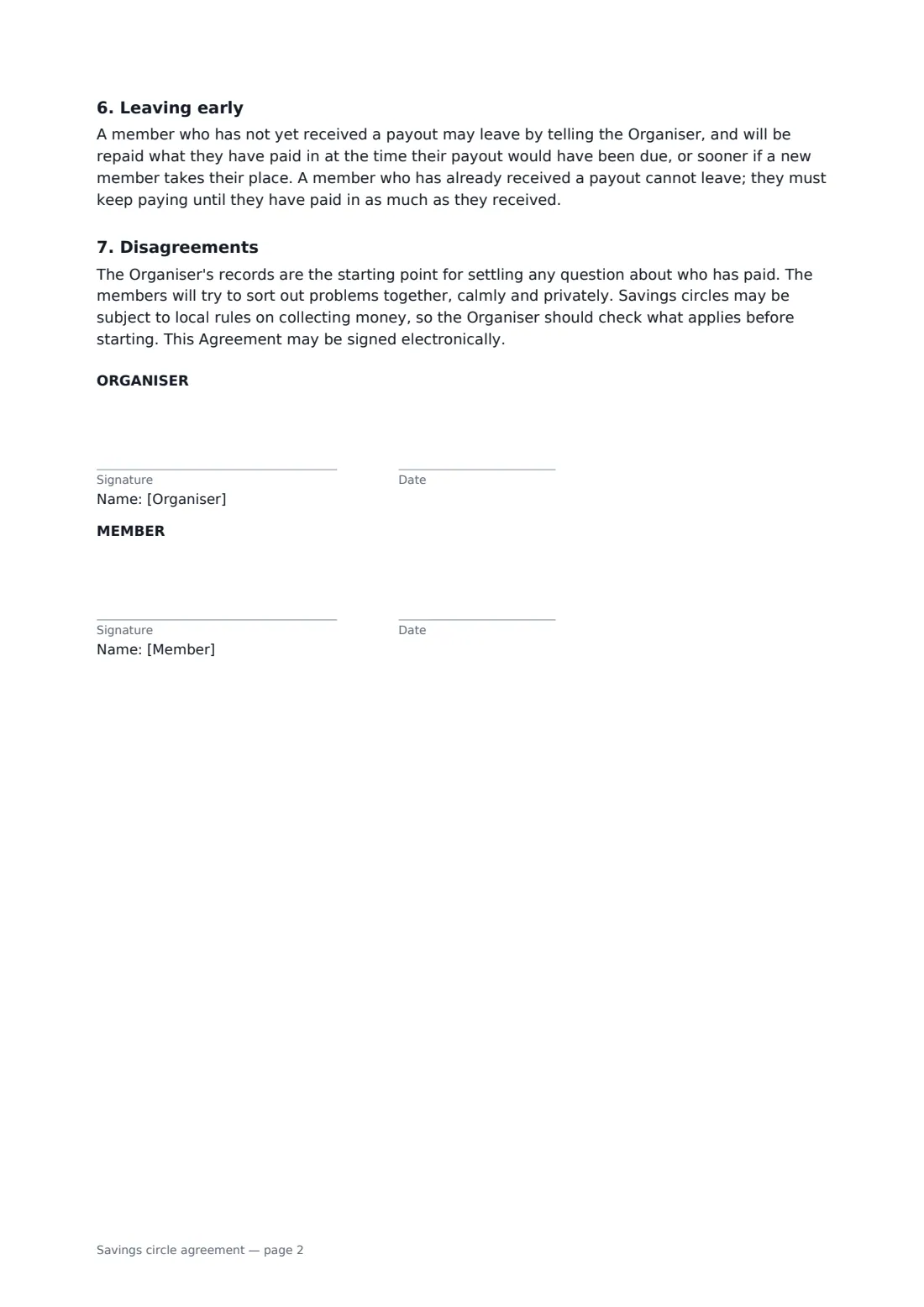
This template sets the circle's name, the amount per round, how often rounds happen, the payout and when and how money moves. It records the full payout order and how it was chosen, and lets members swap turns in writing. It sets out the organiser's job: keeping records, holding money only briefly and paying in like everyone else. It covers a grace period for late payments, what happens if someone doesn't pay, an optional guarantor, and the key rule that anyone who has had their payout keeps paying to the end. Leaving early is handled fairly for both sides.
- Best for
- Family, friends and community savings groups
- Also called
- Tanda, susu, committee, chit, pardner, hui, paluwagan, ROSCA
- Signed by
- The organiser and each member
- Key rule
- Members who have had their payout keep paying until the circle ends
- Length
- 2 pages
When to use a savings circle agreement
- A family tanda saving for holidays and school fees
- Coworkers running a monthly committee
- A community susu helping members with a deposit or a car
- Friends abroad saving together in a pardner hand
- Restarting a circle after a member left mid-way
What you fill in
15 blanks, then the name and email of each person who signs: organiser, member.
1 The circle
- Name of the circle*
- Organiser's full name*
- Member's full name*
2 Payments
- Currency*
- Each member pays per round*
- A round is* every week · every two weeks · every month
- Payout each round*
- Payment due*
- How members pay and are paid*
3 Payout order
- First round*
- Payout order*
- The order was set by* drawing lots at the first meeting · agreement between the members · the order in which members joined
4 Missed payments
- Grace period for a late payment (days)*
- If a member does not pay* the organiser may cover the payment and the member repays the organiser before their own payout · the payout for that round is reduced and made up when the member pays · the member's own payout is moved to the last place in the order
- Guarantor for this member (optional)
5 Who signs
- Organiser signature and date · The person who collects each round's money and pays it out.
- Member signature and date · Send one copy to each member, or add every member as a signer in the editor.
What the savings circle agreement covers
- How the Circle works
- Payments
- Payout order
- The Organiser
- Late and missed payments
- Leaving early
- Disagreements
Using the savings circle agreement, step by step
1 Name the circle
Enter the circle's name, the organiser and this member.
2 Set the money
Enter the amount per round, how often rounds happen, the payout, when payments are due and how money is paid in and out.
3 Write the order
Enter the date of the first round and list every member in payout order. Say whether you drew lots, agreed it or went by joining order.
4 Agree the late-payment rules and send
Set the grace period, choose what happens if someone doesn't pay, add a guarantor if you want one, and send a copy to each member.
Tips before you send it
- Draw lots for the order at a meeting everyone attends, or on a video call. It avoids any hint of favouritism.
- Share a receipt for every payment in and out. A simple running list after each round is enough.
- Newer members are often placed later in the order until the group knows them.
- Some places have rules on collecting money from groups. A quick check before you start is worthwhile, especially for large circles.
- Keep the signed copies and the payment record together, for example in a shared FileIt folder.
Sign it online in minutes
- Fill in the blanks. Names, dates and amounts go straight into the agreement — the preview shows exactly where.
- Name who signs. Tick “This is me” for your own part. FileIt builds the PDF with every signature, date box on the right line, and you can check or move anything before sending.
- Send it. Each signer gets a secure link and signs from any device — no account needed. The signed PDF, with an audit trail and a Certificate of Completion, is filed in your vault and emailed to everyone.
Savings circle agreement: frequently asked questions
What if a member stops paying after they've had their payout?
This is the most common problem, so the agreement says it in bold: anyone who has had their payout must keep paying until the circle ends. You can also ask for a guarantor, and the organiser's records show exactly who owes what.
Does anyone earn interest or a fee?
No. The agreement says no interest is charged or paid and the organiser isn't paid unless every member agrees. Everyone gets back exactly what they put in, just at different times.
Can members swap turns?
Yes, if both agree and tell the organiser in writing before the earlier of the two rounds.
Can members sign from their phones?
Yes. Each member opens the link and signs on any phone or computer, with no FileIt account needed. Everyone gets the signed PDF.