What is a remix agreement?
An official remix can give a release a second life in clubs, on playlists and with a new audience. It also raises questions that are awkward to settle after the remix is finished: can the remixer keep the stems, did they use uncleared samples, is the fee a buy-out or is there a royalty, who owns the new master, and does the remixer now own part of the song?
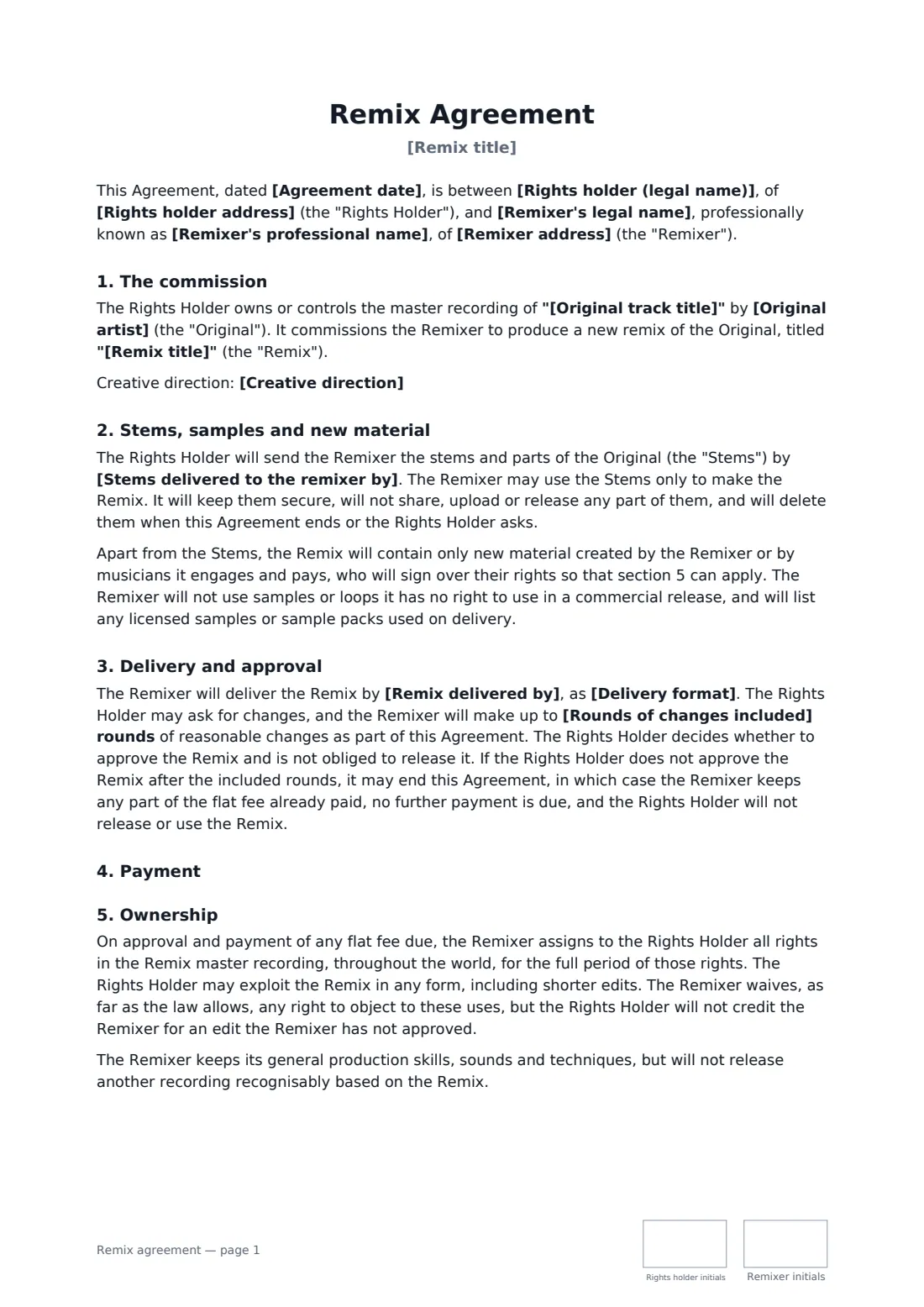
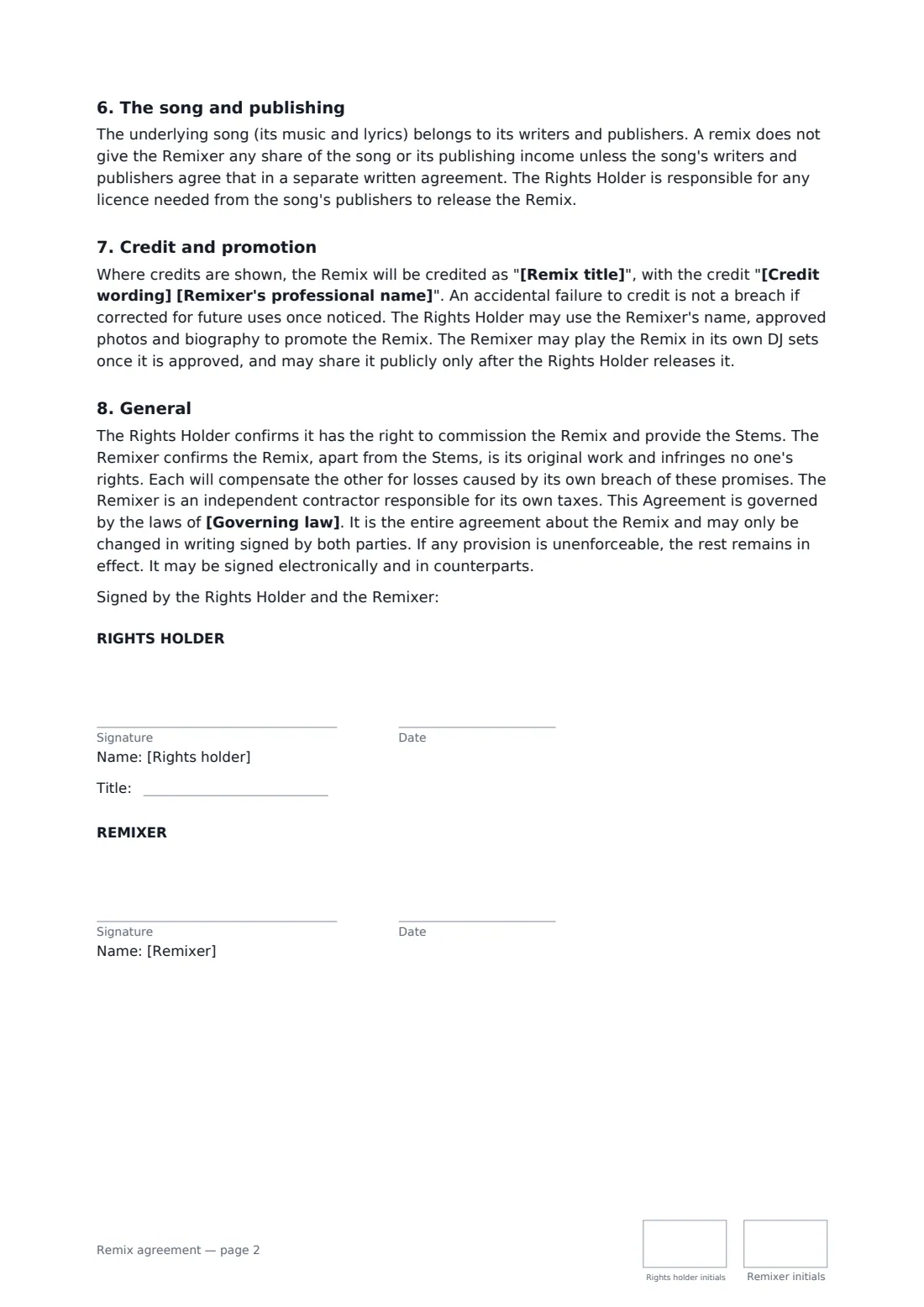
This template names the original track and artist, the remixer and their professional name, the remix title and optional creative direction. It limits stems to making the remix and requires them to be deleted afterwards, bans uncleared samples and asks for a list of licensed ones. It sets stems and delivery dates, the delivery format, included rounds of changes and the rights holder's approval, and covers a flat fee, a royalty or both, with recoupment, royalty statements and audit. The rights holder owns the remix master; the song and its publishing stay with its writers unless they agree otherwise. Credit wording and promotion rights round it off.
- Best for
- Artists and labels commissioning official remixes from producers and DJs
- Signed by
- The rights holder and the remixer
- Payment options
- Flat fee buy-out, royalty, or flat fee plus royalty
- Length
- 2 pages, initialled by both on every page
When to use a remix agreement
- A label commissioning a club remix to support a single
- An independent artist asking a producer friend for an official remix, paid as a flat fee
- A remix package of several remixers, each on the same terms
- A DJ being paid a smaller fee plus a royalty on their remix
- A label commissioning a fresh remix for a back-catalogue reissue
What you fill in
23 blanks, then the name and email of each person who signs: rights holder, remixer.
1 The parties
- Agreement date*
- Rights holder (legal name)*
- Rights holder address
- Remixer's legal name*
- Remixer's professional name*
- Remixer address
2 The remix
- Original track title*
- Original artist*
- Remix title*
- Creative direction
3 Delivery
- Stems delivered to the remixer by*
- Remix delivered by*
- Delivery format*
- Rounds of changes included*
4 Payment
- Payment* Flat fee (buy-out) · Royalty · Flat fee plus royalty
- Currency*
- Flat fee
- Flat fee paid* half on signing and half on approval of the remix · in full on approval of the remix
- Royalty rate
- Flat fee and royalties* The flat fee is an advance, recoupable from the Remixer's royalties before any further royalty is paid. · The flat fee is not recoupable, and royalties are paid from the first unit.
- Royalty statements* every three months · every six months
5 Credit
- Credit wording* Remix and additional production by · Remixed by · Remix by
- Governing law*
6 Who signs
- Rights holder signature and date, job title, initials on every page · The artist or label that owns or controls the original recording.
- Remixer signature and date, initials on every page · The producer or DJ making the remix, or a person signing for their company.
What the remix agreement covers
- The commission
- Stems, samples and new material
- Delivery and approval
- Payment
- Ownership
- The song and publishing
- Credit and promotion
- General
Using the remix agreement, step by step
1 Name the track and remixer
Enter the rights holder, the original track and artist, the remixer and their professional name, and the remix title.
2 Set delivery
Set when stems are sent and the remix is due, the delivery format and the number of rounds of changes.
3 Choose the payment
Choose a flat fee, a royalty or both, enter the amounts, when the fee is paid and whether it is recoupable, and how often statements come.
4 Agree credit and send
Choose the credit wording and send it to the remixer to sign. The signed agreement is filed in your FileIt vault with the release.
Tips before you send it
- Ask for a list of every sample and sample pack used — an uncleared sample can stop a release.
- Make sure you have the publisher's permission to release the remix if you don't control the song.
- A flat fee buy-out is simplest; a royalty suits remixers who expect the remix to perform and accept a smaller fee.
- Keep the stems' confidentiality clause — leaked stems are hard to call back.
Sign it online in minutes
- Fill in the blanks. Names, dates and amounts go straight into the agreement — the preview shows exactly where.
- Name who signs. Tick “This is me” for your own part. FileIt builds the PDF with every signature, date and initials box on the right line, and you can check or move anything before sending.
- Send it. Each signer gets a secure link and signs from any device — no account needed. The signed PDF, with an audit trail and a Certificate of Completion, is filed in your vault and emailed to everyone.
Remix agreement: frequently asked questions
Who owns the remix?
The rights holder owns the remix master recording once it's approved and any flat fee is paid. The remixer keeps their general production skills and sounds but can't release another recording recognisably based on the remix.
Does the remixer get a share of the song?
No. The song's music and lyrics stay with its writers and publishers. A remixer gets a share of the song or its publishing only if the writers and publishers agree that separately in writing.
What if we don't like the remix?
The remixer makes the included rounds of changes. If the rights holder still doesn't approve it, it may end the agreement; the remixer keeps any part of the fee already paid, nothing more is due, and the rights holder won't use the remix.
Can it be signed electronically?
In most countries, including the US (ESIGN Act and UETA), the UK, the EU (eIDAS) and Canada, an electronic signature is generally valid for an agreement like this one. FileIt keeps an audit trail and a Certificate of Completion with the signed PDF as evidence of who signed and when.
Is this template free?
Yes. The template is free to use with the eSignature app in FileIt, and the people you send it to don't need a FileIt account to sign.