What is a recipe development agreement?
Restaurants, food brands, meal-kit companies and publishers regularly hire chefs and recipe developers to create new dishes. The friction points are predictable: how many rounds of changes are included, who pays for ingredients, whether the photographs are part of the job, and above all who owns the recipes afterwards — can the chef publish them, or sell something similar to a competitor?
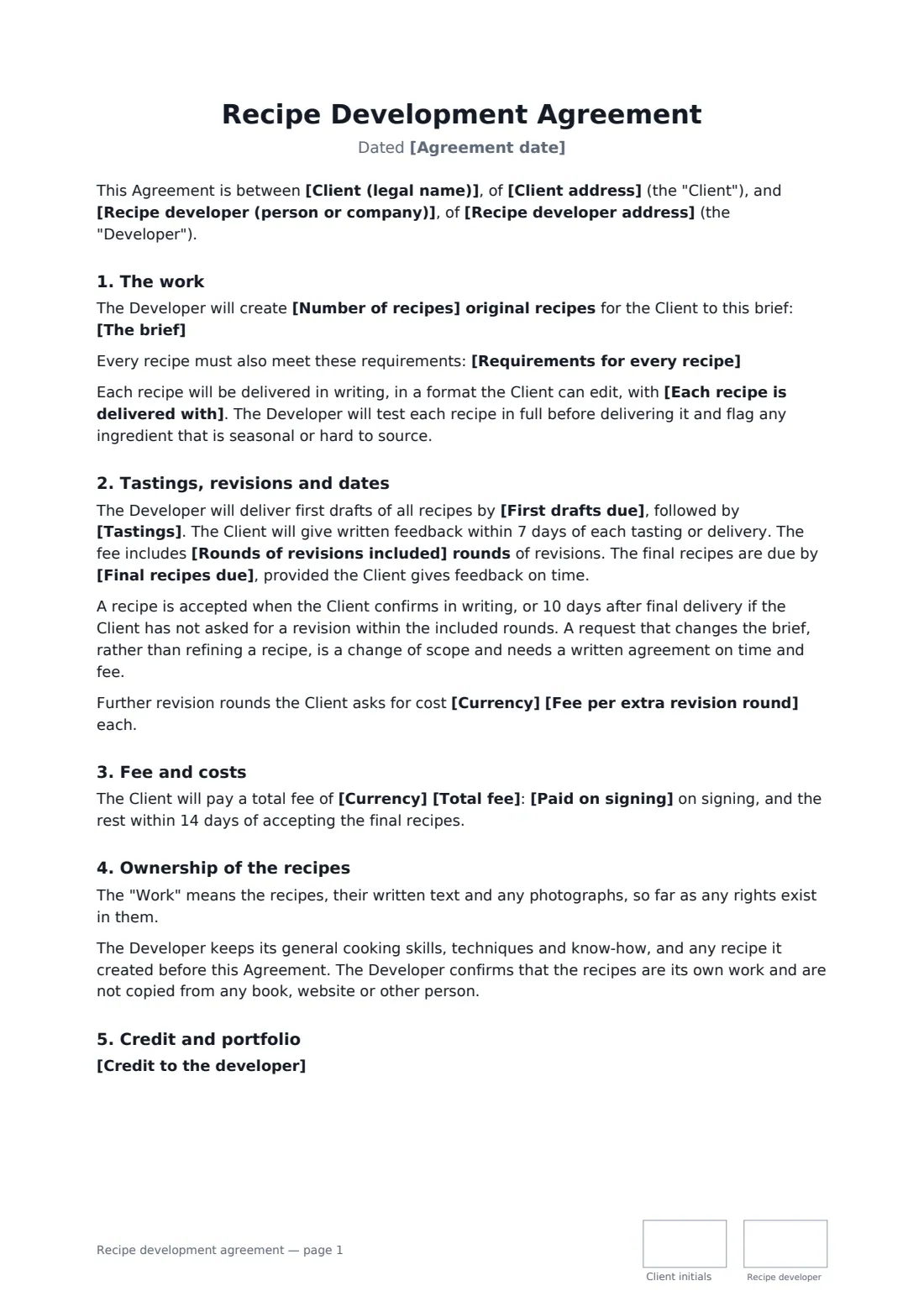
This template sets the brief, the number of recipes and requirements such as food cost, allergens or equipment, and the format each recipe is delivered in: restaurant-style, home-cook style or production with batch scaling and shelf life. It covers reference or publication-quality photos, first drafts, a tasting, included revision rounds and acceptance, the fee and deposit, extra rounds, and three ways to handle ingredient costs. You choose whether the client owns the recipes or the developer keeps them and gives an exclusive or non-exclusive licence, and decide on credit and portfolio use. It also covers food safety and allergens, confidentiality and ending early.
- Best for
- Restaurants, food brands, meal-kit companies, cafés and publishers commissioning recipes
- Signed by
- The client and the chef or recipe developer
- Ownership options
- Client owns, or developer licenses exclusively or non-exclusively
- Length
- 2 pages, initialled by both on every page
When to use a recipe development agreement
- A bistro hiring a consultant chef to write a seasonal menu
- A snack brand commissioning recipes for a new product line
- A meal-kit company buying home-cook recipes with step-by-step methods
- A café chain standardising its bakes with batch-scaled recipes
- A cookware brand commissioning recipes and photographs for its website
What you fill in
25 blanks, then the name and email of each person who signs: client, recipe developer.
1 The parties
- Agreement date*
- Client (legal name)*
- Client address
- Recipe developer (person or company)*
- Recipe developer address
2 The work
- The brief*
- Number of recipes*
- Requirements for every recipe
- Each recipe is delivered with* ingredients by weight, method, yield, prep and cook times, allergens and plating notes · ingredients by weight and by volume, step-by-step method for home cooks, yield, times and allergens · ingredients by weight, method, yield, batch scaling notes, shelf life and storage, and allergens
- Photographs* No photographs · Reference photos of each finished dish · Styled photographs suitable for publication
3 Testing and dates
- Tastings*
- Rounds of revisions included*
- First drafts due*
- Final recipes due*
4 Payment
- Currency*
- Total fee*
- Paid on signing*
- Fee per extra revision round
- Ingredient and testing costs* The Client reimburses ingredient costs with receipts, up to the budget below. · The Client supplies the ingredients for testing. · Ingredient costs are included in the fee.
- Ingredient budget
5 Rights
- Who owns the recipes* The Client owns the recipes. · The Developer owns the recipes and gives the Client an exclusive licence. · The Developer owns the recipes and gives the Client a non-exclusive licence.
- Licence covers use
- Credit to the developer* Credit is not required. · The Developer is credited where the Client publishes the recipes, such as in a cookbook, on recipe cards or online. · The Developer is credited on the menu or the product packaging.
- Developer may show the work in their portfolio* Yes, after the Client launches the recipes · No
- Governing law*
6 Who signs
- Client signature and date, job title, initials on every page · The restaurant, brand or company commissioning the recipes.
- Recipe developer signature and date, initials on every page · The chef or recipe developer, or a person signing for their company.
What the recipe development agreement covers
- The work
- Tastings, revisions and dates
- Fee and costs
- Ownership of the recipes
- Credit and portfolio
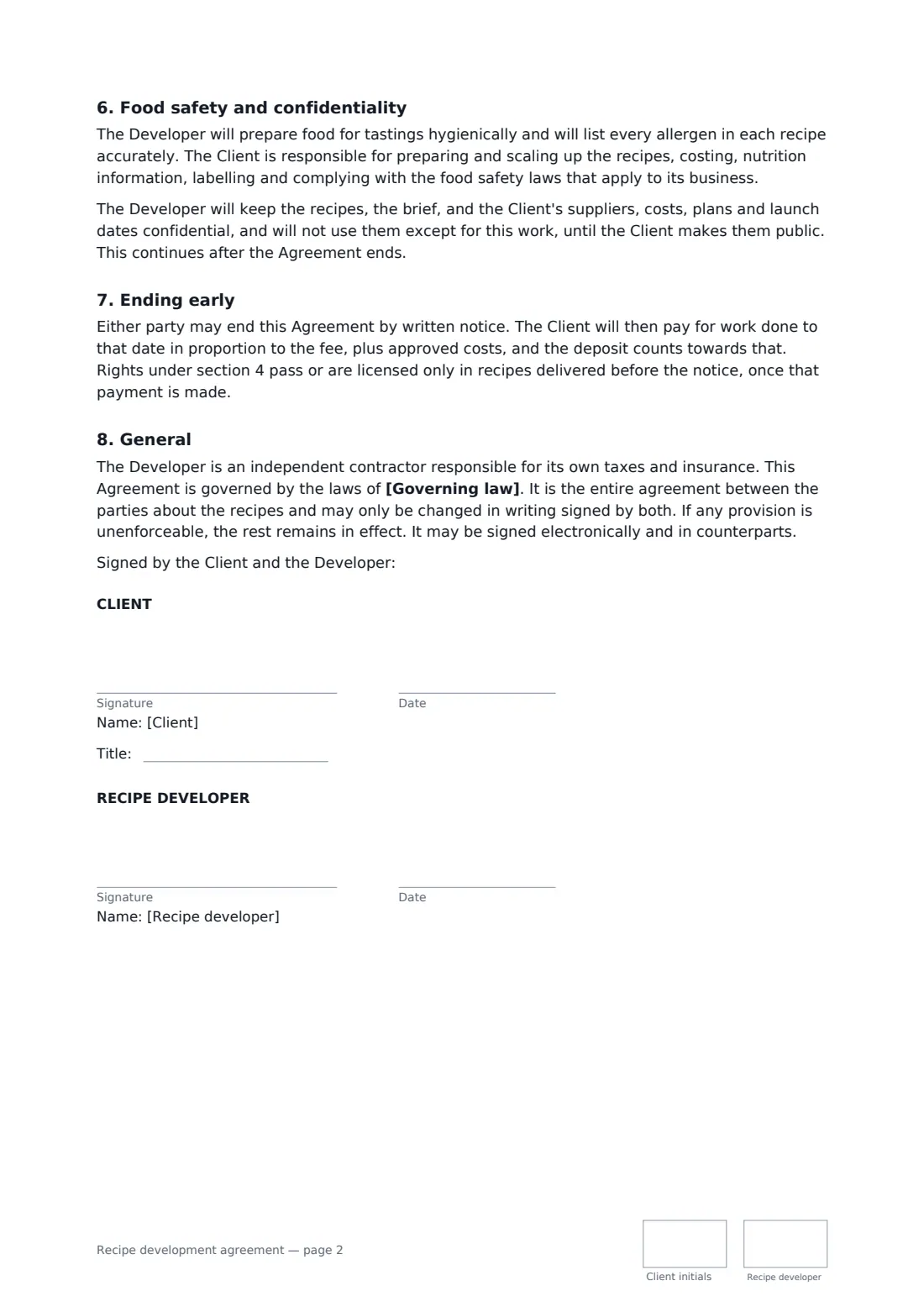
- Food safety and confidentiality
- Ending early
- General
Using the recipe development agreement, step by step
1 Write the brief
Describe what the recipes are for, who will cook them and the style, then add requirements like food cost targets, dietary needs and allergens to avoid.
2 Set the deliverables and dates
Choose the recipe format and whether photos are included, then set the tasting, revision rounds, draft date and final date.
3 Agree fee and costs
Enter the fee and deposit, any fee for extra rounds, and how ingredient costs are covered.
4 Decide ownership and credit
Choose who owns the recipes, whether the developer is credited and can show the work, then send it for signature.
Tips before you send it
- A list of ingredients may get little legal protection on its own; confidentiality and a clear ownership clause do most of the work.
- Put cost-per-portion and equipment limits in the brief — a beautiful dish your line can't plate in time is no use.
- Ask for allergens on every recipe and check them again when you scale up or change suppliers.
- If you'll print the recipes on packaging or in a book, choose styled photographs so the rights are covered in the same agreement.
Sign it online in minutes
- Fill in the blanks. Names, dates and amounts go straight into the agreement — the preview shows exactly where.
- Name who signs. Tick “This is me” for your own part. FileIt builds the PDF with every signature, date and initials box on the right line, and you can check or move anything before sending.
- Send it. Each signer gets a secure link and signs from any device — no account needed. The signed PDF, with an audit trail and a Certificate of Completion, is filed in your vault and emailed to everyone.
Recipe development agreement: frequently asked questions
Who owns the recipes?
You choose: the client owns them outright once the fee is paid, or the developer keeps ownership and gives the client an exclusive or non-exclusive licence for the uses you list. The developer always keeps their general skills and recipes they created before.
What if we want more changes than the included rounds?
Extra rounds can be charged at the fee you set. A request that changes the brief itself is treated as a change of scope and needs agreement on time and fee.
Who is responsible for food safety?
The developer prepares tastings hygienically and lists allergens accurately. The client is responsible for preparing the recipes at scale, labelling, nutrition information and complying with food law for its business.
Can it be signed electronically?
In most countries, including the US (ESIGN Act and UETA), the UK, the EU (eIDAS) and Canada, an electronic signature is generally valid for an agreement like this one. FileIt keeps an audit trail and a Certificate of Completion with the signed PDF as evidence of who signed and when.
Is this template free?
Yes. The template is free to use with the eSignature app in FileIt, and the people you send it to don't need a FileIt account to sign.