What is a product design and development agreement?
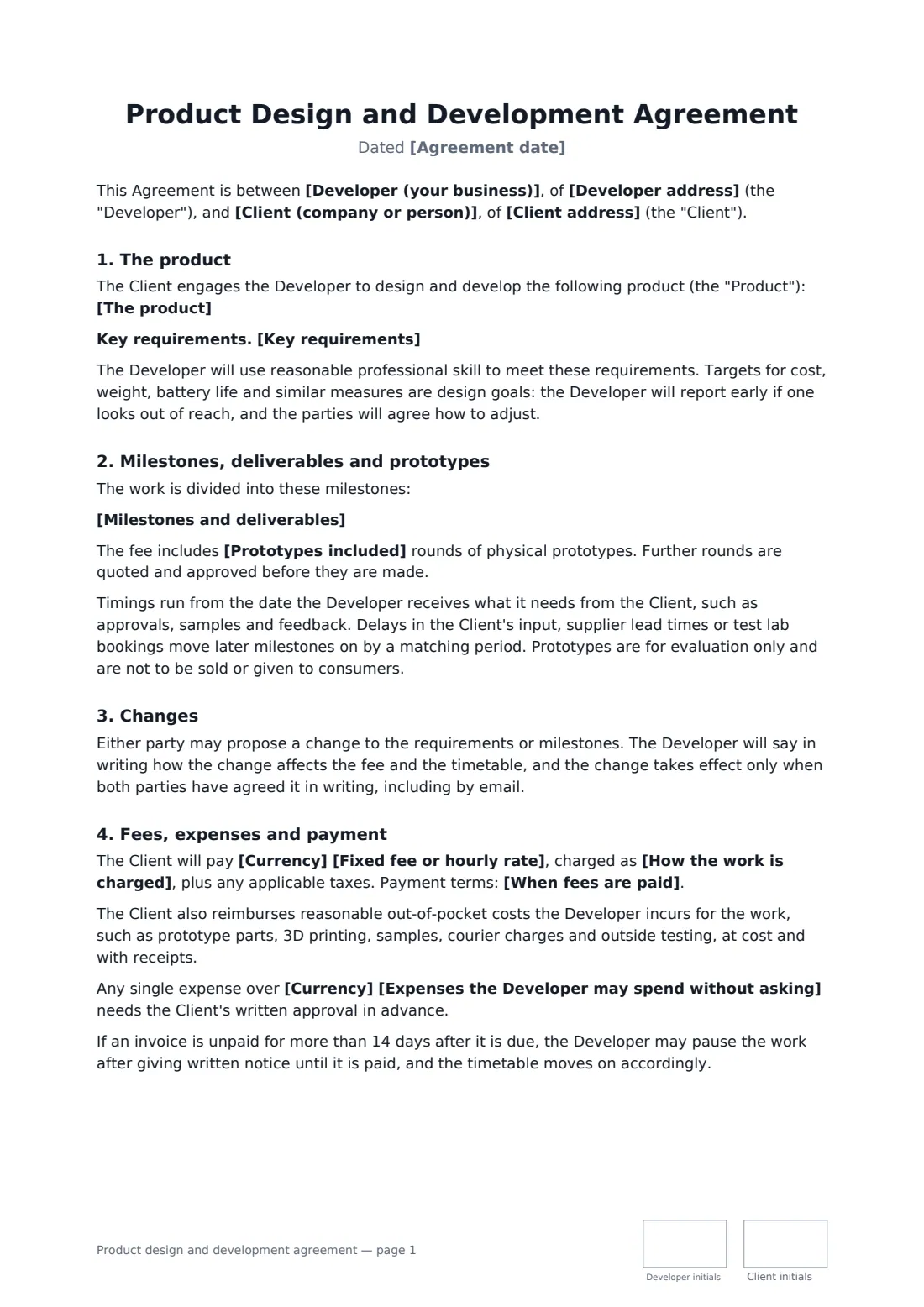
A product design and development agreement is the contract between a business or inventor and the studio, engineer or freelance designer who turns an idea into a manufacturable product. The arguments it heads off are predictable: a cost target that slipped, a third prototype nobody budgeted for, a client who went quiet for a month and then blamed the timetable, and above all, who owns the CAD files once the invoices are paid.
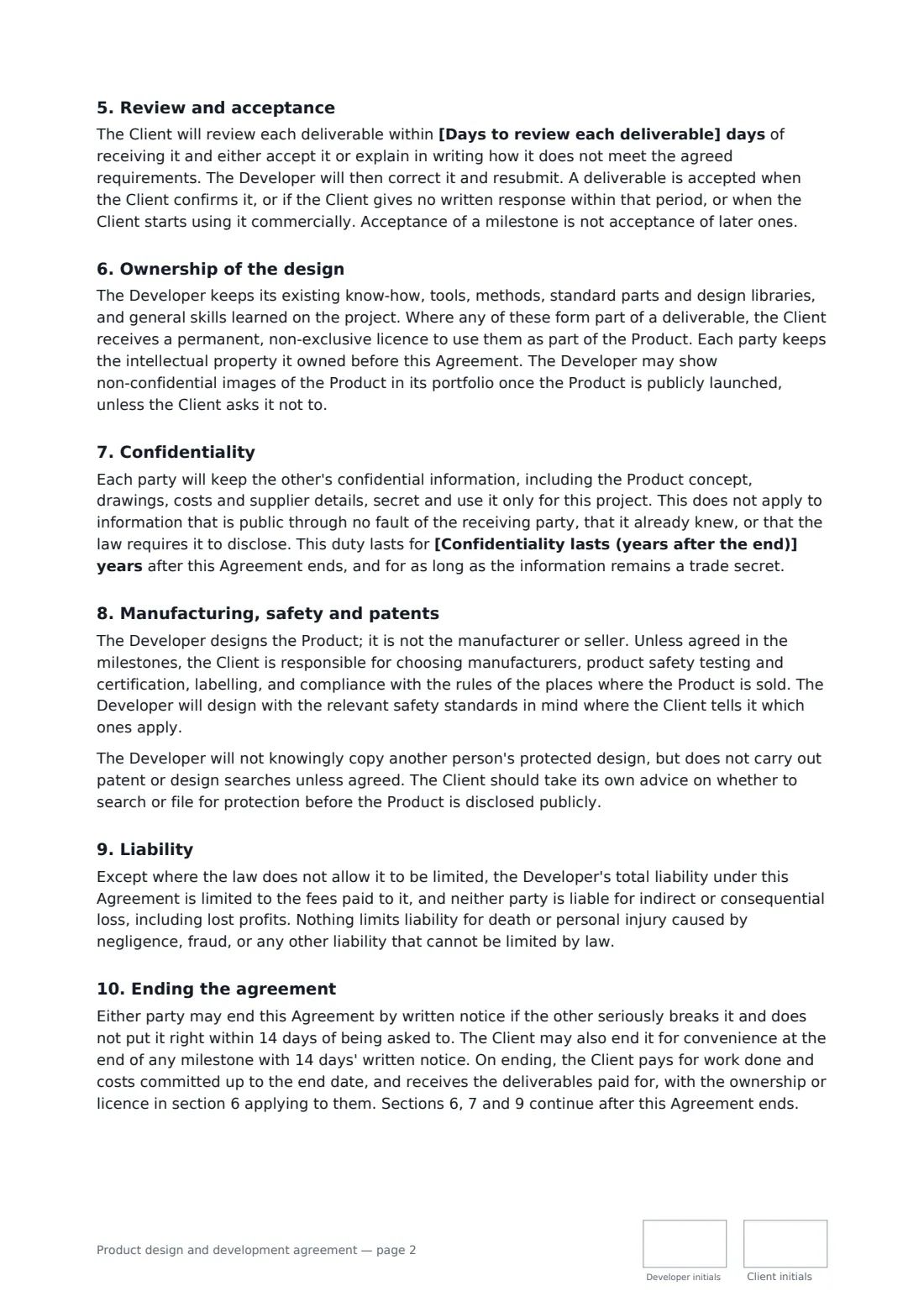
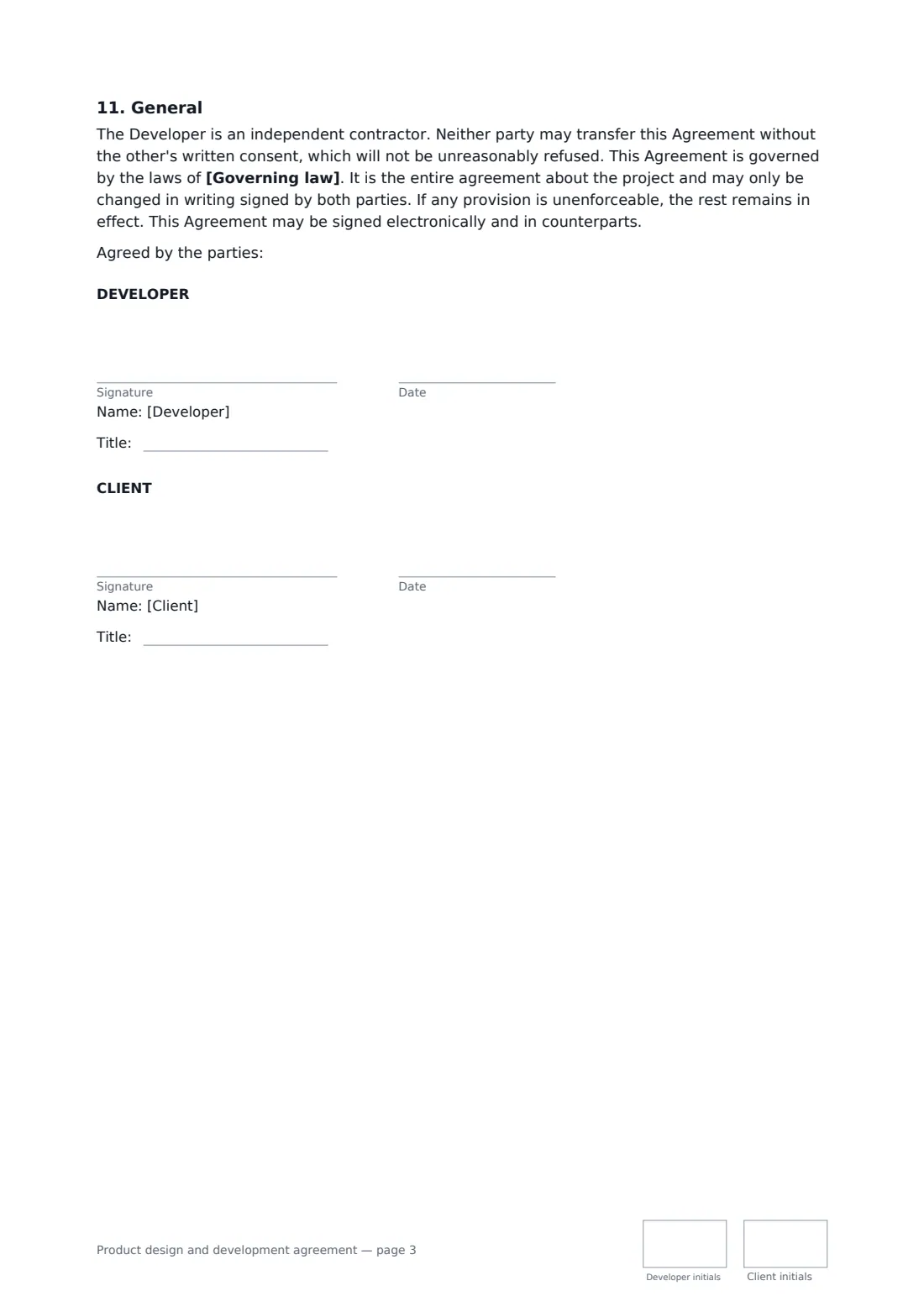
This template sets out the product and its key requirements, the milestones and deliverables, how many prototype rounds the fee covers, and how changes are agreed. It charges a fixed fee or time and materials, with a payment schedule and an optional cap on expenses the developer can spend without asking. Each deliverable has a review period. You choose whether the client owns the final design once paid or the developer keeps it and grants an exclusive licence. It also covers the developer's background know-how, portfolio use, confidentiality, who handles safety certification and patents, liability and ending the project at a milestone.
- Best for
- Industrial designers, product engineering firms and hardware start-ups
- Signed by
- The developer and the client, each with a job title
- Ownership
- Assigned to the client on payment, or an exclusive licence
- Length
- About 3 pages, initialled on every page
When to use a product design and development agreement
- An inventor hiring a design studio to take a kitchen gadget from sketch to production files
- A start-up engaging an engineering firm for a first working prototype of a wearable
- A furniture brand commissioning a freelance designer for a new chair range
- A toy company briefing an outside developer on a new product line
- A retailer developing an own-brand product with a design consultancy
What you fill in
18 blanks, then the name and email of each person who signs: developer, client.
1 The parties
- Agreement date*
- Developer (your business)*
- Developer address
- Client (company or person)*
- Client address
2 The product
- The product*
- Key requirements*
- Milestones and deliverables*
- Prototypes included
3 Fees
- Currency*
- How the work is charged* a fixed fee · time and materials, at an hourly rate
- Fixed fee or hourly rate*
- When fees are paid*
- Expenses the Developer may spend without asking
4 Ownership and other terms
- Who owns the final design* the Client, once all fees are paid · the Developer, with an exclusive licence to the Client
- Days to review each deliverable*
- Confidentiality lasts (years after the end)*
- Governing law*
5 Who signs
- Developer signature and date, job title, initials on every page · The design studio, engineering firm or freelance designer doing the work.
- Client signature and date, job title, initials on every page · The business or inventor commissioning the product.
What the product design and development agreement covers
- The product
- Milestones, deliverables and prototypes
- Changes
- Fees, expenses and payment
- Review and acceptance
- Ownership of the design
- Confidentiality
- Manufacturing, safety and patents
- Liability
- Ending the agreement
- General
Using the product design and development agreement, step by step
1 Describe the product
Write what the product is and the requirements it has to meet, such as target cost, size, battery life or materials. You can point to a fuller brief.
2 Set the milestones
List each milestone with its deliverable and rough timing, and say how many prototype rounds are included in the fee.
3 Agree the money
Choose a fixed fee or an hourly rate, write the payment schedule, and add an expense cap if you want approval for larger out-of-pocket costs.
4 Decide ownership and send
Pick who owns the final design, set the review period and how long confidentiality lasts, add the governing law, and send to the other side to sign.
Tips before you send it
- Treat cost and performance figures as targets and say so. The template asks the developer to flag early if one looks out of reach.
- Talk to a patent adviser before the product is shown publicly. Once a design has been disclosed, protection can be harder or impossible to get in some places.
- If the developer is also finding a factory or running safety tests, add those to the milestones. Otherwise the template leaves them with the client.
- Keep emails approving changes. The template only treats a change as agreed once both sides have confirmed it in writing.
Sign it online in minutes
- Fill in the blanks. Names, dates and amounts go straight into the agreement — the preview shows exactly where.
- Name who signs. Tick “This is me” for your own part. FileIt builds the PDF with every signature, date and initials box on the right line, and you can check or move anything before sending.
- Send it. Each signer gets a secure link and signs from any device — no account needed. The signed PDF, with an audit trail and a Certificate of Completion, is filed in your vault and emailed to everyone.
Product design and development agreement: frequently asked questions
Who owns the design under this agreement?
You choose. One option assigns all rights in the final design and deliverables to the client once every fee is paid. The other lets the developer keep ownership and grants the client an exclusive, worldwide licence to make and sell the product. Either way the developer keeps its existing know-how and tools.
What happens if the client doesn't respond to a deliverable?
The client has a set number of days to accept or explain what is wrong. If it says nothing in that time, or starts using the deliverable commercially, the deliverable counts as accepted.
Can the client stop the project part-way?
Yes. The client can end it at the end of any milestone with 14 days' notice, paying for work done and costs committed, and keeps the deliverables it has paid for.
Is this agreement valid if signed electronically?
In most countries, including the US (ESIGN Act and UETA), the UK, the EU (eIDAS) and Canada, an electronic signature is generally valid for an ordinary commercial contract like this one. FileIt keeps an audit trail and a Certificate of Completion with the signed PDF.
Is the template free?
Yes. It's free to use with FileIt eSignature, and the client doesn't need a FileIt account to sign.