What is a private car installment agreement?
Private car sales on instalments are common between friends, family, colleagues and neighbours — but without a clear agreement, it's easy to argue later about what was owed, who owns the car, or what happens if payments stop.
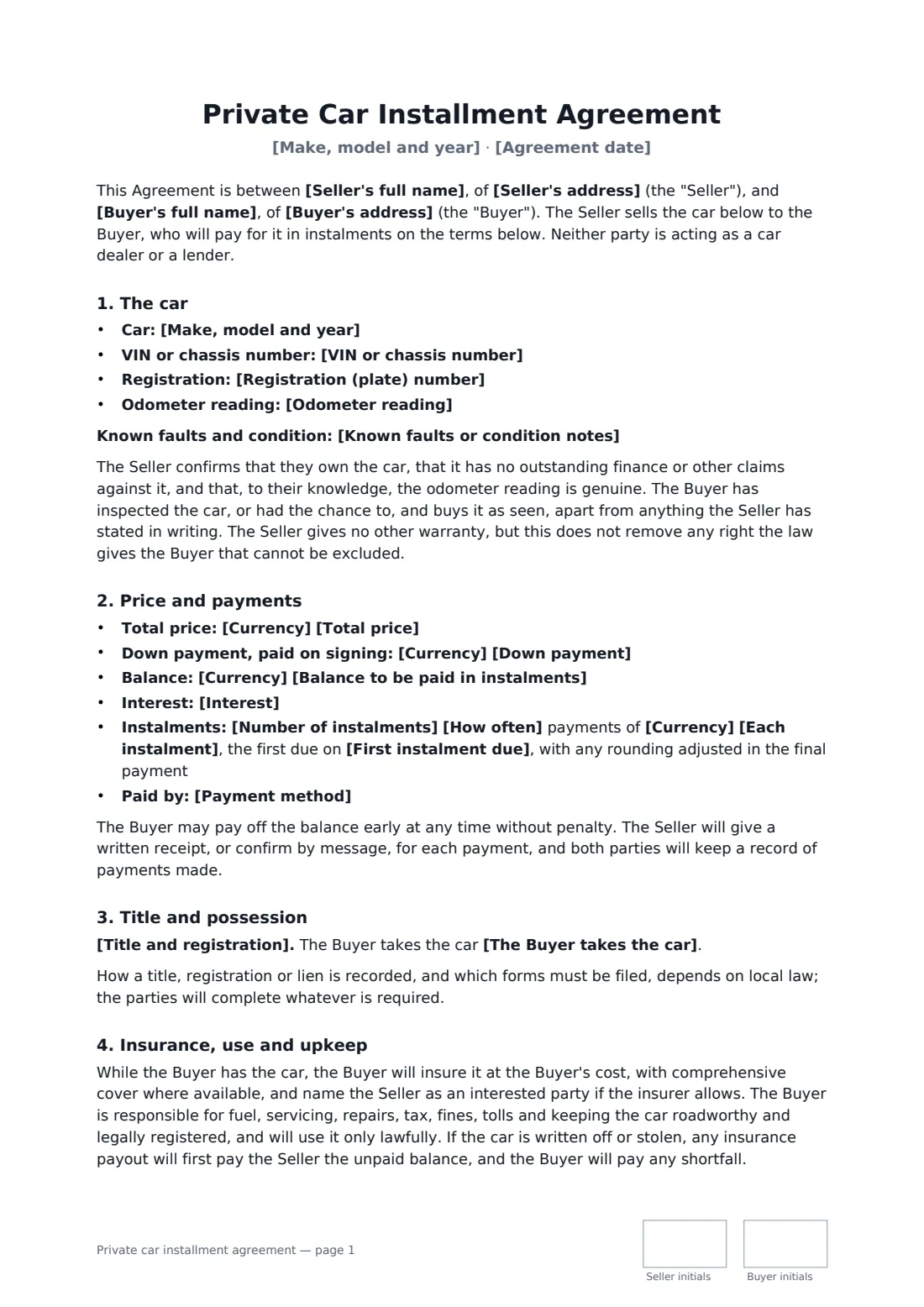
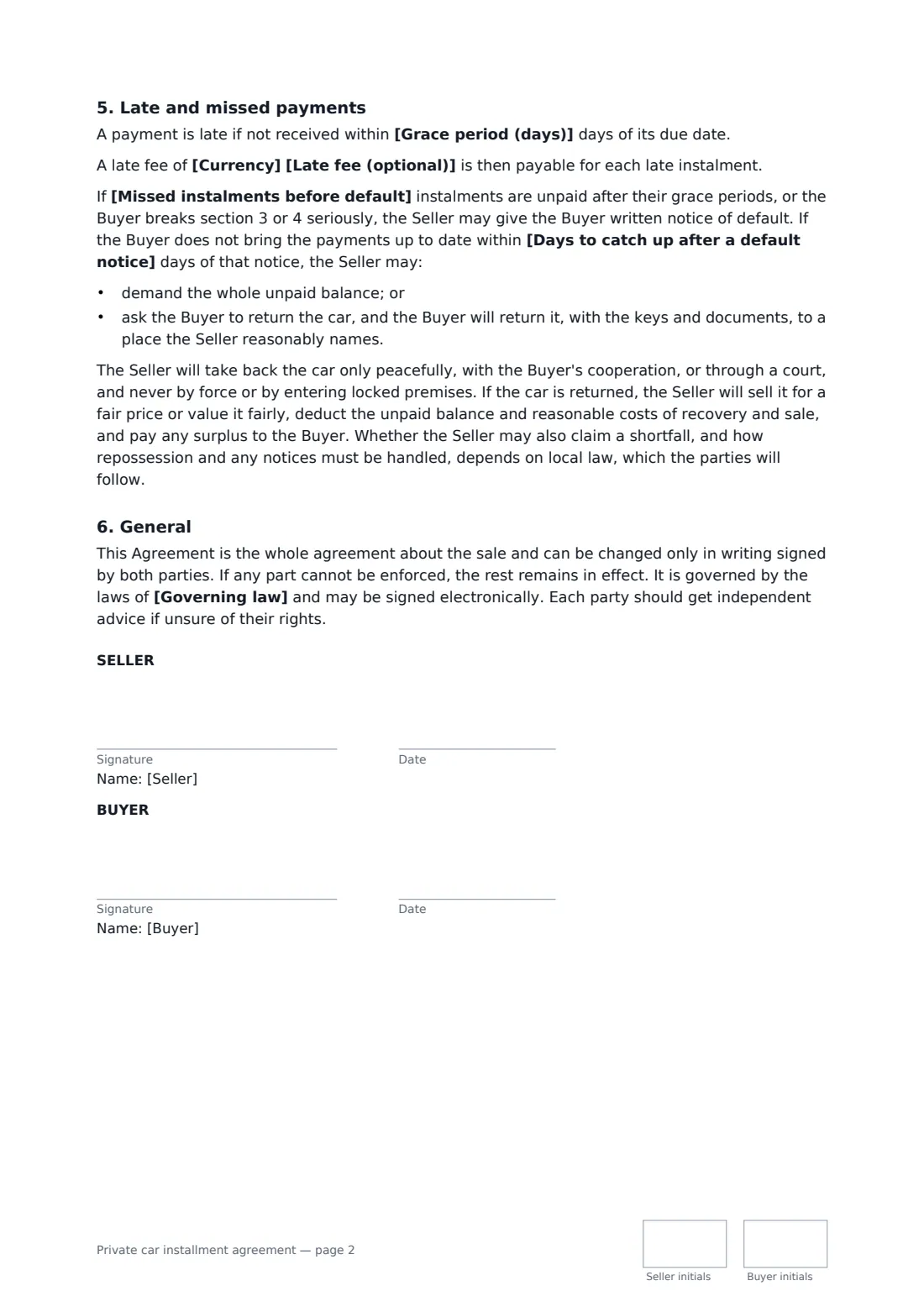
This agreement identifies the car by make, model, VIN, registration and mileage, records any known faults, and confirms there is no outstanding finance. It sets the total price, down payment and balance, whether any interest applies, and the instalment amount, frequency, number and first due date, with early repayment allowed. You choose whether the seller keeps the title until the final payment or the title passes now with the seller recorded as lienholder, when the buyer takes the car, and how quickly the title is handed over at the end. The buyer insures and maintains the car. Late payments, a grace period, an optional late fee, default notice, the time to catch up, and peaceful return of the car are all covered.
- Best for
- Private sellers and buyers, family and friends selling a car on payments
- Signed by
- The seller and the buyer
- You set
- Price, down payment, schedule, interest, title, possession, late fee, default terms
- Length
- 2 pages, initialled on every page
When to use a private car installment agreement
- Selling a car to a relative who pays monthly
- A colleague buying your old car over six months
- A first car for a young driver paid off in instalments
- Selling a car to a neighbour with a down payment and the rest later
- Buying a car privately when bank finance isn't an option
What you fill in
28 blanks, then the name and email of each person who signs: seller, buyer.
1 The parties
- Seller's full name*
- Seller's address*
- Buyer's full name*
- Buyer's address*
- Agreement date*
2 The car
- Make, model and year*
- VIN or chassis number*
- Registration (plate) number*
- Odometer reading*
- Known faults or condition notes
3 The price
- Currency*
- Total price*
- Down payment*
- Balance to be paid in instalments*
- Interest*
4 Payment schedule
- Each instalment*
- How often* weekly · every two weeks · monthly
- Number of instalments*
- First instalment due*
- Payment method*
5 Late payment
- Grace period (days)*
- Late fee (optional)
- Days to catch up after a default notice*
- Missed instalments before default*
6 Title and use
- Title and registration* The Seller keeps the title until the final payment · The title passes to the Buyer now, and the Seller is recorded as a lienholder where the law allows
- Days to hand over title after final payment*
- The Buyer takes the car* on signing, after the down payment · only after the final payment
- Governing law*
7 Who signs
- Seller signature and date, initials on every page
- Buyer signature and date, initials on every page
What the private car installment agreement covers
- The car
- Price and payments
- Title and possession
- Insurance, use and upkeep
- Late and missed payments
- General
Using the private car installment agreement, step by step
1 Identify the car
Enter the make, model, year, VIN, registration and mileage, and any known faults.
2 Set the price and schedule
Enter the price, down payment and balance, then the instalment amount, frequency, number of payments and first due date.
3 Title and possession
Choose who holds the title until it's paid off, when the buyer takes the car, and how many days the seller has to hand over the title.
4 Late payments and sign
Set the grace period, any late fee, how many missed payments count as default and the time to catch up. Both sign and initial every page.
Tips before you send it
- Check the VIN against the registration document before signing.
- Charging interest may bring consumer credit rules into play in some places. If you're unsure, keep it interest-free.
- Make sure the buyer's insurance is in place before they drive away.
- Keep a record of every payment; the agreement asks the seller to confirm each one in writing.
- Title transfer, liens and repossession rules differ by state and country. Check the local process.
Sign it online in minutes
- Fill in the blanks. Names, dates and amounts go straight into the agreement — the preview shows exactly where.
- Name who signs. Tick “This is me” for your own part. FileIt builds the PDF with every signature, date and initials box on the right line, and you can check or move anything before sending.
- Send it. Each signer gets a secure link and signs from any device — no account needed. The signed PDF, with an audit trail and a Certificate of Completion, is filed in your vault and emailed to everyone.
Private car installment agreement: frequently asked questions
Who owns the car while it's being paid off?
You choose. Either the seller keeps the title until the final payment, or the title passes now and the seller is recorded as lienholder where the law allows.
What happens if the buyer stops paying?
After the missed payments you set, the seller gives written notice. If the buyer doesn't catch up within the time you set, the seller can demand the balance or ask for the car back, peacefully or through a court. Any surplus from a sale goes back to the buyer.
Can the seller just take the car back?
Only peacefully, with the buyer's cooperation, or through a court — never by force or by entering locked premises. Local law may add further rules.
Can the buyer pay off early?
Yes, at any time without penalty.
Is the car sold with a warranty?
No, it's sold as seen, apart from what the seller states in writing, but this doesn't remove rights the law gives the buyer that can't be excluded.