What is a podcast co-host agreement?
Most podcasts start as two friends with microphones, and most co-host disputes start when the show begins to earn money or one of them wants to move on. Who keeps the name? Who controls the RSS feed and the subscribers that come with it? Does the person leaving still get paid for the back catalogue? It is far easier to answer these questions while you still enjoy recording together.
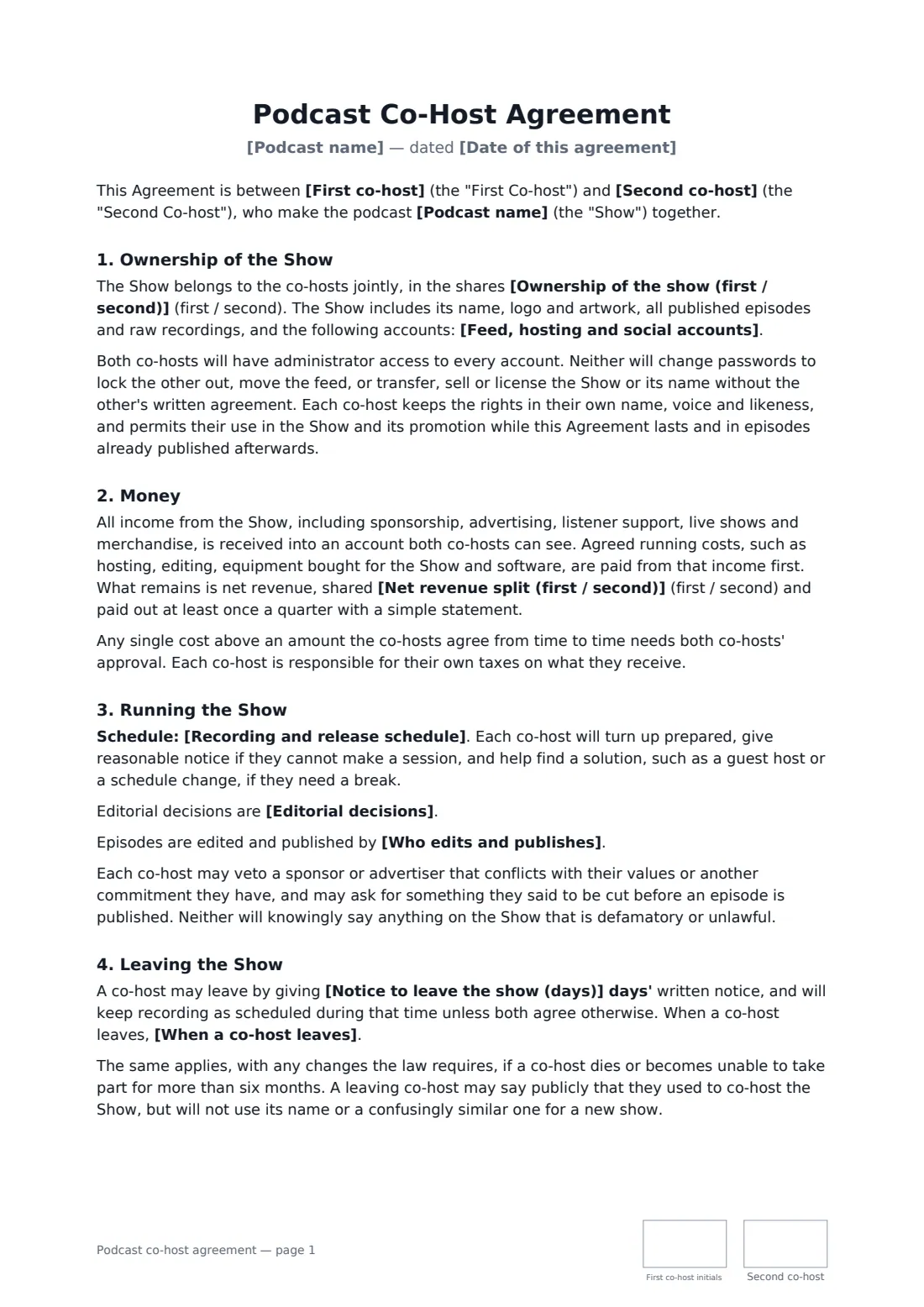
This template records the show's ownership split, covering the name, artwork, episodes and every account, with both hosts keeping admin access. It runs all income through a shared account, pays agreed costs first and splits net revenue quarterly. It sets the recording schedule, who makes editorial calls and who edits, and gives each host a sponsor veto. For departures it adds a notice period and three outcomes to choose from: a buyout, keeping the back catalogue live, or selling the show.
- Best for
- Two-host podcasts, from hobby shows to sponsored series
- Signed by
- Both co-hosts
- Departure options
- Buyout, keep the back catalogue live, or sell the show
- Length
- About 2 to 3 pages, initialled on every page
When to use a podcast co-host agreement
- Two friends whose podcast has just landed its first sponsor
- A host bringing in a permanent co-host to an existing show
- Colleagues launching a show about their industry outside their day jobs
- Co-hosts who want to agree what happens if one moves abroad or burns out
- Writing down an arrangement that has worked informally for a couple of years
What you fill in
14 blanks, then the name and email of each person who signs: first co-host, second co-host.
1 The show
- Date of this agreement*
- First co-host*
- Second co-host*
- Podcast name*
- Feed, hosting and social accounts*
2 Ownership and money
- Ownership of the show (first / second)*
- Net revenue split (first / second)*
3 Running the show
- Recording and release schedule*
- Editorial decisions* agreed by both co-hosts · made by the First Co-host after consulting the Second · made by the Second Co-host after consulting the First
- Who edits and publishes
4 Leaving
- Notice to leave the show (days)*
- When a co-host leaves* the remaining co-host may keep the show and buy the leaving co-host's share · the show ends, the feed stays live with the back catalogue and both share its revenue · the show is offered for sale and the proceeds are split in the ownership shares
- Buyout price based on the leaving co-host's share of net revenue over the previous 12 months · a value agreed between the co-hosts, or set by an independent valuer if they cannot agree
- Governing law*
5 Who signs
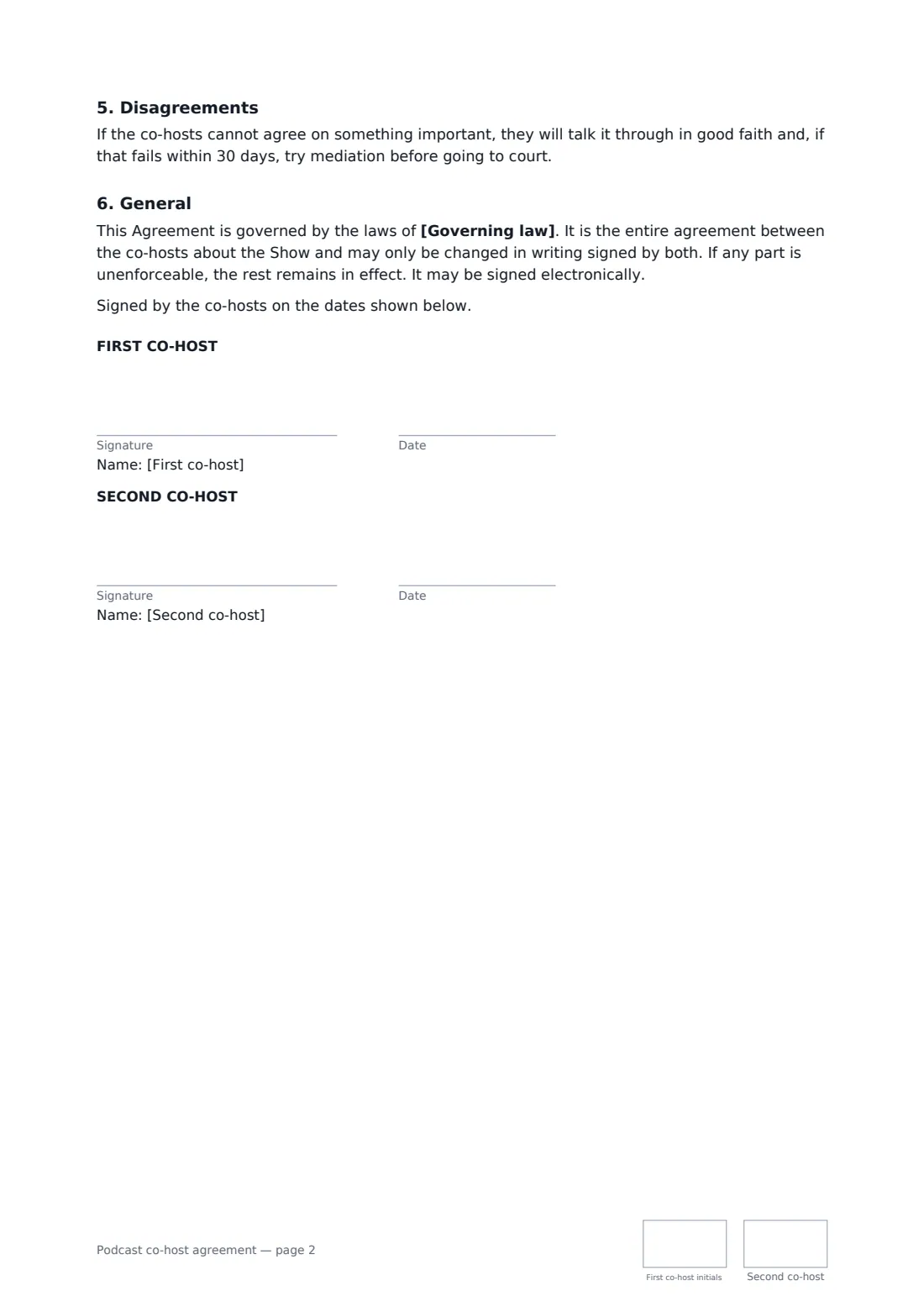
- First co-host signature and date, initials on every page
- Second co-host signature and date, initials on every page
What the podcast co-host agreement covers
- Ownership of the Show
- Money
- Running the Show
- Leaving the Show
- Disagreements
- General
Using the podcast co-host agreement, step by step
1 Name the show and its accounts
Enter the podcast name and list the feed, hosting platform, video channel, social handles and website that belong to it.
2 Agree ownership and revenue
Set the ownership shares and how net revenue is split. They are often the same, but they do not have to be.
3 Decide how the show runs
Enter the recording and release schedule, choose who makes editorial calls, and name who edits and publishes.
4 Plan for someone leaving
Set the notice period and pick what happens when a co-host leaves. If the other keeps the show, choose how the buyout price is worked out. Then both sign.
Tips before you send it
- Register the feed and accounts with a shared show email address rather than one host's personal email.
- If the show name matters commercially, check for trademarks before you invest heavily in it.
- Keep a simple spreadsheet of income and costs. The quarterly statement then takes minutes.
- If you set up a company for the show later, move the ownership into it and update this agreement.
Sign it online in minutes
- Fill in the blanks. Names, dates and amounts go straight into the agreement — the preview shows exactly where.
- Name who signs. Tick “This is me” for your own part. FileIt builds the PDF with every signature, date and initials box on the right line, and you can check or move anything before sending.
- Send it. Each signer gets a secure link and signs from any device — no account needed. The signed PDF, with an audit trail and a Certificate of Completion, is filed in your vault and emailed to everyone.
Podcast co-host agreement: frequently asked questions
Who owns a podcast if nothing is written down?
It is often unclear, which is the problem. Whoever registered the feed and accounts may control them in practice, whatever the other host contributed. This agreement records joint ownership and shared admin access.
Can one co-host keep the show if the other leaves?
Yes, if you choose that option. The remaining host buys the leaving host's share, based either on the last 12 months of revenue or on an agreed or independent valuation.
Can a co-host stop a sponsor they disagree with?
Yes. Each co-host may veto a sponsor or advertiser that conflicts with their values or another commitment they have.
Is this the same as a podcast production agreement?
No. A production agreement hires someone to produce a show for you. This one sets out how equal creative partners own and run their show together.