What is a piece rate pay agreement?
Piece-rate pay rewards output, but it is easy to get wrong. Workers paid only for pieces can end up below the minimum wage on a slow day, unpaid for waiting while a machine is fixed, or docked for rejects that were the fault of bad materials. A written agreement sets the rules both sides can check.
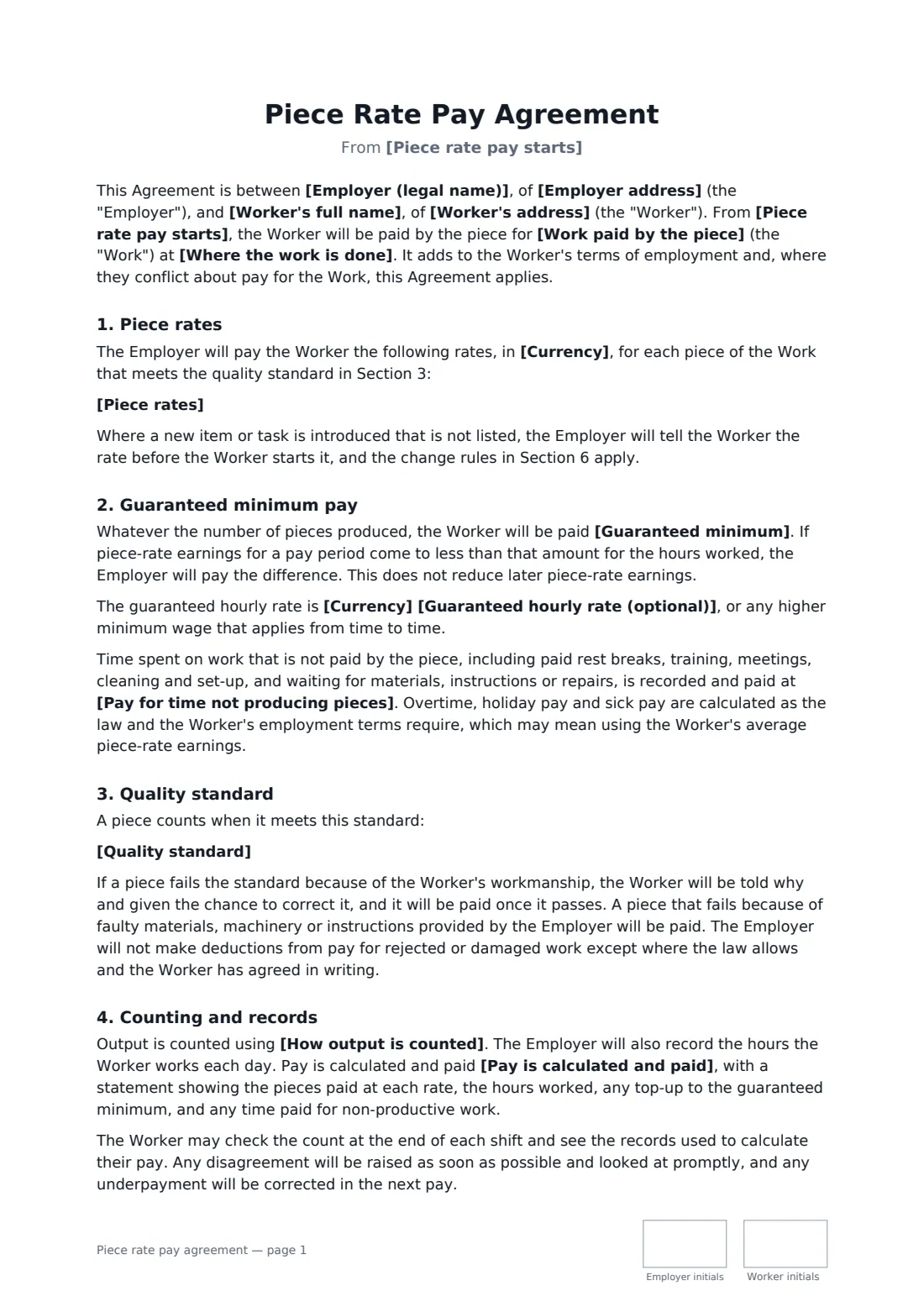
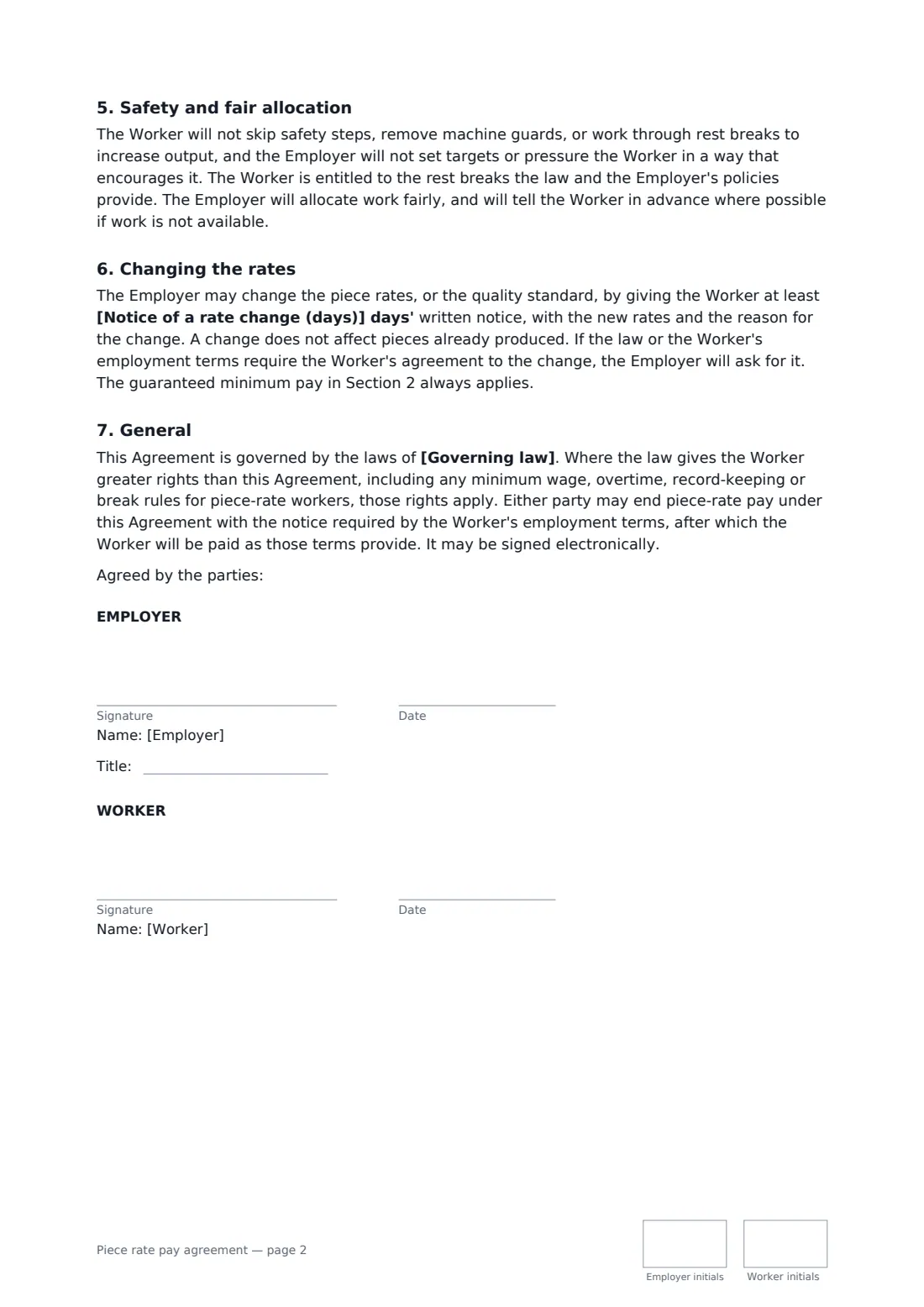
This agreement records the employer, the worker, the work paid by the piece and where it is done. It sets out each item's rate in your currency, and guarantees at least the applicable minimum wage, or a higher hourly rate you set, for every hour worked, with a top-up when piece earnings fall short. Rest breaks, training, cleaning and waiting time are paid at a rate you set. It defines the quality standard, gives the worker the chance to correct rejected work, pays for failures caused by the employer's materials or machines, and limits deductions to what the law allows. Output is counted the way you describe and shown on a pay statement. The agreement keeps safety ahead of speed and requires written notice before rates change.
- Best for
- Garment and craft workshops, farms and orchards, packing, assembly
- Signed by
- The employer and the worker
- Pay
- Rate per piece, guaranteed hourly minimum, paid non-productive time
- Length
- 2 to 3 pages, initialled on each page
When to use a piece rate pay agreement
- A garment workshop paying sewers per finished item
- Fruit picking paid per bin with a minimum wage guarantee
- Packing or assembly lines paid per unit completed
- A bakery or craft business paying per batch or product
- Moving existing staff from hourly pay to piece rates
What you fill in
17 blanks, then the name and email of each person who signs: employer, worker.
1 The parties
- Employer (legal name)*
- Employer address
- Worker's full name*
- Worker's address
2 The work
- Piece rate pay starts*
- Work paid by the piece*
- Where the work is done*
3 Rates
- Currency*
- Piece rates*
- Guaranteed minimum* at least the minimum wage that applies, for every hour worked · at least the guaranteed hourly rate below, for every hour worked
- Guaranteed hourly rate (optional)
- Pay for time not producing pieces*
4 Quality and counting
- Quality standard*
- How output is counted*
- Pay is calculated and paid* weekly · every two weeks · twice a month · monthly
5 Rate changes
- Notice of a rate change (days)*
- Governing law*
6 Who signs
- Employer signature and date, job title, initials on every page
- Worker signature and date, initials on every page
What the piece rate pay agreement covers
- Piece rates
- Guaranteed minimum pay
- Quality standard
- Counting and records
- Safety and fair allocation
- Changing the rates
- General
Using the piece rate pay agreement, step by step
1 Parties and work
Your business name fills in from your account. Add the worker, the start date, the work paid by the piece and where it is done.
2 Rates and guarantee
List each item, its unit and rate, one per line. Choose the minimum wage guarantee or a guaranteed hourly rate, and how non-productive time is paid.
3 Quality and counting
Describe the quality standard a piece must meet, how output is counted, and how often pay is calculated.
4 Rate changes and signing
Set the notice period for rate changes and the governing law, then send. Both of you initial each page and sign.
Tips before you send it
- Check local rules on piece-rate pay: many places require minimum wage for every hour, separate pay for rest breaks and non-productive time, and detailed pay statements.
- Test new rates on real output before you set them, so typical workers can earn a fair hourly figure.
- Let workers check the count at the end of each shift.
- Never deduct for rejects unless the law allows it and the worker has agreed in writing.
Sign it online in minutes
- Fill in the blanks. Names, dates and amounts go straight into the agreement — the preview shows exactly where.
- Name who signs. Tick “This is me” for your own part. FileIt builds the PDF with every signature, date and initials box on the right line, and you can check or move anything before sending.
- Send it. Each signer gets a secure link and signs from any device — no account needed. The signed PDF, with an audit trail and a Certificate of Completion, is filed in your vault and emailed to everyone.
Piece rate pay agreement: frequently asked questions
What if a worker produces very little on a slow day?
They are still paid at least the applicable minimum wage, or your guaranteed hourly rate, for every hour worked. The employer pays the difference, and it does not reduce later earnings.
Are breaks and waiting time paid?
Yes. Rest breaks, training, meetings, cleaning, set-up and waiting for materials or repairs are recorded and paid at the rate you set for non-productive time.
What happens to rejected pieces?
If the worker's workmanship caused the failure, they can correct the piece and it is paid once it passes. Failures caused by the employer's materials, machinery or instructions are paid anyway.
Can the employer change the rates?
Yes, with the written notice you set and a reason, and never for pieces already made. Where the law or the employment terms require the worker's agreement, it must be asked for.