What is a locksmith service authorization?
A locksmith's biggest risk isn't a stubborn lock. It's opening a door for someone who has no right to be inside. A locksmith service authorization records who asked for the work, why they're entitled to it, what proof was shown and what the job will cost, signed on the spot.
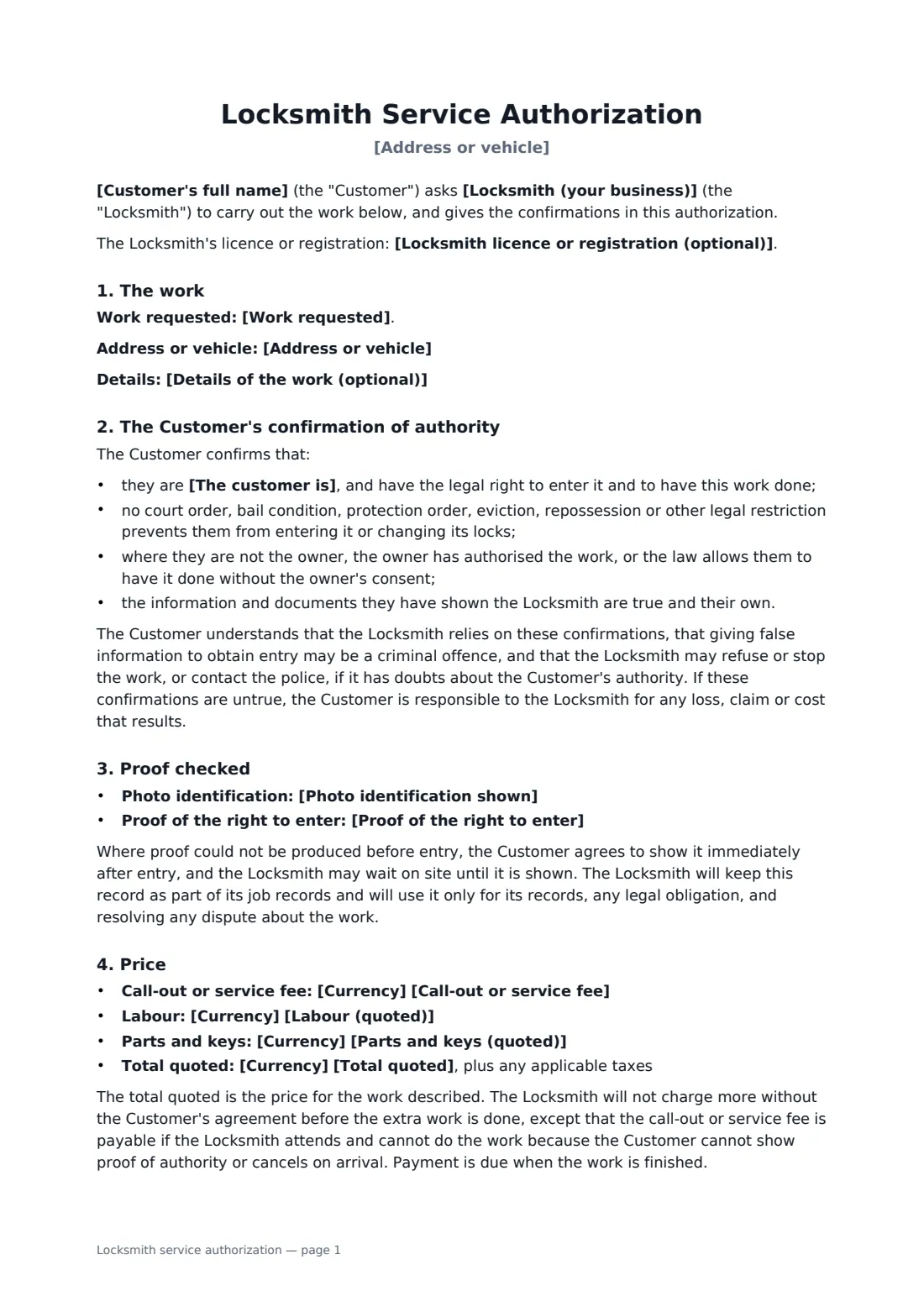
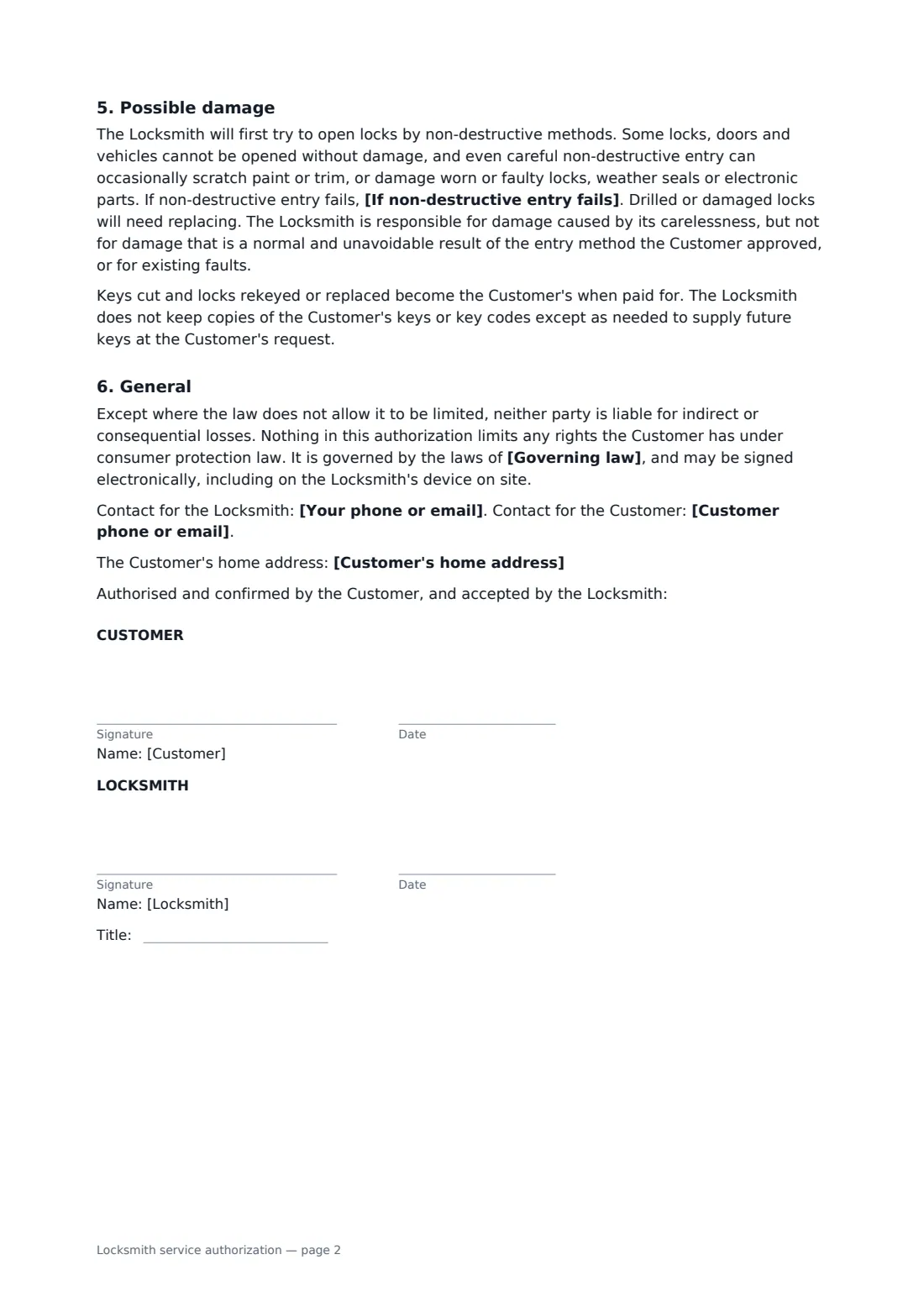
This form covers home, vehicle and business lockouts, safes and cabinets, rekeying, lock changes and key cutting. The customer confirms their capacity (owner, tenant, registered keeper or authorised driver, employee, or agent), that no court order, protection order, eviction or repossession stops them, and that the information they gave is true. It records the photo ID type with only a partial number, and the proof of the right to enter, with a rule for proof shown just after entry. It itemises the call-out fee, labour, parts and total, says when the call-out fee is still payable, and asks whether drilling or other destructive entry may go ahead or needs asking first. It explains possible damage and key ownership.
- Best for
- Locksmiths, auto locksmiths and security installers
- Signed by
- The customer, then the locksmith
- Covers
- Authority to enter, ID and proof, price, destructive entry, damage
- Length
- About 2 pages, signed on a phone or tablet on site
When to use a locksmith service authorization
- A homeowner locked out with the keys inside
- Opening a car for a driver who lost the key
- Rekeying locks for a new tenant or after a break-in
- A shop manager locked out of the business premises
- Opening a safe whose combination has been lost
What you fill in
19 blanks, then the name and email of each person who signs: locksmith, customer.
1 The locksmith
- Locksmith (your business)*
- Your phone or email*
- Locksmith licence or registration (optional)
2 The customer
- Customer's full name*
- Customer phone or email*
- Customer's home address
- The customer is* the owner of the property, vehicle or item named above · a tenant or lawful occupant of the property named above · the registered keeper or an authorised driver of the vehicle named above · an employee or manager authorised by the business at the premises named above · an agent authorised in writing by the owner
3 Proof checked
- Photo identification shown*
- Proof of the right to enter*
4 The work
- Work requested* opening a locked door at a home · opening a locked vehicle · opening a business premises · opening a safe, cabinet or other lock · rekeying locks · replacing or upgrading locks · cutting or programming keys
- Address or vehicle*
- Details of the work (optional)
5 Price
- Currency*
- Call-out or service fee
- Labour (quoted)
- Parts and keys (quoted)
- Total quoted*
- If non-destructive entry fails* the Locksmith must ask the Customer before drilling or other destructive entry · the Customer approves drilling or other destructive entry now, with replacement parts at the prices quoted
- Governing law*
6 Who signs
- Locksmith signature and date, job title · The locksmith or locksmith business doing the work.
- Customer signature and date · The person asking for the work, who confirms their right to have it done.
What the locksmith service authorization covers
- The work
- The Customer's confirmation of authority
- Proof checked
- Price
- Possible damage
- General
Using the locksmith service authorization, step by step
1 Identify the customer
Enter the customer's name and contact, and choose their capacity, such as owner, tenant or authorised driver.
2 Record the proof
Note the type of photo ID and a partial number only, and the document that shows their right to enter.
3 Describe the job
Choose the work, enter the address or vehicle and any details such as how many keys to supply.
4 Quote and sign
Enter the call-out fee, labour, parts and total, choose how destructive entry is handled, and have the customer sign on your device.
Tips before you send it
- Never write down a full ID number. The form asks for the type and the last few characters only.
- If proof is inside the locked property, open the door and check it before you leave. The form lets you wait on site until it's shown.
- Some places license locksmiths and set rules about verifying identity. Check local rules for your area.
- Walk away if the story doesn't add up. The form says you can refuse or stop the work, or call the police.
Sign it online in minutes
- Fill in the blanks. Names, dates and amounts go straight into the agreement — the preview shows exactly where.
- Name who signs. Tick “This is me” for your own part. FileIt builds the PDF with every signature, date box on the right line, and you can check or move anything before sending.
- Send it. Each signer gets a secure link and signs from any device — no account needed. The signed PDF, with an audit trail and a Certificate of Completion, is filed in your vault and emailed to everyone.
Locksmith service authorization: frequently asked questions
What does the customer confirm?
That they have the legal right to enter and have the work done, that no court order, protection order, eviction or repossession prevents it, that the owner has agreed where needed, and that their documents are true and their own.
What proof should a locksmith check?
Usually photo ID plus something linking the person to the property or vehicle, such as a utility bill, tenancy agreement or registration document. The form records both.
Will the locksmith damage my lock?
Non-destructive methods are tried first. If they fail, the customer chooses on the form whether drilling or other destructive entry can go ahead or must be asked about first. Drilled locks need replacing.
Do I pay if the locksmith can't do the job?
The call-out or service fee is payable if the locksmith attends and can't do the work because proof of authority can't be shown or the customer cancels on arrival.
Can the customer sign on my phone?
Yes. The form can be signed electronically on the locksmith's device on site, and FileIt keeps an audit trail with the signed PDF.