What is a iP co-ownership agreement?
Joint ownership of intellectual property happens more often than people plan for: two companies invent something together, co-founders write the code before the company exists, or two creators make a work together. Without an agreement, the default rules depend on the country and the type of IP, and they can be surprising. In some places one co-owner can license freely without the other; in others neither can do anything without the other's consent.
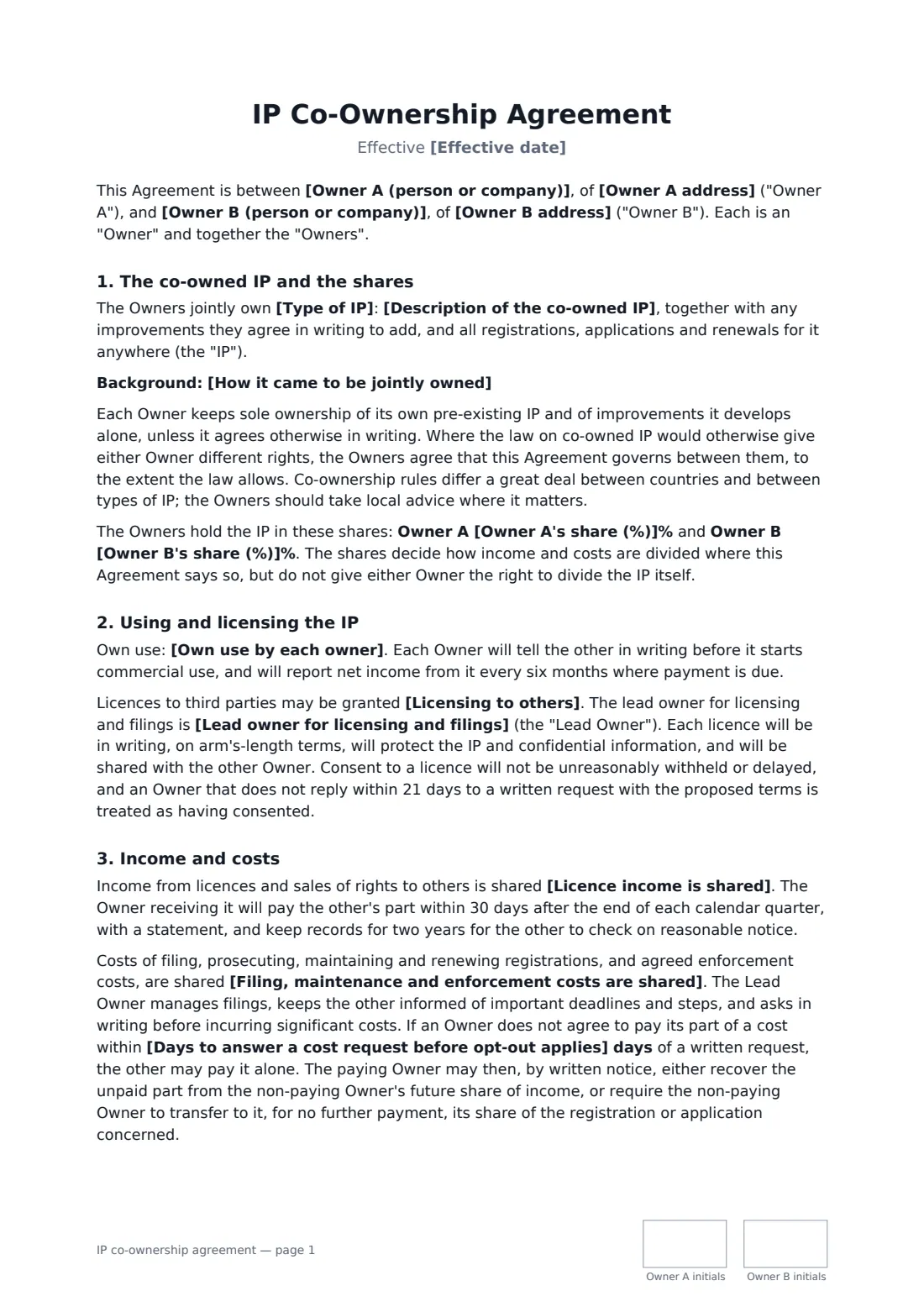
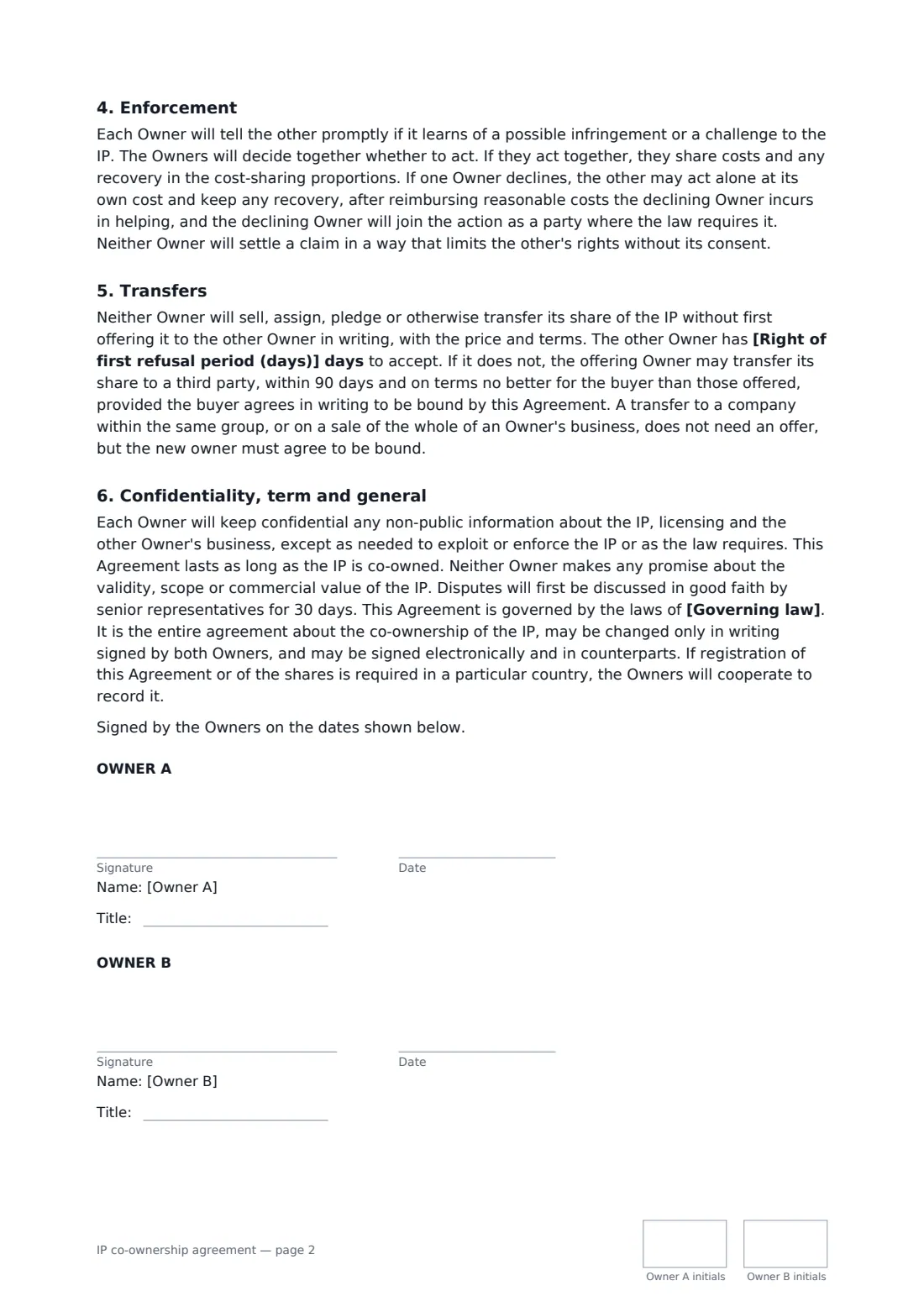
This template records the co-owned IP and how it came about, each owner's percentage share, and whether each may use it in its own business, with or without paying the other. It sets the licensing rule, from both owners' consent to non-exclusive licences by either, names a lead owner for licensing and filings, and shares income and filing, maintenance and enforcement costs in proportion or equally, with an opt-out if an owner won't pay its part. It covers enforcement against infringers together or alone, a right of first refusal before either sells its share, confidentiality, and recording the agreement where registration is needed.
- Best for
- Research partners, co-founders, co-inventors and co-creators
- Signed by
- Both co-owners
- Covers
- Patents, designs, software, written, visual, audio and video content
- Length
- About 2 pages, initialled on every page
When to use a iP co-ownership agreement
- Two companies that jointly filed a patent application after a collaboration
- A university and an industry partner sharing a design right
- Two developers who co-wrote software outside any company
- Co-authors of an online course deciding how to license it
- A brand and a designer who jointly own a product design
What you fill in
18 blanks, then the name and email of each person who signs: owner a, owner b.
1 The parties
- Effective date*
- Owner A (person or company)*
- Owner A address
- Owner B (person or company)*
- Owner B address
2 The IP
- Type of IP* a patent or patent application · a registered or unregistered design · software · written, visual, audio or video content · a mix of the above
- Description of the co-owned IP*
- How it came to be jointly owned
3 Shares
- Owner A's share (%)*
- Owner B's share (%)*
4 Using and licensing
- Own use by each owner* each owner may use and exploit the IP itself, in its own business, without paying the other · each owner may use it itself, but pays the other a part of its net income from that use in proportion to the other's ownership share · neither owner may exploit it commercially without the other's written consent
- Licensing to others* only with both owners' written consent · either owner may grant non-exclusive licences, but exclusive licences need both owners' consent · only by the lead owner named below, after consulting the other
- Lead owner for licensing and filings* Owner A · Owner B
5 Money
- Licence income is shared* in proportion to the ownership shares, after deducting shared costs · equally, after deducting shared costs
- Filing, maintenance and enforcement costs are shared* in proportion to the ownership shares · equally
- Days to answer a cost request before opt-out applies*
6 Transfers
- Right of first refusal period (days)*
- Governing law*
7 Who signs
- Owner A signature and date, job title, initials on every page · The first co-owner.
- Owner B signature and date, job title, initials on every page · The second co-owner.
What the iP co-ownership agreement covers
- The co-owned IP and the shares
- Using and licensing the IP
- Income and costs
- Enforcement
- Transfers
- Confidentiality, term and general
Using the iP co-ownership agreement, step by step
1 Describe the IP
Choose the type, describe it precisely with registration or application numbers, and say how it came to be jointly owned.
2 Set shares and use
Enter each owner's percentage, choose the rule for each owner's own use, the licensing rule, and the lead owner.
3 Agree money
Choose how licence income and costs are shared, and how many days an owner has to answer a cost request before the opt-out applies.
4 Set transfers and send
Enter the right of first refusal period, add the governing law and send to the other owner.
Tips before you send it
- Co-ownership rules differ a lot between countries and types of IP. If the IP is registered in several countries, take local advice on the important ones.
- Name the IP precisely, with application or registration numbers, so there's no argument about what's covered.
- Decide improvements upfront. The template keeps each owner's solo improvements separate unless you agree in writing to add them.
- Record the agreement with the patent or design office where that's needed to protect the shares against third parties.
Sign it online in minutes
- Fill in the blanks. Names, dates and amounts go straight into the agreement — the preview shows exactly where.
- Name who signs. Tick “This is me” for your own part. FileIt builds the PDF with every signature, date and initials box on the right line, and you can check or move anything before sending.
- Send it. Each signer gets a secure link and signs from any device — no account needed. The signed PDF, with an audit trail and a Certificate of Completion, is filed in your vault and emailed to everyone.
IP co-ownership agreement: frequently asked questions
Can one co-owner license the IP without the other?
Only as the licensing rule you choose allows: both owners' consent, non-exclusive licences by either with exclusive ones needing both, or the lead owner after consulting. Consent can't be unreasonably withheld, and silence for 21 days after a written request counts as consent.
What if one owner won't pay its share of costs?
If it doesn't agree within the days you set, the other may pay alone and then, by written notice, either recover the unpaid part from the non-paying owner's future income or take over its share of that registration or application for no further payment.
Can a co-owner sell its share?
Only after offering it to the other owner first. If the other doesn't accept in time, the share can be sold to a third party on terms no better than those offered, and the buyer must agree to be bound.
What about infringement?
The owners decide together. If one declines, the other can act alone at its own cost and keep the recovery, and the declining owner joins the case where the law requires.