What is a grievance outcome letter?
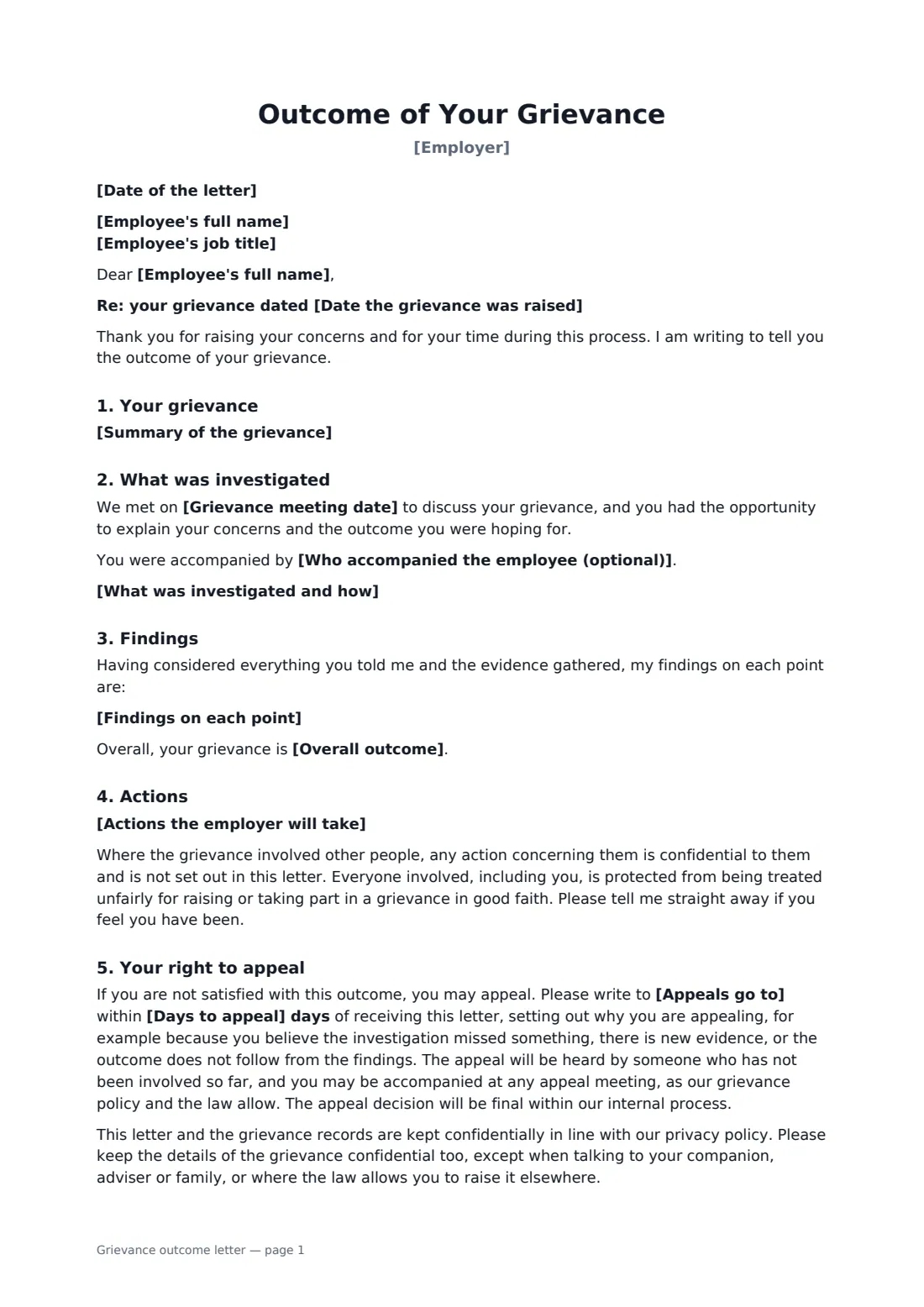
When an employee raises a formal grievance, how the employer closes it matters as much as the investigation. A good outcome letter shows the employee they were heard: it restates their complaints, explains what was looked at, gives a finding on each point with reasons, says what will happen next, and tells them how to appeal if they disagree.
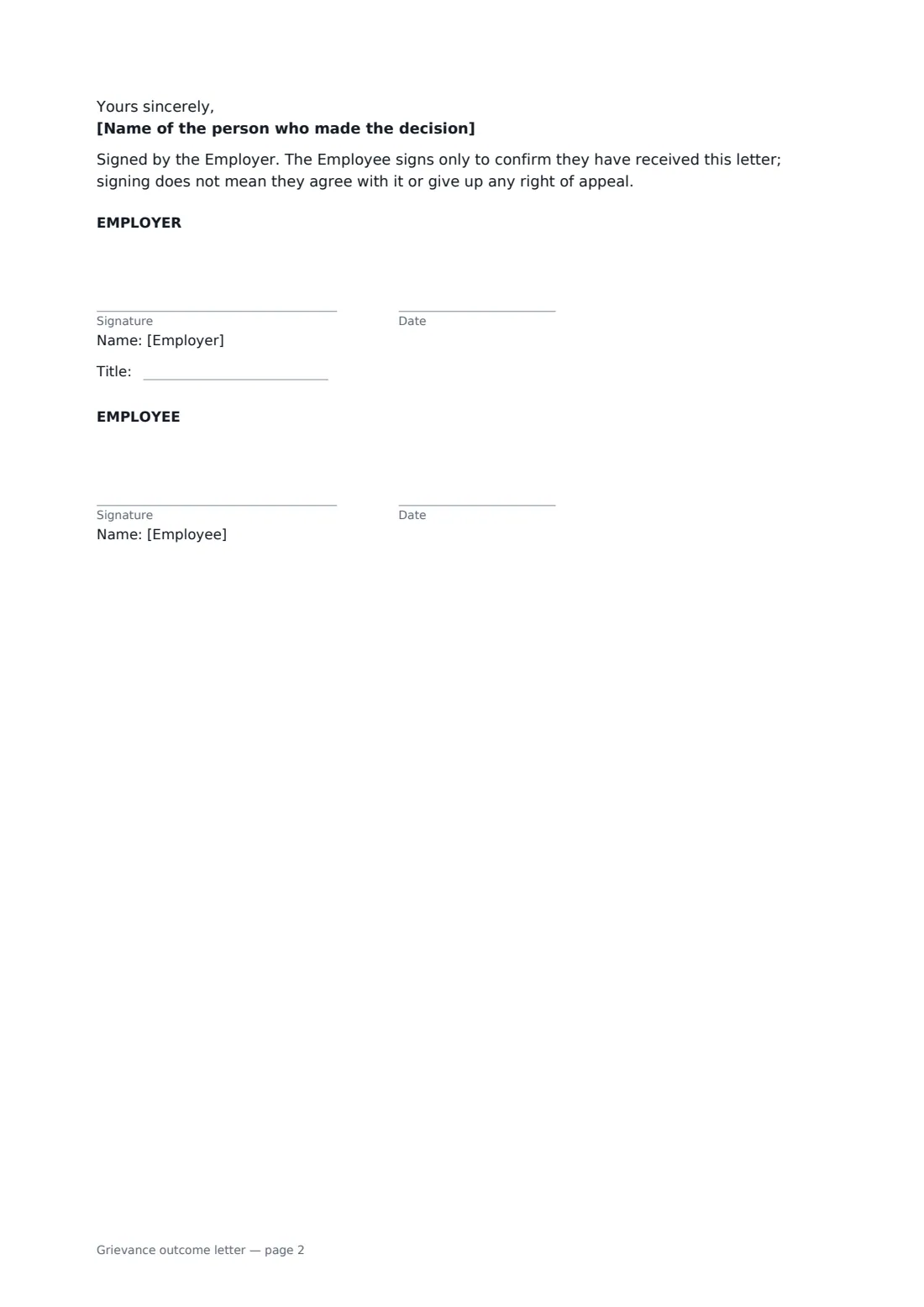
This letter records the date the grievance was raised and a neutral summary of it; the grievance meeting and who accompanied the employee; what was investigated and how; findings on each point; the overall outcome (upheld, partly upheld or not upheld); the actions the employer will take, keeping action about other people confidential; protection from unfair treatment for raising a grievance; and the right to appeal, to whom and within how many days. The employee signs to confirm receipt only, which the letter says does not mean they agree or give up an appeal.
- Best for
- Closing a formal grievance after a meeting and investigation
- Signed by
- The decision maker for the employer, and the employee for receipt
- Outcomes
- Upheld, partly upheld or not upheld, with findings on each point
- Length
- 2 pages
When to use a grievance outcome letter
- Responding to a complaint about a shift change made without consultation
- Closing a grievance about a manager's behaviour
- A grievance about pay, overtime or workload
- Partly upholding a grievance and setting out the changes
- Not upholding a grievance while explaining why
What you fill in
16 blanks, then the name and email of each person who signs: employer, employee.
1 The letter
- Date of the letter*
- Employer*
- Employee's full name*
- Employee's job title
- Mark as private and confidential* Yes · No
2 The grievance
- Date the grievance was raised*
- Summary of the grievance*
3 The investigation
- Grievance meeting date
- Who accompanied the employee (optional)
- What was investigated and how*
4 The decision
- Findings on each point*
- Overall outcome* upheld · partly upheld · not upheld
- Actions the employer will take
5 Appeal
- Appeals go to*
- Days to appeal*
- Name of the person who made the decision*
6 Who signs
- Employer signature and date, job title · The manager or HR person who heard the grievance and made the decision.
- Employee signature and date · The employee who raised the grievance. Signing confirms they received the letter, not that they agree with it.
What the grievance outcome letter covers
- Your grievance
- What was investigated
- Findings
- Actions
- Your right to appeal
Using the grievance outcome letter, step by step
1 Identify the grievance
Enter the employee, the date they raised the grievance, and a neutral summary of each complaint.
2 Describe the investigation
Add the meeting date, who accompanied the employee, and who was interviewed and what was reviewed.
3 Give your findings
For each point, say whether it is upheld, partly upheld or not upheld, and why. Choose the overall outcome.
4 Actions and appeal
Set out what will change, name the person appeals go to and the number of days to appeal, and the decision maker.
5 Send for receipt
Sign and send it. The employee signs to confirm they received it, and the letter is filed with the grievance records in your vault.
Tips before you send it
- Answer every point the employee raised. A point that is ignored is a common ground of appeal.
- Don't share the details of any action against another employee. Say that it has been dealt with.
- Name an appeal manager who wasn't involved in the grievance or the decision.
- Check your grievance policy, any collective agreement and local law for the appeal period and the right to be accompanied.
Sign it online in minutes
- Fill in the blanks. Names, dates and amounts go straight into the agreement — the preview shows exactly where.
- Name who signs. Tick “This is me” for your own part. FileIt builds the PDF with every signature, date box on the right line, and you can check or move anything before sending.
- Send it. Each signer gets a secure link and signs from any device — no account needed. The signed PDF, with an audit trail and a Certificate of Completion, is filed in your vault and emailed to everyone.
Grievance outcome letter: frequently asked questions
Does the employee have to agree with the outcome?
No. They sign only to confirm they received the letter. The letter says signing does not mean they agree with it or give up any right of appeal.
What should the findings include?
A finding on each complaint, upheld, partly upheld or not upheld, with a short reason based on the evidence. Keep other people's confidential details out.
How long does the employee have to appeal?
The days you set, usually from your grievance policy. Check any minimum set by law or a collective agreement.
Is there a form for the original grievance?
Yes. The employee grievance form records the complaint and the employer's acknowledgement at the start of the process.