What is a genealogy research services agreement?
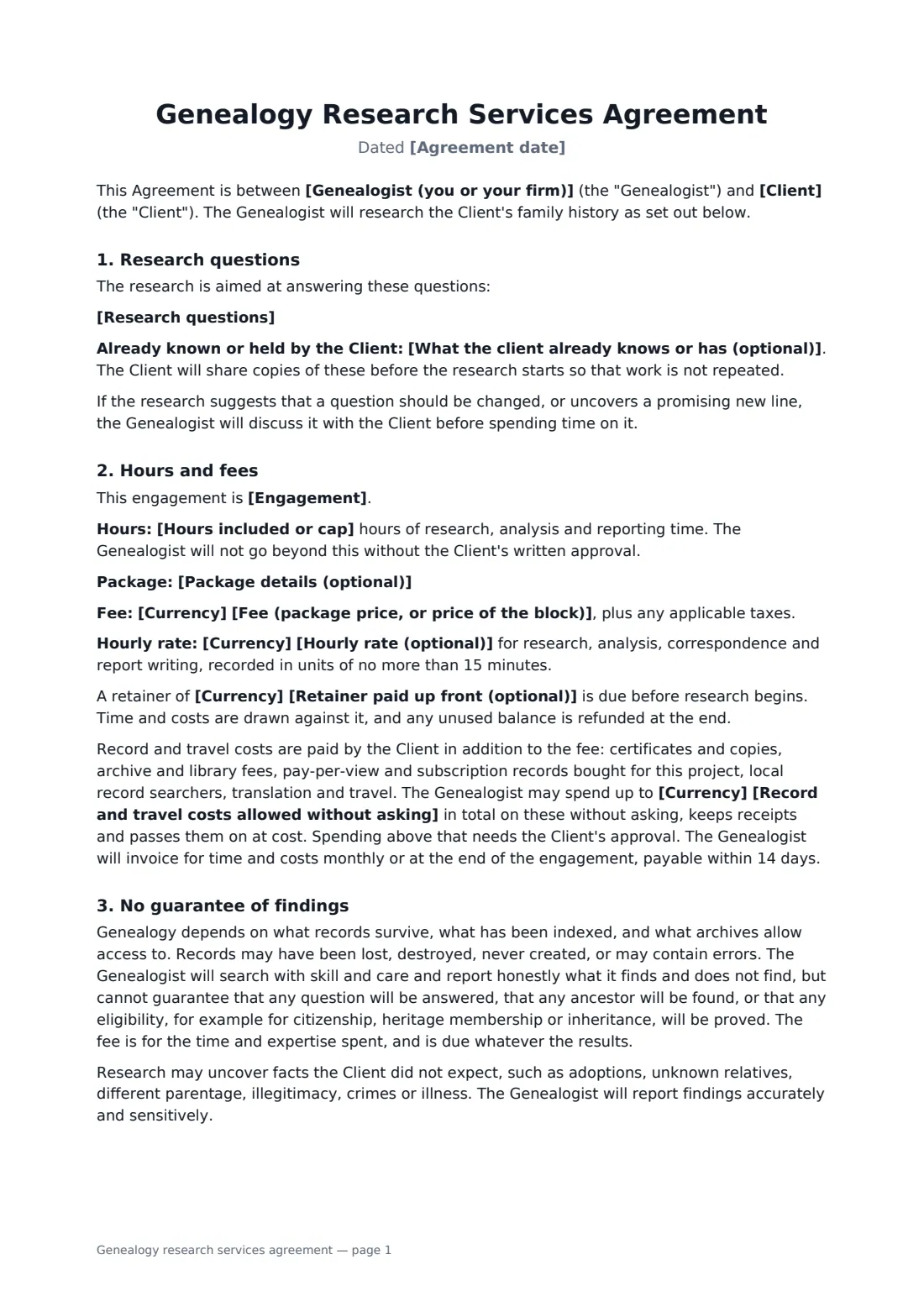
Clients who hire a genealogist often hope for a definite answer: the village their great-grandmother came from, proof of descent for a citizenship application, or the name of an unknown grandfather. Sometimes records answer those questions; sometimes they were never made or did not survive. A genealogy research agreement sets the questions, the budget and the expectations at the start, and deals with DNA data carefully.
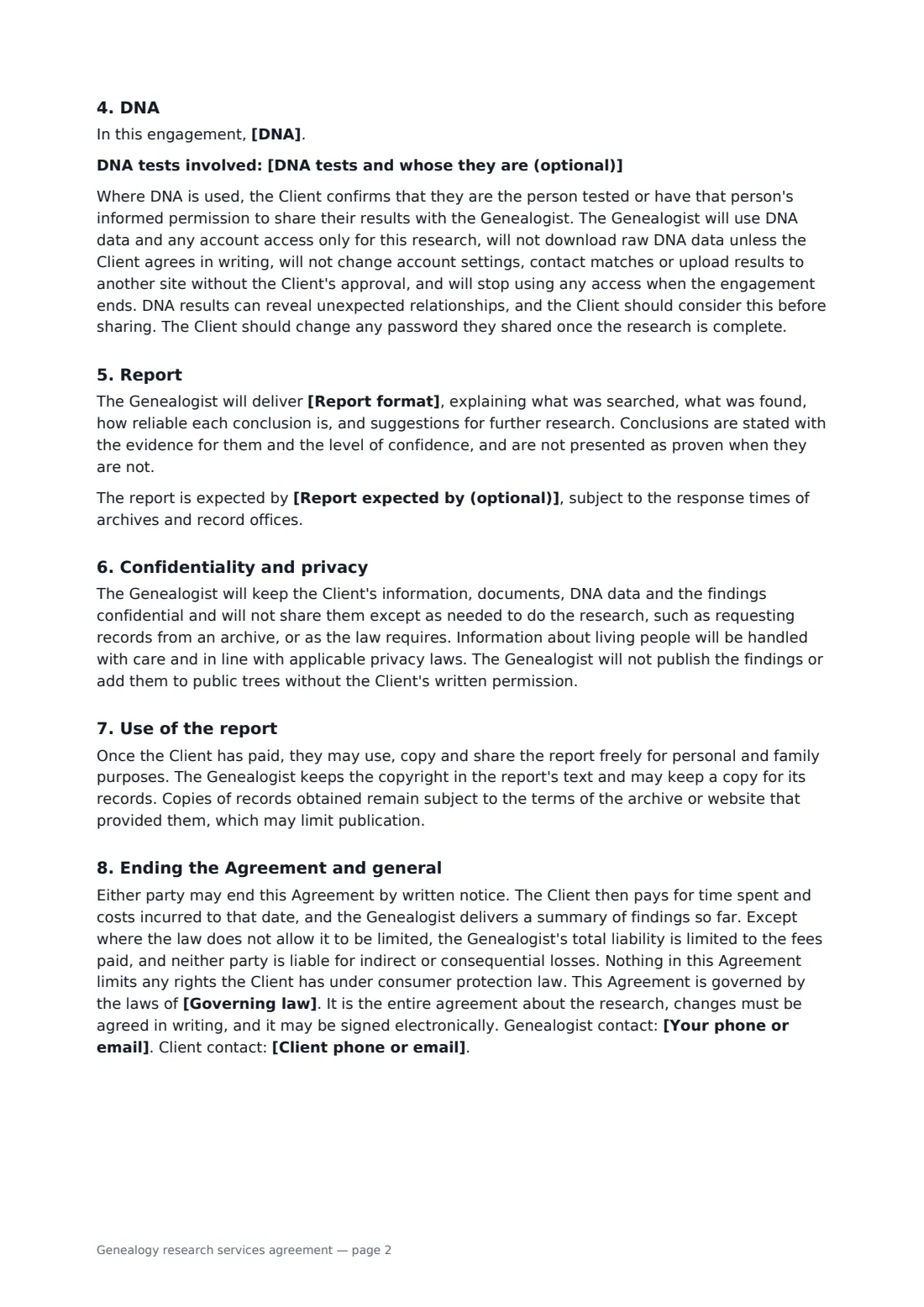
This template records the research questions and what the client already holds, whether the engagement is a block of hours, a fixed-price package or hourly with a cap, the fee, hourly rate and optional retainer, and a limit on record and travel costs passed on at cost. It states plainly that findings are not guaranteed and that research can uncover unexpected facts. It sets rules for DNA results and account access, including permission from other testers, no raw data downloads or contacting matches without approval. It covers the report format and timing, confidentiality and living people's privacy, use of the report, and ending the engagement with a summary of findings so far.
- Best for
- Professional genealogists and family history researchers
- Signed by
- The genealogist and the client
- Pricing
- Block of hours, fixed package, or hourly with a cap, plus record costs
- Length
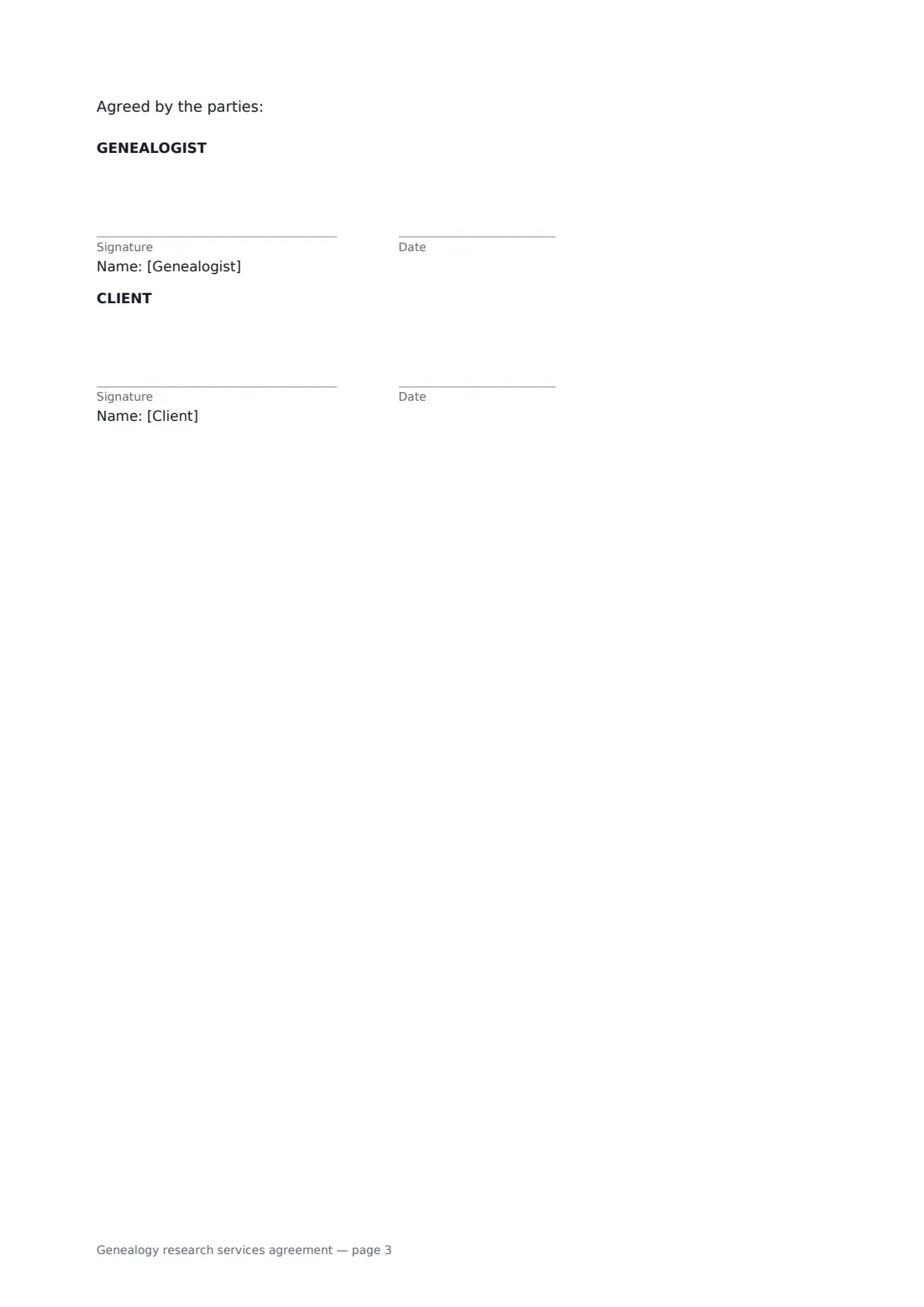
- 3 pages, with both signatures on the last page
When to use a genealogy research services agreement
- Tracing an immigrant ancestor back to their home town
- Breaking through a brick wall in a client's family tree
- Analysing DNA matches to identify an unknown parent or grandparent
- Building a four-generation pedigree with sources as a gift
- Gathering records a client needs for a heritage society application
What you fill in
20 blanks, then the name and email of each person who signs: genealogist, client.
1 The parties
- Agreement date*
- Genealogist (you or your firm)*
- Your phone or email*
- Client*
- Client phone or email*
2 The research
- Research questions*
- What the client already knows or has (optional)
3 Hours and fees
- Engagement* a block of research hours · a fixed-price research package · an hourly engagement with a cap
- Hours included or cap
- Package details (optional)
- Currency*
- Fee (package price, or price of the block)
- Hourly rate (optional)
- Retainer paid up front (optional)
- Record and travel costs allowed without asking*
4 DNA and report
- DNA* DNA is not part of this research · the Client will share DNA test results for analysis · the Client will share DNA results and give the Genealogist access to the testing account
- DNA tests and whose they are (optional)
- Report format* a written report with source citations, as a PDF · a written report with citations and a family tree file (GEDCOM) · a short summary of findings with copies of records · progress updates and a final written report with citations
- Report expected by (optional)
- Governing law*
5 Who signs
- Genealogist signature and date · The genealogist or research firm.
- Client signature and date · The person commissioning the research.
What the genealogy research services agreement covers
- Research questions
- Hours and fees
- No guarantee of findings
- DNA
- Report
- Confidentiality and privacy
- Use of the report
- Ending the Agreement and general
Using the genealogy research services agreement, step by step
1 Write the research questions
Enter specific questions with names, dates and places, and list what the client already has so it isn't searched again.
2 Set hours and fees
Choose a block of hours, package or capped hourly engagement, enter the hours, fee, hourly rate and optional retainer, and the record and travel budget.
3 Decide on DNA
Choose whether DNA is used and whether you get account access, and list whose tests are involved.
4 Report and send
Choose the report format, an optional due date and the governing law, and send it to the client to sign.
Tips before you send it
- Turn a vague request into one or two precise questions. It makes the hours go further and the results easier to judge.
- Get written permission from any relative whose DNA results you will analyse. The agreement makes the client confirm it.
- Ask the client to change any shared password when the work is done. The template reminds them.
- If the research is for a citizenship or legal claim, say clearly that eligibility is decided by the authority, not the genealogist.
Sign it online in minutes
- Fill in the blanks. Names, dates and amounts go straight into the agreement — the preview shows exactly where.
- Name who signs. Tick “This is me” for your own part. FileIt builds the PDF with every signature, date box on the right line, and you can check or move anything before sending.
- Send it. Each signer gets a secure link and signs from any device — no account needed. The signed PDF, with an audit trail and a Certificate of Completion, is filed in your vault and emailed to everyone.
Genealogy research services agreement: frequently asked questions
What if nothing is found?
The fee is for time and expertise, so it is still due. The report explains what was searched and what was not found, which is useful for planning further research.
Are record and certificate costs included?
No. They are paid by the client at cost, and the genealogist may spend only up to the limit you set before asking.
How is DNA data protected?
It is used only for the research. No raw data downloads, contacting matches, uploads or settings changes without the client's approval, and access stops when the engagement ends.
Can the client share the report with family?
Yes. Once paid, the client can use and share it for personal and family purposes. The genealogist keeps copyright in the text, and archive terms still apply to record copies.
Can it be signed electronically?
Yes. E-signatures are generally valid for service agreements like this in the US, UK, EU and Canada. FileIt keeps an audit trail with the signed PDF.