What is a electrical services contract?
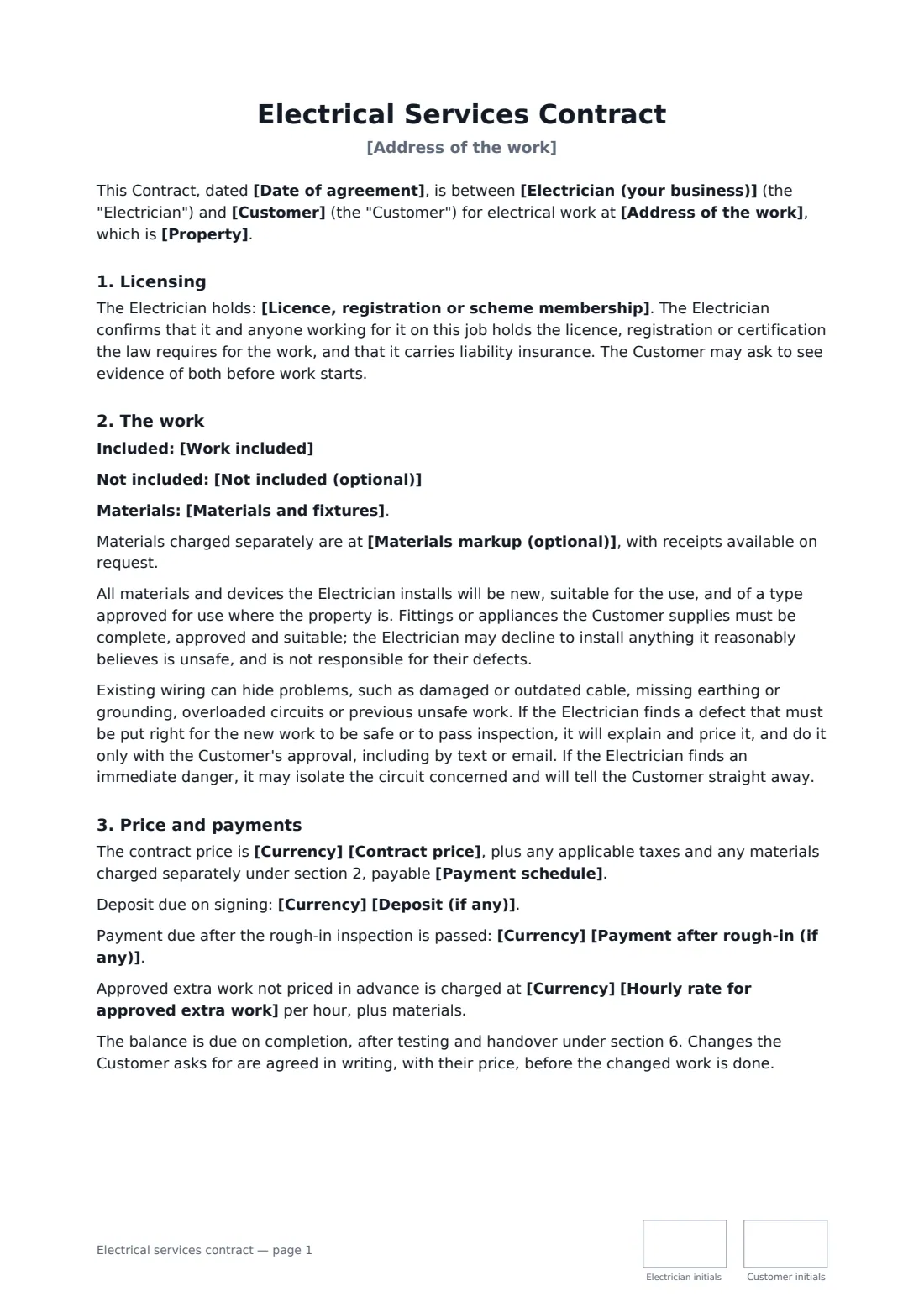
Electrical work is regulated almost everywhere: it usually has to be done by a licensed or registered electrician, often needs a permit and inspection, and should end with testing and a certificate or sign-off. A written contract makes sure the customer knows all of that is handled, and the electrician knows what's included in the price.
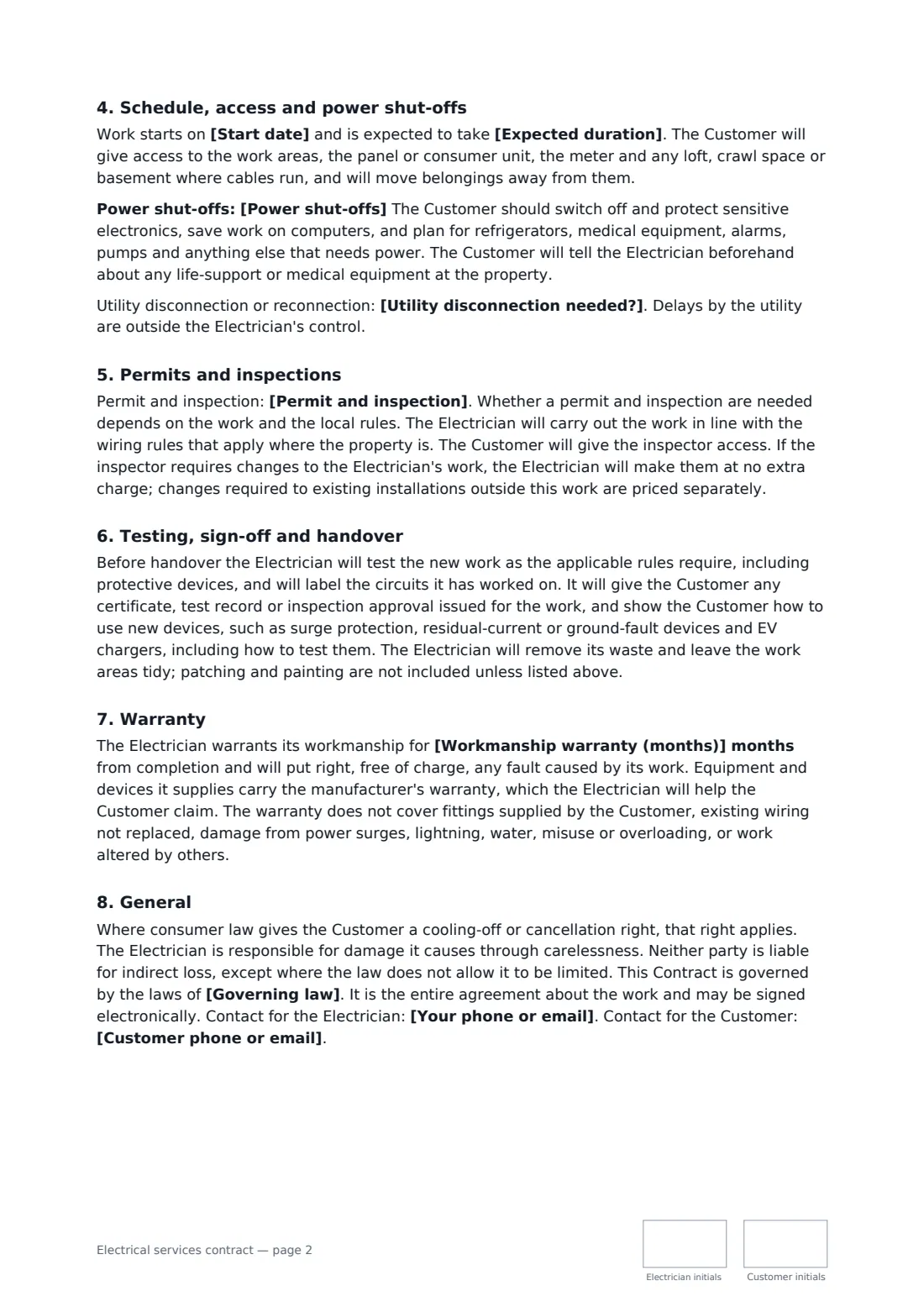
This template records the electrician's licence or scheme membership and insurance, the work included and excluded, and who supplies materials and fittings, with an optional markup. It sets a stop-and-approve rule for defects in existing wiring and lets the electrician isolate an immediate danger. It covers the price with payment in full on completion, a deposit, or staged payments after rough-in inspection, an hourly rate for approved extras, the start date and duration, access, power shut-offs with a reminder about medical equipment, utility disconnection, permits and inspections, testing, circuit labelling and handover of certificates, and a workmanship warranty.
- Best for
- Licensed electricians and electrical contractors
- Signed by
- The electrician and the customer
- Payments
- On completion, deposit and balance, or staged after rough-in
- Length
- About 3 pages, initialled on every page
When to use a electrical services contract
- Upgrading a main panel or consumer unit
- Installing an EV charger on a new dedicated circuit
- Rewiring an older house during a renovation
- Fitting new lighting and switches in a kitchen
- Electrical fit-out for a small shop or office
What you fill in
25 blanks, then the name and email of each person who signs: electrician, customer.
1 The parties
- Date of agreement*
- Electrician (your business)*
- Licence, registration or scheme membership*
- Your phone or email*
- Customer*
- Customer phone or email*
- Address of the work*
2 The work
- Property* a home · a rental property · a shop or office · a commercial or industrial building
- Work included*
- Not included (optional)
- Materials and fixtures* supplied by the Electrician, included in the price · supplied by the Electrician and charged at cost plus the markup below · light fittings and appliances supplied by the Customer; cable, devices and panel by the Electrician
- Materials markup (optional)
3 Price and payments
- Currency*
- Contract price*
- Payment schedule* in full on completion · a deposit on signing and the balance on completion · a deposit, a payment after rough-in inspection, and the balance on completion
- Deposit (if any)
- Payment after rough-in (if any)
- Hourly rate for approved extra work
4 Schedule and power
- Start date*
- Expected duration*
- Power shut-offs*
- Utility disconnection needed?* no · yes — the Electrician arranges it with the utility · yes — the Customer arranges it with the utility
5 Permits and warranty
- Permit and inspection* the Electrician obtains the permit and books inspections, included in the price · the Electrician obtains the permit; permit fees are charged at cost · no permit is expected for this work
- Workmanship warranty (months)*
- Governing law*
6 Who signs
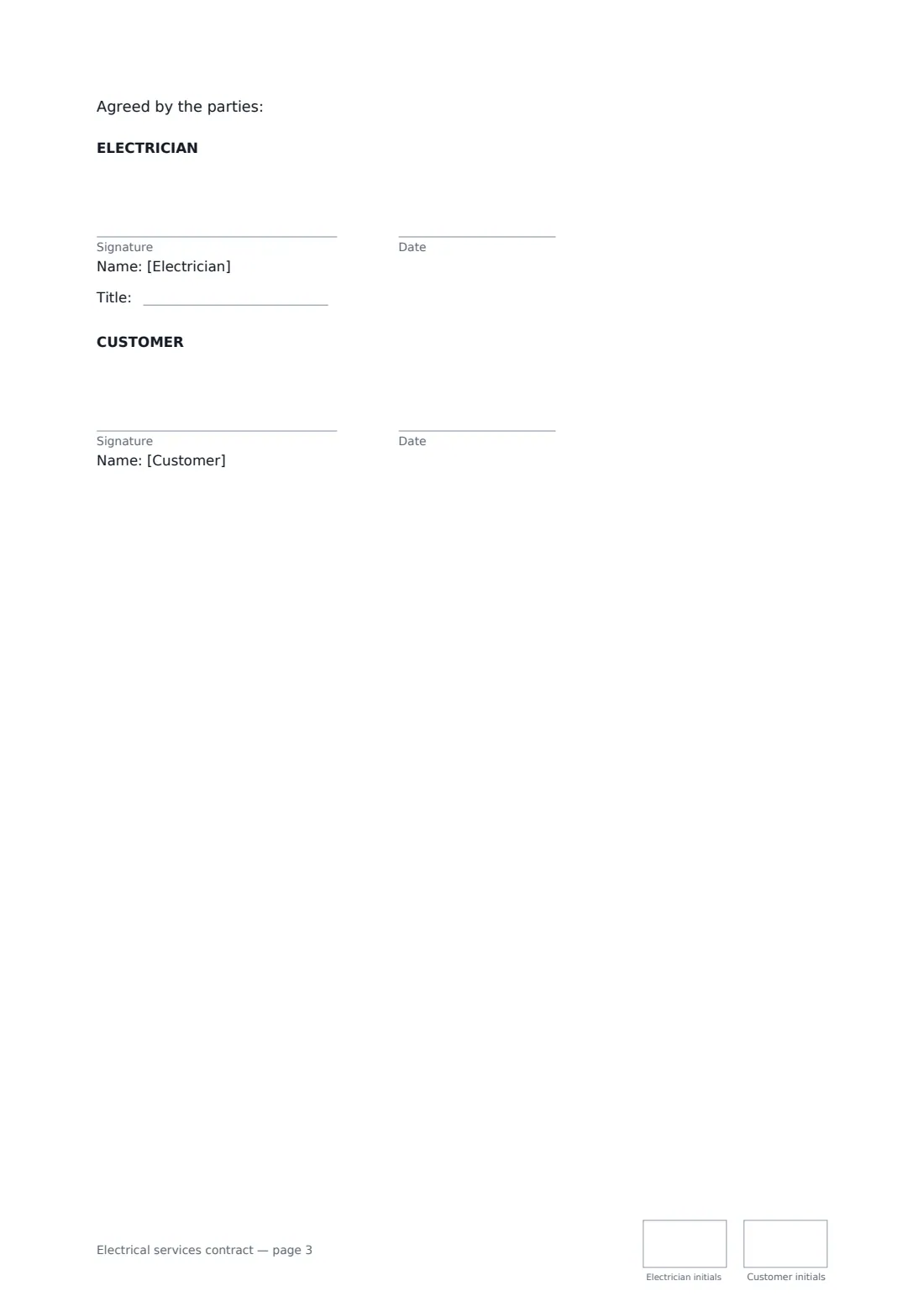
- Electrician signature and date, job title, initials on every page · The electrician or electrical contractor doing the work.
- Customer signature and date, initials on every page · The property owner, tenant with the owner's consent, or business.
What the electrical services contract covers
- Licensing
- The work
- Price and payments
- Schedule, access and power shut-offs
- Permits and inspections
- Testing, sign-off and handover
- Warranty
- General
Using the electrical services contract, step by step
1 Add your licence and the property
Enter your business, licence or registration, the customer and the address, and choose the type of property.
2 Describe the work and materials
Describe what's included and excluded, choose who supplies materials and fittings, and add a markup if you charge one.
3 Set price and payments
Enter the price, choose the payment schedule with any deposit or rough-in payment, and add an hourly rate for approved extras.
4 Plan the shut-offs and send
Enter the start date and duration, edit the power shut-off wording, choose who arranges any utility disconnection and the permit, set the warranty and send.
Tips before you send it
- Ask the customer about medical equipment, freezers, sump pumps and home offices before planning a whole-house shut-off.
- Tie a staged payment to the rough-in inspection being passed, not just to a date.
- Label every circuit you touch. It's in the contract and the customer will thank you the next time a breaker trips.
- Hand over the test certificate or inspection approval with the final invoice. Insurers and buyers may ask for it.
- Say in the scope whether patching and painting after cable runs are included. The contract leaves them out unless listed.
Sign it online in minutes
- Fill in the blanks. Names, dates and amounts go straight into the agreement — the preview shows exactly where.
- Name who signs. Tick “This is me” for your own part. FileIt builds the PDF with every signature, date and initials box on the right line, and you can check or move anything before sending.
- Send it. Each signer gets a secure link and signs from any device — no account needed. The signed PDF, with an audit trail and a Certificate of Completion, is filed in your vault and emailed to everyone.
Electrical services contract: frequently asked questions
What if the existing wiring is unsafe?
If a defect must be fixed for the new work to be safe or pass inspection, the electrician explains and prices it, and does it only with the customer's approval. If there's an immediate danger, the electrician may isolate the circuit and tells the customer straight away.
Is a permit always needed?
It depends on the work and local rules. You choose who obtains it, or record that none is expected. The electrician works to the wiring rules that apply where the property is and fixes anything the inspector requires in its own work free.
Does the customer get a certificate?
The electrician tests the new work as the rules require and gives the customer any certificate, test record or inspection approval issued for it.
What isn't covered by the warranty?
Customer-supplied fittings, existing wiring that wasn't replaced, damage from surges, lightning, water, misuse or overloading, and work altered by others.