What is a convertible note agreement?
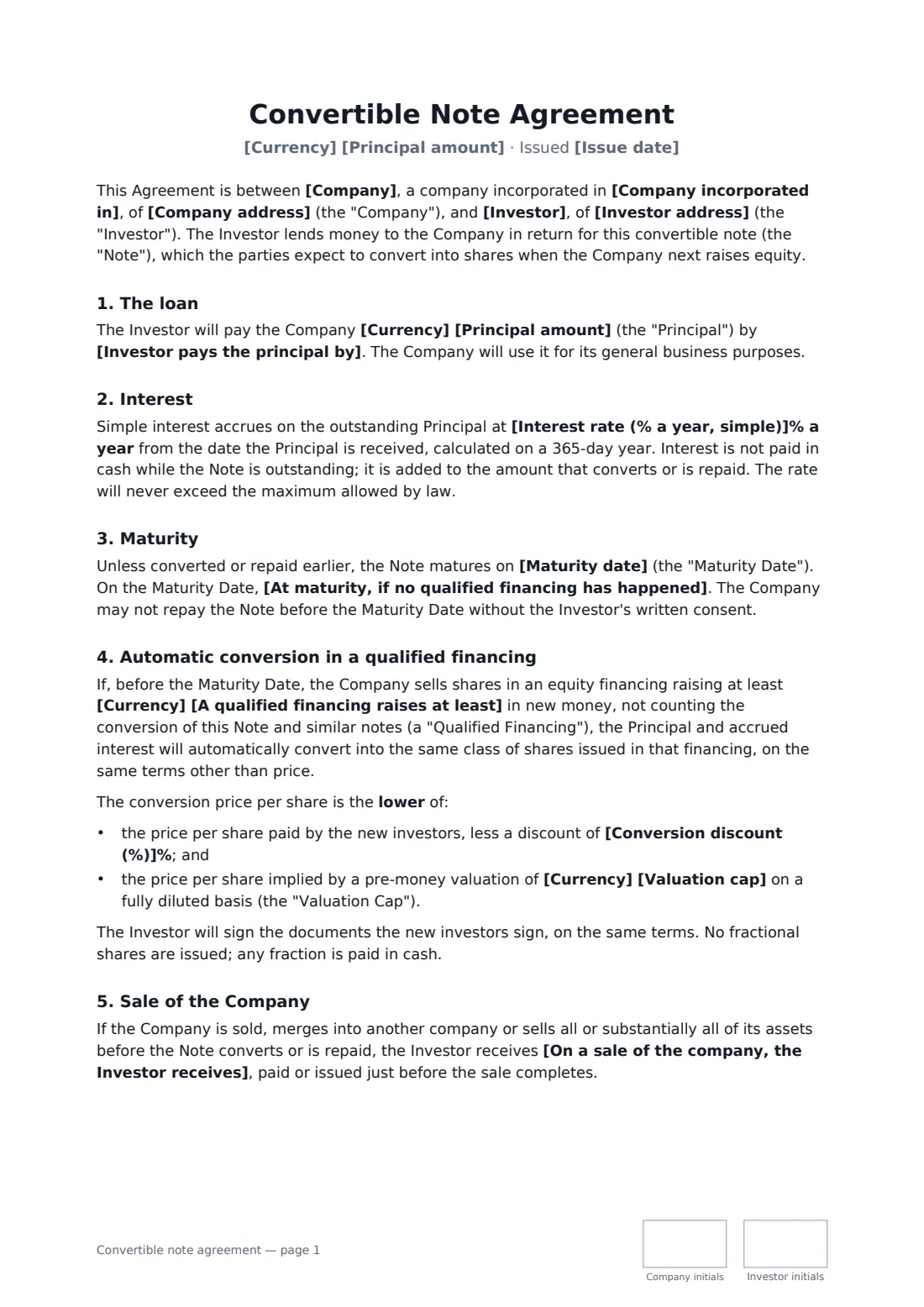
A convertible note lets a startup take investment now and agree the price later. The investor lends money; instead of being repaid, the loan and its interest normally convert into shares when the company raises a priced equity round. In return for backing the company early, the investor usually gets a discount on the new round's price, a valuation cap that limits the price they pay, or both. Because it is still debt until it converts, a note also has a maturity date and default terms that a SAFE does not.
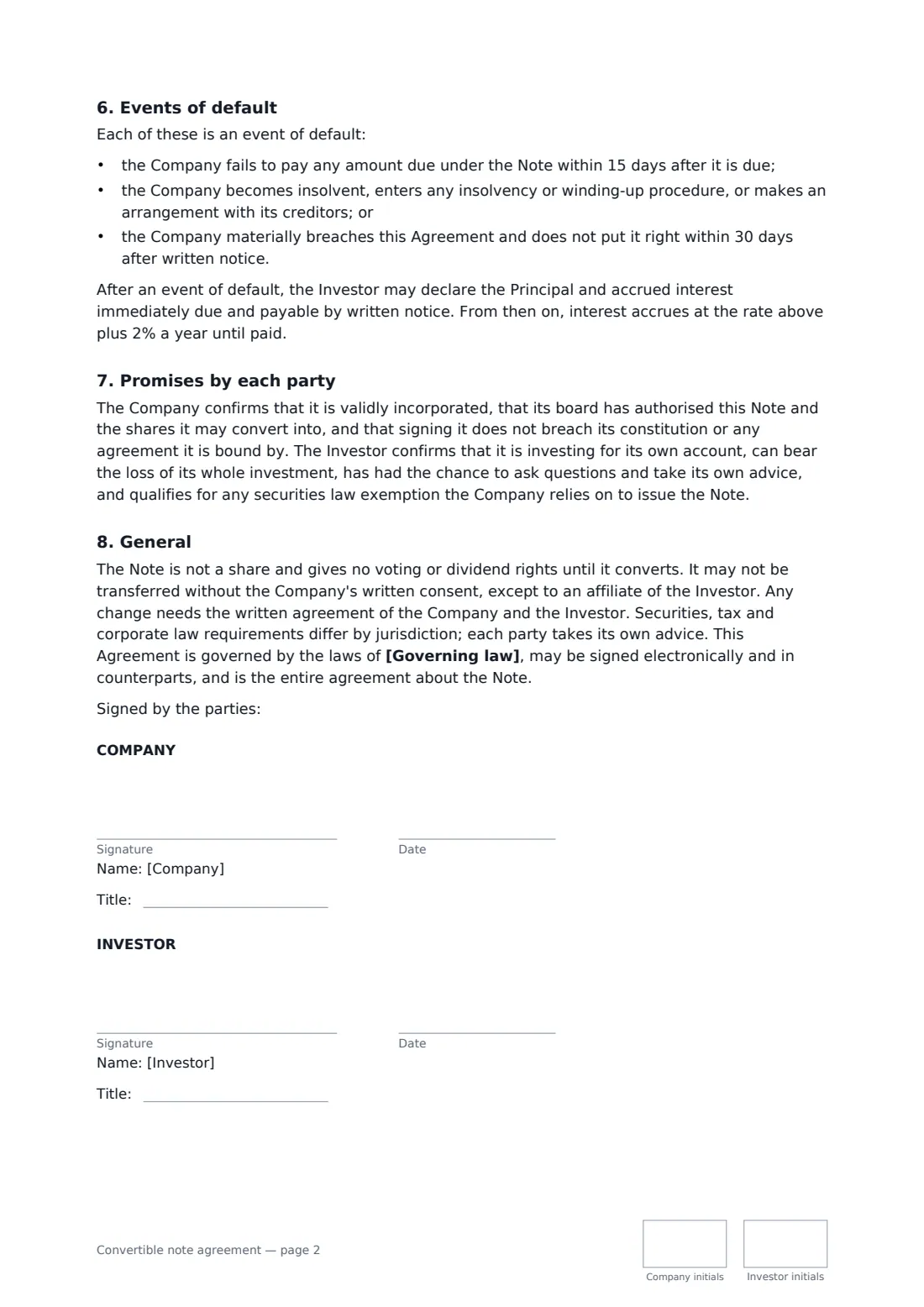
This template records the principal and funding date, simple interest that accrues rather than being paid in cash, the maturity date and what happens then, the size of round that triggers automatic conversion, the discount and optional valuation cap with the lower price applying, the investor's return if the company is sold first, events of default and acceleration, ranking against bank debt, and the basic confirmations each party gives. Securities and tax rules vary, so each side is told to take its own advice.
- Best for
- Startups raising angel, seed or bridge money before a priced round
- Signed by
- The company and the investor
- Key terms
- Interest rate, maturity, qualified financing threshold, discount, optional valuation cap
- Length
- About 3 pages, initialled on every page
When to use a convertible note agreement
- Taking a first cheque from an angel investor before a seed round
- Bridging the gap between two priced rounds
- Issuing the same note to several friends-and-family investors
- Raising from an investor who prefers debt to a SAFE
- Recording a note agreed on a call with an early backer
What you fill in
18 blanks, then the name and email of each person who signs: company, investor.
1 The parties
- Issue date*
- Company*
- Company incorporated in*
- Company address
- Investor*
- Investor address
2 The note
- Currency*
- Principal amount*
- Investor pays the principal by*
- Interest rate (% a year, simple)*
- Maturity date*
3 Conversion
- A qualified financing raises at least*
- Conversion discount (%)*
- Valuation cap
- At maturity, if no qualified financing has happened* the Investor may choose repayment or conversion at the valuation cap · the note is repaid with interest · the note converts into ordinary or common shares at the valuation cap
- On a sale of the company, the Investor receives* the greater of repayment of twice the principal and conversion at the valuation cap · repayment of the principal and interest, or conversion at the valuation cap, at the Investor's choice · repayment of the principal and interest
4 Other terms
- Ranks behind bank debt?* Yes · No
- Governing law*
5 Who signs
- Company signature and date, job title, initials on every page · A director or officer authorised by the board to issue the note.
- Investor signature and date, job title, initials on every page · If the investor is a fund or company, the person signing for it adds their title.
What the convertible note agreement covers
- The loan
- Interest
- Maturity
- Automatic conversion in a qualified financing
- Sale of the Company
- Events of default
- Promises by each party
- General
Using the convertible note agreement, step by step
1 Name the company and investor
Enter the company, where it is incorporated and the investor. A fund or company investor adds the signatory's title.
2 Set the loan terms
Enter the principal, funding date, interest rate and maturity date.
3 Set the conversion terms
Enter the minimum round size that triggers conversion, the discount and, if there is one, the valuation cap.
4 Choose maturity and sale outcomes
Pick what happens if the note reaches maturity without a round, and what the investor receives if the company is sold first.
5 Sign and file
Send it to the investor for signature. The signed note is filed in your vault with your other company records.
Tips before you send it
- Get your board to approve the note, and the shares it can convert into, before you sign.
- Model the conversion before agreeing the cap and discount. Several notes converting at once can dilute founders more than expected.
- Issuing notes is usually a securities offering. Check the exemption you rely on and any filings with a lawyer.
- Track the maturity date. Many notes are extended by agreement, but that needs to happen before they fall due.
Sign it online in minutes
- Fill in the blanks. Names, dates and amounts go straight into the agreement — the preview shows exactly where.
- Name who signs. Tick “This is me” for your own part. FileIt builds the PDF with every signature, date and initials box on the right line, and you can check or move anything before sending.
- Send it. Each signer gets a secure link and signs from any device — no account needed. The signed PDF, with an audit trail and a Certificate of Completion, is filed in your vault and emailed to everyone.
Convertible note agreement: frequently asked questions
What is the difference between a convertible note and a SAFE?
A convertible note is a loan: it carries interest, has a maturity date and can be repaid if it does not convert. A SAFE is not debt, has no interest or maturity, and converts only when an equity round or other event happens.
How do the discount and valuation cap work together?
When the note converts, the investor gets the lower of two prices: the new round's price less the discount, or the price implied by the valuation cap. Leave the cap empty for a discount-only note.
What happens if there is no round before maturity?
You choose: the investor picks repayment or conversion at the cap, the note is simply repaid, or it converts into ordinary shares at the cap.
Is this template enough for a US startup?
It is a plain-English starting point. US companies often use standard forms and must meet federal and state securities rules. Have a lawyer review it before issuing notes.
Can investors sign it online?
Yes. FileIt emails each investor a signing link and adds an audit trail and Certificate of Completion to the signed PDF.