What is a investment term sheet?
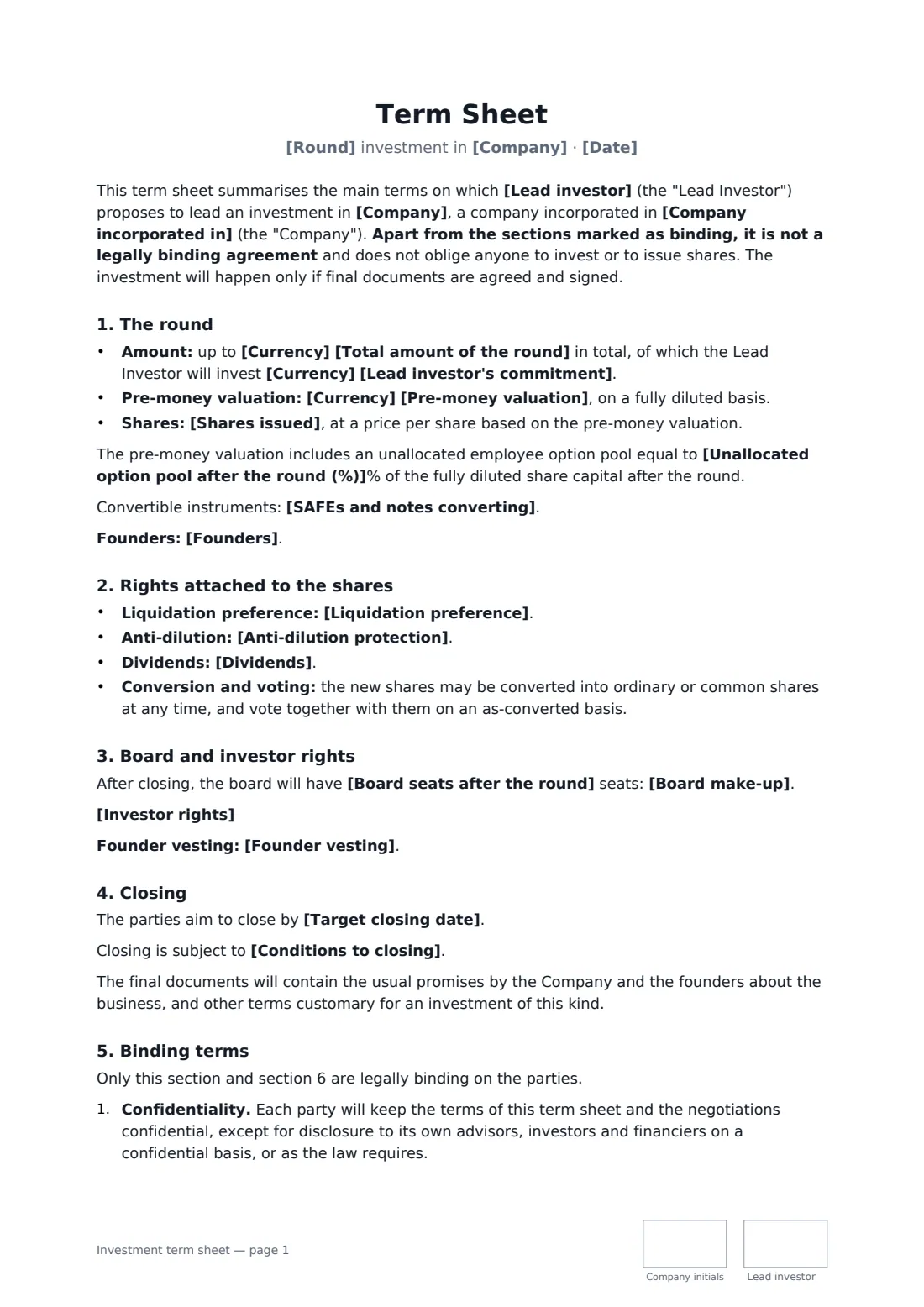
Before a priced equity round closes, the company and the lead investor usually sign a term sheet. It sets out the deal in plain terms: how much is being raised, at what valuation, what kind of shares the investors get and what rights come with them, and how the board will look afterwards. Lawyers then turn it into the subscription agreement, shareholders' agreement and new articles. Getting the term sheet right saves weeks of argument later.
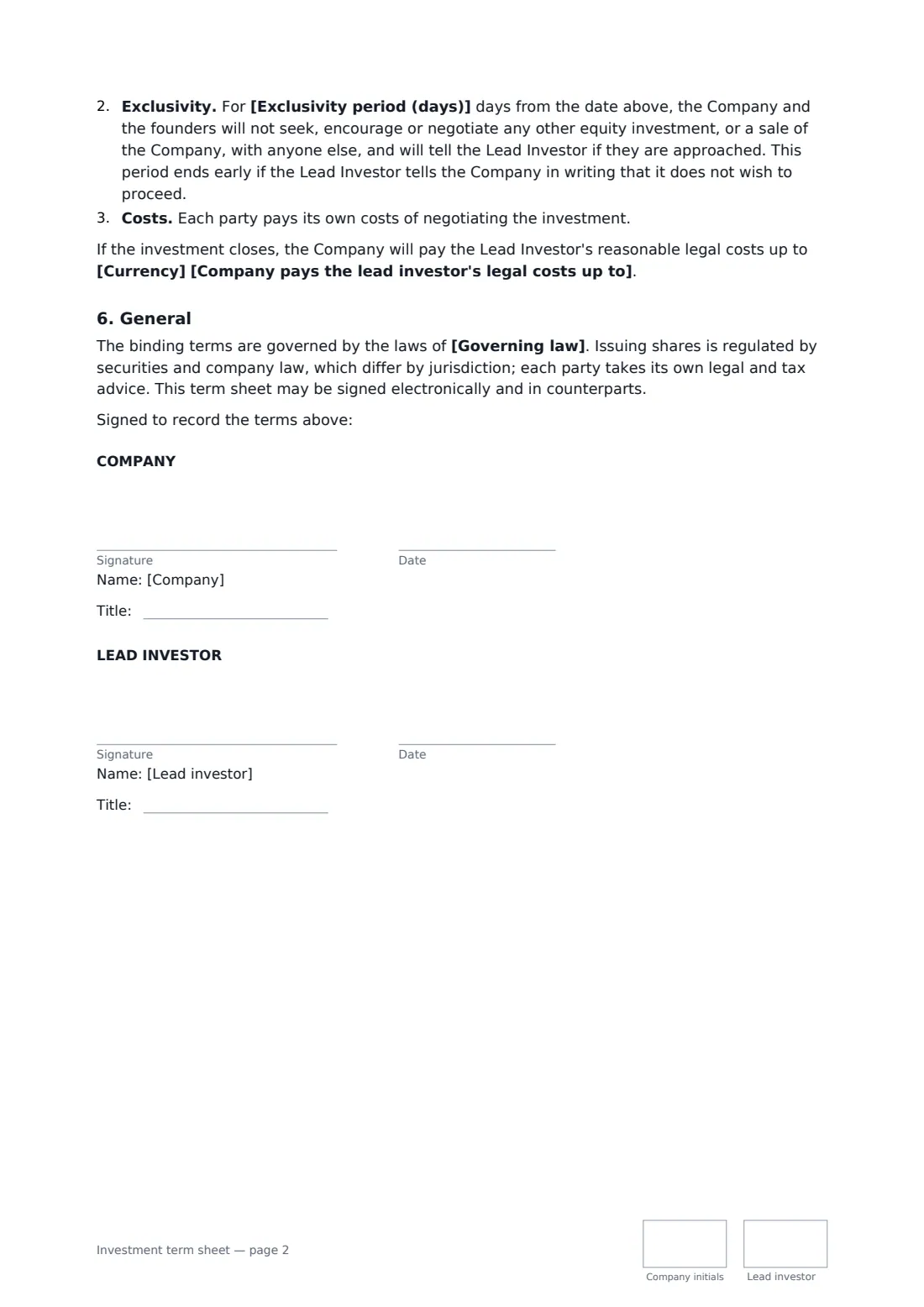
This template covers the round size and the lead's commitment, the pre-money valuation, the option pool and any SAFEs or notes converting; the share type with liquidation preference, anti-dilution, dividends and conversion; board seats and make-up, investor information, pro-rata and consent rights, and founder vesting; and the target closing date and conditions. It says clearly that the commercial terms are not binding, while confidentiality, a fixed exclusivity period and costs are.
- Best for
- Startups and investors agreeing a seed or Series A equity round
- Signed by
- The company and the lead investor
- Binding parts
- Confidentiality, exclusivity, costs and governing law only
- Length
- About 2 pages, initialled on every page
When to use a investment term sheet
- A lead investor and founders agree a seed round after the pitch meetings
- Recording a Series A offer before choosing between investors
- Giving other investors a clear summary of the terms they are joining
- Briefing lawyers on the deal before they draft the full documents
- Settling how converting SAFEs and the option pool affect the valuation
What you fill in
25 blanks, then the name and email of each person who signs: company, lead investor.
1 The parties
- Date*
- Company*
- Company incorporated in*
- Lead investor*
- Founders
2 The round
- Round*
- Currency*
- Total amount of the round*
- Lead investor's commitment*
- Pre-money valuation*
- Unallocated option pool after the round (%)
- SAFEs and notes converting
3 The shares
- Shares issued* preferred shares · ordinary or common shares
- Liquidation preference* 1x, non-participating · 1x, participating · none
- Anti-dilution protection* broad-based weighted average · none
- Dividends* non-cumulative, only if declared by the board · none
4 Governance
- Board seats after the round*
- Board make-up*
- Investor rights
- Founder vesting
5 Process
- Exclusivity period (days)*
- Company pays the lead investor's legal costs up to
- Target closing date
- Conditions to closing
- Governing law*
6 Who signs
- Company signature and date, job title, initials on every page · A director or officer authorised to sign for the company, usually the CEO.
- Lead investor signature and date, job title, initials on every page · The investor leading the round. A fund's signatory adds their title.
What the investment term sheet covers
- The round
- Rights attached to the shares
- Board and investor rights
- Closing
- Binding terms
- General
Using the investment term sheet, step by step
1 Name the parties and the round
Enter the company, where it is incorporated, the lead investor, the founders and the round name.
2 Set the economics
Enter the round size, the lead's commitment and the pre-money valuation, plus the option pool and any converting SAFEs or notes.
3 Choose the share rights
Pick the share type, liquidation preference, anti-dilution and dividends.
4 Agree governance
Enter the board size and who appoints each seat, then edit the investor rights and founder vesting to match the deal.
5 Set the process and sign
Choose the exclusivity period, any costs the company covers, the target close and conditions. Both sides sign, and the term sheet is filed in your vault.
Tips before you send it
- Check whether the option pool is in the pre-money valuation. It changes how much of the company the founders keep.
- Keep exclusivity short. 30 to 60 days is common, and it should end early if the investor walks away.
- A 1x non-participating preference is common in early rounds. Ask what anything stronger would mean for you before you sign.
- Share the signed term sheet with your lawyer straight away, so the long-form documents follow it.
Sign it online in minutes
- Fill in the blanks. Names, dates and amounts go straight into the agreement — the preview shows exactly where.
- Name who signs. Tick “This is me” for your own part. FileIt builds the PDF with every signature, date and initials box on the right line, and you can check or move anything before sending.
- Send it. Each signer gets a secure link and signs from any device — no account needed. The signed PDF, with an audit trail and a Certificate of Completion, is filed in your vault and emailed to everyone.
Investment term sheet: frequently asked questions
Is a term sheet legally binding?
Mostly not. This template says the commercial terms are not binding and nobody has to invest until final documents are signed. Only the confidentiality, exclusivity, costs and governing law terms are binding.
What does a liquidation preference do?
It decides who is paid first if the company is sold or wound up. With 1x non-participating, investors take either their money back or their share of the proceeds, whichever is more.
What is founder vesting?
Founders' shares are earned over time, often four years with a one-year cliff, so a founder who leaves early does not keep all of them. Leave the field empty if it does not apply.
Does the whole syndicate sign?
Usually just the company and the lead investor. Other investors join on the same terms in the final documents.
Can we sign the term sheet online?
Yes. Both sides sign in FileIt from an email link, with an audit trail and Certificate of Completion added to the signed PDF.