What is a simple agreement for future equity (SAFE)?
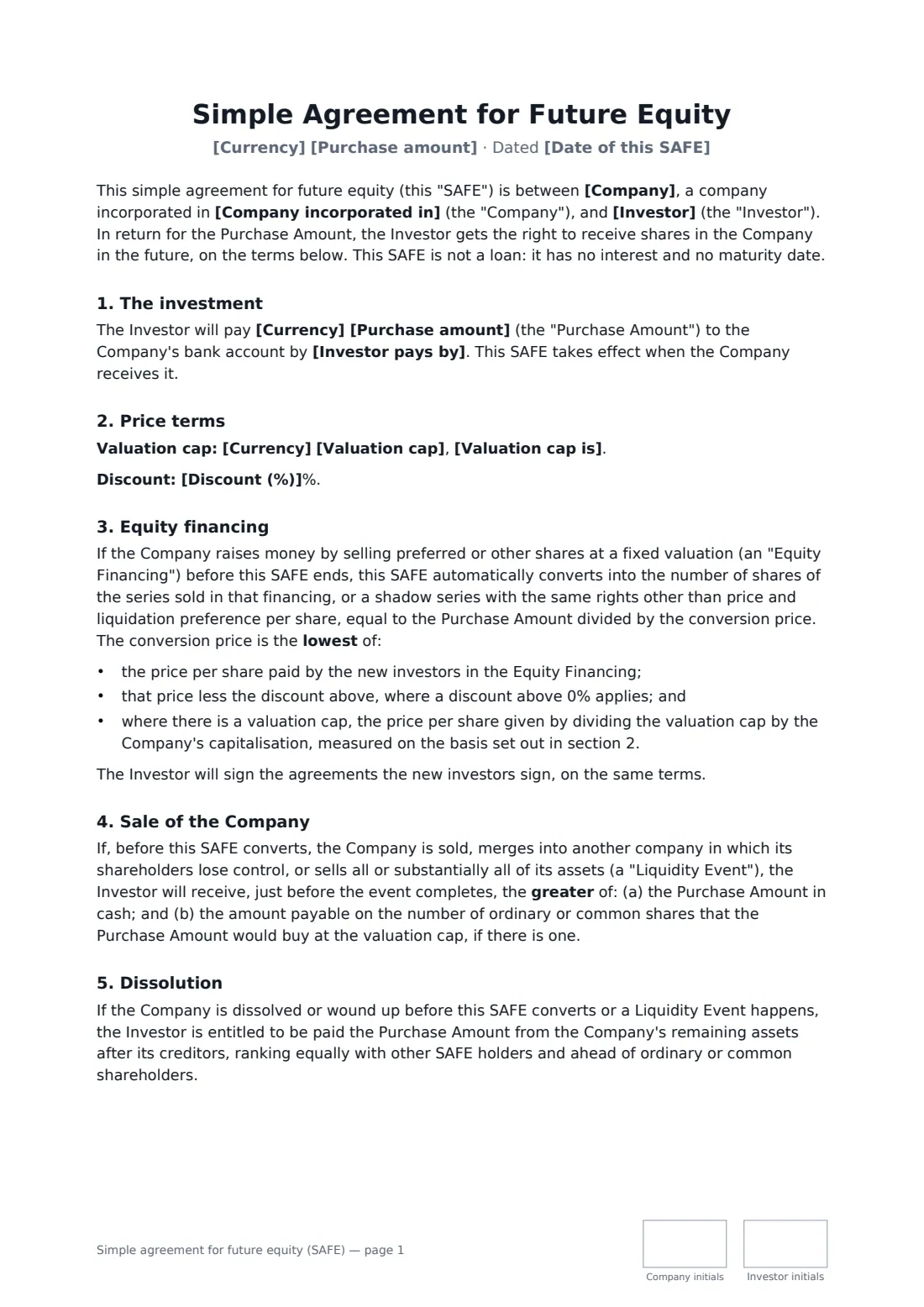
A SAFE is the shortest route to a first investment for many startups. The investor pays now; instead of shares, they get the right to shares later, usually when the company raises a priced equity round. Unlike a convertible note, a SAFE is not a loan. It has no interest, no maturity date and nothing to repay on a fixed day, which is why early-stage companies and angels often prefer it.
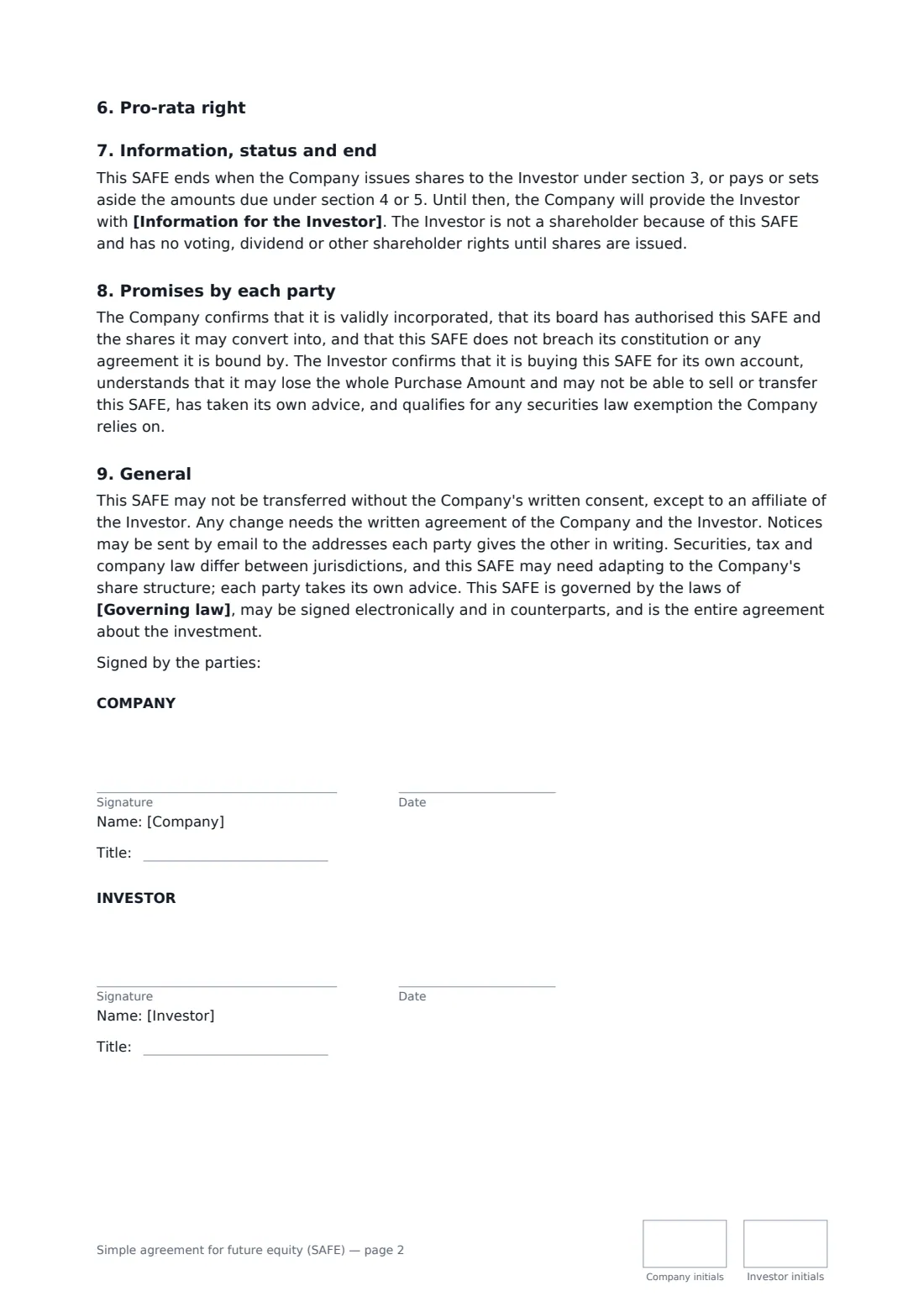
This template records the purchase amount and payment date, whether there is a valuation cap and whether it is post-money or pre-money, and any discount. It explains how the SAFE converts in an equity financing at the lowest of the round price, the discounted price and the cap price; what the investor receives if the company is sold first; their place in line if the company is wound up; an optional pro-rata right to invest in the converting round; information the investor will receive; and the confirmations each side gives. It flags that securities, tax and company law differ and that each party should take its own advice.
- Best for
- Pre-seed and seed startups raising from angels and early funds
- Signed by
- The company and the investor
- Price terms
- Post-money or pre-money cap, no cap, and an optional discount
- Length
- About 3 pages, initialled on every page
When to use a simple agreement for future equity (SAFE)
- Closing a first angel cheque quickly without valuing the company
- Running a rolling pre-seed raise from several investors on the same terms
- Taking investment from an accelerator or early fund
- Letting a supportive customer or advisor invest a small amount
- Topping up a round between priced financings
What you fill in
13 blanks, then the name and email of each person who signs: company, investor.
1 The parties
- Date of this SAFE*
- Company*
- Company incorporated in*
- Investor*
2 The investment
- Currency*
- Purchase amount*
- Investor pays by*
3 Price terms
- Valuation cap is* post-money (including all SAFEs and convertible notes) · pre-money (before the new money in the equity round) · not used — this SAFE has no valuation cap
- Valuation cap
- Discount (%)*
4 Other rights
- Pro-rata right in the next round?* Yes · No
- Information for the Investor* a short update at least every six months · annual financial statements · none beyond what the law requires
- Governing law*
5 Who signs
- Company signature and date, job title, initials on every page · A director or officer authorised by the board.
- Investor signature and date, job title, initials on every page · If the investor is a fund or company, the person signing for it adds their title.
What the simple agreement for future equity (SAFE) covers
- The investment
- Price terms
- Equity financing
- Sale of the Company
- Dissolution
- Pro-rata right
- Information, status and end
- Promises by each party
- General
Using the simple agreement for future equity (SAFE), step by step
1 Name the company and investor
Enter the company, where it is incorporated, and the investor.
2 Enter the investment
Add the purchase amount and the date the investor pays.
3 Set the price terms
Choose a post-money cap, a pre-money cap or no cap, enter the cap amount, and add a discount if you are giving one.
4 Choose the extra rights
Decide whether the investor gets a pro-rata right in the converting round and how often you will send updates.
5 Sign and file
Send it to the investor to sign. Every signed SAFE is filed in your vault, so your list of outstanding SAFEs is easy to check before the next round.
Tips before you send it
- Keep a running total of every SAFE and note you have issued. They all convert together and can dilute founders more than expected.
- Use the same terms for every investor in the same raise, unless there is a clear reason not to.
- Many investors expect a widely used standard SAFE form. If yours differs, explain why up front.
- Selling SAFEs is a securities offering in most countries. Check the exemption you rely on, and any filings, with a lawyer.
Sign it online in minutes
- Fill in the blanks. Names, dates and amounts go straight into the agreement — the preview shows exactly where.
- Name who signs. Tick “This is me” for your own part. FileIt builds the PDF with every signature, date and initials box on the right line, and you can check or move anything before sending.
- Send it. Each signer gets a secure link and signs from any device — no account needed. The signed PDF, with an audit trail and a Certificate of Completion, is filed in your vault and emailed to everyone.
Simple agreement for future equity (SAFE): frequently asked questions
Is a SAFE a loan?
No. A SAFE carries no interest and has no maturity date. The investor gets shares when an equity financing happens, a payout on a sale of the company, or a return of their money ahead of shareholders if the company is wound up.
What is the difference between a post-money and a pre-money cap?
A post-money cap includes the SAFEs and notes themselves in the company's valuation, so each SAFE holder can work out their ownership in advance. A pre-money cap measures the company before the new round's money and is less predictable.
Do I need both a cap and a discount?
No. Many SAFEs have only a cap. Some have only a discount or both. When the SAFE converts, the investor gets the lowest price that applies.
Is this the same as the Y Combinator SAFE?
No. It is a plain-English starting point inspired by common SAFE terms, not a copy of any published standard form. Have a lawyer check it against what your investors expect.
Can investors sign online?
Yes. Each investor gets a signing link by email. FileIt keeps an audit trail and a Certificate of Completion with every signed SAFE.