What is a co-branding agreement?
Brand collaborations look simple from the outside: two logos, one product. Behind them sit real questions. Who makes and sells it, and who answers to customers? Can either brand veto a design? Who pays for samples and photography? Is there a royalty, a profit split, or does each keep what it earns? And when the collaboration ends, what happens to the stock still in the warehouse?
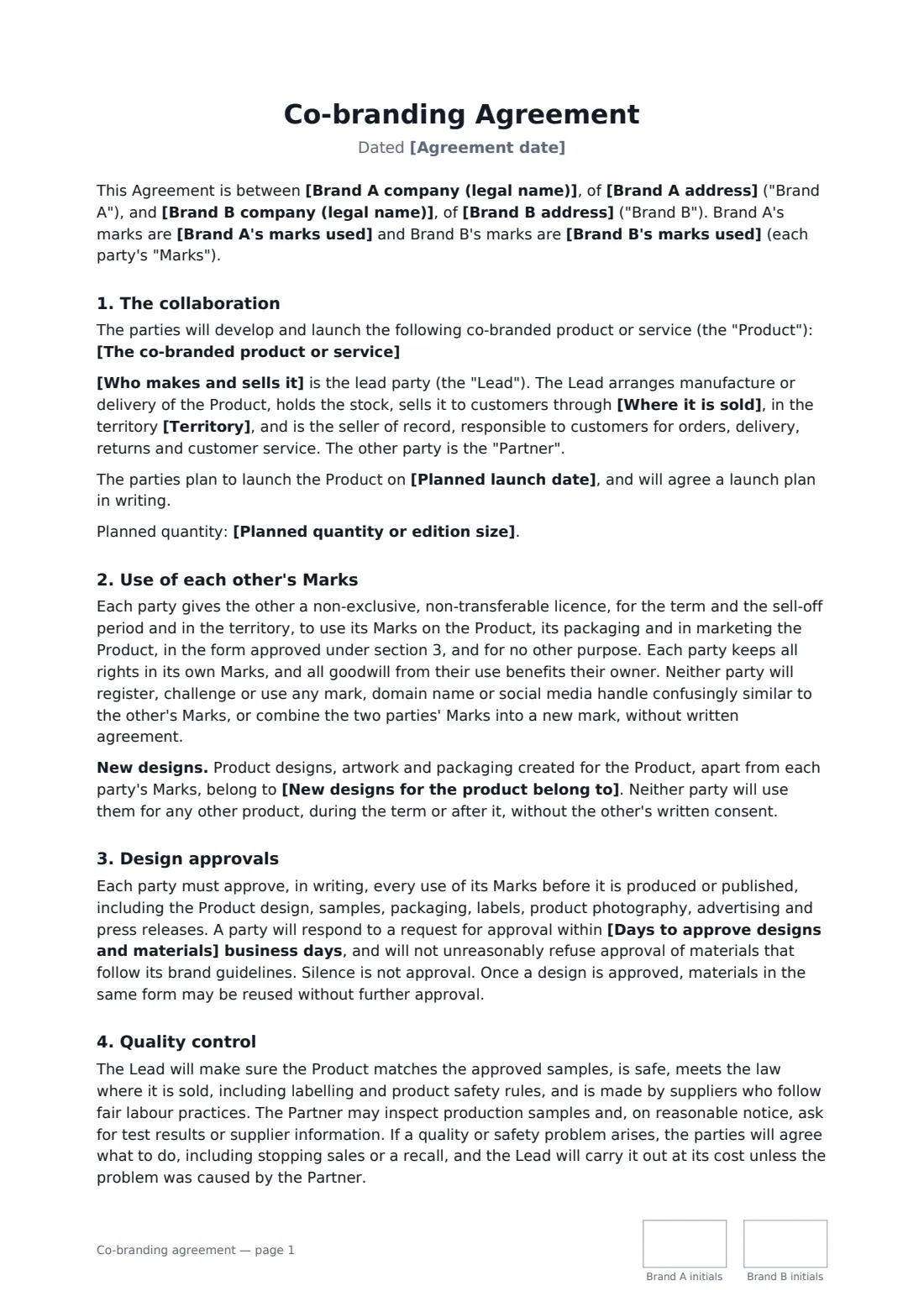
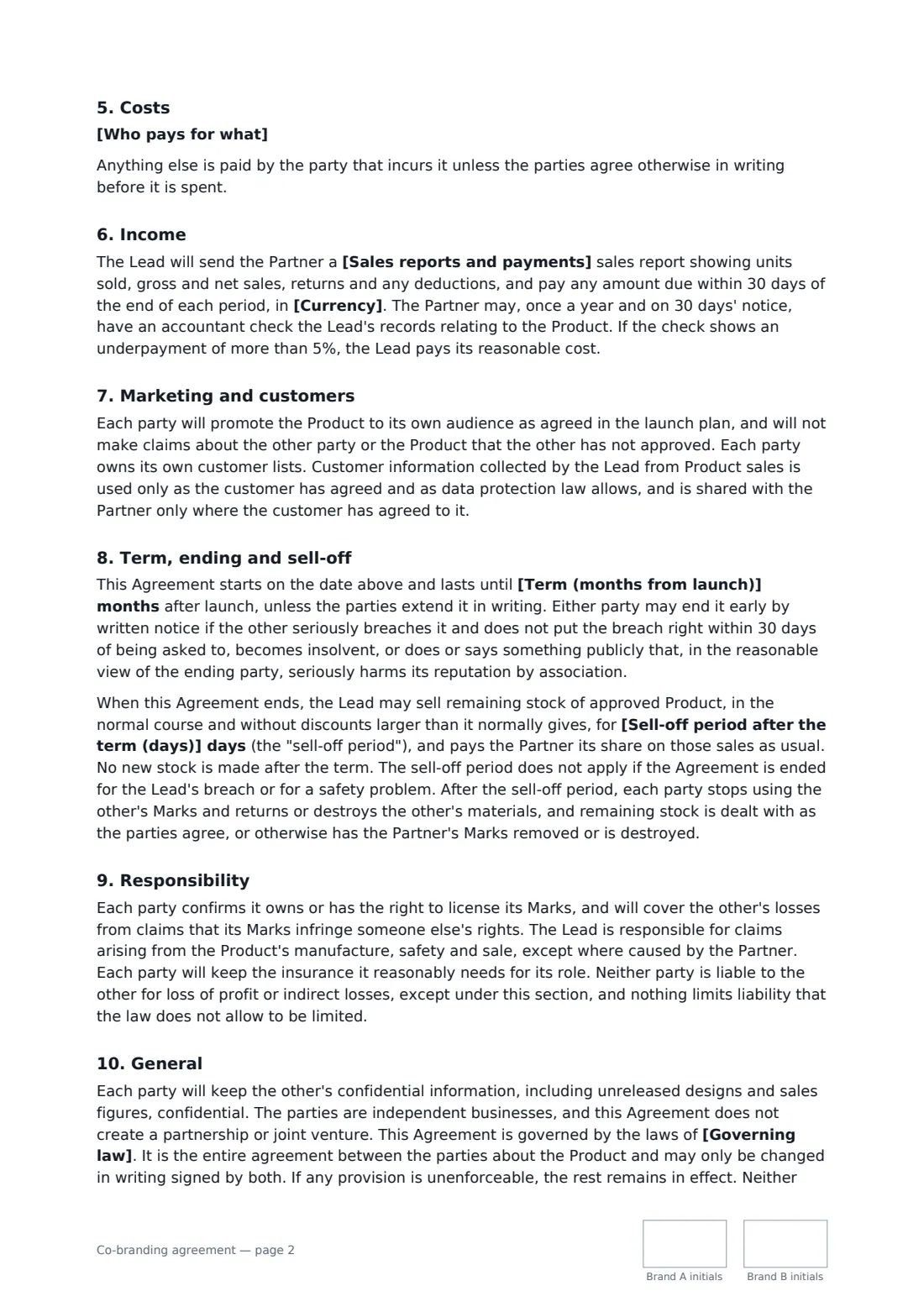
This template names both brands and the marks each brings, describes the product, and makes one brand the lead that manufactures, holds stock and sells it, in the channels and territory you choose. It grants mutual, limited licences to each other's marks with no new combined mark, says who owns new designs made for the product, sets written design approvals with a response time, quality control, safety and recalls, and records who pays for what. Choose a royalty on net sales, a profit split or no payments, with sales reports, payment terms and an audit right. It covers marketing and customer data, optional exclusivity, term and early ending, a sell-off period, responsibility and confidentiality.
- Best for
- Brand collaborations, limited editions and co-branded products or services
- Signed by
- Authorised people at both brands
- Money options
- Royalty on net sales, profit split, or each keeps its own income
- Length
- 3 pages, initialled by both on every page
When to use a co-branding agreement
- An outdoor brand and a coffee roaster launching a limited-edition bottle and bean bundle
- A fashion label and an artist estate making a capsule collection
- A bakery and a brewery selling a co-branded beer
- Two software companies offering a co-branded service bundle
- A charity partnering with a retailer on a product that carries both names
What you fill in
25 blanks, then the name and email of each person who signs: brand a, brand b.
1 The brands
- Agreement date*
- Brand A company (legal name)*
- Brand A address
- Brand A's marks used*
- Brand B company (legal name)*
- Brand B address
- Brand B's marks used*
2 The collaboration
- The co-branded product or service*
- Who makes and sells it* Brand A · Brand B
- Where it is sold*
- Territory*
- Planned launch date
- Planned quantity or edition size
3 Money
- Who pays for what*
- How income is shared* The lead party pays the other a royalty on net sales. · The parties split the net profit. · Each party keeps its own income; no payments between them.
- Royalty rate (of net sales)
- Profit split
- Currency*
- Sales reports and payments* monthly · quarterly
4 Approvals
- New designs for the product belong to* the Lead · the party that created them · both parties jointly
- Days to approve designs and materials*
- Exclusivity* None · Neither party will launch a similar co-branded product with a competitor of the other during the term.
5 Term
- Term (months from launch)*
- Sell-off period after the term (days)*
- Governing law*
6 Who signs
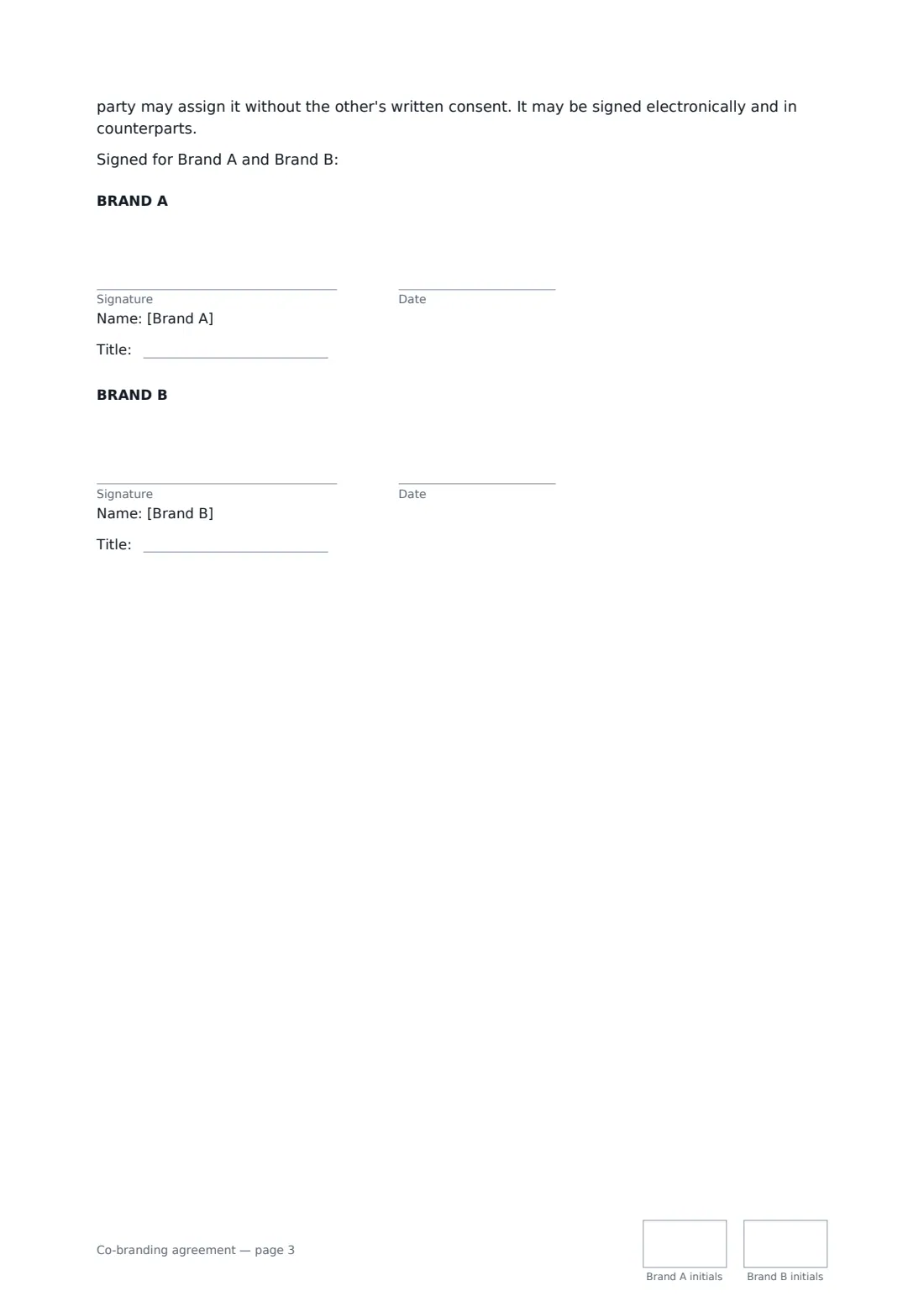
- Brand A signature and date, job title, initials on every page · A person authorised to sign for the first brand.
- Brand B signature and date, job title, initials on every page · A person authorised to sign for the second brand.
What the co-branding agreement covers
- The collaboration
- Use of each other's Marks
- Design approvals
- Quality control
- Costs
- Income
- Marketing and customers
- Term, ending and sell-off
- Responsibility
- General
Using the co-branding agreement, step by step
1 Name the brands and marks
Enter both companies and the marks each lets the other use, such as a word mark and logo.
2 Describe the collaboration
Describe the product, choose the lead brand, and enter the channels, territory, launch date and edition size.
3 Agree the money
Record who pays for what, then choose a royalty, a profit split or no payments, and set reporting.
4 Set approvals and term, then send
Set the approval turnaround, who owns new designs, exclusivity, term and sell-off period, and send it to the other brand.
Tips before you send it
- Agree a launch plan and a sample approval before ordering stock — reprinting packaging is expensive.
- Keep each brand's marks separate; a new combined logo raises ownership questions that are hard to unwind.
- Put the costs list in detail: samples, photography, launch events and returns are where surprises hide.
- Check labelling and product safety rules for every country you'll ship to.
Sign it online in minutes
- Fill in the blanks. Names, dates and amounts go straight into the agreement — the preview shows exactly where.
- Name who signs. Tick “This is me” for your own part. FileIt builds the PDF with every signature, date and initials box on the right line, and you can check or move anything before sending.
- Send it. Each signer gets a secure link and signs from any device — no account needed. The signed PDF, with an audit trail and a Certificate of Completion, is filed in your vault and emailed to everyone.
Co-branding agreement: frequently asked questions
Who owns the co-branded product's design?
Each brand keeps its own marks and the goodwill from them, and neither may register a confusingly similar mark or combine the two into a new mark without agreement. New product designs, artwork and packaging made for the collaboration belong to the lead brand, the brand that created them, or both jointly, as you choose, and neither brand may use them on another product without the other's consent.
What happens to leftover stock?
The lead brand may sell remaining approved stock for the sell-off period you set, without heavy discounting, paying the partner's share as usual. After that, stock is dealt with as agreed, or the partner's marks are removed or it is destroyed.
Can one brand pull out if the other causes a scandal?
Yes. Either brand may end the agreement if the other does or says something publicly that, in its reasonable view, seriously harms its reputation by association, as well as for uncured breach or insolvency.
Can it be signed electronically?
In most countries, including the US (ESIGN Act and UETA), the UK, the EU (eIDAS) and Canada, an electronic signature is generally valid for an agreement like this one. FileIt keeps an audit trail and a Certificate of Completion with the signed PDF as evidence of who signed and when.
Is this template free?
Yes. The template is free to use with the eSignature app in FileIt, and the people you send it to don't need a FileIt account to sign.