What is a certificate of authenticity?
A certificate of authenticity travels with a work for the rest of its life. Collectors, galleries and future buyers look to it for the basic facts: who made the work, what it is, when, how big, which number in which edition, and where it has been. A clear, signed certificate makes a work easier to insure, resell and research.
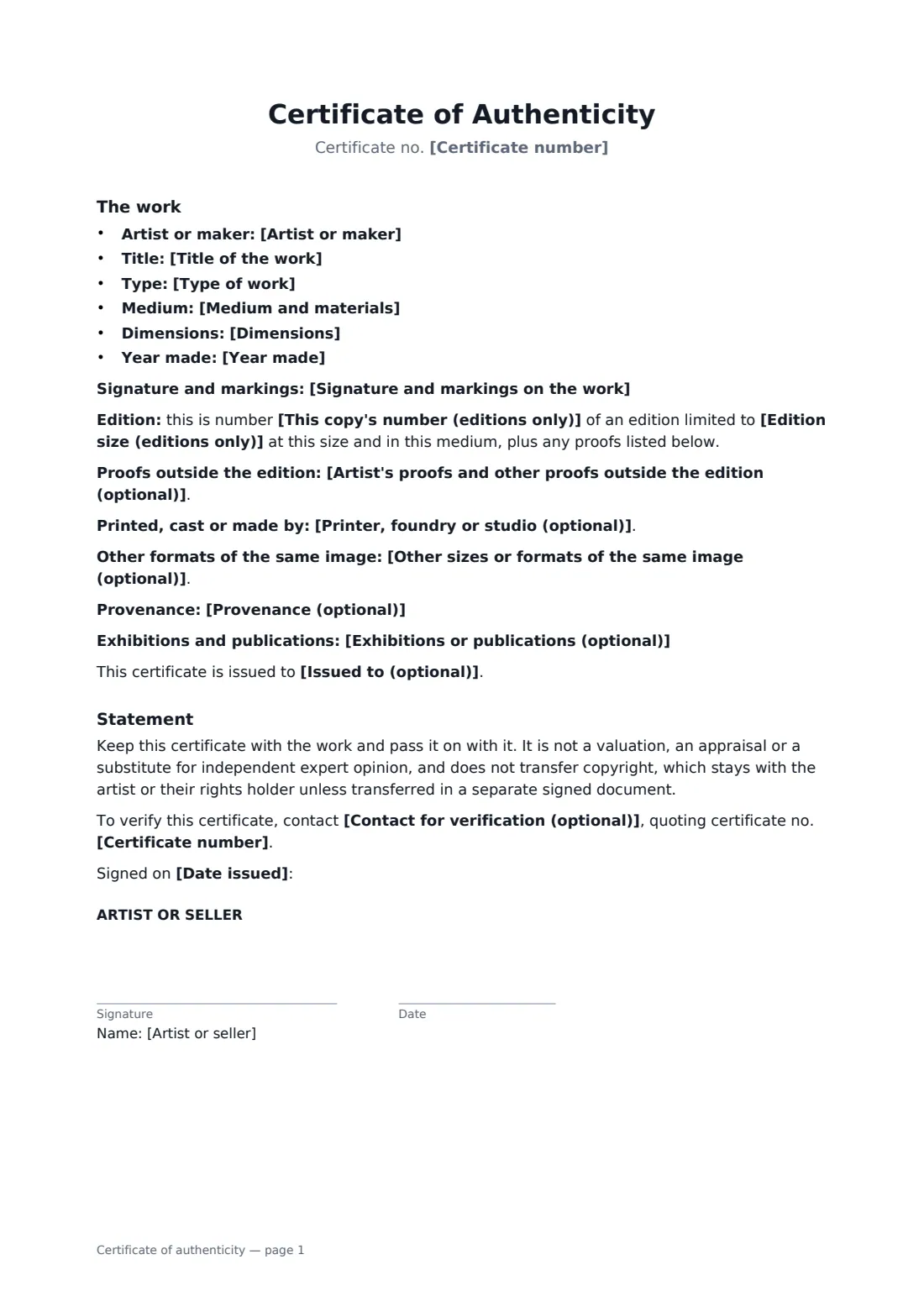
This template issues a numbered certificate from the artist, a seller or gallery, or the artist's estate, with a statement worded to fit each — the artist certifies the work as their own, while a seller or estate certifies to the best of its knowledge and records. It records the artist, title, type of work, medium, dimensions, year and markings, and for editions the copy number, edition size, proofs outside the edition, printer or foundry, and any other formats of the same image, with the edition limited to its stated size and proofs and, where the artist issues it, a promise not to extend it. It adds optional provenance, exhibitions, the owner's name and a verification contact, and states that the certificate is not a valuation and does not transfer copyright.
- Best for
- Artists, printmakers, photographers, galleries, dealers and artists' estates
- Signed by
- The artist, or the seller, gallery or estate issuing it
- Covers
- Unique originals, limited and open edition prints, casts, multiples and collectibles
- Length
- 1 page, with a numbered certificate and a single signature
When to use a certificate of authenticity
- A painter issuing a certificate with each original sold
- A photographer certifying number 7 of a limited edition of 25
- A gallery issuing certificates for works on consignment
- A sculptor certifying a bronze cast with the foundry named
- An artist's estate certifying works from the studio archive
What you fill in
20 blanks, then the name and email of each person who signs: artist or seller.
1 The certificate
- Certificate number*
- Date issued*
- Issued by* the artist · the seller, gallery or dealer · the artist's estate or authorised representative
- Name of the person or business issuing it*
- Contact for verification (optional)
2 The work
- Artist or maker*
- Title of the work*
- Type of work* an original, unique work · a limited edition print · a limited edition cast or multiple · an open edition print · a collectible or object
- Medium and materials*
- Dimensions*
- Year made*
- Signature and markings on the work
3 Edition
- This copy's number (editions only)
- Edition size (editions only)
- Artist's proofs and other proofs outside the edition (optional)
- Printer, foundry or studio (optional)
- Other sizes or formats of the same image (optional)
4 History
- Provenance (optional)
- Exhibitions or publications (optional)
- Issued to (optional)
5 Who signs
- Artist or seller signature and date · The artist who made the work, or the seller, gallery or estate issuing the certificate.
What the certificate of authenticity covers
- The work
- Statement
Using the certificate of authenticity, step by step
1 Number the certificate
Give it a unique certificate number, choose who is issuing it and enter your name or business. Add a contact for verification if you want buyers to be able to check it.
2 Describe the work
Enter the artist, title, type, medium, dimensions, year and where it is signed or marked.
3 Add edition details
For prints and casts, enter this copy's number, the edition size, proofs outside the edition, the printer or foundry and any other formats of the image.
4 Add history and sign
Add provenance, exhibitions and the owner's name if you want them, then sign it. FileIt files the signed PDF so you can keep a copy of every certificate you issue.
Tips before you send it
- Keep a register of certificate numbers and the works they belong to. It is how you, or a buyer, can verify a certificate later.
- State every other edition or format of the same image. Collectors expect to know how many copies exist.
- Attach or keep a photo of the work with your copy of the certificate.
- A certificate is not an appraisal. If the buyer needs a value for insurance, refer them to an appraiser.
Sign it online in minutes
- Fill in the blanks. Names, dates and amounts go straight into the agreement — the preview shows exactly where.
- Name who signs. Tick “This is me” for your own part. FileIt builds the PDF with every signature, date box on the right line, and you can check or move anything before sending.
- Send it. Each signer gets a secure link and signs from any device — no account needed. The signed PDF, with an audit trail and a Certificate of Completion, is filed in your vault and emailed to everyone.
Certificate of authenticity: frequently asked questions
Who should sign a certificate of authenticity?
Ideally the artist. A seller, gallery or the artist's estate can also issue one; the statement then certifies authenticity to the best of its knowledge and records rather than as the maker.
Does the certificate transfer copyright to the buyer?
No. It states that copyright stays with the artist or rights holder unless transferred in a separate signed document.
What if the print is an open edition?
Choose open edition and leave the edition size empty. The edition line is then left out, and the artist's promise not to extend an edition does not apply.
Does a certificate prove the work is genuine?
It is a signed statement by the person issuing it. It is valuable evidence, especially from the artist, but it does not replace independent expert opinion where that is needed.
Can I sign it electronically?
Yes. FileIt adds a single signature and date box and keeps an audit trail with the signed PDF, which you can print and keep with the work.