What is a case report publication consent?
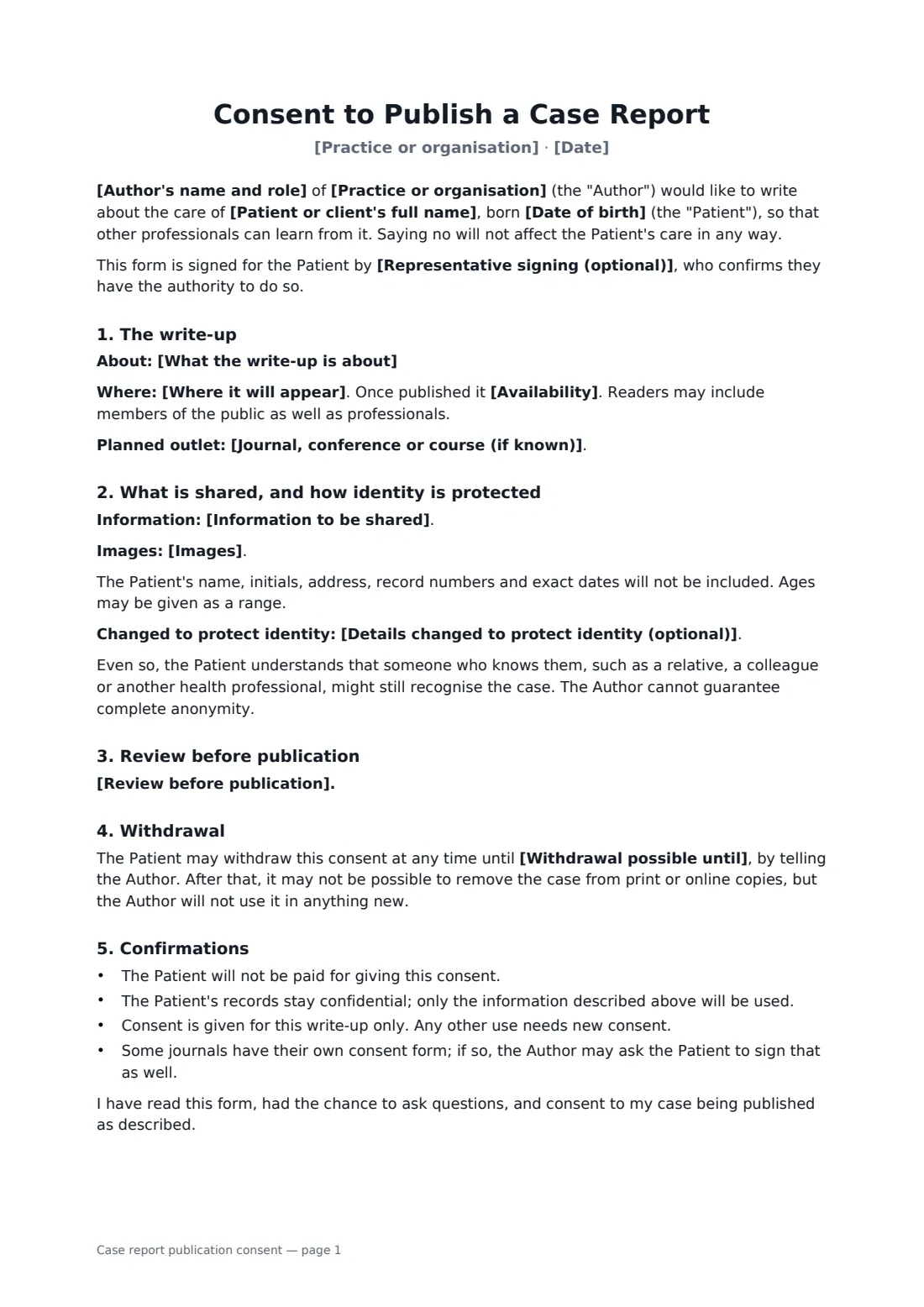
Case reports and teaching cases help professionals learn from unusual conditions and treatments. Most journals expect written patient consent, and good practice in conferences and teaching is the same. Patients need to know what will be shared, where, and that someone who knows them might still recognise the case.
This form names the author and practice, what the write-up is about, where it will appear and whether it may be freely available online. You list the information shared and choose the images: none, de-identified scans, photographs without the face, or photographs that may identify the patient, which gets its own confirmation. Names, initials, record numbers and exact dates are left out, and you can note other details changed. The patient chooses whether to see the draft first, and can withdraw until a point you set. The form makes clear the patient isn't paid, that consent covers this write-up only, and that a journal may have its own form too.
- Best for
- Doctors, dentists, therapists, psychologists and other clinicians writing up cases
- Signed by
- The patient or client (or representative) and the author
- You set
- Outlet, topic, information and images shared, details changed, review, withdrawal point
- Length
- About 2 pages
When to use a case report publication consent
- A journal case report on an unusual presentation
- A case presentation at a conference or grand rounds
- Teaching material for students or trainees
- A therapy or psychology case study
- Clinical images in a published article
What you fill in
16 blanks, then the name and email of each person who signs: patient or client, author.
1 The publication
- Author's name and role*
- Practice or organisation*
- Where it will appear* a journal article · a conference talk or poster · teaching material for students and professionals · a journal article, talks and teaching material
- Journal, conference or course (if known)
- What the write-up is about*
- Availability* may be freely available online to anyone · will be available only to subscribers, attendees or course participants
2 The patient
- Patient or client's full name*
- Date of birth*
- Representative signing (optional)
3 What is shared
- Information to be shared*
- Images* no images · scans, X-rays or test images with identifying details removed · clinical photographs that do not show the Patient's face or identifying marks · clinical photographs that may identify the Patient
- Details changed to protect identity (optional)
4 Review and withdrawal
- Review before publication* I want to see the draft before it is submitted · I do not need to see the draft
- Patient's email or phone for the draft
- Withdrawal possible until*
- Date*
5 Who signs
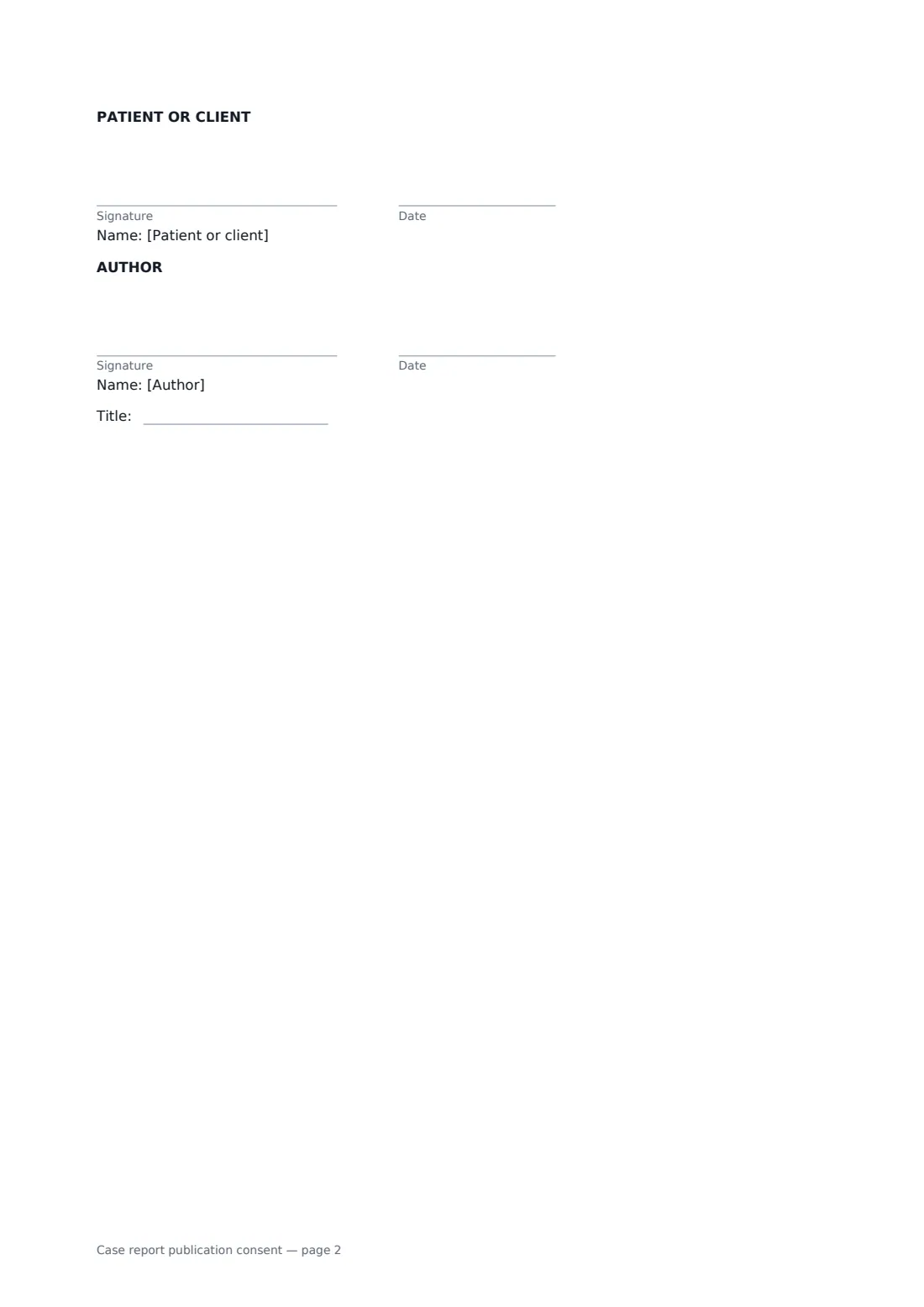
- Patient or client signature and date · The patient or client, or a parent, guardian or legal representative signing for them.
- Author signature and date, job title · The clinician or practitioner writing up the case.
What the case report publication consent covers
- The write-up
- What is shared, and how identity is protected
- Review before publication
- Withdrawal
- Confirmations
Using the case report publication consent, step by step
1 Describe the write-up
Enter the topic, choose where it will appear and whether it may be freely available online, and name the planned journal or conference if known.
2 What is shared
List the information included, choose the images, and note any details changed to protect identity.
3 Review and withdrawal
The patient chooses whether to see the draft; add their contact. Set when withdrawal is no longer possible.
4 Sign
The patient signs, you countersign, and the signed consent is kept for the journal or conference to see if they ask.
Tips before you send it
- Check your target journal's consent requirements before you start; some insist on their own form.
- De-identification isn't anonymity. Tell the patient honestly that people who know them might recognise the case.
- Show patients any photographs you plan to use, especially if they could be identified.
- Get separate consent for any new use, such as a later book chapter.
- Ethics or governance approval may also be needed in some settings. Check your institution's rules.
Sign it online in minutes
- Fill in the blanks. Names, dates and amounts go straight into the agreement — the preview shows exactly where.
- Name who signs. Tick “This is me” for your own part. FileIt builds the PDF with every signature, date box on the right line, and you can check or move anything before sending.
- Send it. Each signer gets a secure link and signs from any device — no account needed. The signed PDF, with an audit trail and a Certificate of Completion, is filed in your vault and emailed to everyone.
Case report publication consent: frequently asked questions
Do journals require patient consent for case reports?
Many do, especially where any detail or image could identify the patient. Some ask authors to use their own form as well; this form says the author may ask the patient to sign that too.
Will the patient be anonymous?
Names, initials, record numbers and exact dates are removed, and you can change other details. But the form is honest that someone who knows the patient might still recognise the case.
Can the patient see the article first?
Yes, if they choose that option. The author sends the draft and gives reasonable time to comment, and won't make later edits that would identify the patient more.
Can consent be withdrawn?
Yes, until the point you set, such as acceptance for publication. After that, removal from published copies may not be possible, but the case won't be used in anything new.
Can a parent sign for a child?
Yes. Enter the representative's name; they confirm they have authority to consent for the patient.