What is a boat bill of sale?
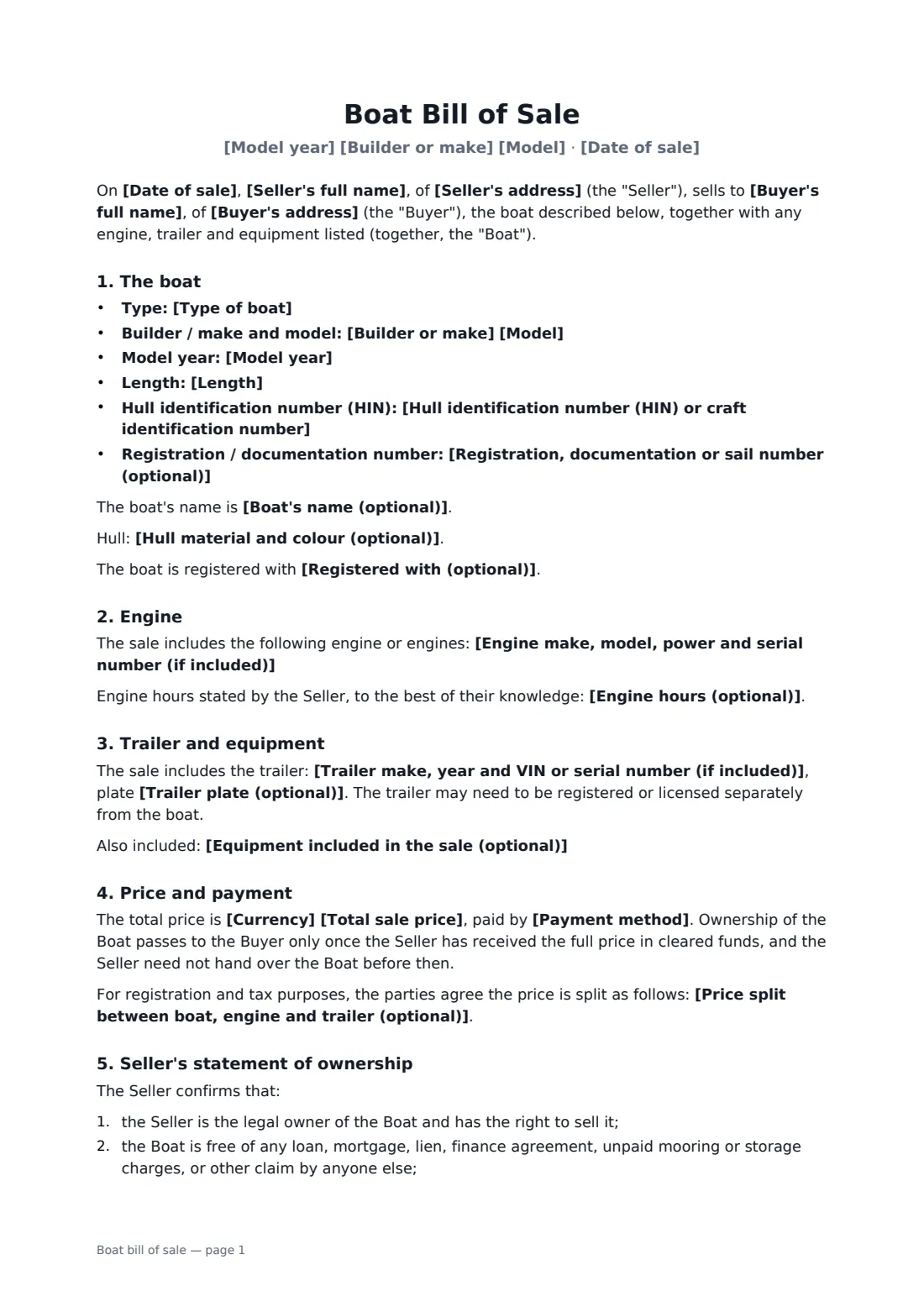
A boat bill of sale is the written record of a private boat sale. The buyer needs it to register the boat and show they own it. The seller needs it to show the date they stopped being responsible for mooring fees, insurance and anything that happens on the water. With a boat, the sale often includes an outboard or inboard engine and a trailer, each with its own serial number and sometimes its own registration, so it helps to list them all.
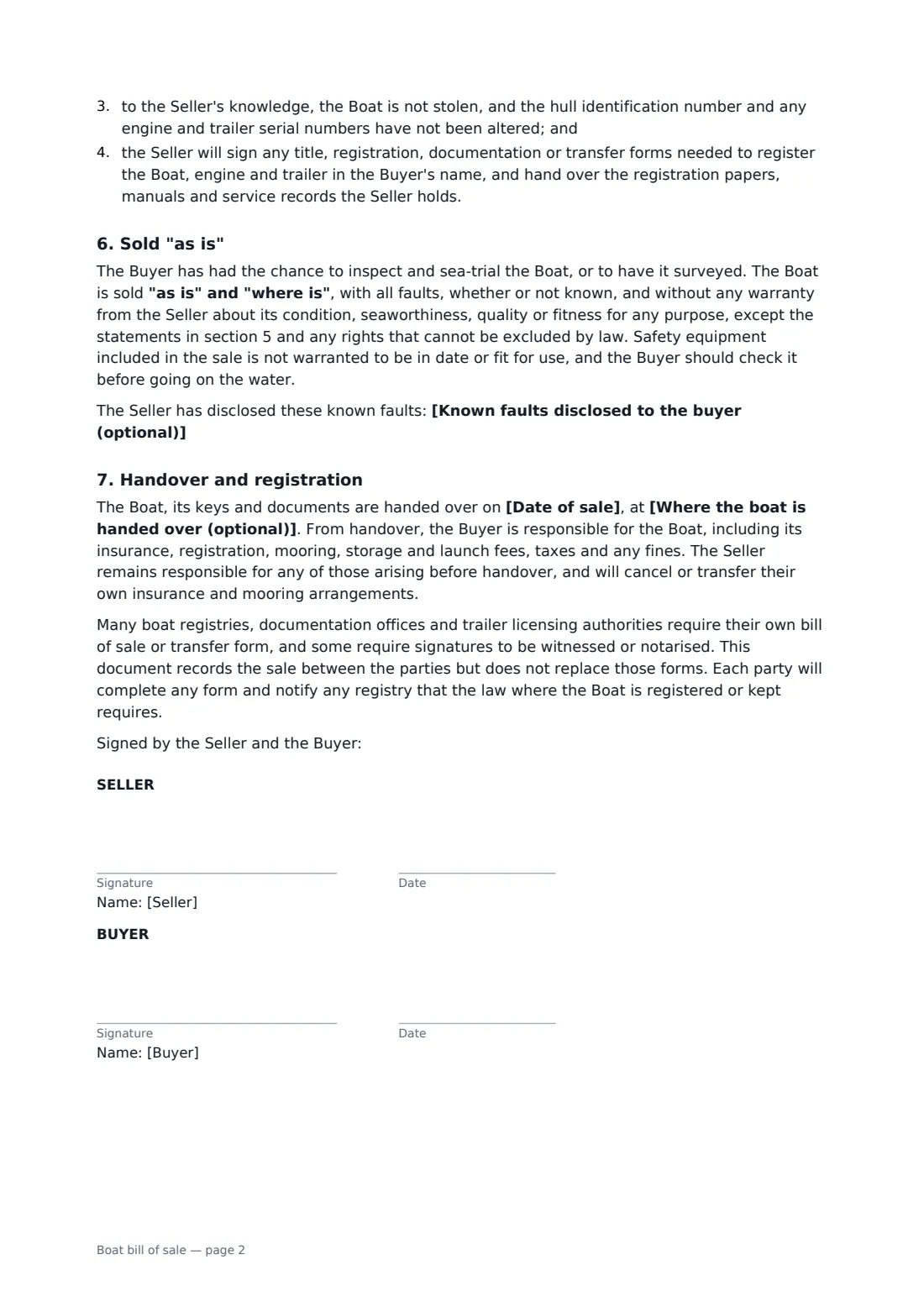
This template records the type of boat, its name, builder, model, year, length and hull, the hull identification number (HIN) and any registration or documentation number. You list any engine with its make, power, serial number and hours, and any trailer with its VIN and plate. It covers equipment included, the total price and payment method, an optional split of the price between boat, engine and trailer, and the seller's confirmation of ownership with no loans or unpaid mooring charges. The boat is sold as is, with known faults listed. It also covers handover, who pays what from then on, and a reminder that registries may need their own form.
- Best for
- Private sales of motorboats, sailboats, fishing boats and personal watercraft
- Signed by
- Seller and buyer
- Includes
- Optional engine and trailer sections, price split, known faults
- Length
- About 2 pages
When to use a boat bill of sale
- Selling a used motorboat with its outboard and trailer
- Buying a sailboat from a private seller at a marina
- Selling a jet ski or other personal watercraft
- Selling a small fishing boat to a friend or relative
- Recording the price split for a registry or tax office
What you fill in
26 blanks, then the name and email of each person who signs: seller, buyer.
1 The seller
- Seller's full name*
- Seller's address
2 The buyer
- Buyer's full name*
- Buyer's address
3 The boat
- Type of boat*
- Boat's name (optional)
- Builder or make*
- Model*
- Model year*
- Length
- Hull material and colour (optional)
- Hull identification number (HIN) or craft identification number*
- Registration, documentation or sail number (optional)
- Registered with (optional)
4 Engine
- Engine make, model, power and serial number (if included)
- Engine hours (optional)
5 Trailer
- Trailer make, year and VIN or serial number (if included)
- Trailer plate (optional)
6 The sale
- Date of sale*
- Currency*
- Total sale price*
- Price split between boat, engine and trailer (optional)
- Payment method* bank transfer · cash · cashier's cheque or bank draft · personal cheque · other agreed method
- Equipment included in the sale (optional)
- Known faults disclosed to the buyer (optional)
- Where the boat is handed over (optional)
7 Who signs
- Seller signature and date
- Buyer signature and date
What the boat bill of sale covers
- The boat
- Engine
- Trailer and equipment
- Price and payment
- Seller's statement of ownership
- Sold "as is"
- Handover and registration
Using the boat bill of sale, step by step
1 Identify the boat
Enter the type, builder, model, year and length. Copy the hull identification number from the transom, check it matches the registration papers, and add any registration or documentation number.
2 Add the engine and trailer
List each engine's make, power and serial number, and the trailer's VIN and plate. Leave either empty and the bill of sale says clearly that no engine or no trailer is included.
3 Set the price and disclose faults
Enter the total price and how it's paid, plus a split between boat, engine and trailer if your registry or tax office asks for one. List included equipment and any known faults.
4 Sign and register
Send it to the buyer. You both sign online, and the signed bill of sale is filed in your FileIt vault. Then complete any registry or licensing forms where the boat is kept.
Tips before you send it
- Check the HIN on the boat against the papers, and check the boat isn't under finance or owed mooring fees before paying.
- Do a sea trial or get a marine survey for anything but a small boat. The sale is as is.
- Don't hand over keys or papers until payment has cleared. The bill of sale says ownership passes only on full payment.
- Registries, documentation offices and trailer authorities often have their own forms, and some need a witness or notary. This bill of sale doesn't replace them.
- Cancel or transfer your insurance and mooring contract once the boat is handed over.
Sign it online in minutes
- Fill in the blanks. Names, dates and amounts go straight into the agreement — the preview shows exactly where.
- Name who signs. Tick “This is me” for your own part. FileIt builds the PDF with every signature, date box on the right line, and you can check or move anything before sending.
- Send it. Each signer gets a secure link and signs from any device — no account needed. The signed PDF, with an audit trail and a Certificate of Completion, is filed in your vault and emailed to everyone.
Boat bill of sale: frequently asked questions
Does this bill of sale register the boat in the buyer's name?
No. It records the sale and the seller's promise to sign any title, registration or transfer forms. Registering the boat, and sometimes the engine and trailer, still happens with the relevant registry or authority using its own forms.
What is a hull identification number?
A HIN is a code moulded or plated on the hull, usually on the transom, that identifies that particular boat. Some countries call it a craft identification number. Copy it exactly from the boat and check it against the registration papers.
Why split the price between boat, engine and trailer?
Some registries and tax offices treat the boat, engine and trailer as separate items for registration or tax. The optional split records the figures you both agreed.
Is an electronically signed boat bill of sale valid?
Electronic signatures are generally valid for a private sale agreement in the US, UK, EU, Canada and many other places. Some registries want a notarised or wet-ink signature on their own form, so check before relying on it for registration.