What is a art conservation agreement?
Conservation is careful, slow work on something irreplaceable, and owners do not always know what to expect. They may hope a painting will look new, expect a fixed price for a job whose problems only appear once old varnish comes off, or assume their home insurance covers the work in someone else's studio. An art conservation agreement sets expectations before the work arrives.
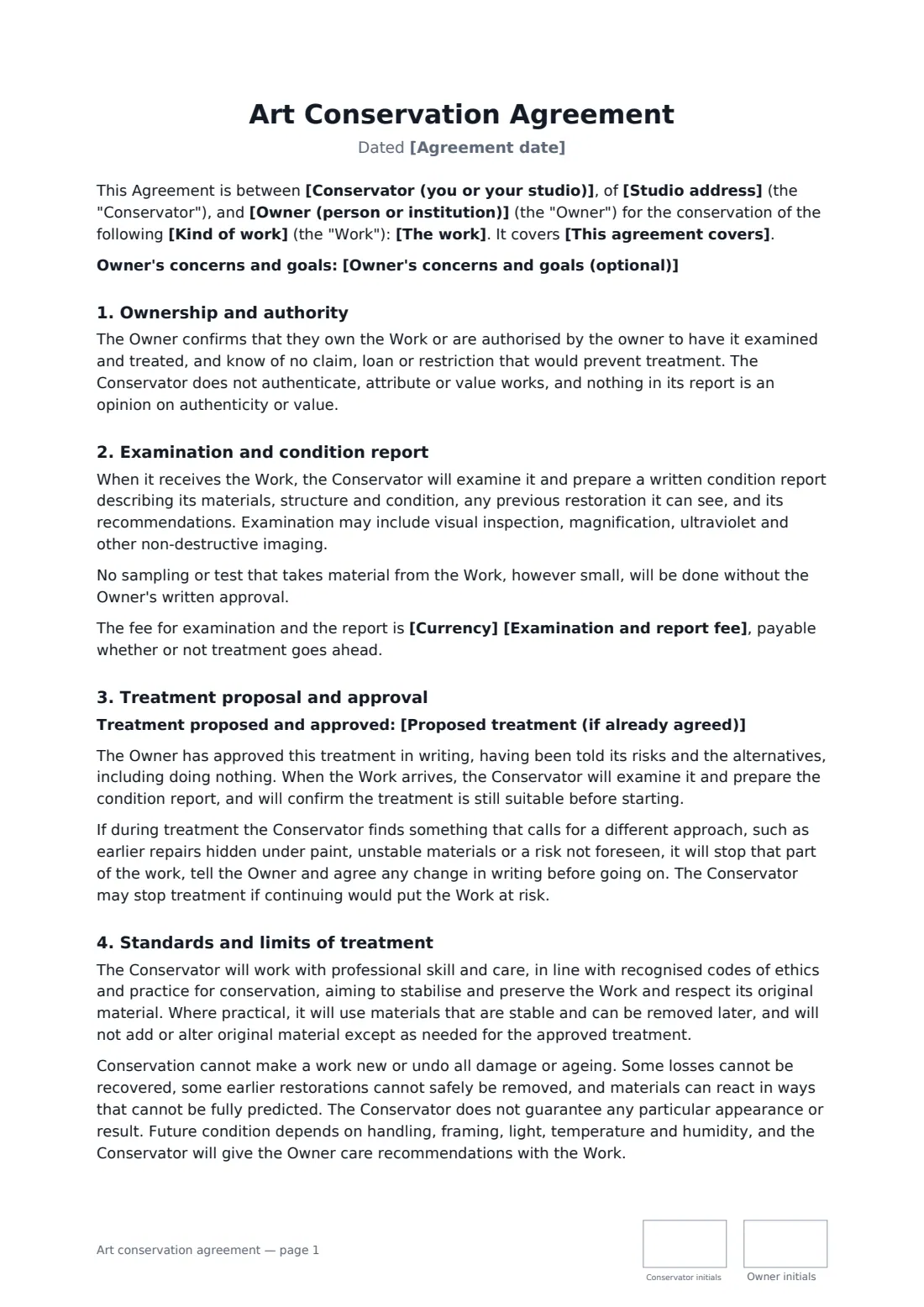
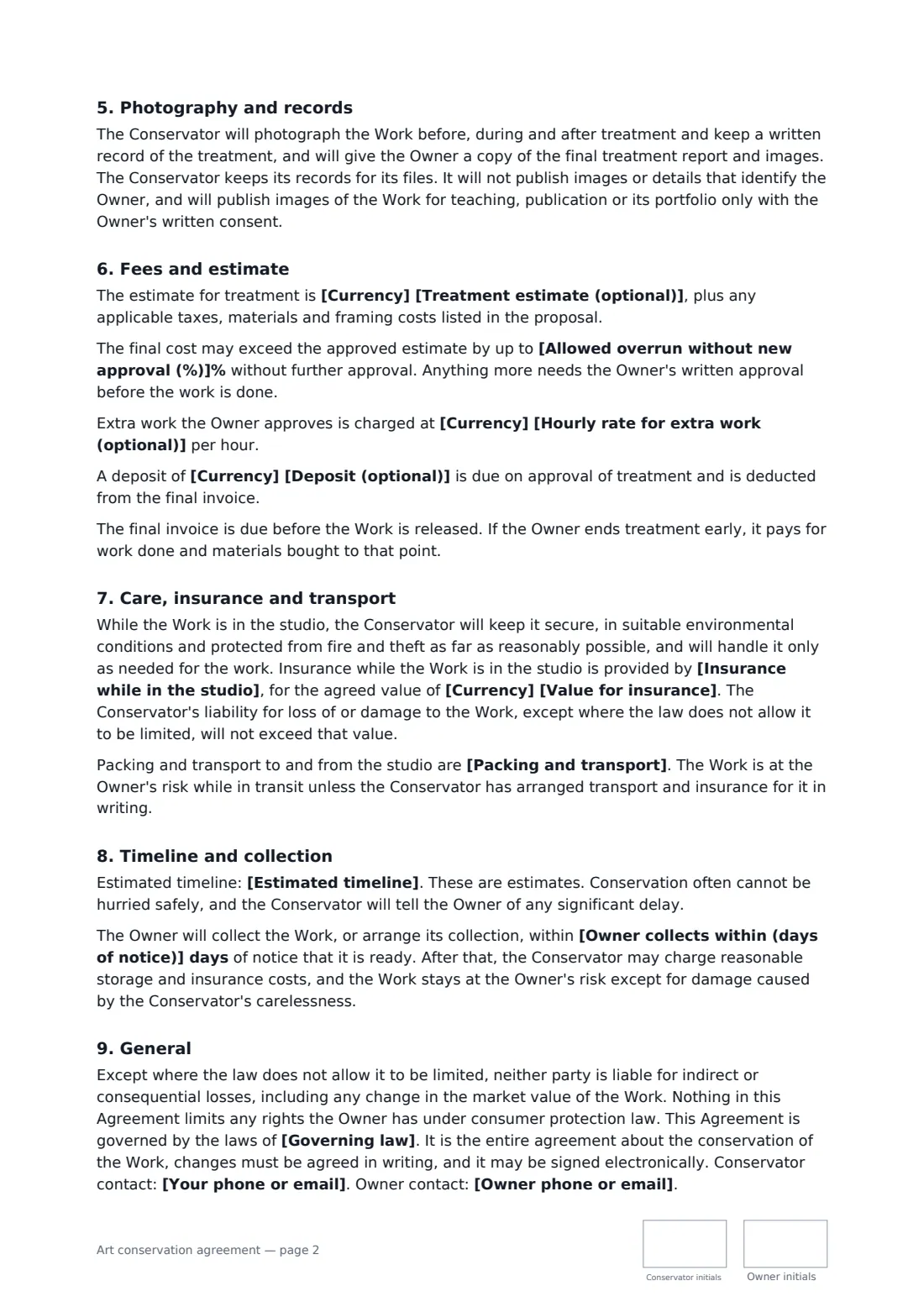
This template records the work, its kind and an agreed value for insurance, and confirms the owner's authority. It covers examination and a written condition report, no sampling without consent, a treatment proposal with risks and alternatives, and treatment only after written approval, with a stop-and-ask rule when something unexpected turns up. It states the professional standards followed and the honest limits of conservation, before-and-after photography and records, the examination fee, estimate, allowed overrun, hourly rate and deposit, care, insurance and transport, the timeline and collection, and liability capped at the agreed value. It makes clear that the conservator does not authenticate or appraise.
- Best for
- Paintings, paper and photograph conservators, object and textile conservators
- Signed by
- The conservator and the owner (or someone authorised by them)
- Stages
- Examination and report only, report then treatment, or an approved treatment
- Length
- 3 pages, initialled on every page, signatures on the last page
When to use a art conservation agreement
- Cleaning and revarnishing a family oil painting
- Repairing a torn watercolour or a foxed print
- Stabilising a faded or flaking historic photograph
- Treating a sculpture or decorative object for a private collector
- A condition report before a collector decides whether to treat or sell
What you fill in
23 blanks, then the name and email of each person who signs: conservator, owner.
1 The parties
- Agreement date*
- Conservator (you or your studio)*
- Your phone or email*
- Studio address*
- Owner (person or institution)*
- Owner phone or email*
2 The work
- The work*
- Kind of work* painting · work on paper · photograph · textile · sculpture or three-dimensional object · frame
- Value for insurance*
- Owner's concerns and goals (optional)
3 Treatment
- This agreement covers* examination, condition report and treatment proposal only · examination, condition report and treatment proposal, with treatment to follow on approval · the treatment already proposed and approved below
- Proposed treatment (if already agreed)
4 Fees
- Currency*
- Examination and report fee
- Treatment estimate (optional)
- Allowed overrun without new approval (%)*
- Hourly rate for extra work (optional)
- Deposit (optional)
5 Logistics
- Estimated timeline*
- Packing and transport* arranged and paid for by the Owner · arranged by the Conservator and paid for by the Owner · delivered and collected by the Owner in person
- Insurance while in the studio* the Conservator's insurance · the Owner's own fine art insurance, with the Conservator named or a waiver of subrogation where available
- Owner collects within (days of notice)*
- Governing law*
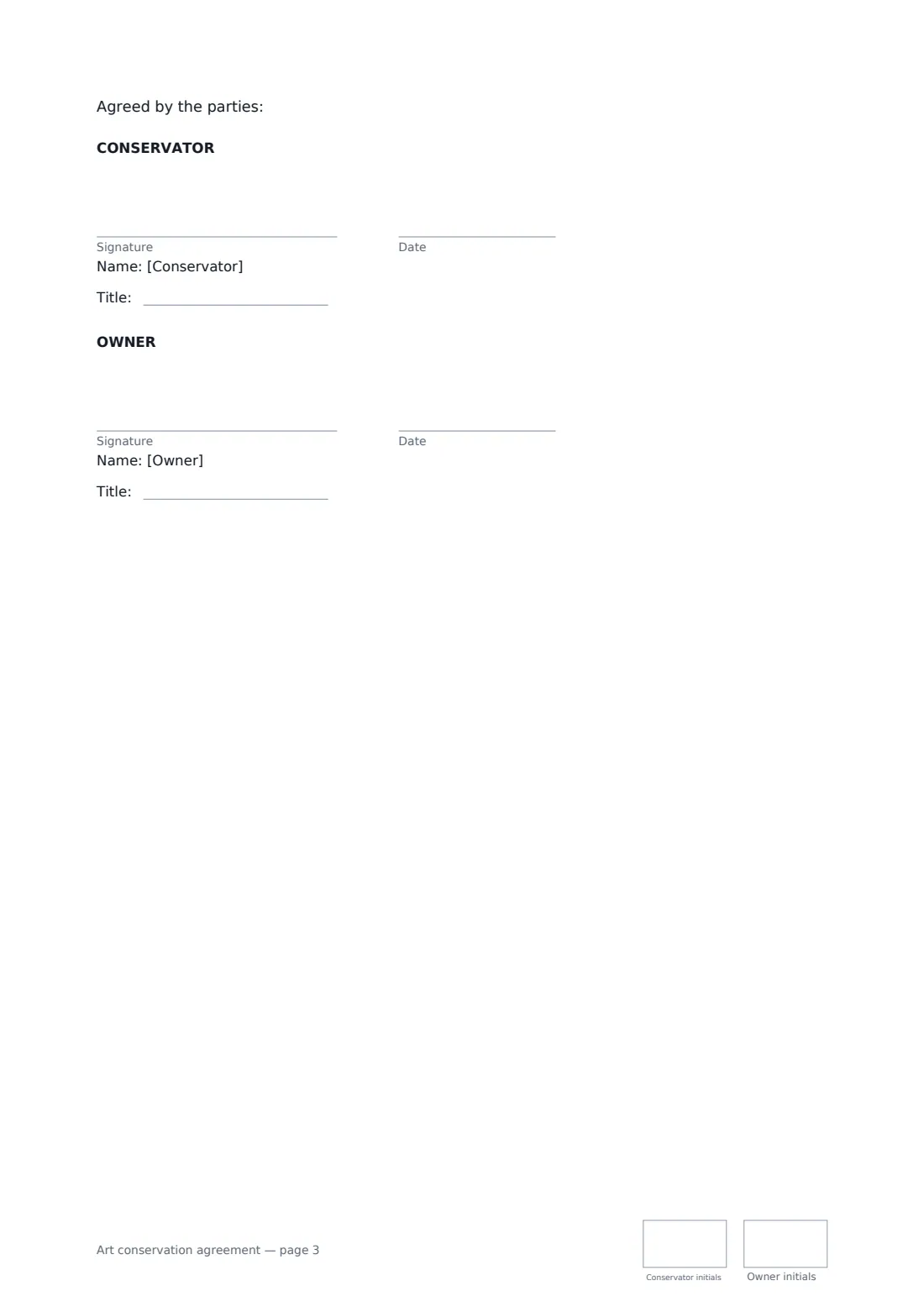
6 Who signs
- Conservator signature and date, job title, initials on every page · The conservator or conservation studio.
- Owner signature and date, job title, initials on every page · The owner of the work, or a person or institution authorised to act for the owner.
What the art conservation agreement covers
- Ownership and authority
- Examination and condition report
- Treatment proposal and approval
- Standards and limits of treatment
- Photography and records
- Fees and estimate
- Care, insurance and transport
- Timeline and collection
- General
Using the art conservation agreement, step by step
1 Describe the work and its value
Enter the title, medium, size, signature and date as known, choose the kind of work, and enter the value both sides agree to use for insurance.
2 Choose the stage
Choose examination only, examination then treatment on approval, or a treatment already proposed. Paste the treatment in if it is already agreed.
3 Set fees
Enter the examination fee, an optional treatment estimate, the overrun allowed without new approval, an hourly rate for extra work and any deposit.
4 Logistics and send
Enter the timeline, choose transport and insurance arrangements, the collection period and governing law, then send it to the owner.
Tips before you send it
- Agree the insurance value at the start. The conservator does not appraise, and the agreement caps liability at that value.
- Photograph the work as it arrives, before any handling, and keep the images with the condition report.
- If you find something unexpected, stop and get written approval for the change. The agreement requires it.
- If the owner's own fine art policy will cover the work, check with their insurer that it extends to the studio and to transit.
Sign it online in minutes
- Fill in the blanks. Names, dates and amounts go straight into the agreement — the preview shows exactly where.
- Name who signs. Tick “This is me” for your own part. FileIt builds the PDF with every signature, date and initials box on the right line, and you can check or move anything before sending.
- Send it. Each signer gets a secure link and signs from any device — no account needed. The signed PDF, with an audit trail and a Certificate of Completion, is filed in your vault and emailed to everyone.
Art conservation agreement: frequently asked questions
Will the conservator tell me if my painting is genuine or what it's worth?
No. The agreement states the conservator does not authenticate, attribute or value works, and the condition report is not an opinion on either.
Can the cost go above the estimate?
Only by the percentage you set. Anything more needs the owner's written approval before that work is done.
Is the work insured while it is in the studio?
Yes, by the conservator's insurance or the owner's own policy, as you choose, for the agreed value. In transit it is at the owner's risk unless the conservator arranged transport and insurance in writing.
Does conservation make the work look new?
No. The agreement explains that conservation aims to stabilise and preserve, some losses cannot be recovered, and no particular appearance is guaranteed.
Can it be signed electronically?
Yes. E-signatures are generally valid for service agreements like this in the US, UK, EU and Canada. FileIt keeps an audit trail with the signed PDF.