What is a aI training data consent?
Writers, artists, voice actors, research participants and customers increasingly want a say in whether their work and data are used to train AI. Organisations building or fine-tuning models want a clean record that they asked, what they were allowed to use, and for what. A vague line in a privacy policy rarely does either job well.
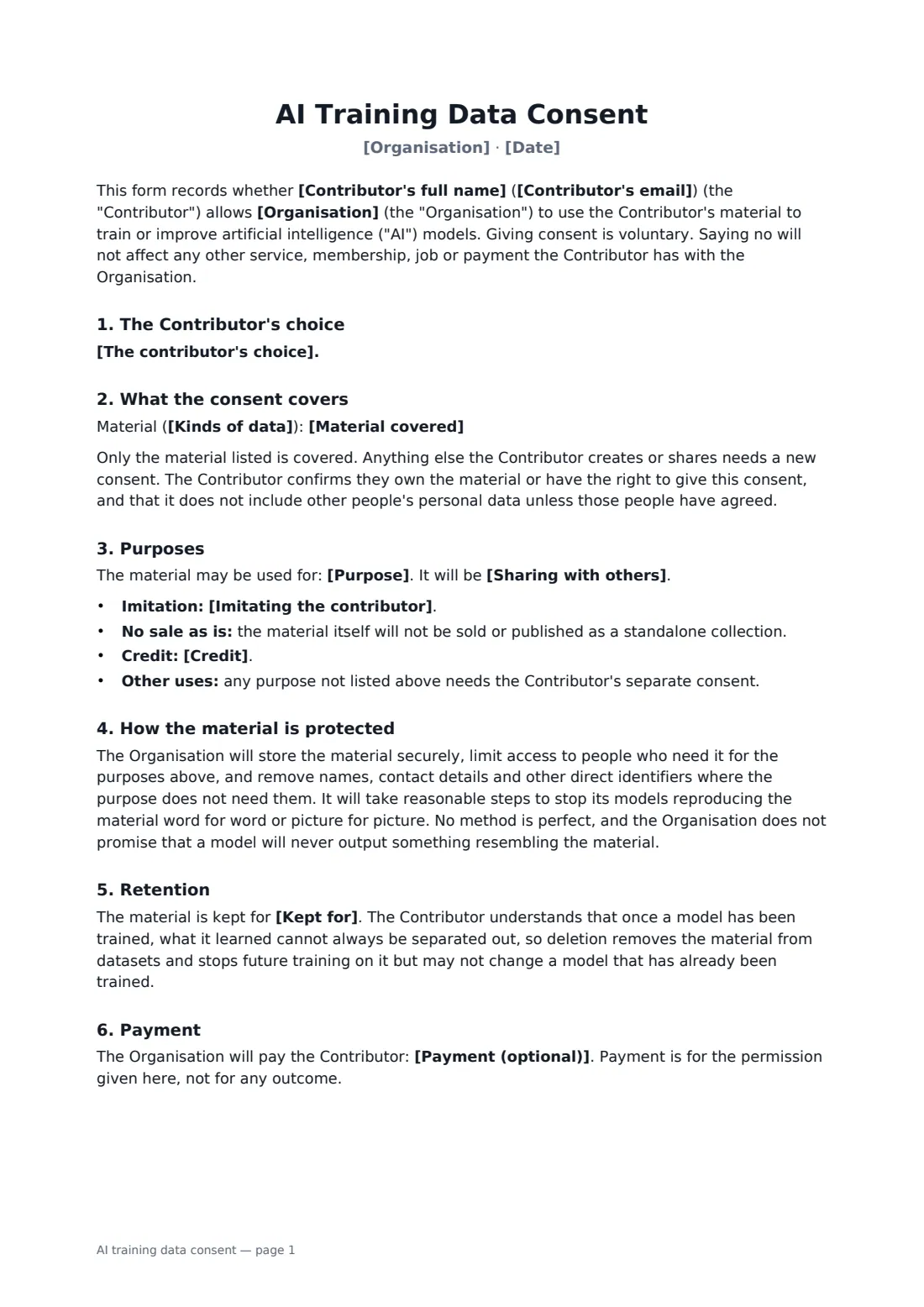
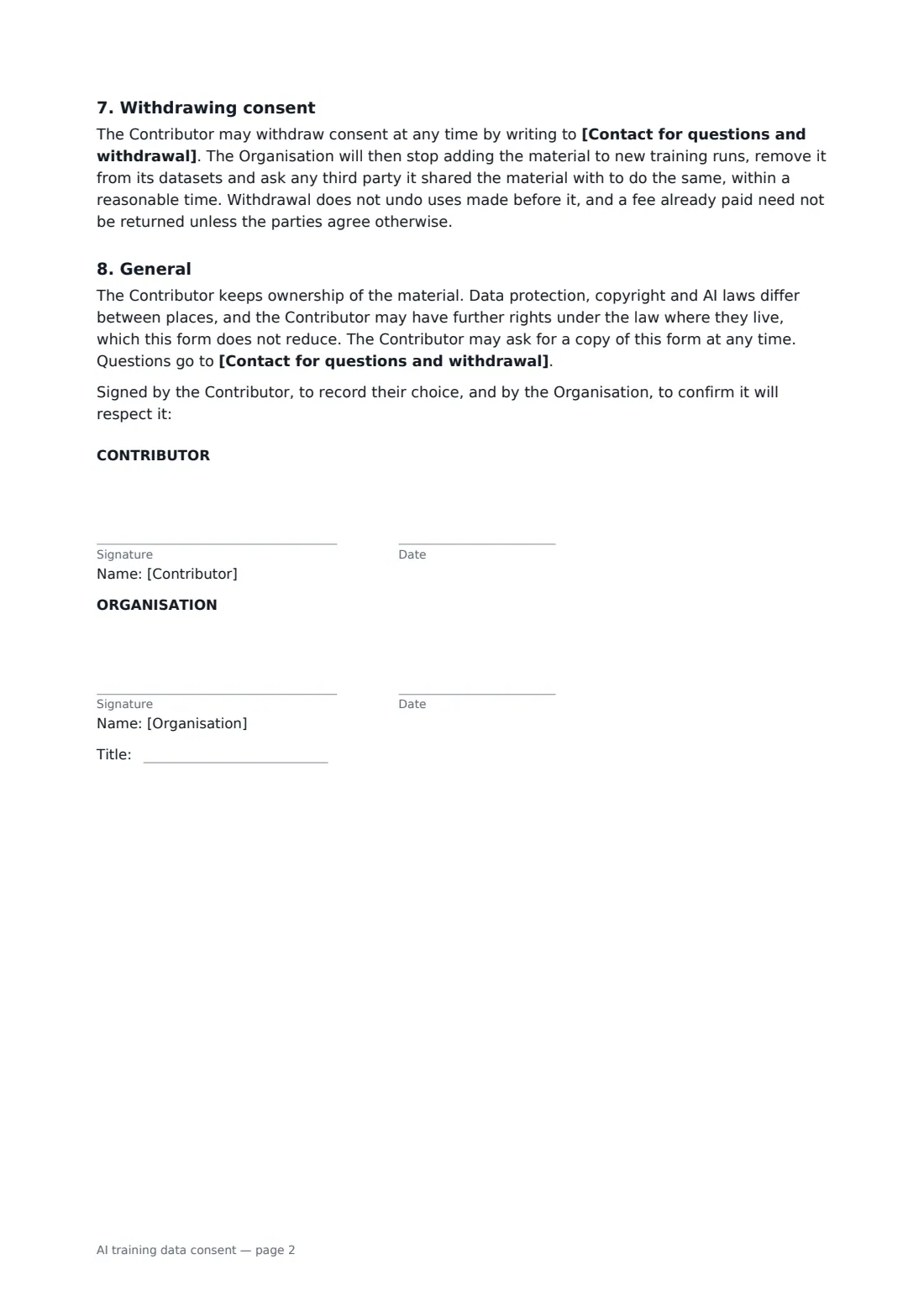
This form starts with the choice itself: the contributor consents or declines, and if they decline, the organisation commits to keeping the material out of its datasets. If they consent, you list the specific material, the kind of data, the purposes, and whether it stays in-house or may be licensed to named third parties. The contributor chooses whether models may be tuned to imitate their name, voice, face or style, and whether they are credited. The form covers protection and de-identification, honest limits on what deletion can undo once a model is trained, how long material is kept, any payment, and how to withdraw.
- Best for
- AI companies, publishers, studios, research teams and platforms collecting training data
- Signed by
- The contributor and the organisation
- You set
- Material, data type, purposes, sharing, imitation, credit, retention, payment
- Length
- About 2 pages
When to use a aI training data consent
- A publisher asking authors before using their books to fine-tune a model
- A studio recording voice samples for a speech model
- An illustrator licensing a portfolio for image-model training
- A research project collecting writing samples from volunteers
- Recording a customer's decision to opt out of AI training
What you fill in
16 blanks, then the name and email of each person who signs: contributor, organisation.
1 The parties
- Organisation*
- Contributor's full name*
- Contributor's email*
- Date*
2 The choice
- The contributor's choice* I consent, on the terms below · I do not consent
3 What is used
- Material covered*
- Kinds of data* written work · images or artwork · audio or voice recordings · video · a mix of the above · usage or interaction data
4 Purposes
- Purpose*
- Sharing with others* used only by the Organisation and its service providers acting on its instructions · used by the Organisation and its service providers, and may also be licensed to the third parties named below
- Third parties (if licensed)
- Imitating the contributor* not allowed: models may not be prompted or tuned to imitate my name, voice, face or personal style · allowed only with my separate written consent for each project
- Credit* no public credit · credited by name in the dataset documentation · credited under the name below
- Name for credit
5 Retention and payment
- Kept for*
- Payment (optional)
- Contact for questions and withdrawal*
6 Who signs
- Contributor signature and date · The person whose writing, images, recordings or data are concerned.
- Organisation signature and date, job title · Someone authorised to make commitments about how the organisation uses data.
What the aI training data consent covers
- The Contributor's choice
- What the consent covers
- Purposes
- How the material is protected
- Retention
- Payment
- Withdrawing consent
- General
Using the aI training data consent, step by step
1 Record the choice
The contributor picks consent or no consent. A no is recorded on its own, with your promise to exclude the material.
2 Describe the material
List exactly what is covered, such as named works or a recording session, and the kind of data. Only what is listed is covered.
3 Set purposes and limits
Write the purpose, choose whether third parties may use it, and let the contributor rule out imitation of their name, voice, face or style and choose how they are credited.
4 Retention, payment and sign
Set how long material is kept, any fee and a contact for withdrawal, then send it for both signatures.
Tips before you send it
- Be specific about the material. A list of works or a session date is better than "all content".
- The form promises that saying no won't affect any other service, membership, job or payment. Make sure that is true in practice before you send it.
- Be honest that a trained model can't always "unlearn". The form says withdrawal stops future use but may not change a model already trained.
- If the material includes other people, such as faces in photos or voices in recordings, they need to agree too.
- AI and data protection rules are changing fast and differ by country. Check what applies to you.
Sign it online in minutes
- Fill in the blanks. Names, dates and amounts go straight into the agreement — the preview shows exactly where.
- Name who signs. Tick “This is me” for your own part. FileIt builds the PDF with every signature, date box on the right line, and you can check or move anything before sending.
- Send it. Each signer gets a secure link and signs from any device — no account needed. The signed PDF, with an audit trail and a Certificate of Completion, is filed in your vault and emailed to everyone.
AI training data consent: frequently asked questions
Can someone use this form to say no?
Yes. The first choice is consent or no consent. If they decline, the organisation commits not to use the listed material to train, fine-tune, test or evaluate AI models.
Does withdrawing consent remove my data from the model?
It removes the material from the organisation's datasets and stops it being used in future training, and third parties are asked to do the same. The form explains that a model already trained may not be changed, because what it learned can't always be separated out.
Can the organisation make an AI that sounds or looks like me?
Only if the contributor allows it. The default option forbids tuning or prompting models to imitate the contributor's name, voice, face or personal style; the other option requires separate written consent for each project.
Who owns the material?
The contributor keeps ownership. The form gives permission for the listed uses only.
Is this enough to meet AI or privacy laws?
It is a clear consent record, but laws differ by country and are changing. You may also need a privacy notice or other steps, so check the rules that apply to you.